
In 2026, ultimate beneficial ownership registries are opening all over the world. Countries are scrambling to either publicize or create these platforms to give more visibility into company ownership and prevent fraud and financial crime.
Just look at the Netherland’s recent decision to reopen its UBO register, making it essential that all information is available and up to date, or the UBO registry launched by Pakistan in March of this year.
Hidden ownership structures have long been used to disguise corruption, sanctions evasion, tax fraud, and large-scale money laundering. When the true controller of a company remains invisible, criminal activity can move through the financial system with little resistance.
For banks, fintechs, and regulated businesses, the challenge is growing. Know your business (KYB) workflows are tested as corporate structures are becoming more complex, and the documents used to verify ownership can be manipulated, forged, or entirely fabricated.
This guide explains the threat of ultimate beneficial owners transparency, how criminals exploit fake ownership structures, and how institutions can identify the real individuals behind corporate entities.
Let’s get started.
Threat intelligence: The threat of fake UBOs
Large investigative projects have repeatedly demonstrated how easily ownership can be obscured.
The Panama Papers and Pandora Papers exposed hundreds of thousands of shell companies used to hide beneficial owners across offshore jurisdictions. These structures often span multiple countries with intricate layers of directors, shareholders, and intermediaries designed specifically to conceal the person ultimately controlling the assets.
Part of the problem is differences between UBO laws globally. Many jurisdictions allowed or still allow companies to be formed without identifying the real controlling individual. In some cases, only nominee directors or corporate shareholders were required in official filings, leaving the true owner effectively invisible.
“An even more extreme example of ownership opacity historically comes in the form of bearer shares. Unlike registered shares tied to a named individual, bearer shares grant ownership to whoever physically held the certificate. Possession alone confers control. This meant the true owner of a company could change hands simply by transferring the document, leaving no trace in company registries or official filings.”

Even where mandatory registries exist, many rely on self-declared ownership information, and verification standards vary widely between countries. This means the declared UBO may not always reflect the person actually controlling the business.
Digital company formation services, automated document generators, and online template farms, only complicate the threat further. Now, individuals can create convincing UBO documents in minutes.
“Another potential threat comes in the form of UBO filings or register excerpts. With the onset of new registries opening across regions like the EU, it probably won’t be long before fraudster pick up the corresponding documents and begin elimination.”
For now, most companies verify UBOs using business register excerpts and various business documents.
Articles of association, certificates of incorporation, business licenses, and any other KYB document can be produced at scale, making it easier to fabricate or manipulate business existence, right to operate, and ownership structures.
Institutions responsible for KYB and AML compliance need to be aware of this. The ownership information presented during onboarding may appear legitimate on the surface, while the fraud lies hidden underneath the fake documents.
Missing one of these bad actors can have some dire consequences:
- Regulatory exposure. Failures in beneficial ownership verification can trigger violations of AML and KYC obligations under frameworks such as the U.S. Bank Secrecy Act (BSA) and similar regimes globally, resulting in penalties that can reach hundreds of millions or even billions of dollars (for example, BNP Paribas’ $8.9 billion fine in 2014).
- Sanctions evasion risk. Under sanctions laws in the US like the Trading with the Enemy Act or the Foreign Narcotics Kingpin Designation, companies can experience fines of up to $111,308 and $1,876,699 respectively.
- Operational and financial risk. Approving loans for companies controlled by criminals, underwriting fraudulent insurance policies, onboarding high-risk merchants, or allowing sanctioned actors to access payment systems indirectly. Once inside your system, it can distort credit assessments, and trigger fraudulent transactions.
How UBOs enable money laundering
When the real controller of a company is concealed, the entity itself can appear legitimate and avoid the restrictions placed on that individual.
In money laundering schemes, this anonymity is extremely valuable. While a high risk individual might have trouble opening a business bank account for example, shell companies and layered ownership structures allow them to distance themselves while still accessing global financial systems.
With the right UBO fraud tactics, any high risk individual can create a company, move money, layer the transactions through third parties, and integrate their illegitimately obtained funds into the legitimate economy.
As money laundering evolves, UBO concealment will remain a critical component of how dangerous individuals move their money.
How to identify UBOs
In practice, UBO identification can either be relatively clean or extremely muddy. Ownership can be indirect, split across multiple shareholders, or buried under parent companies, trusts, and offshore entities.
.png?width=1200&height=1500&name=How%20to%20identify%20UBOs%20(step%20by%20Step).png)
A typical UBO identification workflow looks like this:
- Verify the legal entity. Check official corporate registries, review documents for content and authenticity, validate the registered address and company identifiers, and confirm the business has not been dissolved, struck off, or suspended.
- Review the ownership structure. Map out who owns and controls the company by examining shareholder registers, corporate registry filings, ownership charts provided during onboarding, and parent company disclosures to identify shareholders, directors, and any controlling entities.
- Trace ownership to natural persons. Follow each ownership layer through parent companies, subsidiaries, and intermediaries until the structure resolves to an actual person; the individual or individuals who ultimately own or control the entity.
- Assess control (not just percentage). Identify individuals who may exercise control through voting rights, board authority, or contractual influence even if they do not meet standard ownership thresholds.
- Screen the identified UBOs. Run sanctions, politically exposed person (PEP), and adverse media checks on the individuals identified as beneficial owners.
- Make a risk decision. Approve the onboarding, escalate for enhanced due diligence, or reject the entity based on ownership transparency, document integrity, and overall financial crime risk.
That is the broad process. But it’s not always so simple. UBO identification changes based on the industry you’re working in. Here’s some key verticals to keep in mind:
Banks and commercial lenders
When a bank onboards a business customer, UBO identification is part of core anti-money laundering (AML) and know your business (KYB) controls.
In this sector, UBO identification is closely tied to sanctions screening, correspondent banking risk, and ongoing transaction monitoring. A hidden owner can expose the institution to regulatory penalties and serious financial crime risk.
Fintechs and payment providers
Fintechs, payment processors, e-money institutions, and merchant acquirers face many of the same risks as banks, but often with faster onboarding expectations and higher digital exposure.
These businesses frequently verify companies remotely, which makes document quality and corporate transparency even more important. UBO identification needs to happen quickly, at scale, and with strong escalation logic for suspicious structures or weak documentation.
Crypto and virtual asset service providers
Crypto exchanges and other virtual asset service providers are under growing pressure to apply stronger KYB and beneficial ownership checks to corporate customers.
Due to the off-grid nature of these dealings, these businesses are especially exposed to layered ownership, offshore entities, and fast-moving cross-border activity.
Insurance companies
Insurance providers offering AML regulated insurance products need visibility into who controls corporate policyholders and counterparties.
Enabling the movement, storage, or transfer of value through these products is illegal and, since they are less suspicious than traditional banking channels, a prime target for financial crime.
Corporate service providers and company formation agents
Corporate service can become a gateway for shell companies and hidden ownership structures if beneficial ownership checks are weak. In many cases, these firms are expected to identify the individuals behind the entity before providing nominee, registration, or administrative services.
Law firms, accountants, and trust service providers
Professional services firms that help establish companies, manage trusts, move funds, or structure transactions can encounter some of the most complex ownership arrangements, especially where trusts, holding companies, or cross-border corporate vehicles are involved.
Their challenge is often less about volume and more about complexity, source-of-funds risk, and identifying who actually exercises control. In these cases, UBO identification tends to be part of enhanced due diligence rather than a simple onboarding check.
Real estate and high-value asset sectors
Real estate businesses, investment vehicles, and other sectors can be attractive tools for laundering funds or storing wealth through opaque entities. When a company purchases an asset, the named entity may reveal very little about who is actually behind the transaction.
Why the process changes by industry
The core logic of UBO identification stays the same across industries: find the real person behind the company, verify them, and assess the risk.
What changes is the context.
A bank may care most about account access and transaction exposure. A payment provider may care about onboarding speed and vendor onboarding fraud. A crypto platform may focus on sanctions and cross-border anonymity. A law firm or trust provider may deal with fewer entities, but much more complex structures.
That is why there is no single universal UBO workflow that works everywhere. The process has to reflect the industry, the product, the customer type, and the level of financial crime risk involved.
UBO risk levels
Now that we understand how to identify UBOs, we need to assess their risk level. Some companies are entirely transparent, simple structures, and easily verifiable.
Others span jurisdictions, have opaque corporate layers, and individuals whose background raises compliance concerns.
Below is a simplified framework often used when evaluating beneficial ownership risk.
Legitimate ownership
In these cases, the beneficial owner can be identified quickly and supported by reliable documentation.
Common signals:
- Clear ownership structure with few layers.
- Verifiable corporate registry records.
- Consistent documentation across filings.
- Identifiable natural persons as beneficial owners.
- No sanctions, PEP, or adverse media exposure.
While legitimate structures still require verification, they typically move through KYB processes with minimal friction.
Low risk UBOs
Low-risk UBO operate across multiple jurisdictions or involve corporate shareholders, but the ownership chain can still be traced to natural persons without significant gaps.
Common signals:
- Moderate ownership layering that can be traced through registry records.
- Jurisdictions with strong corporate transparency requirement.
- Consistent documentation supporting ownership claims.
- Individuals with normal commercial backgrounds and low compliance risk.
These cases typically require standard due diligence procedures.
Medium risk UBOs
Medium-risk UBO ownership chains are more complex, involve cross-border entities, or include individuals whose background requires additional screening.
Common signals:
- Multi-layer corporate ownership across several jurisdictions.
- Nominee directors or shareholders present in the structure.
- Limited registry transparency in one or more jurisdictions
- Inconsistencies between submitted documents and registry data.
- Individuals connected to higher-risk industries or regions.
In these cases, institutions often apply enhanced due diligence before onboarding or approving transactions.
High risk UBOs
High-risk UBO profiles include sanctions risk, politically exposed persons, opaque offshore structures, or documentation that appears unreliable or manipulated.
Common signals:
- Ownership structures involving secrecy jurisdictions or opaque entities.
- Individuals linked to sanctions lists or high-risk political exposure.
- Corporate records that conflict or appear manipulated.
- Ownership chains that cannot be traced to a clear natural person.
- Complex structures with no clear commercial justification.
High-risk structures often trigger enhanced due diligence, transaction monitoring restrictions, or outright rejection depending on institutional risk policies.
UBO identification challenges
Part of the difficulty with Identifying UBOs comes from the tactics criminals use to obscure ownership in the first place:
- Shell companies. Entities created with little or no real operations that exist primarily to hold assets or move funds (typically “managed” or “owned” by a money mule).
- Layered ownership structures. Chains of companies across jurisdictions designed to hide the individual at the top.
- Nominee shareholders and directors. Individuals listed in filings who act on behalf of the real owner.
- Trust and legal arrangements. Structures that separate legal ownership from beneficial control.
- False or manipulated corporate documents. Forged shareholder registers, altered incorporation records, or fabricated ownership declarations.
These tactics directly create the challenges institutions face during UBO verification.
Inconsistent global transparency standards
Some jurisdictions maintain detailed corporate registries and beneficial ownership databases, while others provide very limited information.
Even where registers exist, the information may be incomplete, outdated, or based entirely on self-reported declarations.
Nominee structures and legal proxies
A nominee director is a person who is officially listed as a company’s director but acts on behalf of another individual or entity that actually controls the company.
When nominee arrangements or legal proxies are involved, the individuals listed in official filings may have little or no actual authority over the business.
Operational complexity
Even when no fraud detectionis involved, beneficial ownership investigations can be resource-intensive. Compliance teams must review ownership chains, interpret legal structures, and verify documents that may come from different jurisdictions and languages.
As onboarding volumes grow and corporate structures become more complex, maintaining accurate UBO identification becomes increasingly difficult without specialized tools and structured workflows.
Document reliability and fraud
UBO identification often depends heavily on corporate documents. Shareholder registers, ownership declarations, incorporation records, and other filings are used to demonstrate how control flows through the company.
These documents can easily be manipulated by fraudsters, altering ownership percentages, fabricating shareholder lists, or generating entirely fake corporate records using template generators and editing tools.
In most cases, the answer to “can I trust this UBO structure or not,” lies in the documents used to prove ownership in the first place.
UBO documents
Managing fraud during UBO identification begins with documents.
Institutions must rely on a collection of records to understand how a company is structured, who holds shares, and who ultimately controls the entity. These documents form the backbone of most UBO verification workflows.
Below are the most common document types involved in beneficial ownership identification and the risks associated with each.
Shareholder registers
A shareholder register lists the individuals or entities that hold shares in a company and the percentage of ownership each holds.
It provides a snapshot of who appears to control the business on paper.
Risk factors may include:
- Ownership percentages that do not add up correctly.
- Shareholders listed as other companies without clear parent information.
- Individuals with changed identities on the list or removed entirely.
Articles of association
Articles of association define how a company is governed and how ownership rights are structured internally. They do not directly identify the UBO, but provide important context for how control can be exercised within the organization.
For example, certain share classes or voting arrangements may give specific individuals disproportionate influence over company decisions.
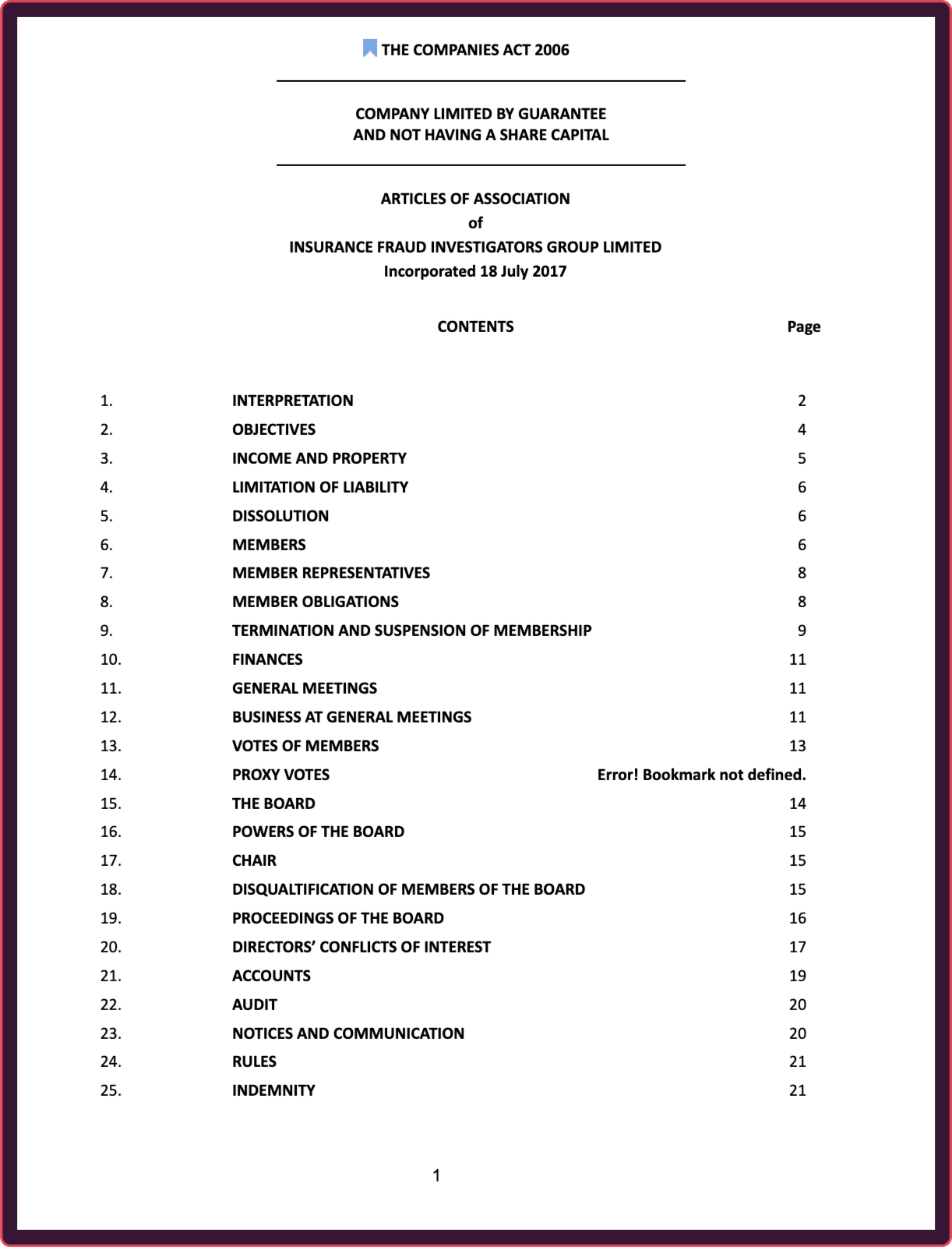
The table of contents for an Articles of Association for illustrative purposes only.
Risk factors may include:
- Unusual share classes or voting rights that concentrate control.
- Governance rules that conflict with other corporate records.
- Provisions that allow control through board appointments or special voting rights despite low ownership percentages.
Beneficial ownership declarations
Some jurisdictions require companies to submit a beneficial ownership declaration identifying the individuals who ultimately control the business.
Risk factors may include:
- Declarations that conflict with other corporate records.
- Ownership structures that appear unusually simple compared to the company’s activity.
- Declarations created through unofficial templates rather than regulatory forms.
Identity documents of UBOs
Once the beneficial owner has been identified, institutions usually need to verify the identity of that individual.
This may involve passports, national identity cards, or other government-issued identification. These documents helps with screening against sanctions, PEP lists, and adverse media sources.
Risk factors may include:
- Identity documents that appear edited or digitally manipulated
- Mismatched personal information across documents
- Reused identity images (with different information) across multiple ownership declarations
Supporting corporate records
These can include board resolutions, partnership agreements, trust deeds, or ownership charts provided during onboarding.
Risk factors may include:
- Ownership charts that cannot be reconciled with official filings.
- Inconsistent entity names across documents.
UBOs & KYB
Know your business (KYB) is the process institutions use to verify the legitimacy of a company before providing financial services. It is the corporate equivalent of know your customer (KYC), focusing on businesses rather than individuals.
UBO identification is one of the most important parts of this process.
Companies themselves cannot commit fraud, document fraud, or money laundering. People do. By identifying the UBO, institutions can understand who controls the business, if they have a right to do so, if they’re a financial crime risk, and if onboarding them will be in line with regulatory expectations.
UBO Legislation
Over the past decade, regulators around the world have introduced laws that require institutions to identify and verify the individuals who ultimately control corporate entities.
Below are some of the major legal frameworks governing UBO identification:
- United States. The Corporate Transparency Act (CTA), enacted through the Anti-Money Laundering Act of 2020, requires many companies to report their beneficial owners to the Financial Crimes Enforcement Network (FinCEN) for inclusion in the Beneficial Ownership Information (BOI) database, while financial institutions must identify and verify beneficial owners of legal entity customers under the Customer Due Diligence (CDD) Rule issued pursuant to the Bank Secrecy Act (BSA).
- European Union. Governed by successive Anti-Money Laundering Directives. The Fourth Anti-Money Laundering Directive (AMLD4) required member states to establish beneficial ownership registers, the Fifth Anti-Money Laundering Directive (AMLD5) expanded transparency and access to ownership information, and the Sixth Anti-Money Laundering Directive (AMLD6) strengthened enforcement and broadened the list of financial crime predicate offenses, with each directive implemented into national law by individual EU member states.
- United Kingdom. Enforced through the Persons with Significant Control (PSC) Register, established under the Small Business, Enterprise and Employment Act 2015, which requires companies to disclose individuals who exercise significant control over the entity to Companies House, while broader AML obligations are governed by the Money Laundering, Terrorist Financing and Transfer of Funds (Information on the Payer) Regulations 2017 (MLR 2017).
- Asia-Pacific. Some examples across the region:
- Singapore. Companies Act and Accounting and Corporate Regulatory Authority (ACRA) rules require companies to maintain registers of beneficial owners.
- Hong Kong. Companies Ordinance mandates a Significant Controllers Register (SCR).
- Australia. Anti-Money Laundering and Counter-Terrorism Financing Act 2006 (AML/CTF Act) imposes customer due diligence obligations that include identifying beneficial owners during financial services onboarding.
- Latin America. Some examples across the region:
- Brazil. Normative Instruction RFB No. 1,863/2018 requires companies registered with the Federal Revenue Service (Receita Federal) to disclose their ultimate beneficial owners in the Cadastro Nacional da Pessoa Jurídica (CNPJ).
- Mexico. The Federal Law for the Prevention and Identification of Operations with Resources of Illicit Origin (LFPIORPI) and related tax authority rules require companies and certain legal entities to report beneficial ownership information to the Servicio de Administración Tributaria (SAT).
- Colombia. Resolution 000164 of 2021 established the Registro Único de Beneficiarios Finales (RUB), requiring legal entities to report their ultimate beneficial owners to the national tax authority (DIAN).
- Argentina. General Resolution 4697/2020 requires companies to disclose beneficial ownership information to the Administración Federal de Ingresos Públicos (AFIP) as part of corporate and tax reporting obligations.
High risk regions for UBO identification
In many cases, the geographic context surrounding a company, its owners, or related entities can significantly affect how institutions approach UBO identification.
This does not mean certain countries are automatically suspicious. Instead, geopolitical conditions, regulatory gaps, and economic pressures can create environments where obscuring beneficial ownership becomes easier or more attractive.
For compliance teams, geography often acts as a contextual signal that influences the level of scrutiny applied during UBO verification:
Sanctions exposure
If a beneficial owner is located in, resides in, or is connected to a sanctioned jurisdiction, institutions must determine whether the individual or entity is subject to sanctions restrictions. This means screening the UBO against relevant sanctions lists and examining whether any entities in the ownership chain are registered in sanctioned countries.
These restrictions vary depending on the authority imposing them, such as the U.S. Office of Foreign Assets Control (OFAC), the European Union, the United Kingdom’s Office of Financial Sanctions Implementation (OFSI), or the United Nations.
Because sanctions regimes differ across jurisdictions, institutions must assess which sanctions programs apply to them and screen beneficial owners and ownership chains accordingly.
Tariff evasion and trade restrictions
Trade controls and tariffs can also motivate companies to obscure ownership structures.
Businesses attempting to avoid tariffs or export restrictions may establish companies in different jurisdictions, route transactions through intermediary entities, or structure ownership in ways that disguise who ultimately controls the business.
These arrangements can make it difficult to determine whether a company is legitimately operating in a jurisdiction or acting as a front for another entity.
For institutions involved in trade finance, logistics, and cross-border payments, understanding the true beneficial owner can reveal whether a company is being used to bypass trade regulations.
Criminal hubs and safe havens
Some regions become attractive to criminal networks due to weak corporate transparency requirements, limited regulatory oversight, or under-resourced enforcement authorities.
Criminal organizations may use these conditions to build networks of entities designed to obscure the individuals who ultimately control them.
When corporate ownership chains involve multiple jurisdictions with varying transparency standards, institutions should research the ownership declaration policies of that region to see if loose restrictions can indicate high risk.
Politically exposed persons (PEPs)
A PEP is an individual who holds or has held a prominent public position, such as a government official, senior politician, judge, military leader, or executive at a state-owned enterprise.
Because of their influence over public resources and decision-making, PEPs present a higher risk of corruption, bribery, or abuse of power.
In some cases, politically exposed individuals may attempt to conceal their involvement in companies by placing ownership under relatives, associates, or intermediary entities. The declared shareholders of a company may therefore appear unrelated to the political figure while the real control remains hidden.
What is a UBO?
If you’ve made it all the way here and still don’t know what a UBO is, allow us to lay it out for you:
In most regulatory frameworks, an individual is considered a UBO if they own 25 percent or more of a company’s shares or voting rights, or otherwise exercise significant control over the business.
UBO Identification typically occurs during:
- Business onboarding and KYB checks.
- Anti-money laundering compliance reviews.
- Sanctions and politically exposed person screening.
- Corporate ownership investigations.
- Ongoing monitoring of business customers.
What is UBO fraud?
UBO fraud is when individuals deliberately hide or falsify the identity of the ultimate beneficial owner of a company.
Common forms of UBO fraud include:
- Declaring nominee shareholders or directors instead of the real controlling individual.
- Creating layered corporate ownership structures designed to obscure control.
- Submitting false beneficial ownership declarations during onboarding.
- Providing forged or manipulated corporate records to support a fake ownership structure.
- Using shell companies or trusts to hide the real owner behind legal entities.
UBO fraud is often used to support financial crimes such as money laundering, sanctions evasion, and corruption. The best way to spot it is with an AI fraud detection tool.
Conclusion
Identifying the ultimate beneficial owner of a company is a critical part of modern financial crime prevention. Banks, fintechs, insurers, and other regulated institutions are expected to look beyond the legal entity and determine who ultimately controls the business.
It all starts with documents. If those records are manipulated or fabricated, the entire UBO verification process becomes unreliable.
Resistant Documents can verify the authenticity of a document in less than 20 seconds. It does so through forensic structural analysis (looking at how the document was built) as opposed to content scanning. This means we can work with any KYB document from anywhere in the world.
Scroll down to book a demo.

Fraud awareness, examples, and lessons
Learn more about fraud in specific industries, best practices, and targeted documents.
View all
Application fraud in 2026 is easier to attempt: accessible tools and services help applicants turn false claims ...
Within the fake document ecosystem, things can change fast. Four months ago, we reported that OnlyFake, the ...
In May 2026, a Dallas resident was convicted of running coin-operated “amusement machines” without a business ...

NEW YORK & PRAGUE – 1 October 2026 – Ocrolus, the AI workflow and analytics platform for lenders, today ...
For a few hundred dollars, sellers on Telegram promise to boost your credit score using someone else's credit ...

Key takeaways Fake certificates can use real numbers Fraudsters can copy a genuine business’s VAT number onto a ...