
Given the events of early 2026, the state of Minnesota has considered offering a reprieve on certain business licensing fees. With a surge of fake Minnesota businesses licenses on the rise, it makes one wonder: are all those businesses legit?
Fake Minnesota business licenses are risky for lending, insurance, tenant screening, e-commerce marketplaces, and vendor onboarding. A submitted document may look official while onboarding an unlicensed contractor, approving a misrepresented merchant, underwriting the wrong business risk, or accepting a vendor that lacks the authority it claims.
Publicly available templates, document e-shops, and generative AI tools make these documents easier to fabricate or misrepresent. Institutions could be seeing tons of them in their KYB workflows without knowing the larger document fraud risk at hand.
Read on to learn what Minnesota business licenses are, how they are being forged, how to spot a fake Minnesota business license, and how AI-powered tools can help.
Check out our “how to spot fake business licenses” blog for a universal guide on how to spot fake documents of this type.
What is a Minnesota business license?
A Minnesota business license is not usually one universal statewide document. In Minnesota, the term more often refers to an industry-specific, activity-specific, professional, state, or local authorization required for a certain type of business.
This is why Minnesota eLicensing is important. It maps licenses by regulated business activity, agency, and topic, rather than serving as a universal business-license issuer.
The state’s eLicensing topic page organizes business-related licenses across areas such as agriculture, alcoholic beverages, buildings and construction, corporations and organizations, employment, finance, health care, hospitality, technology, tobacco, transportation, and other regulated activities.
This is important because, depending on the industry, the issuing office can change (not just the document). For example, restaurant licenses in Saint Paul are issued through the Minnesota Department of Health, while tobacco-related businesses apply through the City of Saint Paul’s local licensing system.
Other industries may route through the Department of Labor and Industry, Department of Commerce, Department of Agriculture, or another Minnesota board or agency.
For verification, this means a “Minnesota business license” should be treated as a broad claim until the reviewer identifies the actual document type, issuing authority, and business activity.
Minnesota business authorization is usually split across several layers:
- Minnesota Secretary of State business registration. The business filing layer. The Minnesota Secretary of State says almost all businesses in Minnesota must register with its office, but this is not the same as an industry license.
- Minnesota eLicensing. A state licensing directory that helps businesses identify licenses, permits, registrations, and certifications by activity, administering agency, license name, or keyword. It is a routing tool, not proof that a license has been issued.
- State agency or board license. The actual license, permit, registration, or certification for many regulated activities at the state level (searchable on the eLicensing page).
- Local city or county license. An authorization tied to local rules, zoning, inspections, or other city/county-specific business requirements (searchable through local government websites).
- Minnesota Department of Revenue tax registration. A tax-account layer for businesses with Minnesota tax obligations, such as employees, taxable sales, use tax, or information-return filing requirements. A sole proprietorship or single-member limited liability company without those obligations may not need a Minnesota Tax ID. This supports tax compliance, not industry licensing or local operating approval.
- Certificate of Assumed Name. A Secretary of State filing used when a business operates under a name other than its legal name. It can support name verification, but it does not prove licensed activity.
Unlike states that issue a single general business license (like Washintgon), Minnesota distributes authority across these different documents and agencies. It’s also different from a state like Florida, where a document serves this purpose but goes by a different name.
Instead, Minnesota business licensing is truly held on a case by case basis depending on your industry and where in the state you’re operating.
These documents and registrations help create a case for legally conducting business in Minnesota when combined together. They should always be checked against industry, state, and jurisdiction specific standards and no single document or registration should be seen as a 1:1 replacement for a “Minnesota Business License” (because such a state-encompassing document does not exist).
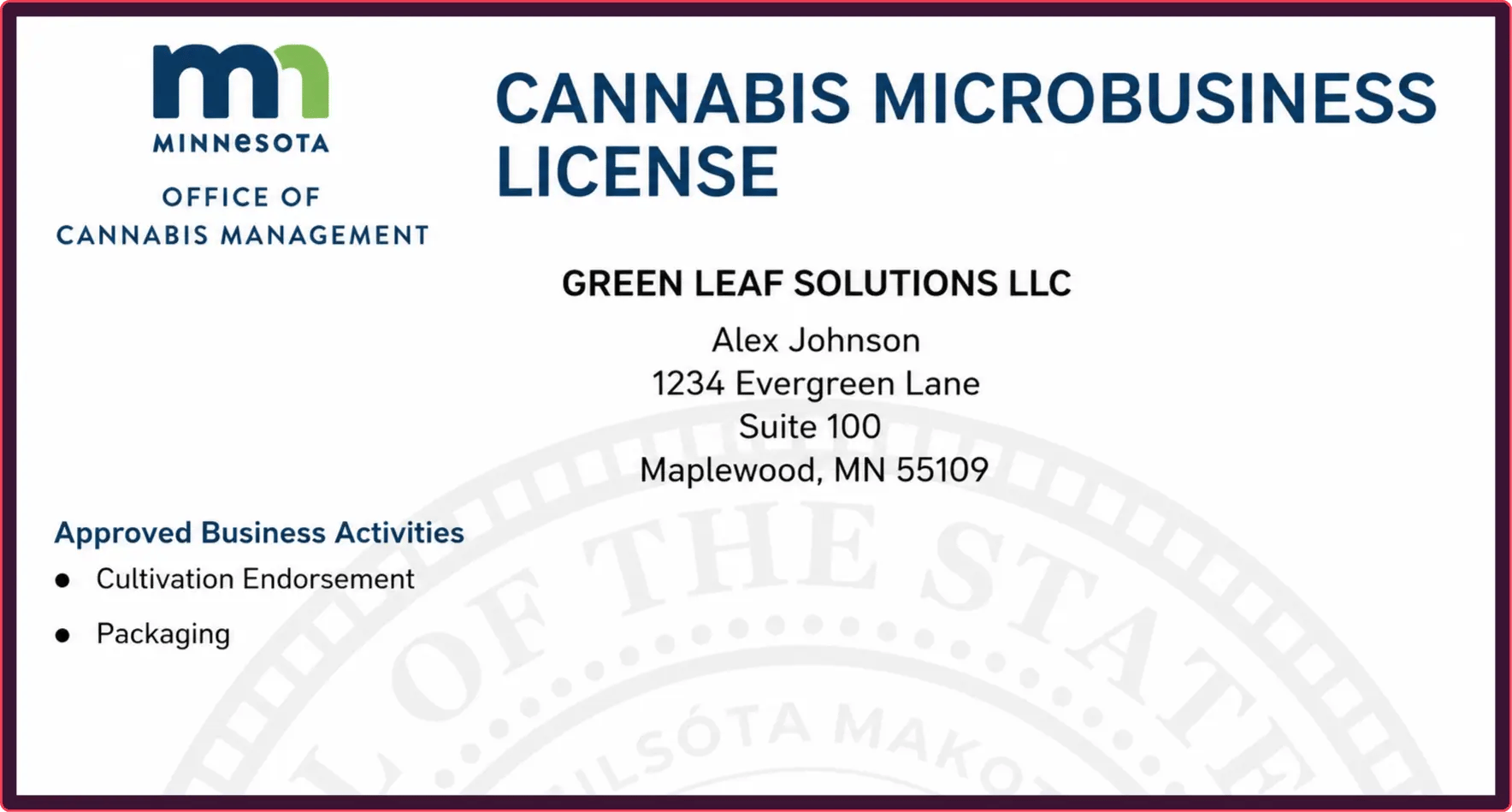
Example of a fake Minnesota license for the marijuana industry (not a business license) for illustrative purposes only.
Why are Minnesota business licenses important?
Minnesota business licenses confirm whether a business is registered, properly licensed for its activity, and authorized to operate in the relevant jurisdiction.
A lender, insurer, landlord, marketplace, or vendor onboarding team may need to know whether the company is merely registered with the Secretary of State, or whether it also holds the right agency, board, city, county, tax, or professional license.
So, knowing the exact document that ties them to what you’re trying to verify is also essential.
Here’s how Minnesota business licenses are used in document verification:
- Lending. Business lenders, fintech lenders, and commercial credit teams use Minnesota business documents to confirm that an applicant exists, operates in the claimed industry, and holds the required activity-specific license before approving financing.
- Insurance. Commercial insurance teams review Minnesota license records to confirm that the business activity, regulated status, premises, and professional authority match the risk being insured.
- Tenant screening. Property managers, landlords, and leasing teams check whether a business can operate from the proposed location and whether local licenses, permits, zoning approvals, or inspections may apply.
- E-commerce marketplaces. Marketplace onboarding and trust and safety teams verify Minnesota business records to detect fake sellers, misclassified service providers, expired registrations, or businesses using Secretary of State filings as if they prove regulated authority.
- Procurement and vendor onboarding. Procurement, vendor risk, and supplier compliance teams check Minnesota business licenses to confirm that contractors, service providers, and regulated vendors have the right state, local, or professional approvals before contracts are approved.
These documents are trusted because they often come from government agencies, professional boards, or local licensing systems. When combined, they can be treated as “proof of authorization to do business in Minnesota.”
Minnesota business license law
Minnesota business license law is built around separate registration, tax, licensing, permit, and local compliance steps.
Minnesota’s own business-starting guidance tells businesses to choose a business structure, register with the Secretary of State, obtain state and federal tax ID numbers, and then determine whether the business requires licenses and permits.
The Secretary of State registration step is the filing layer. It confirms the business entity, assumed name, or other filing record, but it does not automatically authorize every business activity.
The licensing layer depends on the business activity. Minnesota DEED says licenses and permits may be required at the state and local levels, and businesses should use Minnesota eLicensing to determine whether they need a state license, permit, registration, or certification.
- State-level examples include: Construction and contractor licenses, finance and lending licenses, insurance licenses, health care licenses, and cannabis licenses.
- Local examples include: City or county licenses tied to premises, zoning, inspections, entertainment.
Some businesses overlap both layers: restaurants, alcohol sellers, contractors, lodging businesses, and tobacco retailers may need state, county, and city approvals depending on the activity and location.
Renewal also depends on the record type. Secretary of State business filings must be renewed or amended through the business filing system, while state agency, professional, and local licenses follow their own renewal rules.
The business licensing process in Minnesota
Here is the basic process for getting the right business documents:
- Choose the business structure. Decide whether the business will operate as a sole proprietorship, limited liability company, corporation, partnership, nonprofit, or another structure.
- Register with the Minnesota Secretary of State if required. Confirm the business name and file the correct entity or assumed name record.
- Obtain state and federal tax ID numbers. Register for a Minnesota tax ID through the Department of Revenue if the business needs Minnesota tax accounts, and obtain a federal employer identification number (EIN) from the Internal Revenue Service (IRS) if required.
- Check Minnesota eLicensing. Search by business activity, agency, license name, topic, or keyword to identify any state licenses, permits, registrations, or certifications connected to the business.
- Apply through the correct agency or board. If the business activity is regulated, complete the actual application with the relevant Minnesota agency, board, or department. The eLicensing directory is not itself an issued license.
- Check local city and county requirements. Confirm whether the business needs local licenses, zoning approval, inspections, certificates, or permits from the city or county where it operates.
- Track each renewal separately. Renew the Secretary of State filing annually where required, and track each state, professional, local, tax, or permit renewal according to the issuing authority.
Threat intel: Template data about Minnesota business documents
Our Threat Intelligence Unit collects data about template farms which make and distribute fake document templates for fraudulent purposes.
Below, you'll find an infographic containing data about all the fake Minnesota business documents we've found: their availability, their distributors, the institutions or "issuers" whose documents have been exposed, and how much it costs to buy one.
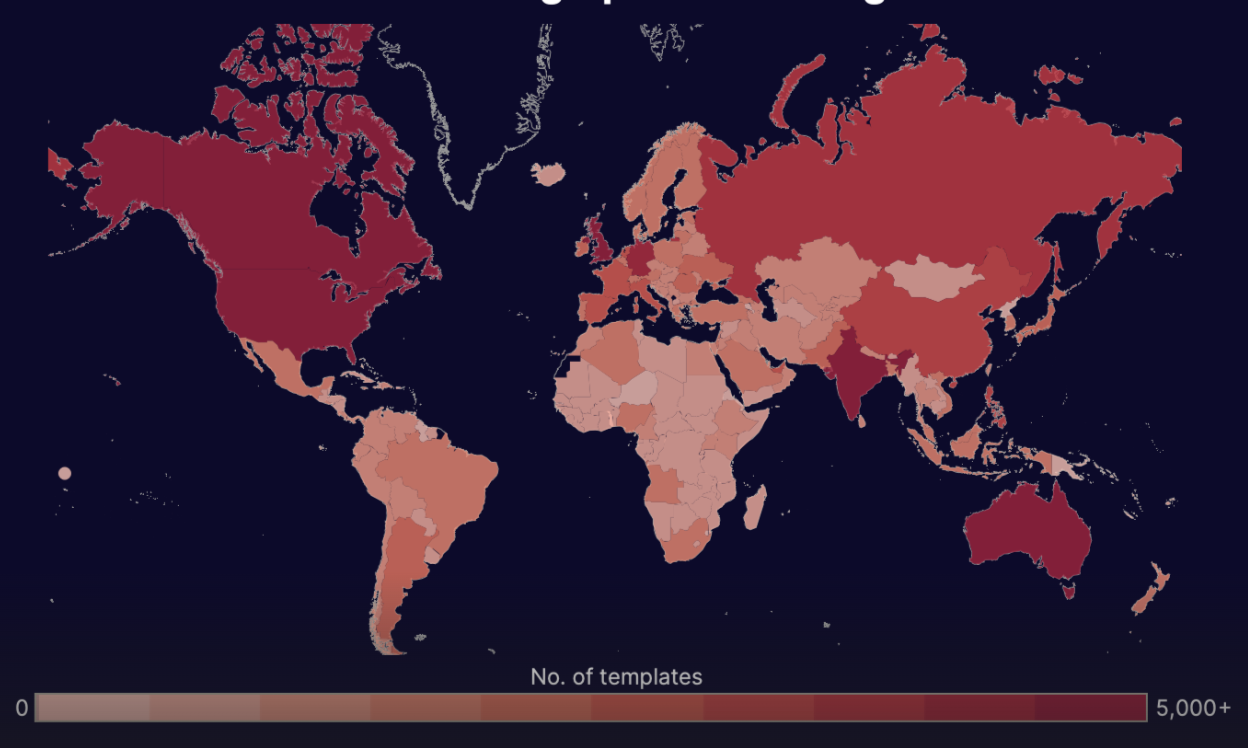
Threat intel stats: Minnesota business documents
Find more information about the threat these farms pose in our threat intel blog and webinar content.
5 Signs of a forged or fake Minnesota business license
Spotting a fake Minnesota business license is not about looking for generic design flaws. The stronger question is whether the document matches the issuing system, regulated activity, license category, and jurisdiction it claims to represent.
Minnesota business records can come from the Secretary of State, Minnesota eLicensing, the Department of Revenue, state agencies, professional boards, counties, and cities. A convincing fake may use real Minnesota terminology, but combine it in a way that no legitimate licensing path would.
Here’s what to look for:
1. Inconsistent formatting
Minnesota business documents vary by issuer, but real records should still look like they came from one issuing system.
- Hybrid “Minnesota business license” certificate. A fake may combine a Minnesota Secretary of State file number, Minnesota Tax ID, eLicensing topic label, and agency-license wording into one certificate. Real Minnesota records come from separate systems, so one document should not visually merge SOS filing data, tax registration, directory text, and professional-license language.
- Directory page redesigned as a license. Minnesota eLicensing is a license-finding portal. It lists license topics and agencies across hundreds of state licenses, permits, registrations, and certifications, but the listing itself is not the issued license.
2. Incorrect or misleading information
Misleading Minnesota business license documents often contain fields that appear official but do not contain information typical of that document.
- Seven-digit tax ID. Minnesota Tax ID Numbers are seven digits and are used to report and pay Minnesota business taxes. If that number appears as the “license number” or in another field claiming to be something it’s not, the document may be substituting tax registration for a license.
- Wrong license status language for the issuing board. Some Minnesota licensing boards distinguish active, expired, revoked, retired, or other status categories. For example, Minnesota’s AELSLAGID board says revoked, retired, or expired statuses mean the person cannot currently practice in Minnesota. Misusing or mixing up this terminology between documents or jurisdictions can be indicative of fraud.
3. Uncharacteristic figures
Minnesota fraud can show up in dates, numbers, validity periods, processing claims, and more.
- SOS certificate with no issue date or permanent validity. Minnesota Secretary of State certificates list the certificate issue date and confirm status only on the day issued. A certificate-style record with no issue date, no certificate date, or “expiration: none” is suspicious.
- DLI processing timeline. Minnesota Department of Labor and Industry says complete construction contractor registration applications may take two to three business days to issue, and up to 30 days during peak renewal periods from October to December in odd-numbered years.
4. Minnesota business license inconsistencies
A convincing fake may include real Minnesota document names, but the package may still be incomplete or inconsistent.
- One document submitted when two or more are needed. Minnesota eLicensing can identify the license category and responsible agency, but a topic page or license description is not the issued license. A complete package should include the actual record from the agency, board, city, or county that administers that license.
- Contractor registration used for licensed work categories. DLI says contractors performing boiler, electrical, elevator, high-pressure piping, plumbing, or residential building contractor work must apply for the required license and may not submit contractor registration instead.
- Local license used outside the issuing jurisdiction. A Minneapolis license should not be accepted for a Saint Paul location, and a Hennepin County record should not be accepted for a Ramsey County location without checking the local licensing system for the actual operating address.
5. Metadata discrepancies
Metadata should not replace document verification, but it can support a fraud finding when the file source contradicts the expected Minnesota issuing workflow.
- Screenshot or scan submitted when an electronic certificate should be available. Minnesota Secretary of State says online copy orders are returned electronically by email. A cropped screenshot or phone photo of an SOS certificate should warrant pause when an electronic copy can be ordered or supplied.
- Cropped portal image hides the record type. A cropped eLicensing, SOS, DLI, or local portal screenshot can hide whether the page is a search result, topic listing, license description, application, renewal page, or issued record.
- Consumer-edited file origin for an agency or board license. If a Minnesota license, certificate, or permit appears rebuilt in Canva, Photoshop, a mobile editor, or a generic PDF tool, the issue is not metadata alone. The file source conflicts with the expected government, board, agency, or local licensing workflow.
Disclaimer: Manual review can catch obvious Minnesota business license scams, but the strongest signals are document-function mismatches. The question is not just whether the document looks real. It is whether that Minnesota record proves what the applicant says it proves.
How to verify a Minnesota business license
Lending teams, insurance underwriters, tenant screening teams, marketplace trust and safety reviewers, procurement teams, and fraud investigators can verify Minnesota business documents in one of two ways: manually or automatically.
Manual verification is slow because teams need to first identify which type of Minnesota record they are looking at (and if its the right one for that use case).
AI document verification can analyze a document for fraud without knowing what it’s for or where it's from.
That said, manual review still matters, but reviewers need to check the issuer, record type, activity, status, renewal logic, and jurisdiction before trusting a Minnesota business license document.
Manual verification of a Minnesota business license
The best place to start is with the warning signs above, then you can check the following databases:
- Minnesota Secretary of State business filing search. Search the business name, assumed name, file number, filing history, status, and renewal information. This can confirm business registration, but it should not be treated as proof of regulated activity or local operating approval. For a complete guide of all US business registries, visit our USA KYB guide.
- Minnesota Department of Labor and Industry (MDLI). Use the MLDI business license search to see if a relevant industry license exists and is still valid.
Keep in mind: Manual verification becomes slow because Minnesota business authorization is spread across entity filings, tax records, agency licenses, professional boards, eLicensing categories, and local permit systems. Even if one files is valid, you still have to do thorough research to find out if it's the right document for that specific use case.
Using AI and machine learning to spot fake Minnesota business licenses
AI fraud detection can strengthen Minnesota business license verification.
Rather than relying on fixed templates or database lookups, strong AI systems analyze how a document was built, how it may have been manipulated, and hundreds of other indicators to spot signs of fraud.
Key benefits include:
- Document-agnostic review. Minnesota business documents can come from the Secretary of State, Department of Revenue, state boards, local licensing offices, and industry-specific agencies. A document-agnostic system can review varied formats without depending on one Minnesota template.
- Cross-document intelligence. AI can compare records across a submission package, helping identify when the business name, assumed name, tax ID, local permit, industry license, and Secretary of State record do not align.
- GenAI detection. Fraudsters can use generative AI and editing tools to create polished Minnesota business records that look credible at a glance. AI can detect visual and structural patterns that suggest synthetic generation or digital reconstruction.
- Explainable review signals. Strong fraud review needs reasons, not just scores. AI can surface plain-language signals that create easily defensible decisions.
Automation vs. AI
Rules-based automation struggles with Minnesota’s licensing structure because the main fraud risk is often contextual. A document can contain every required field and still be misleading if it is the wrong record type.
AI is better suited to these cases because it learns from document structure, manipulation patterns, and cross-document relationships.
Instead of only checking whether fields are present, it can help identify when a Minnesota business document was rebuilt, when a portal screenshot has been stripped of context, or when one record is being used to imply broader authority than it actually provides.
Conclusion
Fake Minnesota business licenses make manual review difficult because you need to understand the difference between entity registration, tax accounts, industry licenses, local permits, professional approvals, and directory results.
Resistant Documents can detect fraud without pesky state-level nuances. Instead of checking what the document is, it analyzes it directly for signs of tampering. Your review team won’t need to check every industry and permit in Minnesota. Just run a less than 20 second scan.
Scroll down to book a demo.

Fraud awareness, examples, and lessons
Learn more about fraud in specific industries, best practices, and targeted documents.
View all
Application fraud in 2026 is easier to attempt: accessible tools and services help applicants turn false claims ...

Within the fake document ecosystem, things can change fast. Four months ago, we reported that OnlyFake, the ...

In May 2026, a Dallas resident was convicted of running coin-operated “amusement machines” without a business ...

NEW YORK & PRAGUE – 1 October 2026 – Ocrolus, the AI workflow and analytics platform for lenders, today ...
For a few hundred dollars, sellers on Telegram promise to boost your credit score using someone else's credit ...

Key takeaways Fake certificates can use real numbers Fraudsters can copy a genuine business’s VAT number onto a ...