
Money moves faster than ever in 2026. Instant payments, digital wallets, embedded finance, online marketplaces, and global fintech platforms have made it easier for legitimate customers to transact in seconds.
They have also made it easier for fraudsters, mule networks, and money launderers to move funds before traditional controls can react…
That is why transaction monitoring is becoming more AI-driven. But only if done the right way. AI adoption in transaction monitoring is about using the right models, the right data, and the right workflows (you have at your disposal) to uncover suspicious behavior that traditional approaches may miss.
Traditional transaction monitoring is still essential, but static rules and batch-based reviews can struggle in a world where suspicious activity unfolds across accounts, counterparties, devices, and networks.
So let’s look at AI transaction monitoring: how it helps financial institutions detect suspicious behavior faster, behavioral changes, anomalies, and relationships that may not be obvious from a single payment.
Because no institution wants to create more alerts. But everyone needs to detect the right risks earlier, reduce analyst noise, and help teams stop fraud and financial crime before the damage is done.
Let’s get started.
For a deeper breakdown of the systems, risks, rules, AI use cases, and best practices behind effective monitoring, read our full Transaction monitoring: Ultimate guide.
What is AI transaction monitoring?
That activity may indicate: Fraud, money laundering, mule activity, account takeover, terrorist financing, or other financial crime.
Transaction monitoring itself looks at how money moves, where it goes, who is involved, how often transactions occur, and whether that behavior matches what is expected for the account or customer.
AI changes fraud detection in transaction monitoring by building on that foundation. Instead of relying only on fixed rules, AI models can analyze a broader set of signals and identify suspicious patterns as they emerge.
For example, one transaction may look normal on its own. But when viewed alongside recent account behavior, beneficiary changes, shared recipient accounts, payment velocity, device signals, and activity across similar customers, it may become clear that the transaction is part of a wider fraud or money laundering pattern.
How does AI transaction monitoring work?
AI transaction monitoring works by analyzing transactions in context. Rather than looking only for predefined thresholds, AI models evaluate activity across: behavior, timing, counterparties, locations, amounts, account relationships, and broader transaction history.
This gives financial institutions a more complete view of risk than any single rule, threshold, or transaction-level alert could provide on its own.
Traditional rules are useful for detecting known scenarios, but financial crime changes quickly. Mule networks adapt, fraud patterns evolve, and suspicious behavior can look legitimate when each transaction is viewed in isolation. AI helps by identifying patterns across large, messy, fast-moving data and surfacing risk signals that may not be obvious from a single payment.
One important concept is behavioral baselining. The system learns what normal activity looks like for a customer, account, merchant, business, or segment. A sudden change from that baseline can then become a risk signal.
For example: A dormant account suddenly receiving and dispersing funds, a business account processing payments inconsistent with its profile, or anything that falls outside of typical customer behavior.
AI can also strengthen monitoring through an ensemble approach. Instead of relying on one model to make the full decision, an ensemble combines multiple smaller models that each examine a different part of the problem. For example:
- Transaction behavior. Amount, frequency, timing, velocity, and payment type.
- Customer or account behavior. Historical behavior, expected usage, and peer groups.
- Counterparty and relationship signals. Recipients, senders, merchants, beneficiaries, and linked accounts.
- Geographic and contextual signals. Location, jurisdiction, device, channel, and other contextual indicators.
- Alert prioritization. Ranking alerts by risk by evaluating multiple signals together, helping teams reduce false positives and focus analyst time on activity that truly deserves investigation.
- Network-level patterns. Coordinated movement of funds across accounts, merchants, devices, and transaction flows.
Modern fraud and money laundering rarely happen through one account in isolation. Criminals often rely on many accounts moving funds in coordinated ways. AI can help connect those relationships and show when individual transactions that seem ordinary on their own form part of a suspicious wider pattern.
As Resistant AI’s Kathy Gormley puts it,
“Suspicious behavior is easier to detect when teams look at the data and the behavior through different lenses: the ensemble approach.”

Rules still matter, and human oversight remains essential. But effective systems combine rules, machine learning, behavioral analysis, network intelligence, and analyst expertise to detect both known typologies and emerging threats.
Why is AI essential for transaction monitoring?
Transaction risk has become faster, more connected, and harder to interpret through isolated rules. AI helps evaluate these large volumes of activity, detect subtle risk signals, and support real-time decisions across fraud and AML workflows.
Here is why AI has become essential:
Scaling with transaction volume
Financial institutions, fintechs, payment service providers, marketplaces, lenders, and crypto platforms process huge volumes of payments, transfers, payouts, deposits, withdrawals, and account activity every day.
Manual review cannot keep pace. Rule-based monitoring can process volume, but it struggles to interpret the full context behind that activity.
AI can analyze large, multi-dimensional transaction datasets simultaneously. It evaluates behavior, counterparties, timing, velocity, locations, account relationships, and historical patterns in real time.
Fighting automated financial crime with AI
Criminals use automation, synthetic identities, account networks, and coordinated payment flows to test controls and move funds quickly.
These are systematic operations designed to stay below thresholds, mimic normal behavior, and exploit gaps between fraud and AML controls.
AI allows institutions to respond dynamically rather than reactively, identifying suspicious patterns as they emerge instead of waiting for fixed rules or batch reviews to catch up.
Detecting subtle, low-signal transaction risk
Modern transaction risk is rarely obvious from one payment. A transfer amount may sit below a threshold. A new recipient may look legitimate. A change in timing, destination, or account behavior may not be enough to trigger a rule on its own.
AI aggregates weak indicators into probabilistic assessments. It can identify suspicious combinations of behavior, timing, velocity, counterparties, locations, and network relationships that may be invisible to threshold-based systems or human reviewers.
Reducing false positives without increasing risk
By modeling customer behavior and contextual transaction risk, AI helps institutions apply scrutiny selectively according to their risk appetite. This reduces low-value alerts, supports better alert prioritization, and helps analysts focus on the activity that truly deserves investigation.
Adapting as transaction risk evolves
Typologies evolve. Mule networks change routing patterns. Payment thresholds are tested. New accounts, merchants, devices, and counterparties are introduced to avoid detection.
AI systems learn from new data. They update behavioral models, incorporate feedback from confirmed suspicious activity, and adjust to emerging patterns.
Conclusion
AI transaction monitoring helps financial institutions move beyond static alerts and fragmented risk signals. It analyzes behavior, detects anomalies, connects activity across networks, and helps teams prioritize the cases that matter most.
If you want to experience all the benefits we’ve mentioned above, Resistant Transactions is an excellent choice. It can quintuple analyst productivity while tripling risk coverage and reducing response rates to less than 100 milliseconds.
Scroll down to book a demo.

Fraud awareness, examples, and lessons
Learn more about fraud in specific industries, best practices, and targeted documents.
View all
Application fraud in 2026 is easier to attempt: accessible tools and services help applicants turn false claims ...
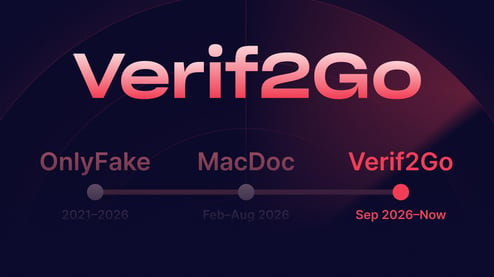
Within the fake document ecosystem, things can change fast. Four months ago, we reported that OnlyFake, the ...

In May 2026, a Dallas resident was convicted of running coin-operated “amusement machines” without a business ...

NEW YORK & PRAGUE – 1 October 2026 – Ocrolus, the AI workflow and analytics platform for lenders, today ...

For a few hundred dollars, sellers on Telegram promise to boost your credit score using someone else's credit ...

Key takeaways Fake certificates can use real numbers Fraudsters can copy a genuine business’s VAT number onto a ...