
In 2026, insurers will collect trillions of dollars in premiums to protect individuals, businesses, and entire economies from financial shock. When working well, the insurance industry provides stability, trust, and confidence at scale to our world’s financial institutions and individuals.
Insurance fraud, however, is deeply embedded in this system. $308.6 billion is lost to insurance fraud every year in the U.S. alone, and that number compounds by 10-15% annually. Undetected, it quietly slips through claims workflows every day, inflating losses, driving up premiums, and putting pressure on claims teams already operating at scale.
So what does this mean for your business?
For insurers, fraud is not just a financial problem. It is an operational one. It increases claims handling costs, slows down legitimate payouts, and forces teams to make high-stakes decisions based on evidence that is increasingly digital, fragmented, and easy to manipulate.
This is especially true for travel insurance, where claims are frequent, time-sensitive, and heavily dependent on documents such as flight tickets, medical invoices, police reports, and receipts submitted by customers from anywhere in the world.
In this guide, we break down how insurance fraud actually works, why document-driven claims are particularly vulnerable, what fraud looks like in real-world insurance workflows, and how insurers can detect and prevent it without sacrificing speed or customer experience.
Read on to learn more.
Interested about fraud in other industries? Check out our blogs about payment and trade finance fraud.
What is insurance fraud?
Insurance fraud is the intentional act of deceiving an insurer for financial gain by misrepresenting information, fabricating events, or submitting false or manipulated evidence.
It can occur at different stages of the insurance lifecycle. You might fabricate documents during application and underwriting, stage or exaggerate losses throughout the policy period, or submit manipulated reports at the point of claim.
In all cases, the goal is the same: obtain coverage, benefits, or payouts that would not otherwise be granted.
Insurance fraud is typically split into two categories: soft and hard fraud
- Soft fraud. A legitimate claim is exaggerated through inflated expenses, overstated losses, or selective omission of facts.
- Hard fraud. Deliberate fabrication, such as staged incidents, fictitious losses, or entirely false claims.
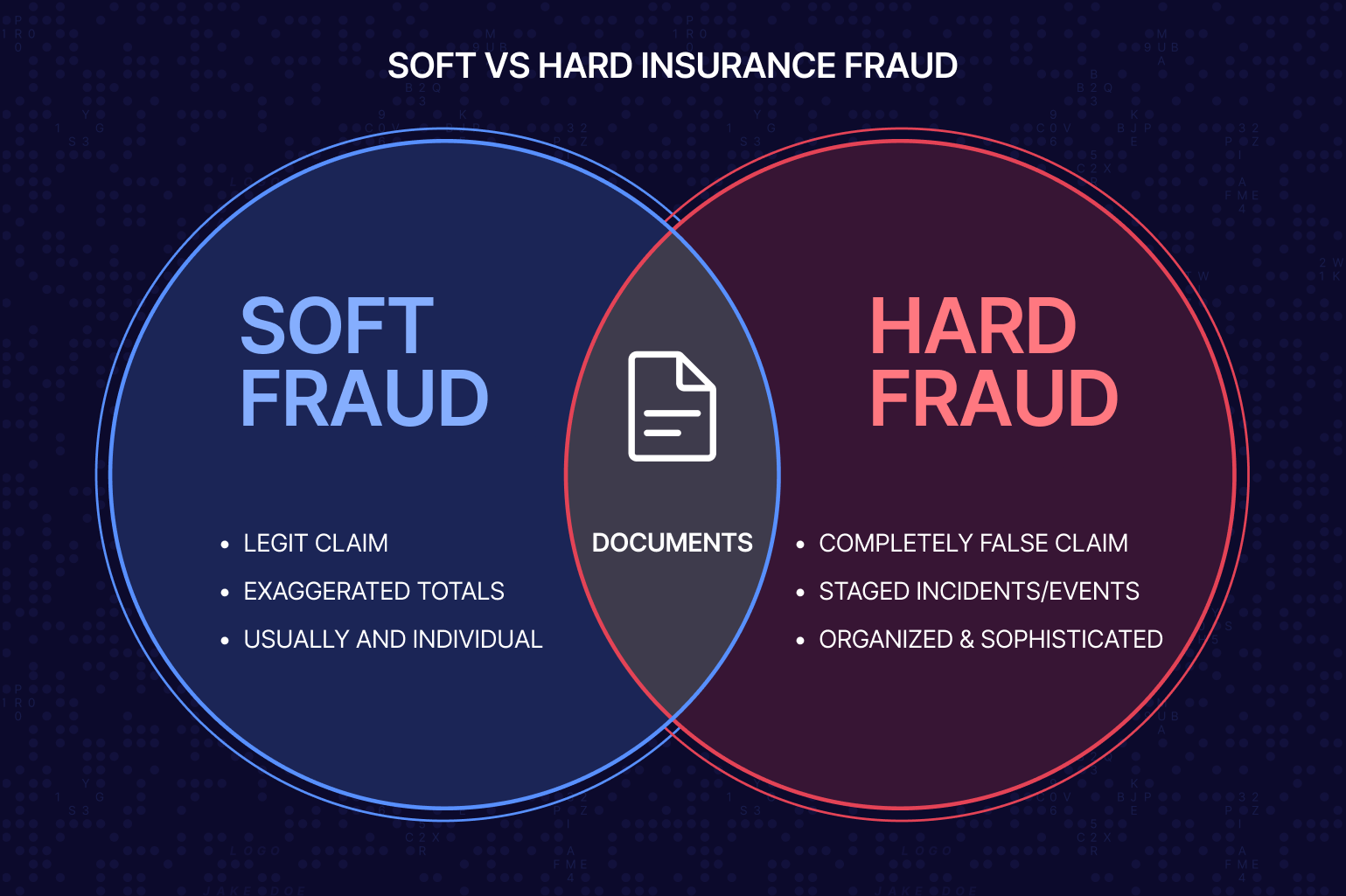
Soft or hard, what connects fraud across insurance is the role of documentation.
Insurance is fundamentally a document-driven industry. Claims decisions are rarely made based on direct observation. Instead, insurers rely on documents and images submitted by customers (and third parties) to verify that an insured event occurred and to quantify the loss.
For example, in travel insurance this typically includes flight tickets and boarding passes, hotel bookings, receipts, medical reports, invoices from foreign clinics, and police reports for theft or loss.
As true for travel insurance and other types like auto and home, the nature of these documents has changed dramatically.
Paper originals have largely been replaced by PDFs, screenshots, and photos captured on mobile devices. Travelers no longer print tickets at the airport or collect stamped confirmations. Receipts are usually hastily taken with smart phones, not painstakingly stuffed into folders. Airlines, hotels, and service providers issue digital-only records that are easy to forward, edit, or recreate.
This shift improves customer convenience and accelerated claims processing, it has also reduced many of the traditional friction points that once made fraud harder to execute.
Reliance on digital documentation makes insurance particularly vulnerable to document fraud. Edited receipts, altered travel confirmations, forged medical invoices, and recycled police reports can be created or modified in minutes using widely available tools.
All it takes is an altered date, a shifted amount, a doctored photo, and providers can end up paying out massive claims that end up fraudulent.
Real world example: In one high-profile travel insurance fraud case, a North Carolina man was charged with more than 50 felonies in connection with an extensive travel insurance fraud operation that spanned several years. Prosecutors allege the defendant submitted falsified medical paperwork, altered airline documentation, forged identification, and manipulated credit card records to support bogus claims and collect payouts from multiple travel insurers.
Industry context: What does fraud look like in the insurance industry
Insurance fraud shows up wherever insurers must make high-stakes decisions quickly, at scale, based on evidence they cannot independently verify.
That is the reality of modern insurance operations: most claims are adjudicated based on documents and images submitted by claimants and third parties, not on direct observation.
The more the workflow depends on this evidence, the more attackers can “move the outcome” via manipulation.
This risk is not hypothetical. In the UK alone, the Association of British Insurers reported that insurers identified £1.16 billion worth of fraudulent general insurance claims in 2024, with over 98,400 fraud-related claims detected, a 12% rise from 2023.
Recent events paint an even grimmer picture. Back in June 2025 the U.S. DOJ had its largest coordinated enforcement action against healthcare insurance fraud, putting a stop to over $14.6 billion with 324 defendants.
This fraud illustrated how quickly fraudulent insurance operations can be created, scaled, and monetized in today’s climate. The organization acquired dozens of medical supply companies across the United States and used them to submit $10.6 billion in fraudulent claims, exploiting the stolen identities and medical information of more than one million individuals across all 50 states.
Enabled by digital onboarding, electronic documentation, and automated claims submission, the scheme was able to operate at national scale and move proceeds rapidly through modern financial systems, allowing losses to accumulate before traditional detection and recovery mechanisms could respond.
The link between stolen identities and huge insurance fraud cases doesn’t end there. Fraudsters need other people's data to falsely submit claims and move money through mule accounts to access their stolen funds. The National Insurance Fraud Bureau (NICB) projected a 49% increase in insurance fraud linked to stolen identities in 2025, calling it the “foundation for life insurance, medical-related fraud, and cargo theft.”
Document fraud is often the mechanism that makes identity-driven insurance fraud possible at scale. Stolen identities are rarely used in isolation. They are paired with supporting documents that make false claims appear legitimate, providing the narrative and proof insurers require to process claims, making them the primary access point through which identity theft, exaggerated losses, and entirely fabricated claims are converted into payouts.
The nature of insurance workflows only worsens the document problem. Claims teams face constant pressure to move quickly, meet service expectations, and avoid adding friction for honest customers. Because decisions hinge on documents and images, fraudsters target that layer directly.
This is why document fraud deserves focused attention: stopping manipulated or reused evidence early is one of the most effective ways to reduce fraud risk without slowing claims. With the right tools, insurers can lower false positives, escalate only high-risk cases, and block fraudulent claims before money moves.
But who’s behind all this fraud and fake documents? Some are opportunistic individuals, not experienced in fraud but seeking a quick buck. Others are sophisticated, repeat offenders operating at scale with templates, stolen identities, and coordinated submissions across insurers.
The difference is not intent, but volume and polish. In both cases, the common denominator is documentation. Whether fraud is amateur or industrialized, it ultimately succeeds or fails based on the credibility and reuse of the documents submitted.
10 Steps of insurance fraud
To understand how document-driven insurance fraud actually unfolds, it helps to follow a simple, real-world example. In this case, we will use an example from the travel insurance industry, tracing the journey of a hotel receipt and booking confirmation, from a legitimate disruption to repeated fraudulent payouts.
.png?width=1200&length=1200&name=10%20Steps%20of%20Insurance%20Fraud%20(1).png)
.png?width=1200&length=1200&name=10%20Steps%20of%20Insurance%20Fraud%208%20(1).png)
.png?width=1200&length=1200&name=10%20Steps%20of%20Insurance%20Fraud%209%20(1).png)
.png?width=1200&length=1200&name=10%20Steps%20of%20Insurance%20Fraud%2010%20(1).png)
.png?width=1200&length=1200&name=10%20Steps%20of%20Insurance%20Fraud%2011%20(1).png)
.png?width=1200&length=1200&name=10%20Steps%20of%20Insurance%20Fraud%2014%20(1).png)
- Policy selection. A traveler purchases a travel insurance policy that reimburses additional accommodation costs caused by a covered flight disruption, with reimbursement based on hotel booking confirmations and receipts uploaded as screenshots, photos, or pdfs through a digital claims portal.
- Triggering event. The traveler experiences a real flight cancellation or missed connection that requires an overnight stay, creating a legitimate basis for an accommodation claim.
- Legitimate purchase. The traveler books a hotel room at one of the insurance agency’s accepted hotels for one night and receives a genuine booking confirmation and receipt showing the room rate, taxes, and stay dates.
- Document manipulation. The traveler uploads the receipt and booking confirmation to ChatGPT and asks it to inflate the nightly rate, add additional nights, upgrade the room type, and include fabricated charges for breakfast and city taxes, while keeping branding, formatting, and totals internally consistent.
- Claim submission. The manipulated hotel receipt and booking confirmation are uploaded as screenshots, along with flight details and a short narrative explaining the disruption.
- Plausibility review. The claim passes basic checks because the delay is real, the receipt and booking look normal at a glance, and the claim amount is under a threshold that doesn’t typically lead to case escalation.
- Payout. The insurer reimburses the expenses based primarily on the submitted receipt, prioritizing fast settlement and customer experience.
- Evidence reuse. Weeks later, the same receipt and booking template is reused in another claim with changed dates, totals, and claimant details, while the underlying structure remains the same.
- Late detection. The reuse is only identified after multiple payouts through investigation, cross-claim pattern analysis, or external intelligence, when recovery is difficult and the loss has already been realized.
- Too-late outcome. By the time fraud is confirmed, the money has already left the system, recovery is uncertain, and the insurer is forced into a slower, more expensive cycle of investigation, escalation, and control tightening that also increases friction for honest customers.
This is how seemingly low-risk, document-based fraud quietly scales. Each individual claim looks plausible in isolation, but together they create cumulative loss that is difficult to unwind once payments are made.
Who is responsible for insurance fraud and who is affected?
Insurance fraud is not committed by a single type of actor, nor does it affect only one part of the industry. It exists on a spectrum, ranging from one-off exaggerations by individual policyholders to coordinated, professional operations designed to extract payouts at scale.
What connects these behaviors is not motivation or sophistication, but access: fraud succeeds when bad actors can submit evidence that appears credible enough to pass claims workflows. As a result, the burden of fraud is shared unevenly across the ecosystem, with losses, friction, and operational strain extending far beyond the person who submits the claim.
Bad actors typically include:
- Opportunistic claimants inflating losses using altered receipts or selectively edited documents.
- Professional or organized fraudsters who reuse document templates and repeat workflows at scale.
- Collusive third parties who supply “supporting” documents, such as inflated invoices or fabricated confirmations.
Victims typically include:
- Insurers, through direct loss and higher operating costs.
- Honest policyholders, through higher premiums and increased friction during legitimate claims.
- Claims teams, through higher caseloads and time spent resolving questionable evidence rather than serving legitimate customers.
Why insurance is vulnerable to fraud
Insurance is particularly vulnerable for four reasons:
- Its low risk repeatability.
- The ease at which it is committed.
- The fragmentation of fraud detection.
- The difficulty of recovery/reimbursement.
Insurance fraud can be low-risk and repeatable.
Payout decision hinges on documentation rather than direct verification. Even small manipulations can produce real money, and many claims environments are designed to prioritize customer experience and turnaround time.
Insurance evidence has become easier to fabricate convincingly.
Swiss Re, one of the world's leading providers of reinsurance, insurance and other forms of insurance-based risk transfer, has already flagged deepfakes, disinformation, and AI as emerging threats that enable insurance fraud and increase insurers’ operational costs to manage these risks (and so have we). As evidence becomes more digital and more synthetic, the gap between “looks real” and “is real” only widens.
Fraud detection in insurance is often fragmented.
When systems, teams, and data are siloed, repeat behavior is harder to spot, and fraudsters can recycle the same documents or narratives across multiple claims.
Detection may still happen, but it often happens after losses accumulate, which is why prevention has to include evidence integrity checks and cross-claim pattern visibility, not just manual review.
That's why you need fraud management, to ensure your processes are clear and well defined.
Recovery or reimbursement is often challenging.
Funds get disbursed quickly and are difficult to claw back, especially when the money has already moved across borders. Once you spot a fraudulent claim, it might not even be worth pursuing. Unless you tie the losses to an extensive ring or connected attacks, the cost of investigation or litigation can exceed the value of many individual claims.
And still, evidence may be cross-jurisdictional, inconsistent, or difficult to validate after the fact. If you want a successful recovery you need fast detection before funds disperse. Your evidence must be preserved and structured well enough to support an investigation. Finally, you’ll need clear reporting pathways and the authority to coordinate with law enforcement, which is a core goal of anti-fraud regulatory frameworks like the NAIC model approach.
Types of insurance fraud
Insurance fraud takes many forms, but it is best understood by how the fraud is executed and what evidence is abused.
Below are the most common types of insurance fraud affecting insurers today, with real-world examples that show how these schemes actually work in practice.
Document fraud
Document fraud is when false, altered, or reused documents are submitted to support a claim. Instead of manipulating the underlying event, fraudsters manipulate the evidence insurers rely on to validate coverage and quantify loss.
Rather than existing as a separate type of insurance fraud, document fraud is the means by which most insurance fraud is committed. You need the fake or altered documents as supporting evidence behind your claims.
With that in mind, let’s look at the different types of documents involved in the insurance use case as the type of fraud depends heavily on the type of documents involved…
Medical documents
Documents used to prove injury, illness, treatment, and cost (medical certificates, clinic invoices, treatment summaries).
Common schemes:
- Forged medical certificates to trigger trip cancellation or emergency medical coverage.
- Altered dates of treatment to fall inside policy coverage.
- Inflated invoices or added procedures that were never performed.
- Reused medical paperwork across claims or insurers.
Real world example: Two people in California were arrested in 2025 for stealing patient identities to create false medical records and submit fraudulent medical insurance claims.
Travel documents
Documents that prove travel occurred and disruptions happened (tickets, itineraries, carrier letters, delay confirmations).
Common schemes:
- Fabricated delay or cancellation confirmations.
- Edited itineraries to change dates, routes, or traveler identity.
- Reused boarding pass or itinerary screenshots from past trips.
- Altered airline correspondence to hit payout thresholds.
Real world example: As recently as January of this year, a UK man submitted false documents (including a fake hotel booking) to support a fake travel insurance claim. He was later arrested and sentenced to two years in prison.
Receipts and invoices
Documents used to prove and value expenses or losses (replacement purchases, lodging, transport, repairs).
Common schemes:
- Increasing prices or item counts to push a claim closer to policy limits or maximize reimbursement.
- Creating entirely fake proof of purchase to justify expenses that were never incurred.
- Repurposing legitimate receipts from non-covered purchases and presenting them as evidence of an insured event.
- Submitting the same underlying document to multiple insurers or across multiple claims to extract repeated payouts.
Real world example: In mid-2025, police in Ghaziabad arrested multiple suspects who used counterfeit receipts generated with software alongside fake insurance documents to collect payments from over 1,500 victims.
Police reports and incident reports
Reports used to prove theft, loss, or incident circumstances, often treated as high-trust evidence.
Common schemes:
- Producing entirely fake reports to fabricate an insured event, such as theft or loss.
- Modifying legitimate reports so the incident falls within the policy period, matches covered items, or aligns with policy exclusions and limits.
- Submitting the same police report across multiple claims or insurers to extract repeated payouts from a single incident.
- Using the existence of a police report to lend credibility to an event that did not occur as described or did not occur at all.
Real world example: In May 2025, California authorities arrested a woman accused of staging a carjacking as part of an insurance fraud scheme. Investigators allege the suspect filed a false police report describing a violent theft in order to legitimize an insurance claim for the vehicle.
Identity documents
IDs, identity artifacts, and documents like birth, marriage, and death certificates used to establish claimant legitimacy and route payouts.
Common schemes:
- Using another person’s identity to file insurance claims or redirect payouts.
- Combining real personal information with fabricated elements to create new identities that can open policies, submit claims, or pass basic identity checks.
- Routing insurance payments to accounts controlled by third parties, allowing fraudsters to cash out.
- Submitting the same underlying ID images or identity details across multiple claims or insurers to support repeated fraudulent payouts.
Real world example: In the UK, insurers uncovered a “crash-for-cash” scheme in which criminals used stolen personal details to take out more than 1,100 fraudulent insurance policies, exploiting compromised identities to generate false coverage and extract payouts before detection.
Staged accidents and manufactured losses
Deliberately creating an “insurable event” (often motor) and then filing claims for damages and injury.
Common tactics and subtypes:
- Staged collisions (including “swoop and squat” style tactics).
- Inflated repair bills and medical treatment plans after a manufactured crash.
- Recruited participants who file coordinated injury and damage claims.
- Reuse of the same clinics, attorneys, or repair facilities across multiple staged events.
Recent world example: New York regulators announced charges in 2025 against two men accused of staging multiple vehicle crashes and then seeking insurance payouts for damages and purported injuries.
Health insurance and medical billing fraud
Billing insurers for services not rendered, medically unnecessary services, or fraud enabled by stolen identities and patient data. It is often organized and high-scale.
Common tactics and subtypes:
- Billing for services never provided.
- Billing medically unnecessary services or upcoding.
- Durable medical equipment schemes.
- Identity theft used to submit fraudulent patient claims.
Real world example: Australia’s insurers have jointly launched a national, AI-powered fraud detection platform designed to share intelligence across the industry and identify insurance fraud patterns earlier and at greater scale than individual insurers could on their own.
Arson and deliberate property damage
Intentionally causing or exaggerating damage, then filing a property claim.
Common tactics and subtypes:
- Deliberately set fires or staged break-ins.
- Inflated inventories of “lost items.”
- Fabricated repair invoices and contractor estimates.
- Coordinated timing around financial stress or policy changes
Real world example: Minnesota reporting in December 2025 described prosecutors charging the owner of a resort with arson and insurance fraud related to a 2024 lodge fire.
Compliance in the insurance industry
At the heart of insurance compliance is a single balancing act:
Prevent and detect fraud without unfairly denying, delaying, or burdening legitimate customers.
Regulators expect insurers to:
- Pay valid claims promptly.
- Detect and stop fraudulent claims.
- Treat customers fairly and consistently.
- Maintain audit trails that explain how decisions were made.
- Cooperate with regulators and law enforcement when fraud is identified.
That being said, Insurance operates in one of the most heavily regulated environments in financial services.
Governed by a combination of financial crime, consumer protection, and sector-specific supervisory frameworks, here are the most relevant frameworks:
- Anti-fraud. Require insurers to actively prevent, detect, investigate, and report fraudulent activity.
- AML and financial crime. Applying primarily to life insurance, investment-linked products, and payout flows that can be misused for money laundering.
- Customer due diligence (KYC/KYB). When insurers onboard policyholders, beneficiaries, intermediaries, or third-party service providers.
- Governance and risk management. Require insurers to show that controls are effective, proportionate, and consistently applied.
Importantly, compliance in insurance is not limited to onboarding. Claims handling is a regulated activity in its own right, and fraud controls applied during claims must be fair, explainable, and defensible.
Insurance fraud legislation (by region)
Insurance is subject to specific anti-fraud legislation and mandates.
Examples include:
- Insurance Fraud Prevention Model Act (US). Establishes insurer obligations to detect, investigate, and report fraud, and enables coordination with law enforcement.
- Insurance-specific enforcement frameworks (UK). While fraud law is general, the UK insurance sector has dedicated intelligence-sharing and enforcement mechanisms through the IFB and insurer reporting obligations.
- Supervisory governance requirements (EU). Solvency II requires insurers to embed fraud risk into internal control and risk management frameworks.
How to detect and prevent insurance fraud
Detecting insurance fraud is fundamentally different from detecting many other forms of financial crime. Insurers must make decisions at scale, under time pressure, and often with incomplete information. Most claims are legitimate, most evidence looks plausible, and the cost of excessive friction is real.
Fraud prevention cannot rely on obvious red flags alone. It requires controls that distinguish between plausible but false evidence and genuinely valid documentation, without slowing down honest customers.
And technology only makes everything harder. As fraud tactics become more repeatable and technology-driven, insurers need detection methods that scale with volume and evolve alongside attacker behavior.
Detect document fraud with AI
Because insurance claims are evidence-driven, AI document verification is one of the most effective control points available to insurers.
Rather than focusing solely on claimant behavior or post-payment investigations, document intelligence allows insurers to assess the integrity of the evidence itself at the moment it enters the claims workflow.
AI driven document fraud detection solutions can provide automated analysis to the documents insurers already rely on.
Using AI to analyze document structure, consistency, and reuse patterns allows insurers to detect signs of forgery, manipulation, or recycling that are difficult to spot through manual review alone.
Claims teams receive clear, auditable signals rather than gut feelings or visual impressions, supporting faster triage, reducing false positives, and ensuring the escalation of suspicious claims with defensible reasoning rather than intuition.
For fraud teams this means fewer unnecessary manual reviews, earlier fraud detection before payout, and better alignment with compliance expectations around consistency and explainability.
Strengthen identity and third-party trust through structured onboarding
The insurance equivalent of a “trusted vendor network” is not a single registry but a combination of identity verification, third-party validation, and ongoing monitoring. Fraud often succeeds because insurers implicitly trust the entities behind the documents, whether that is the claimant, a medical provider, a repair shop, or another third party supplying evidence.
To reduce this risk, insurers can rely on:
- Customer and beneficiary identity verification. Especially for payout routing and repeat claims
- Third-party validation. Such as maintaining trusted lists of providers, repairers, or partners where appropriate
- Ongoing monitoring. Rather than one-time checks, detect changes in behavior over time
In practice, this means combining KYC-style controls for policyholders and beneficiaries with structured oversight of third parties that frequently appear in claims data.
When identity checks and document intelligence are applied together, insurers gain a clearer picture of both who is submitting a claim and whether the evidence supporting it can be trusted.
This layered approach reduces reliance on any single signal, strengthens fraud controls without creating unnecessary friction, and helps insurers move from reactive investigation to proactive prevention.
How insurance fraud is evolving
Insurance fraud evolves alongside claims processes, evidence formats, and the tools insurers use to verify losses. What has changed most dramatically in recent years is not fraudsters’ intent, but their ability to scale and disguise deception through digital evidence.
Understanding how fraud has evolved helps explain why traditional controls are struggling and why document-driven fraud has become a frontline risk rather than a niche issue.
The past
Historically, insurance fraud was constrained by friction.
Claims relied heavily on:
- Paper documents
- Physical receipts and invoices
- Original signatures and stamps
- In-person inspections or interviews
Fraud still occurred, but it was labor-intensive. Forging a document required printing, scanning, or physical alteration. Reusing the same evidence across claims was risky and difficult to disguise. Most fraud was local, opportunistic, and relatively small in scale.
Detection relied on:
- Experienced adjusters spotting inconsistencies
- Tip-offs from law enforcement or providers
- Post-claim investigations after patterns emerged
While imperfect, this environment limited throughput. Fraud did not industrialize easily.
The present
Modern insurance fraud looks very different.
As insurers digitized claims intake and optimized for speed and customer experience, paper evidence gave way to all the formats we’ve been discussing throughout this piece, pdfs, screenshots, scans, etc.
This shift improved efficiency but quietly expanded the attack surface.
Fraudsters no longer need to fabricate entire events. They can manipulate the proof. Altered receipts, edited flight confirmations, reused medical invoices, and recycled photos can pass initial plausibility checks, especially in high-volume claims environments like travel insurance.
The future
Fraud is now entering a new phase, driven by automation and generative technology. Our Threat Intelligence Unit investigates emerging fraud threats to keep our readers ahead of the curve. Key emerging tactics to be aware of include:
- AI-generated documents. Realistic evidence can now be generated on demand, complete with logos, line items, and formatting that mirrors legitimate merchants.
- Document template reuse at scale. Fraud rings reuse the same online document fraud templates across dozens or hundreds of claims, changing only surface details like names and dates.
- Fraud-as-a-service models. Tools, templates, and whole onboarded platform accounts, are increasingly sold on websites as entire packages, lowering the barrier to entry and making it easier for anybody to commit insurance fraud.
The future of insurance fraud will not be defined by louder red flags, but by quieter inconsistencies buried inside documents and images. Insurers that can analyze evidence at scale, detect reuse and manipulation early, and surface clear, auditable signals will be better positioned to stop fraud before it turns into loss, investigation, and recovery.
Insurance fraud: Industry challenges
Now that we’ve established a baseline for fraud in the insurance industry, what it looks like, how it happens, and how it changed over time, let’s look at some of the circumstances that make combatting it difficult.
The following challenges explain why insurance fraud is particularly hard to detect and control:
- Heavy reliance on customer-submitted evidence. Claims decisions are based on documents and images the insurer did not create or control. Receipts, medical reports, travel documents, and police reports can look legitimate in isolation, even when they are altered or fabricated, especially if you’re not familiar with the document type or its issuing authority.
- Digital documents are easy to manipulate and reuse. PDFs, screenshots, and photos can be edited quickly and reused across multiple claims or insurers. Small, plausible changes often evade visual inspection and basic rule checks.
- Pressure to settle claims quickly. Customer experience expectations and competitive pressure push insurers toward fast payouts. This limits the depth of manual review and creates opportunities for low-value, high-volume fraud to slip through.
- Fragmented data and limited cross-claim visibility. Fraud patterns often only emerge across multiple claims, products, or entities. Siloed systems and disconnected workflows make it difficult to spot document reuse and serial behavior early.
- Attackers evolve faster than manual controls. Fraud tactics adapt quickly as tools like AI-generated documents become more accessible. Manual review processes and static rules struggle to keep pace without automation and evidence-level intelligence.
Top takeaways for insurance fraud experts
TL;DR: Modern insurance fraud is driven by manipulated digital evidence. Insurers that cannot perform document verification at scale will struggle to control losses without slowing down legitimate claims.
- Document fraud scales quietly and efficiently. Altered receipts, travel documents, and medical invoices enable low-value, high-volume fraud that is hard to detect claim by claim but highly damaging at scale. AI-generated and subtly edited documents now look credible enough to pass manual review.
- Late detection turns fraud into a recovery problem. When fraud is caught after payout, recovery is expensive and uncertain. Intake-level detection is far more effective than post-payment investigation.
- Fraud controls must be explainable as well as accurate. Insurers need scalable controls that reduce manual effort while producing clear, auditable decision signals to satisfy regulators and protect customer trust.
Conclusion
As insurers digitize workflows and accelerate payouts, fraudsters target the evidence layer, manipulating receipts, travel documents, medical reports, and other claim artifacts to slip through manual review.
The result is a system where fraud often scales unnoticed until losses accumulate and recovery becomes costly or impossible.
Resistant Documents helps insurers address this challenge by bringing structure, consistency, and explainability to document checks. The document fraud detection software analyzes the authenticity and reuse of the documents insurers already rely on, surfacing clear, auditable fraud signals without slowing down legitimate claims.
This allows insurance teams to reduce false positives, detect fraud earlier in the claims lifecycle, and meet compliance expectations while preserving customer experience.
Scroll down to book a demo.
Frequently asked questions (FAQ)
Hungry for more insurance fraud content? Here are some of the most frequently asked insurance fraud questions from around the web, answered with an insurance-industry lens.
What are the most commonly forged documents in insurance fraud?
The most commonly forged or manipulated documents include medical reports and invoices, receipts for replacement items or expenses, travel documents such as flight tickets and itineraries, police or incident reports, and identity documents used to claim benefits or receive payouts.
Who needs to detect insurance fraud?
Insurance fraud detection is not limited to fraud or SIU teams. Claims handlers, operations leaders, risk and compliance teams, underwriting, and product owners all play a role.
Frontline claims teams are often the first to encounter suspicious evidence, while fraud and compliance teams are responsible for investigation, escalation, and governance.
Which industries and business types must spot insurance fraud?
Any organization involved in issuing, administering, or paying insurance claims must be able to detect insurance fraud. This includes insurers and reinsurers, travel insurance providers, health and medical insurers, property and casualty carriers, embedded insurance providers, and third-party administrators handling claims on behalf of insurers.
What countries experience the most insurance fraud?
Large, mature insurance markets such as the US, UK, and EU tend to report higher absolute figures due to scale, not necessarily higher fraud prevalence.
What is KYC in insurance?
KYC in insurance refers to the processes insurers use to verify the identity of policyholders, beneficiaries, and payees. It is most relevant in life insurance, investment-linked products, and payout routing, but it also plays a role in claims fraud prevention by reducing impersonation, identity misuse, and fraudulent redirection of funds.
What are the red flags of insurance fraud?
Common red flags include:
- Inconsistent or low-quality documentation.
- Repeated use of similar documents.
- Discrepancies between documents and claim narratives.
- Unusual timing of claims relative to policy inception.
- Frequent claims from the same individual or device.
- Evidence that appears templated or reused across claims..
Is there software to detect insurance fraud?
Yes. Resistant Documents document fraud detection can spot fraudulent insurance documents from any country in less than twenty seconds.
What are insurance compliance risks?
Insurance compliance risks include:
- Failing to detect and report fraud.
- Unfairly denying or delaying legitimate claims.
- Inconsistent decision-making.
- Inadequate governance of fraud controls.
- Poor auditability.
How can insurers protect against fraud?
Effective fraud protection requires a layered approach. Insurers should combine identity verification, document and image integrity checks, cross-claim pattern analysis, and clear escalation workflows.

Fraud awareness, examples, and lessons
Learn more about fraud in specific industries, best practices, and targeted documents.
View all
Application fraud in 2026 is easier to attempt: accessible tools and services help applicants turn false claims ...
Within the fake document ecosystem, things can change fast. Four months ago, we reported that OnlyFake, the ...
In May 2026, a Dallas resident was convicted of running coin-operated “amusement machines” without a business ...

NEW YORK & PRAGUE – 1 October 2026 – Ocrolus, the AI workflow and analytics platform for lenders, today ...
For a few hundred dollars, sellers on Telegram promise to boost your credit score using someone else's credit ...

Key takeaways Fake certificates can use real numbers Fraudsters can copy a genuine business’s VAT number onto a ...