
How is your organization handling fraud management?
Not your defenses or the specific preparations you undergo to prevent fraud. How are you managing the workflows and protocols behind those defenses? The escalations? Continuous monitoring? Governance of tools and models?
Fraud management contains the policies, workflows, and oversight structures that define how an organization responds (and improves their response) to risk signals. It governs how fraud risk is identified, reviewed, escalated, documented, and learned from.
These processes form the operational backbone that keeps a fraud program consistent rather than reactive.
As we move into 2026, an unsupervised or poorly structured approach can lead to inconsistent decisions, missed red flags, higher operational costs, and unnecessary customer friction.
Even strong fraud tools lose effectiveness when the processes surrounding them are weak and uncared for.
This blog explores what fraud management actually involves, why it matters now, what makes a strong framework, and how structured intelligence can help align defenses with risk appetite and regulatory expectations.
Read on to learn more.
What is fraud management?
Fraud management is the operational and strategic discipline of how an organization manages fraud risk across the entire customer lifecycle. It includes:
- Defining risk appetite. What level of risk the business is willing to accept (e.g. acceptable fraud loss, false positive rates, zero-tolerance categories, etc).
- Setting policies. What rules must exist to enforce that appetite (e.g., CDD, EDD, filing SARs, setting thresholds, etc).
- Designing workflows. How those rules are operationalized step by step (e.g., onboarding checks, alert routing, SLA timing, case creation, etc).
- Establishing escalation paths. When workflows aren’t enough and require human oversight.
- Governance. Monitoring, choosing, improving, and educating team members on the tools and technologies used to detect and respond to fraud.
It also covers: The continuous evaluation, monitoring, and improvement of those systems.
What’s the difference between fraud management, prevention, and detection?
Fraud management is often confused with fraud prevention and fraud detection, but all happen at different stages and for different reasons:
- Fraud prevention. Focuses on the strategies, training, and technology designed to stop fraud before it happens and prepare the system for when it occurs.
- Fraud detection. Refers to the capabilities and defenses that identify suspicious activity within your systems, flag it, and stop it altogether.
- Fraud management. The framework that deploys, supervises, and improves both. It ensures that every control is used consistently, every alert is handled appropriately, and every decision is defensible.
In other words, fraud prevention ensures you have the right tools, practices, and culture in place to stop the fraud, fraud detection is the actual action of catching and stopping that fraud, and fraud management is taking a step back, looking at the threats and defenses you have and saying “is all of this working, are we doing a good job, is there any place we can improve?”
In practice, strong fraud management creates clarity, reduces friction, guarantees effectiveness, and ensures an organization’s defenses evolve as fast as the threats they are meant to stop.
Why is fraud management important?
Even the strongest defenses fail without clear ownership, coordinated workflows, and actionable plans. Many organizations focus on prevention and detection but overlook the processes that decide how fraud is handled when it appears (and if it's handled well).
A fraud program without structure, accountability, and the ability to learn and improve itself can become as ineffective as having no program at all. In some cases, it can make the situation worse by creating blind spots, inconsistent decisions, and delayed responses that give attackers room to operate.
Fraud management is also essential for compliance.
Requirements around auditability, consistency, and defensibility are embedded across major frameworks, including:
- The Bank Secrecy Act
- Anti Money Laundering directives
- The EU’s Payment Services Directive
- FFIEC guidelines.
- And more!
Each expects institutions to demonstrate not only that controls exist, but that they are governed, monitored, and applied consistently.
Fraud moves faster than most internal update cycles. Without strong management, controls fall out of sync with reality. This creates organizational friction: siloed teams, conflicting decisions, overwhelmed analysts, and gaps where fraud slips through.
Why is fraud management more important in 2026?
Modern threats raise the stakes even further. Faster payments, AI-enabled document and identity fraud, template farms, account reselling networks, and fraud-as-a-service kits give criminals weapons at industrial scale. Everything is digital, automated, and easy to replicate, widening the attack service while controls struggle to keep up.
It only takes one small gap in defenses for fraudsters to flood an organization with automated attempts. A single mouse hole becomes an infestation. All it takes is one horde of rats to notice the weak point.
Fraud controls in 2026 requires clarity, coordination, and ongoing oversight (everything that builds a successful fraud management initiative).
Core elements of modern fraud management
We’ve already briefly mentioned the components of an effective fraud management initiative in our “what is fraud management” section, but what are the exact policies and protocols that fall into those buckets? And how do we, as modern institutions, operationalize and benefit from them?
Risk appetite
Risk appetite defines the level of fraud risk an organization is willing to accept in exchange for growth, customer experience, and operational efficiency. It’s built through alignment across risk, fraud, compliance, and product, grounded in real business priorities rather than intuition or fear of losses.
It also sets segment-specific expectations, acknowledging that different customers, products, or transaction types may warrant different tolerances. A mature risk appetite quantifies things like:
- Acceptable fraud loss ranges.
- Acceptable false positive rates.
- Acceptable levels of customer friction.
- Zero tolerance categories.
- Segment-specific thresholds.
The best way to build a risk appetite is by putting real numbers to these tradeoffs, not vague ambitions. For example, a company that says it wants “low fraud” and “zero onboarding friction” has not defined its appetite. It has created a contradiction. A real appetite sounds like:
“We accept X basis points of loss on unsecured lending if conversion stays above Y percent.”
Or: “False positives must remain below Z percent for verified customers.”
Or: “Synthetic identities are never acceptable risks.”
These boundaries become the north star for fraud management. They prevent teams from blocking legitimate customers out of fear or, conversely, allowing creeping loss because no one agreed on an acceptable threshold.
They are the philosophical and strategic boundaries from which all policies, workflows, and escalations are born. They determine the shape of the entire fraud management framework.
Setting policies
Setting policies means translating the organization’s risk appetite into clear, enforceable rules that guide how fraud risk is managed day to day.
Policies define what must be true before a customer is approved, a transaction is released, or a case is closed. They turn philosophical boundaries into operational standards that analysts, systems, and auditors can consistently reference.
A strong policy framework establishes requirements around verification levels, documentation quality, review conditions, and evidence standards. These rules determine what is acceptable, what isn’t, and what must happen before risk can be taken. They are the stable, non-negotiable criteria that all other processes depend on.
Examples of fraud management policies include:
- Required verification levels (“EDD required for high-risk jurisdictions”).
- Required documentation standards (“Screenshots are not acceptable proofs of income”).
- Required review conditions (“AML must review all transactions flagged for structuring”).
- SAR filing criteria (“A SAR review is triggered when X and Y behaviors occur”).
- Payout release rules (“Funds cannot be released until identity is fully verified”).
- Evidence requirements (“All declines must include documented rationale referencing specific rule triggers”).
Policies must be specific, testable, and enforceable, mapping directly to identifiable behaviors or conditions (within your industry context) so analysts and automated systems know exactly when a rule is met.
For example, a policy that says “Investigate unusual income documents” is useless. It has no threshold, no criteria, and no objectivity. A real policy sounds like:
“Any pay stub with inconsistent metadata or mismatched employer details must be routed to EDD.”
Or: “If a bank statement is submitted as a screenshot, request a PDF version or bank-verified data source.”
Or: “If a transaction is flagged for structuring, an AML analyst must review within 24 hours for potential SAR filing.”
These rules anchor the fraud management framework. They prevent guesswork, reduce inconsistent decisions, and ensure analysts and automated controls operate within the same clear, defensible criteria. They are the backbone from which workflows and escalations are built.
Workflow design
Workflow design defines how fraud alerts move through the organization, who reviews them, and how quickly decisions must be made. It turns policies into executable sequences of work, ensuring that the right cases reach the right people at the right time.
A well-designed workflow draws on data about alert volumes, analyst capacity, historical bottlenecks, and failure patterns across onboarding, payments, and account management.
They use this data to determine thing like:
- Alert routing. How alerts move between teams in a sequential flow (e.g., Alert created → sent to Level 1 → escalated to Level 2 if unresolved…).
- Sequence of checks. The exact order in which onboarding checks run (e.g., Start with document verification → then device intelligence → then behavioral scoring…).
- Queue structure. Define which cases enter which queue and what happens next (e.g., EDD cases → routed to the specialized onboarding queue → picked up only by EDD analysts…).
- Service level agreement (SLA) timing. Define the timing expectation and what happens when it’s missed (e.g., Level 1 must act within 15 minutes → if not, auto-escalate to Level 2…).
- Case creation automation. Define when and how cases are automatically created (e.g., If Resistant AI flags manipulation → system auto-creates a case → attaches evidence…).
When workflows are poorly designed, entire fraud programs slow down: high-risk alerts pile up, SLAs are missed, fraud slips through during delays, and analysts end up firefighting instead of investigating.
Some common mistakes include:
- Single points of failure. For example, all high-risk alerts land with one senior analyst who is out on PTO every other Friday.
- Linear review queues. Can lead to low-risk alerts clogging the system ahead of critical cases.
- Overreliance on manual triage. Causes inconsistent routing and unpredictable workload spikes.
- Unclear evidence requirements. Analysts sending cases back and forth with no clear next steps.
- Alert surges (e.g., product launches, holiday spikes, attack waves). Can overwhelm fixed-capacity teams.
- Cases created without context. Forces analysts to hunt for supporting data before making decisions.
A mature workflow avoids these pitfalls by distributing workload, automating routing, and prioritizing cases based on risk. For example, defining a workflow that allows high-risk onboarding cases to be reviewed within 30 minutes; high-value payouts within 5 minutes.
Or: Automatically creating cases with attached evidence based on a reliable tool.
Strong workflows reduce queue buildup, close the gap between detection and action, and prevent analysts from becoming bottlenecks or burnout risks. They ensure that fraud management functions operate with both speed and consistency.
Escalation paths
Establishing escalation paths defines how cases move beyond standard workflows when the risk exceeds the authority of the current reviewer or when an automated decision requires human intervention.
This is one of the highest-risk points in any fraud program because it is where human judgment intersects with automated controls. Escalation paths determine who takes over, under what conditions, and what evidence is required to justify decisions that fall outside normal processing.
Examples of escalation paths include:
- If a payout rises above a specified threshold, who needs to approve it?
- If document manipulation and repeated template reuse are detected, will the document be moved to human review?
- If an automated decline is overridden, the analyst must attach documented evidence such as verified employer confirmation or consistent account history.
- If activity meets SAR criteria, escalate from fraud operations to AML for review within 24 hours.
- If a case cannot be resolved within its SLA due to missing documentation, escalate to a team lead for reassignment.
You build escalation paths by identifying scenarios where frontline analysts or automated systems cannot safely make the final call. This includes high-value transactions, conflicting risk signals, manipulated documents, identity discrepancies, or situations that may trigger regulatory obligations.
Effective escalations rely on strict criteria, mandatory evidence fields, and post-review audits to keep decisions consistent and defensible A defensible escalation note looks like: “Approved due to verified employer confirmation and consistent account history; supporting documentation attached.”
An indefensible one looks like: “It seemed fine.”
These are the moments where fraud can slip through gaps in the process. Well-defined triggers and evidence requirements close those gaps, reduce regulatory exposure, and prevent manual judgment from becoming an uncontrolled backdoor into the system.
Governance
Governance defines how a fraud program is monitored, reviewed, and improved over time. It establishes the oversight structures, documentation standards, audit trails, and review cadences that keep controls effective and defensible.
Typical tools and processes that require governance in fraud management include:
- Document fraud detection tools. Must be monitored to ensure detectors remain accurate as document manipulation techniques evolve.
- Transaction monitoring systems. Require ongoing rule tuning to keep false positives manageable and maintain coverage against new behavioral patterns.
- Identity verification processes. Must be reviewed for verification accuracy, data quality, and compliance with regulatory standards.
- Machine learning models. Must undergo version control, performance monitoring, drift testing, and periodic retraining.
- Case management systems. Require audits to ensure consistent evidence collection, proper escalation, and complete decision logs.
You build governance by creating a formal review calendar and ensuring decisions cannot bypass auditability. This includes routine checks on rule performance, periodic validation of machine learning models, audits of case handling quality, and documentation updates whenever controls or workflows change.
Without this structure, fraud defenses age quickly, controls stagnate, and risk grows silently.
Examples of this in the real world include: Monthly rule reviews, quarterly model governance boards, and annual fraud framework audits.
Governance keeps you compliant, consistent, and credible in front of regulators and internal audits. It is the mechanism that ensures a fraud program remains reliable, explainable, and aligned with the organization’s risk appetite and threat evolution. Anything less, and your controls age faster than your defenses adapt.
Continuous improvement
Fraud programs must evolve as quickly as the threats they face. Drawing on governance outcomes, analyst feedback, performance metrics, and emerging fraud patterns, you can refine controls, workflows, and decisioning.
This keeps the program adaptive rather than static, preventing outdated controls from becoming blind spots.
Make sure you’re measuring what matters: false positives, missed fraud, review times, control performance, and fraud intelligence.
When analysts repeatedly encounter the same forged template or manipulation pattern, that insight should become a new automated signal, not a recurring manual task. Fraud evolves every month. Your framework must evolve every month too.
What makes a successful fraud management framework?
Now that we’ve established the core components of a strong fraud management framework, what are the do’s and don’ts that will ensure its success? Below are the practices that separate organizations that just have fraud controls from those that manage fraud effectively.
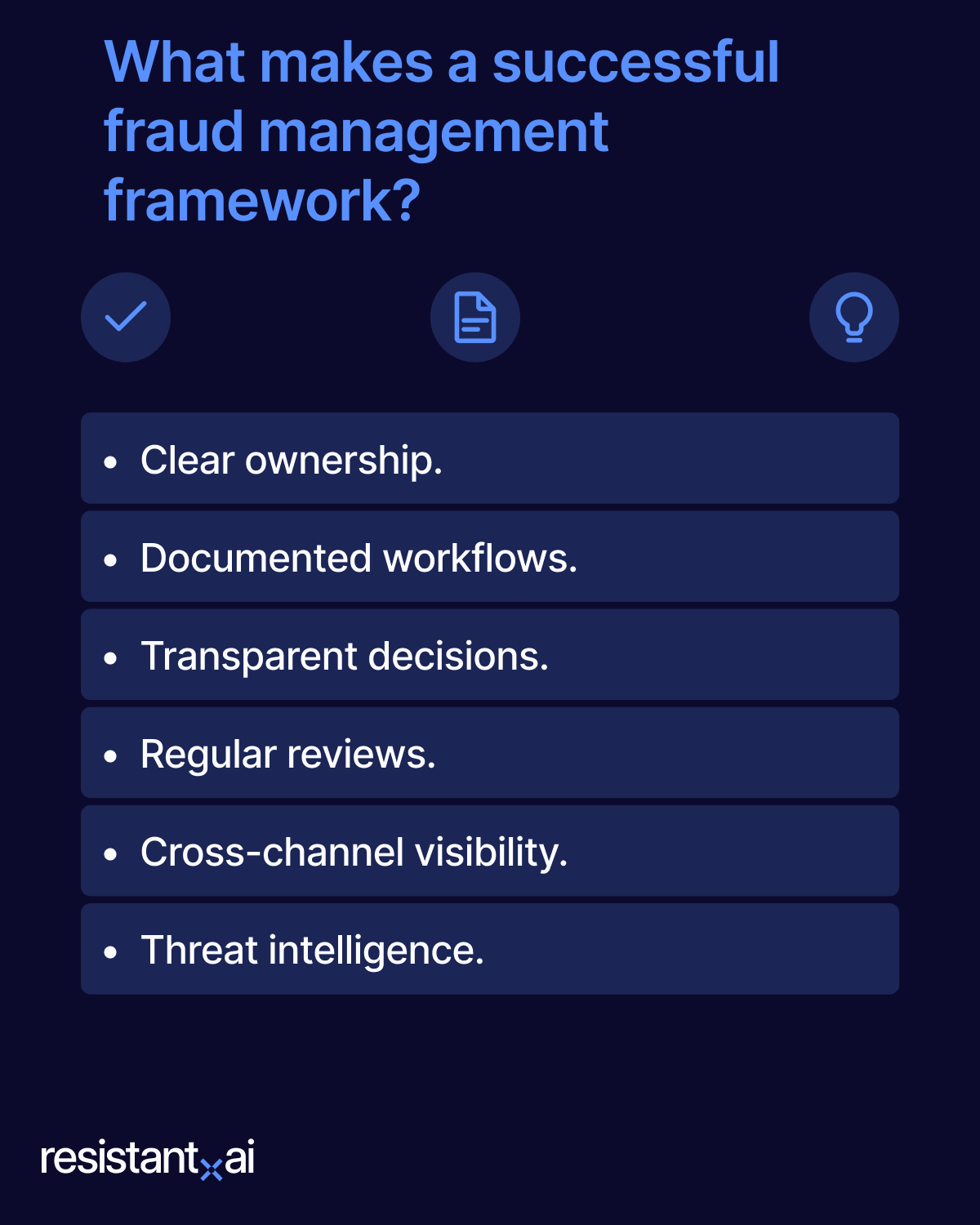
Clear ownership.
Fraud management only works when risk, fraud, and compliance teams share accountability instead of operating in parallel.
- Do: Assign explicit ownership for rule governance, case handling oversight, and escalation approvals. For example, fraud owns triage logic, compliance owns defensibility, and risk owns thresholds.
- Don’t: Leave ownership up to interpretation. This creates situations where two teams assume the other is reviewing a high-risk case, resulting in missed fraud or conflicting decisions.
Documented workflows (in a way that analysts can actually follow).
Workflows only work if they’re real, accurate, and used. Documentation isn’t just for your next audit, by creating a logical trail it's easier for departments to understand decisions and know what to do next.
- Do: Maintain clean documentation supported by standardized data fields, consistent labeling, and easy access in the case management system. For example, analysts should know exactly which evidence is required before escalating a case.
- Don’t: Rely on tribal knowledge or outdated standard operating procedures (SOPs). This leads to analysts improvising, inconsistent reviews, and breakdowns during audits.
Transparent decisions.
Approvals and denials must be justified with clear evidence and aligned to company goals. This prevents: inconsistent decisions, bad audits, and questioning logic/authority within the team.
- Do: Use systems that surface explainable signals and require analysts to document rationale. For example, “denied due to manipulation indicators in document structure” is defensible.
- Don’t: Allow opaque decisions based on intuition alone. Unexplained overrides or gut-feel approvals become liabilities during regulatory reviews.
Regular reviews.
Controls decay quickly when they are not revisited. Monthly reviews are the bare minimum when fraudsters reiterate every day.
- Do: Implement a structured schedule that takes context into account. For example, holiday season fraud patterns should drive targeted winter adjustments.
- Don’t: Wait for a fraud spike before updating controls. Stale rules create blind spots that attackers exploit long before leadership notices the trend.
Cross-channel visibility.
Fraud rarely stays in one place. Departments and tools need to communicate and learn from one another to ensure the same key can’t open multiple locks.
- Do: Link onboarding signals, transaction behavior, device intelligence, and document forensics so teams see the full picture. A customer who passes onboarding but behaves unusually at payout should trigger connected alerts.
- Don’t: Manage each channel independently. Fraudsters test weaknesses in one channel and strike in another. Siloed systems never see the full pattern.
Threat intelligence.
Not everything is a lesson learned from your own system. Real-world fraud attempts, the efforts of your peers, and external research provide intelligence about threats you may never have heard of.
- Do: Research industry news, fraud technologies, and high profile assaults. For example, did you know about the online account reselling economy?
- Don’t: Ignore frontline news and rely only on your own intelligence. Only half the picture leads to only half the defense.
Consequences of poor fraud management
Poor fraud management doesn’t just weaken defenses; it creates vulnerabilities across operations, finances, and compliance that compound quickly. Don’t underestimate the reputational, operational, and financial costs of not taking this seriously:
- Inconsistent decisions. Analysts rely on judgment instead of standards, creating uneven approvals and missed fraud.
- Operational bottlenecks. Slow reviews, unclear escalations, and analyst overload lead to growing backlogs and customer delays.
- Excessive friction. Customers face unnecessary checks because workflows aren’t tuned or governed.
- Financial losses. Fraud passes unchecked, scales rapidly, and compounds before anyone notices.
- Customer frustration. Poor experiences drive churn and damage trust.
- Regulatory exposure. Missing documentation, unjustified overrides, and weak governance result in findings, downgrades, or fines.
Tools alone cannot compensate for weak management. Poor frameworks create systemic risk.
How Resistant AI strengthens fraud management
Fraud management is only as strong as the evidence and consistency behind each decision.
Most programs do not fail because they lack tools. They fail because those tools create noise, ambiguity, or privacy headaches that make governance, case handling, improvements, and escalation messy.
Resistant AI helps by making document checks something leaders can actually manage, audit, and scale:
Turning document checks into reliable controls
Is document review the weakest link in your control framework? Analysts arguing about fonts, logos, and layouts? Resistant Documents' structural analysis turns that chaos into standardized signals, so “suspicious document” becomes a specific, repeatable reason code the control framework can rely on.
No need to replace the existing tech stack
Introducing new tools can often feel like a rewrite of the entire fraud tech stack: it demands new policies, significant retraining, extended onboarding cycles, and fresh improvement loops before any value is realized.
Resistant Transactions sidesteps that challenge by bolting on to your current transaction monitoring infrastructure. With 80+ off-the-shelf, explainable models designed to augment traditional rule-based systems, it enhances risk coverage, prioritizes alerts, and uncovers advanced fraud and money-laundering behaviors.
Scaling workflows without drowning analysts
When document fraud controls are noisy, everything upstream of case handling suffers: queues explode, SLAs slip, and analysts burn out. Layered, high-quality signals cut false positives, so fewer cases hit manual review and those that do come with clear context. That lets workflow design focus on genuine risk, not cleaning up tool output.
Feeding governance with real attacker patterns
Fraud governance needs more than dashboards. It needs to know how attackers are actually behaving. Serial fraud detection across documents and submissions reveals repeated templates, devices, and patterns that governance teams can turn into new rules, policy changes, or stricter thresholds in high-risk segments.
Operationalizing risk appetite
Adaptive decisioning lets teams define which combinations of document risk, customer profile, and transaction context should auto-approve, route to review, or decline. That keeps daily decisions aligned with the written appetite rather than drifting toward individual analyst preferences.
Protecting privacy while keeping controls strong
Because Resistant AI focuses on how documents are built rather than reading the sensitive contents, it helps institutions enforce strong document controls without unnecessarily expanding the footprint of PII in their systems, which is a real concern for compliance and data protection teams.
Conclusion
Fraud management succeeds when strategy, governance, and execution work together across every stage of the program.
As the previous section showed, Resistant AI directly strengthens those capabilities by giving teams reliable evidence, clearer decisioning, and tools that evolve as fast as modern fraud tactics.
It brings structure to ambiguity, consistency to judgment, and confidence to the parts of fraud management where most organizations fail.
Scroll down to book a demo.
Frequently asked questions (FAQ)
Hungry for more fraud management content? Here are some of the most frequently asked fraud management questions from around the web.
Who is responsible for fraud management?
Fraud management is shared across risk, fraud, compliance, and operations:
- Risk defines appetite
- Fraud designs controls
- Compliance ensures defensibility
- Operations execute workflows and escalations.
Does AI replace fraud management?
No. AI enhances prevention and detection, but fraud management decides how controls are used, reviewed, tuned, and justified. Tools provide signals; management ensures signals become consistent, defensible, and adaptable.
What is the role of a fraud manager?
A fraud manager oversees fraud strategy, control performance, workflows, and escalations. They align teams around risk appetite, ensure decisions are consistent, monitor emerging threats, and maintain governance standards across the fraud program.
How do we manage fraud?
Organizations manage fraud by defining risk appetite, building strong controls, designing workflows, enforcing governance, and continuously improving based on performance and new attack patterns. Effective fraud management keeps defenses current, consistent, and aligned with business goals.

Fraud awareness, examples, and lessons
Learn more about fraud in specific industries, best practices, and targeted documents.
View all
Application fraud in 2026 is easier to attempt: accessible tools and services help applicants turn false claims ...

Within the fake document ecosystem, things can change fast. Four months ago, we reported that OnlyFake, the ...

In May 2026, a Dallas resident was convicted of running coin-operated “amusement machines” without a business ...

NEW YORK & PRAGUE – 1 October 2026 – Ocrolus, the AI workflow and analytics platform for lenders, today ...
For a few hundred dollars, sellers on Telegram promise to boost your credit score using someone else's credit ...

Key takeaways Fake certificates can use real numbers Fraudsters can copy a genuine business’s VAT number onto a ...