
Are your fraud prevention measures evolving as fast as fraud itself?
Most businesses have modernized on paper. They have bigger fraud teams, more tools, more data, and more AI somewhere in the stack.
But losses continue to climb, attack surfaces are expanding, and criminals now use generative AI to produce fake documents, synthetic IDs, deep fakes, and industrial-scale social engineering.
The result is a widening gap between what organizations think counts as fraud prevention and what actually prevents fraud.
Fraud prevention today is no longer about waiting for something suspicious to appear in a queue. You have to harden onboarding, bolsters identity and document verification, understand customer behavior, educate your teams and users, and invest in systems that adapt as fast as the criminals who challenge them.
This way, you've got the right defenses in place when those suspicious queues arrive.
So the real question isn’t whether your business has fraud prevention.
It’s whether your business has fraud prevention built for 2025: modern, adaptive, explainable, and capable of fighting AI with AI.
What is fraud prevention?
Fraud prevention is everything an organization does to reduce the likelihood of fraud and enhance their ability to spot it.
Unlike fraud detection which spots suspicious activity once it enters your system (a risky payment, a forged document, an abnormal login, a transaction that doesn’t fit the customer’s history), fraud prevention is the measures (infrastructure and training) you put in place to ensure those threats never even reach your systems and that you’re ready if (when) they do.
Fraud detection is the suit of armor.
Fraud prevention is the decision to forge the armor, maintain it, and wear it because you know the battle is coming.
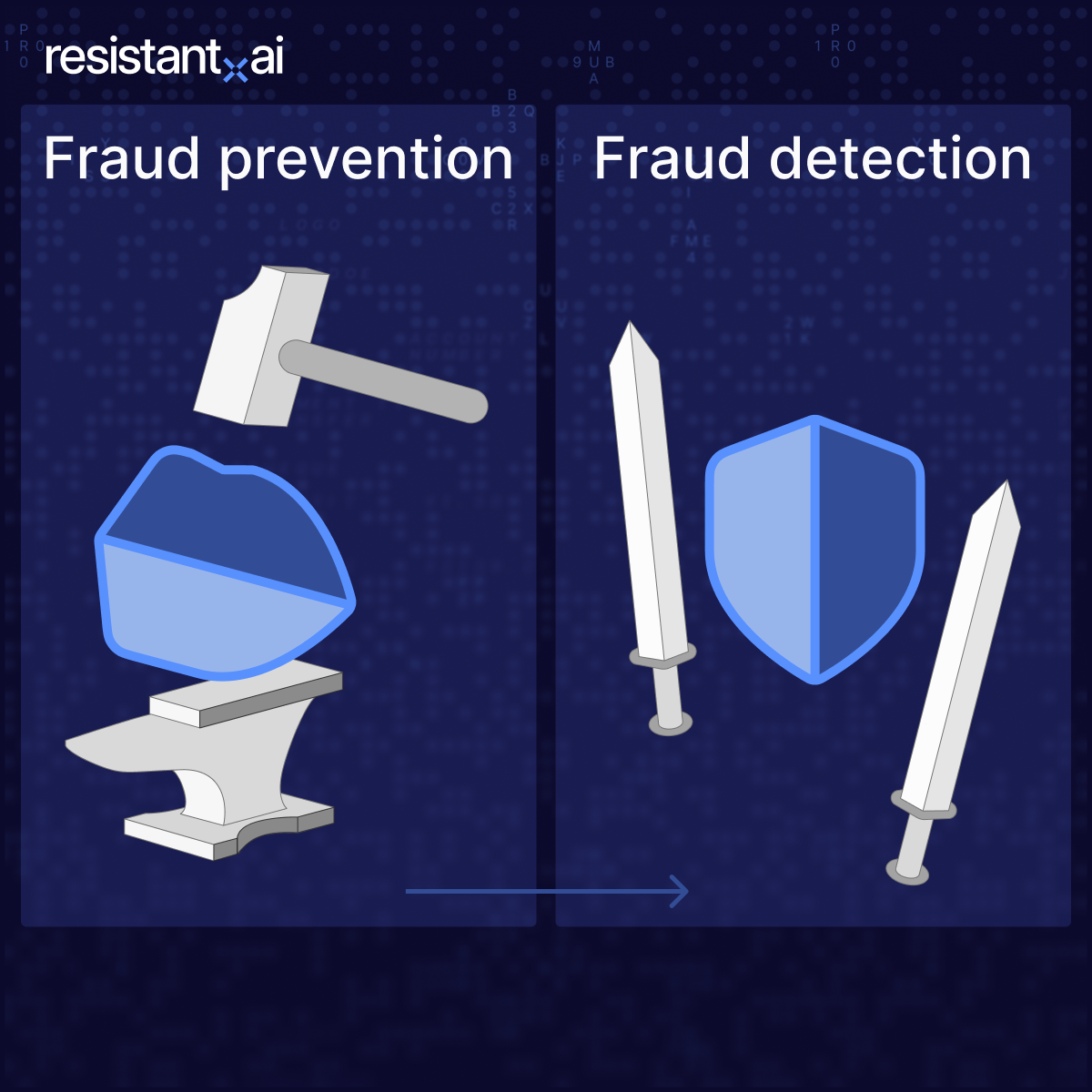
With instant payments, AI-generated fraud, and industrialized document forgery, organizations can’t simply hope they’re prepared for fraud. They need to invest in technology, threat research, and training to ensure they’re battle-ready for the most imminent threats.
Prevention prepares the surface for attack so detection can recognize it and sound the alarm.
Why is fraud prevention important?
The cost of getting fraud prevention wrong has never been higher and the margin for error has never been smaller.
Fraud is evolving faster than most organizations can respond. Criminals use automation and generative AI to scale attacks, manipulate documents, impersonate executives, and target customers in ways that look legitimate to both humans and legacy systems.
Spotting those threats when they pop up is essential, but you need the right tools and practices in place to do that effectively. Fraud prevention really means investing in that infrastructure and training so you can adequately repel attacks when they arise, regardless of how new or advanced they may be.
Meanwhile, businesses also face rising regulatory pressure, instant-payment environments that eliminate recovery windows, and customers who expect safety by default.
“Moving into 2026, fraud shows no sign of slowing down. While many companies are in the early stages of automation and AI, fraudsters are already implementing them to scale. A strong fraud prevention culture is critical to stay ahead of the curve.”

Modern fraud prevention is no longer a “nice to have.” It is a competitive requirement.
Here’s why:
- The true cost of fraud keeps rising. For many industries, every dollar lost to fraud triggers three to four dollars more in operational overhead, chargebacks, reimbursements, customer churn, and reputational damage. Even small increases in fraud can wipe out margins.
- Instant payments leave no time to react. RTP, SEPA Instant, and similar rails give fraud teams milliseconds to block suspicious activity. Once funds leave the ecosystem, recovery is unlikely. Prevention ensures you have the right guardrails in place to spot these threats in that incredibly short window.
- AI is lowering the barrier to entry for criminals. Deepfakes, synthetic identities, forged documents, and automated scam scripts are now widely available. The quality is high, the cost is low, and the volume is overwhelming traditional detection. If your controls aren’t ready for these new types of assaults you’re in trouble.
- Regulators expect proactive protection. Banks and platforms are being held accountable not just for investigating fraud, but for preventing it. Regulators don’t have time to audit everyone, often they’ll look at what controls you have in place to determine if you’re adequately defending your institution.
- Customers choose providers they trust. Fraud incidents break confidence. Strong, modern fraud prevention builds it, directly supporting acquisition, onboarding conversion, and long-term retention.
Principles of fraud prevention
Ask ten companies for their “fraud prevention principles” and you’ll usually get the same textbook answers: culture matters, controls matter, oversight matters. All true — but none of it is enough anymore.
Fraud prevention requires yearly renewals, updates, and improvements. Fraud in 2025 is nothing like ‘24 and is already miles away from ‘23. Image generation only gets better as models like Nano Banana and GPT5 release new versions and updates.
This doesn’t just make criminals opportunistic. They’re organized, automated, and increasingly augmented by these very models. Who knows what this will bring in 2026 and beyond.
Prevention today requires principles that acknowledge that reality, but also remain flexible and comprehensive enough to adapt to new threats as they emerge.
Here’s what actually matters.
1. Pressure, opportunity, rationalization still apply (but opportunity has multiplied)
The fraud triangle hasn’t changed, but the environment around it has.
Opportunity used to mean weak controls or inattentive staff. Today it means:
- Synthetic identities that aren’t tied to real humans
- AI-forged documents that pass the naked eye
- Industrial-scale social engineering
- Instant payment rails that erase time-to-react
Prevention is fundamentally about shrinking opportunity, and in today’s climate that means controlling the digital edges where criminals exploit speed, automation, and scale. Automation needs to be built on strong foundations that account for fraud potential.
Institutions that treat it as a band-aid or an afterthought are going to get stuck playing catch-up to model update announcements.
2. Cultural honesty, but, more importantly: clarity
Yes, tone-from-the-top reduces internal rationalization. But modern organizations need something stronger: clarity about what is acceptable, what is risky, and what is non-negotiable.
Fraud teams fail just as often for too many rejection as they do for too little. Companies need to be transparent about the levels of risk they’re willing to endure to maximize their capabilities and best benefit their customers (who hate being slowed down as much as they hate getting scammed).
Another problem is when risk teams put measures in place while other functions quietly work around them. Revenue teams skip verification steps, onboarding teams optimize for speed at the cost of accuracy, product teams reduce friction without understanding why friction exists.
Prevention requires a culture where risk is understood, not merely acknowledged, and where everyone recognizes that a smooth user experience is worthless if the wrong users get through.
3. Risk assessments must reflect how fraud actually works today
Most fraud risk assessments are outdated the moment they’re written. Rules-based systems focus on known schemes, not emerging ones. They emphasize compliance controls and well-known fraud typologies, not behavioral or technological gaps. Treating threats as linear rather than dynamic will only get you so far.
A modern fraud risk assessment needs to:
- Consider AI-enabled forgery and impersonation.
- Evaluate onboarding as the primary attack surface.
- Map controls to real-world attempts, not hypothetical scenarios.
- Treat documents, devices, behavior, and transactions as a single ecosystem.
If your risk tools don’t explicitly speak to one another and learn from each other, you’ll never be able to detect the giveaway patterns of generative AI fraud, template farms, deepfake identities, and real-time payment fraud. Without considering these threats and maintaining the ability to adapt to them, you can’t make a modern risk assessment.
4. Oversight must be continuous, not periodic
Internal audit, QA, and model validation used to run quarterly or annually.
That cadence won’t survive another year. Fraud attempts mutate weekly (sometimes daily) and oversight must do the same.
Monitor fraud patterns and model performance daily. Invoke rapid-turnaround and tuning cycle. Cross-functionally control reviews. Use metrics that show where controls slip, not just where they’re performing well.
Organizations don’t fall behind because they lack oversight. They do because their oversight moves slower than the attackers.
5. AI vs AI is now a principle, not a slogan
The industry still talks about AI as if it’s optional. It isn’t. It’s stunning how many institutions are still relying on manual processes to detect fraud.
Criminals use AI to scale document forgery, generate identities, impersonate executives, and automate scam scripts. They can deepfake your boss and phish out your social security number. They’ll drive automation to test your controls at volume and adapt faster than your rule writers.
If your prevention strategy doesn’t include adaptive, explainable AI, you are accepting asymmetry by default.
6. Fraud as a service is real and growing
Fraud rarely happens in isolation anymore. Where there’s one cockroach there’s usually hundreds. We’ve already identified thriving marketplaces for templates and fully onboarded platform accounts.
It flows across banks, platforms, marketplaces, telcos, crypto exchanges, and payment providers. Criminals exploit the gaps between these systems whether that’s weak merchant onboarding, lax document checks, or outdated device risk scoring.
And it doesn’t have to be yours. One of the easiest ways to access your systems is through the weaker security of third parties.
Prevention requires ecosystem thinking:
- Shared intelligence.
- Cross-platform trust signals.
- Consistent verification standards.
- Alignment between fraud, AML, cyber, and product.
- Constant research into threat intelligence.
If your defenses stop at your platform’s borders, you’re already compromised. You have to understand the entire environment to defend yourself.
7. The principle everyone forgets: prevention must be operationally survivable
This is the one almost no one talks about. It separates mature fraud programs from burned-out, reactive ones.
A prevention strategy is only as strong as your team’s ability to execute it every single day. That means your controls need to scale and reduce noise, not amplify it. It has to be explainable with workflows that don’t break when fraud spikes and systems that integrate without forcing teams into manual triage.
If your operations buckle under the weight of your controls, you might end up with a problem bigger than the threat of fraud itself.
Invest responsibly and constantly communicate to see what’s working and what won’t. The controls you deploy need to protect your business, not overwhelm it.
Fraud prevention techniques
Modern fraud prevention isn’t one control or piece of technology. It’s a layered defense that prepares every stage of the customer journey for criminal exploitation. Below you’ll find a list of seven proven techniques that will make sure you have the right suit of armor for the job.
1. Document fraud controls: secure the front door
Most fraud operations still begin with a document. Bank statements, pay stubs, invoices, articles of association, company registrations (anything that convinces your system to trust the applicant).
Modern prevention requires structural document fraud detection tools powered by AI. These help keep criminals out during your KYC and KYB checks. That’s how you catch AI-generated images, mismatched metadata, re-digitized scans, template reuse, and manipulation invisible to the naked eye.
Real world example:
Police in Noida’s Surajpur area recently caught several forgers using fake documents to create faulty loan applications. They were able to do so thanks to a tip from a bank officer who flagged a suspicious number of high-value loan applications.
2. Device, network, and session intelligence: catch the infrastructure, not just the person
Fraudsters rotate identities easily. What they struggle to rotate is their infrastructure (their devices, IP footprints, environments, and behavioral signals).
Modern prevention invests in tools that can flags impossible device changes, emulator usage, coordinated IPs, mule clusters, and session anomalies that indicate organized operations rather than isolated fraud attempts. This is what we call “serial fraud,” and you need a tool that work with data across the entire customer lifecycle to recognize these patterns and repeat attempts.
Real world example:
Serial scammer Adekoya, was recently caught after 20 years of illegal activity. Their ring of money launderers and identity theives being recognized across multiple states, institutions, and jurisdictions.
3. Behavioral analytics
Criminals and genuine users behave differently. Behavioral analytics models those patterns (how users type, navigate, hesitate, or react to friction) and detects shifts that indicate coercion, bot assistance, or account takeover.
By reading those signals you can acquire the necessary defenses and triggers that recognize when something falls out of place. It reveals someone may do something wrong long before a transaction becomes suspicious.
Real world example:
An employee at Arup, a British engineering company, was tricked into wiring more than 25 million dollars during a deepfake video call. One of the biggest red flags was behavioral anomalies: unusual urgency, atypical payment patterns, and deviations from normal authorization behavior. Behavioral analytics could have flagged those anomalies before funds were released (long before the deception became public).
4. Transaction monitoring
Transaction monitoring is not “reactive” when done right. Every transaction teaches you how attackers operate: what mule accounts look like, where the social engineering starts, how funds move, which controls were tested, and which vulnerabilities criminals discovered.
Monitoring becomes prevention when you feed those insights back into onboarding, document checks, and risk scoring to get the right defenses in place before attackers reuse the same playbook.
Real world example:
In a 2023–2024 U.S. fraud investigation, authorities uncovered an $8.8 million identity-theft and wire-fraud ring after a bank’s transaction-monitoring system flagged a suspicious transfer tied to an account that didn’t match the customer’s typical behavior, triggering a deeper review, which revealed a coordinated network using stolen identities, fraudulent checks, and rapid-fire wire transfers across multiple states.
5. Customer and user education: shaping behaviour prevents loss
Fraudsters have scripts for fooling their victims. Modern prevention scripts interruptions: real-time scam warnings, friction at high-risk points, human review where behavioral cues indicate coercion, and proactive outreach to vulnerable customers.
This isn’t “awareness.” It’s intervention engineering and it starts with educating all relevant users and customers of emerging threats.
Real world example:
Kish Bank reported a sharp drop in customer scam losses after rolling out a simple but highly effective education initiative called “Stop and Think.” The campaign taught customers to pause before responding to urgent money requests, clicking unfamiliar links, or acting on pressure from someone claiming to be a bank representative.
AI Fraud prevention
Most organizations talk about using AI to fight fraud, but few are using it in ways that actually prevent it. That’s because a lot of what gets marketed as “AI” is really just automation wearing a new label. Rules running faster. OCR running louder. Dashboards updating themselves.
True fraud prevention AI invests in software and tools that see the things that fraudsters can’t fully hide (how a document was assembled, how a device behaves under stress, how a synthetic identity moves through a workflow, or how a mule account shifts its behavior when it becomes active).
For example, structural analysis has become the backbone of modern AI document verification. Content-based approaches (OCR, template checks, knowledge-based verification) break the moment criminals generate content with AI.
But structure is harder to fake. The compression pattern inside a PDF, the pixel noise left behind by a diffusion model, the order in which objects were layered during editing, the mismatch between a claimed identity and the device rendering the image.
Generative AI has also changed attacker economics, too. Fraudsters don’t need to be designers or developers anymore. They need prompts. They can synthesize IDs, payroll documents, invoices, tax forms, and images at scale. They can produce entire applicant personas, each with its own believable paper trail. And most don’t even have to do that. They can buy templates or entire accounts from well established criminals.
AI fraud prevention matches that capability by effectively adapting to these markets when they emerge and letting out signals on how to detect them.
Most importantly, prevention of AI compounds in value over time. Every document scanned, every suspicious session analyzed, every transaction monitored contributes to a continuously evolving picture of the adversary.
Criminals repeat themselves; they reuse templates, devices, networks, services, and techniques. They test your boundaries and watch how you react. Ongoing monitoring stops the fraud you’re already seeing while preventing the fraud you haven’t seen yet. It turns analysis into anticipation.
When done right, AI fraud prevention means:
- Exposing manipulation before it reaches your workflow.
- Detecting generative AI forgeries that look perfect to humans.
- Adapting as criminals iterate.
- Reducing false positives so prevention efforts scale.
- Strengthening controls upstream, long before losses occur.
“2025 was the year the horse truly left the barn on whether or not to leverage AI for fraud prevention. But the real opportunity lies in distinguishing AI that enables you to stop things you couldn't before from AI that simply automates your workflows.”
Fraud prevention requirements
Most organizations think they’re ready for AI-driven fraud prevention because they have a fraud team, a few vendor tools, and dashboards that light up when something looks strange. That is not readiness. Modern fraud prevention is about investing in a “technical floor:” a set of capabilities you must have before any AI model, any document forensic system, or any behavioral engine can actually protect you.
Here’s what it really takes.
1. Clean, structured, consistently accessible data
Everything in fraud prevention breaks without data discipline. AI can't learn, rules can't fire, analysts can't investigate, and auditors can't validate a single decision if the underlying data is fragmented, outdated, or incomplete.
Modern prevention requires:
- Unified data models. Customer data, device intelligence, document metadata, behavioral signals, and transaction history must live in formats your systems can query in milliseconds.
- Real-time event streams. Fraud isn’t a batch problem anymore. You need Kafka-style streams or equivalent publish/subscribe infrastructure that can deliver events as they happen: new login → device check → document submission → transaction attempt → behavioral anomaly → escalation.
- High-quality labels. AI is only as good as the truth you feed it. You need a steady flow of confirmed fraud cases, false positives, mule identifications, document forgeries, and account takeovers labeled correctly so your models learn from reality (not assumptions).
2. Processing power where the fraud actually happens
Stopping fraud upstream requires decisioning at the edge of the user journey.
That means:
- Sub-100ms scoring. For instant payments, onboarding flows, or password resets, you have a window measured in milliseconds. Your models and pipelines must complete ingestion, enrichment, scoring, and response faster than a human can blink.
- GPU/accelerated inference for structural AI. Optimized compute, often GPU-backed, to process PDFs and images with forensic precision and still return a verdict in seconds.
- Horizontal scaling. Fraud attempts come in bursts. One minute you’re quiet, the next you’re hit with 20,000 synthetic applications generated by a botnet. Your infrastructure must autoscale or queue intelligently so your controls don’t collapse under load.
3. Workflows designed for both humans and machines
The fraud prevention sweet spot requires workflows where AI handles volume and humans handle ambiguity.
Key components:
- Decision APIs. Your fraud engine must integrate with your onboarding system, CRM, core banking, payments processor, and document capture system (instantly, not through nightly batch jobs).
- Clear handoff logic. Confident AI decides, unsure AI escalates, wrong AI is overridden by humans.
- Tiered case routing. High-risk cases go to specialists, medium-risk to generalists, low-confidence anomalies to QA.
- Analyst writeback loops. Every time an analyst labels a case (fraud, false positive, mule, benign) that decision needs to route back to your models.
4. Governance that can withstand regulators
Regulators don’t just want fraud stopped. They want every decision defensible.
That means:
- Explainable AI. Scores with no evidence won’t pass audit. Prevention systems must show detectors triggered, page objects flagged, device mismatches observed, behavioral anomalies noted, and why a decision was made.
- Model monitoring. Drift happens. Fraud changes. You need dashboards showing false positives, false negatives, confidence distributions, and sudden shifts in feature importance.
- Access controls & audit trails. Everything must be logged: who approved what, who overrode AI, which inputs were used, which outputs were generated.
Who is responsible for preventing fraud at your organization?
Fraud prevention is never owned by one team. It’s owned by everyone who touches the customer journey and everyone whose decisions shape the attack surface.
But the exact distribution of responsibility varies by industry. Here’s how fraud prevention responsibility really breaks down across key industries: insurance, lending, fintech, banking, tenant screening, payments, and neobanks.
“The most successful companies we work with create fraud champions across the organization, going so far as providing them access to the tools and insights they need to make decision independently of any centralized fraud or compliance team.”


Insurance
Insurance fraud isn’t just claims fraud. It’s policy fraud, identity fraud, staged losses, synthetic customers, and inflated documentation.
Primary owners:
- Claims & SIU (Special Investigations Unit): The operational core. They spot patterns, escalate suspicious claims, and identify repeat offenders.
- Underwriting: The first line of prevention. If underwriting accepts fabricated documents, inflated valuations, or misrepresented risk, downstream teams have no chance.
- Fraud analytics: Builds the scoring models and pattern detectors across claims, policies, and historical fraud networks.
- Product & operations: Responsible for enforcing mandatory steps (document capture, photo verification, inspection workflows) without creating escape hatches fraudsters exploit.
Lending
Lenders face fraud threats like synthetic identities, forged income documents, inflated appraisals, and laundering via loan proceeds.
Primary owners:
- Credit risk: Owns decisioning frameworks and initial applicant screening.
- Fraud operations: Owns document examination, identity checks, and early-life loan monitoring.
- Collections/recovery: Often first to detect fraud that slipped through; feeds intelligence back into prevention.
- Underwriting: Responsible for verifying financial documents, income, employment, and business legitimacy.
Fintech
Fintech is built on speed, making it a magnet for rapid-cycling fraud, synthetic accounts, and programmatic exploitation of onboarding flows.
Primary owners:
- Fraud & risk: Designs controls and investigates cases, but often constrained by growth targets.
- Product: Every UX decision changes the threat model.
- Engineering: Implements real-time scoring, decisioning APIs, and telemetry required for prevention.
- Compliance: Ensures KYC/KYB, sanctions, and AML controls align with regulatory expectations.
Banking (traditional FI)
Banks carry the broadest fraud surface: onboarding, account takeover, scams, insider fraud, check fraud, ACH/wire, card rails, business accounts, and instant payments.
Primary owners:
- Fraud operations: The first line of defense for alerts, escalations, and investigations.
- Financial crime / AML: Oversees suspicious activity reporting and ensures prevention aligns with AML/CTF obligations.
- Risk management: Sets fraud appetite, owns governance, and allocates budget.
- Digital banking & product: Controls login flows, authentication, step-up logic, and UX that can weaken or strengthen protection.
- IT/Security: Owns device trust, network controls, anomaly detection, and account integrity.
Tenant screening
Fraud in the tenant screening sector is exploding: fake pay stubs, AI-generated employment letters, manipulated bank statements, and identity misrepresentation.
Primary owners:
- Leasing teams / property managers: The human bottleneck where most document fraud passes undetected.
- Screening providers: Provide background checks but are not built to detect document forgery on their own.
Payments (PSPs, processors, merchant acquirers)
Payment fraud is fast, scalable, and often industrialized. Responsibility extends beyond simply catching bad transactions.
Primary owners:
- Merchant risk / Underwriting: Approves merchants and determines their risk profile — a critical fraud gateway.
- Transaction risk teams: Monitor card-present, card-not-present, and alternative payments for suspicious patterns.
- Chargeback & disputes teams: Identify emerging fraud trends and merchant abuse earlier than most risk systems.
- Compliance: Ensures adherence to card scheme rules, AML obligations, and high-risk merchant controls.
Neobanks
Neobanks inherit all the risks of fintech and all the regulatory scrutiny of traditional banks with thinner margins and faster onboarding.
Primary owners:
- Fraud & financial crime: Handles alerting, investigations, mule detection, and scam interdiction.
- Product engineering: Owns authentication flows, real-time decisioning, and integrations with fraud tools.
- Operations: Runs KYC/KYB, manual reviews, sanctions and PEP workflows.
- Growth teams: Must balance friction with quality — often the single largest driver of fraud exposure.
Conclusion
Modern fraud prevention only works if you invest in the education and infrastructure that locks the front door of your business. In 2025, one of the biggest key holes in that door is documents (pay stubs, bank statements, IDs, invoices, certificates) that fraudsters now forge with AI, recycle across applications, and weaponize at scale.
Resistant Documents exists to give you the structural fraud intelligence you simply can’t get from OCR, template checks, or manual review. Our AI examines how a document was built (its pixels, its layers, its metadata, its device fingerprint) and detects the synthetic artifacts, template reuse, and hidden manipulation that modern fraud teams miss.
Make the difference between catching fraud and never letting it in at all. Scroll down to book a demo.
Frequently asked questions (FAQ)
Hungry for more fraud prevention content? Here are some of the most frequently asked fraud prevention questions from around the web.
1. What is the difference between fraud prevention and fraud detection?
Fraud prevention focuses on building the infrastructure and training to ensure fraud detection is effective and updated for modern threats.
2. What is the purpose of fraud prevention?
The purpose of fraud prevention is to reduce the likelihood and impact of fraud by strengthening controls and education/training to limit the opportunities criminals can exploit.
3. What are ways to prevent fraud?
By investing in the technology, workshops, and cultural shifts that allow people to appreciate the gravity of fraud threats with preparation for new and emerging assaults.
4. What is the three-step fraud prevention plan?
Many frameworks summarize fraud prevention into three phases:
- Assess risk.
- Implement layered controls.
- Continuously monitor and adapt as fraud tactics evolve.
5. What are fraud prevention services?
Fraud prevention services are tools and platforms (such as document fraud detection, identity verification, transaction monitoring, and behavioral analytics) that help organizations stop fraud before it causes financial or operational damage.

Fraud awareness, examples, and lessons
Learn more about fraud in specific industries, best practices, and targeted documents.
View all
Application fraud in 2026 is easier to attempt: accessible tools and services help applicants turn false claims ...

Within the fake document ecosystem, things can change fast. Four months ago, we reported that OnlyFake, the ...

In May 2026, a Dallas resident was convicted of running coin-operated “amusement machines” without a business ...

NEW YORK & PRAGUE – 1 October 2026 – Ocrolus, the AI workflow and analytics platform for lenders, today ...

For a few hundred dollars, sellers on Telegram promise to boost your credit score using someone else's credit ...

Key takeaways Fake certificates can use real numbers Fraudsters can copy a genuine business’s VAT number onto a ...