
What happens when fraud gets powered by AI?
You need AI-powered fraud detection.
Phishing emails, altered PDFs, stolen credit card numbers, are getting organized, calculated, and happening at a massive scale. And, increasingly, powered by artificial intelligence.
In 2026, fraudsters use generative tools to draft synthetic bank statements, fabricate flight tickets, and create convincing financial narratives in seconds.
Image generation models can produce realistic documents at scale. Account farms openly sell aged accounts, verified profiles, and pre-built digital identities in bulk. What once required skill and time now requires a prompt and a payment.
The barrier to entry has collapsed. The volume has exploded.
At the same time, institutions are upgrading their approach to remain relevant in the fight against fraud and financial crime. Just look at JPMorgan, who have blended generative AI and machine learning to improve their fraud prevention efforts.
AI fraud detection is now essential.
By using machine learning and behavioral modeling to identify patterns, anomalies, and coordinated activity, institutions can catch fraud that traditional systems miss.
Fraud is now AI versus AI. The only question is who adapts faster.
What is AI fraud detection?
Before diving deeper, it helps to step back and define fraud detection itself:
-
Fraud detection: The process of identifying and preventing deceptive activity intended to result in financial or personal gain.
For decades, fraud detection followed a predictable evolution.
The old era: manual controls
In the early days of digital finance, fraud detection was largely manual:
- Analysts reviewed transactions one by one.
- They checked documents visually.
- They compared names, signatures, and balances against internal records.
- Decisions were guided by experience, static policies, and institutional knowledge.
This approach worked when volumes were low and fraud schemes were simple. But human review is slow, expensive, and inconsistent. Fatigue sets in. Patterns across thousands of accounts are nearly impossible to detect manually.
The automation era: Rule-based systems
As digital activity increased, institutions introduced rules-based automation:
-
Rule-based automation: Systems that execute predefined if/then logic at machine speed.
For example: Flagging transactions above a certain threshold, blocking logins from restricted geographies, rejecting applications with missing fields, escalating accounts after three failed login attempts.
Automation improved speed and consistency. But it remained static. It could only detect what it was programmed to detect. When fraudsters adjusted their tactics, institutions had to manually rewrite rules.
Automation executes instructions. It does not reason.
The AI era: Adaptive fraud detection
AI fraud detection represents the next layer.
Instead of relying solely on fixed thresholds, AI systems:
- Learn what normal behavior looks like across users, devices, and transactions.
- Detect subtle deviations that do not violate any explicit rule.
- Identify correlations across seemingly unrelated accounts.
- Continuously adapt as new fraud patterns emerge.
- Produce probabilistic risk assessments rather than binary outcomes.
Where manual review sees individual cases and automation enforces predefined boundaries, AI evaluates behavior in context.
It does not just ask, “Did this break a rule?”
It asks, “How likely is this to be fraudulent given everything we know?”
How does AI change fraud management and prevention?
AI reshapes fraud detection in two key areas: management and prevention.
Fraud management
Fraud management ensures that prevention and detection efforts operate within a structured, governed framework. It connects tools, workflows, escalation paths, and performance monitoring into a coordinated program.
AI improves fraud management by:
- Workflow consistency. Risk signals come with structured context, helping analysts make consistent, defensible decisions rather than relying on intuition or fragmented alerts.
- Explainable oversight. Decisions are traceable and auditable, supporting regulatory requirements and internal governance.
- Performance monitoring. Models can be measured for drift, false positives, and missed fraud, allowing continuous calibration.
- Feedback loops. Confirmed fraud cases and analyst input feed back into models and policies, strengthening controls over time.
- Operational efficiency. Smarter prioritization reduces alert fatigue and focuses resources where risk is highest.
In the old model, fraud programs relied heavily on manual reviews, static rulebooks, and reactive policy updates. Management was often fragmented across teams and tools.
In an AI-driven model, fraud management becomes adaptive.
Prevention, detection, and escalation are aligned. Risk decisions are measurable. And the entire system evolves alongside emerging threats rather than lagging behind them.
Fraud prevention
Fraud prevention reduces the opportunity for fraud to succeed.
AI strengthens defense by:
- Real-time intervention. High-risk activity can trigger step-up authentication, transaction delays, or enhanced verification.
- Adaptive friction. Low-risk users experience smooth journeys. High-risk scenarios receive additional scrutiny.
- Dynamic policy adjustment. Risk thresholds can shift based on evolving attack patterns.
- Network disruption. Coordinated fraud rings can be identified and dismantled earlier.
In the old model, institutions tightened controls globally after fraud increased. Everyone paid the price in friction. In an AI-driven model, defense becomes precise.
Low-risk activity flows freely. High-risk activity encounters proportional resistance.
Why is AI essential for fraud detection?
Fraud has become scalable, automated, and increasingly coordinated. AI is a structural requirement for operating in this digital, high-velocity threat environment.
Here is why AI has become essential:
.png?width=1200&height=1500&name=why%20AI%20is%20essential%20for%20fraud%20detection%20(infographic).png)
Scaling with volume
Financial institutions process millions of transactions, logins, account changes, documents submissions, etc. daily.
Manual review cannot keep pace. Rule-based automation can process volume, but it cannot intelligently interpret it.
AI can analyze large, multi-dimensional datasets simultaneously. It evaluates behavior, context, and patterns across accounts and timeframes in real time.
Fighting AI with AI
Fraudsters now use generative tools, automation, and organized infrastructure to test system thresholds.
These attempts are not isolated attempts, but systematic operations.
AI allows institutions to respond dynamically rather than reactively.
Detecting subtle, low-signal fraud
Modern fraud, for example document fraud, is rarely obvious. Slight behavioral deviations, carefully tuned transaction amounts, and reused infrastructure make it harder to detect.
No single signal is strong enough to trigger a rule. But collectively, the signals indicate elevated risk. AI aggregates weak indicators into probabilistic assessments. It can identify anomalies invisible to threshold-based systems or human reviewers.
Reducing false positives without increasing risk
Fraud detection doesn’t have to be a trade-off between tight controls and customer experience. AI improves calibration.
By modeling individual behavior and contextual risk, AI enables institutions to apply friction selectively according to their risk appetite, reducing manual reviews and improving approval rates for legitimate users.
Identifying coordinated fraud networks
Fraudsters share devices across multiple accounts, repeat document structures across applications and create transaction patterns that only become suspicious when viewed collectively.
AI systems can perform graph and network analysis, identifying clusters of related activity that signal organized fraud.
Adapting as fraud evolves
Templates evolve. Attack infrastructure rotates. Thresholds are tested. Scripts are refined.
AI systems learn from new data. They update behavioral models. They incorporate feedback from confirmed fraud cases. Defense becomes a learning system rather than a fixed configuration.
How AI fraud detection works
AI fraud detection is a layered process that moves from data ingestion to modeling to decisioning.
At a high level, it follows three stages: collecting signals, analyzing patterns, and acting on risk.
1. Data ingestion: Collecting multi-dimensional signals
AI systems rely on diverse, high-quality data. The more contextual signals available, the more accurate the risk assessment.
Common inputs include:
- Transaction data. Amount, frequency, merchant type, location, time of day.
- Identity attributes. Name, address, government ID, business registration data.
- Device signals. IP address, browser fingerprint, device model, operating system.
- Behavioral patterns. Login velocity, session activity, interaction timing.
- Document submissions. Metadata, structure, formatting signals.
- Historical outcomes. Confirmed fraud cases and legitimate behavior.
AI systems analyze these signals together to create critical context.
For example: A document verification check may look passed, until you look at the IP address and discover that the French utility bill was submitted from Hong Kong.
2. Modeling: Identifying patterns and anomalies
Once data is collected, AI models evaluate it using different techniques.
Common approaches include:
- Supervised machine learning. Models trained on labeled historical fraud and legitimate activity to predict future risk.
- Unsupervised anomaly detection. Identifies deviations from normal behavior without relying solely on predefined fraud examples.
- Behavioral baselining. Builds profiles of typical activity for users, devices, or businesses.
- Graph and network analysis. Maps relationships between accounts, devices, transactions, and documents to uncover coordinated fraud.
- Ensemble modeling. Combines multiple models to improve accuracy and reduce blind spots.
These models evaluate how likely an event is to be fraudulent given all available context, producing actionable insights rather than a binary outcome.
3. Risk scoring and decisioning: Turning insight into action
AI fraud detection systems convert model outputs into operational decisions. They can recommend approvals, escalations, step-up verification (like in neobank KYC), and recommend to block or decline.
They can also identify risk signals so manual reviewers can assess the threat level themselves.
Advanced systems allow for adaptive decisioning:
- Low-risk activity moves through with minimal friction.
- Medium-risk activity may trigger additional verification.
- High-risk activity is interrupted in real time.
Feedback loops are essential. Confirmed fraud cases and false positives are fed back into the system, allowing models to refine predictions over time.
AI fraud detection tools
AI fraud detection is an ecosystem of tools designed to identify and prevent risk across different stages of the customer lifecycle.
At a high level, these tools fall into five categories.
- Transaction monitoring. Analyze payment flows, transfers, and account activity for suspicious patterns. Often used in anti-money laundering and card fraud prevention.
- Identity and onboarding solutions. Evaluate your customer signals, device risk, behavioral anomalies, and synthetic identity indicators during account creation.
- Document fraud detection tools. Assess the authenticity of submitted documents, including signs of manipulation, tampering, or AI-generated artifacts.
- Behavioral biometrics platforms. Analyze typing cadence, mouse movements, touchscreen gestures, and session behavior to detect account takeover attempts.
- Network intelligence tools. Map relationships across accounts, devices, and transactions to identify fraud rings and coordinated activity.
What to look for an AI fraud detection tool
Not all fraud tools are created equal. Look for:
- Adaptive learning over static rule engines.
- Explainable outputs that support auditability.
- Layered detection models instead of single-signal checks.
- Low false positive rates.
- Flexible integration through APIs.
- Specialize in detecting fraud (don’t treat it as an add-on to a larger use case
Just because a tool is labeled “AI,” doesn’t mean it operates at the same depth. Some simply layer machine learning on top of existing rules. Others rely heavily on content extraction or threshold scoring.
The difference often lies in how well the system adapts, how transparently it explains risk, and how effectively it correlates signals across channels.
What are AI fraud detection use cases?
AI fraud detection now supports both onboarding and ongoing monitoring across industries. Some common use cases include:
Payments and card fraud
AI detects unauthorized transactions, transaction laundering, and merchant abuse by modeling cardholder behavior, identifying anomalies in transaction velocity and geography, and correlating suspicious activity across networks in real time.
Essential roles within the organization:
- Fraud operations managers, payment risk analysts, transaction monitoring teams, chief risk officers.
Account takeover prevention
AI identifies suspicious login behavior, device anomalies, and credential stuffing attempts by analyzing behavioral patterns, device fingerprints, and session activity, detecting subtle deviations that signal compromised accounts before funds are moved or sensitive data is altered.
Essential roles within the organization:
- Identity and access management teams, security operations analysts, fraud investigators, digital risk leaders.
Anti-money laundering
AI enhances AML monitoring by identifying unusual transaction patterns, surfacing hidden relationships across accounts, and prioritizing high-risk alerts using probabilistic scoring.
Essential roles within the organization:
- AML analysts, financial crime compliance officers, regulatory reporting teams, enterprise risk leadership.
Loan origination and lending
AI detects synthetic identities, falsified income claims, and coordinated application fraud by analyzing behavioral signals, cross-application patterns, and document manipulation.
Essential roles within the organization:
- Underwriting teams, lending risk analysts, credit risk officers, fraud strategy managers.
Insurance claims
AI identifies inflated claims, manipulated documentation, and staged loss events by detecting anomalies in submission patterns, behavioral inconsistencies, and cross-policy correlations.
Essential roles within the organization:
- Claims investigators, insurance fraud units, risk and compliance teams, operations managers.
E-commerce and marketplaces
AI prevents refund abuse, seller fraud, and coordinated buyer scams by modeling transactional behavior, detecting bot-driven activity, securing KYB and identifying networked fraud patterns across users and merchants.
Essential roles within the organization:
- Marketplace trust and safety teams, fraud operations managers, platform risk analysts, chief trust officers.
Government programs
AI detects benefits fraud, identity abuse, and subsidy manipulation by analyzing application behavior, cross-claim relationships, and anomalous transaction flows at scale.
Essential roles within the organization:
- Program integrity units, public sector fraud investigators, compliance and audit teams, risk oversight leadership.
AI fraud detection challenges
Institutions must consider several factors when implementing and operating these systems:
- Data quality. Models are only as reliable as the data they ingest. Incomplete or biased datasets can degrade performance.
- Explainability. In regulated industries, risk decisions must be auditable. Black-box systems create compliance challenges.
- Model drift. Fraud tactics evolve. Models must be monitored and retrained to prevent performance degradation.
- Integration complexity. AI systems must connect to existing workflows, case management tools, and customer experience flows.
- Overreliance on automation. AI augments human expertise. It does not eliminate the need for oversight and escalation.
The strongest fraud programs treat AI as a continuously monitored and calibrated system, not a one-time deployment.
Conclusion
Fraud detection was once manual and opportunistic, now it’s automated, networked, and increasingly AI-assisted.
Static rules and manual review were not built for this landscape.
By combining multiple layers of signals, AI fraud detection can detect subtle and coordinated fraud, adapt to evolving tactics, and scale protection across millions of events.
At Resistant AI, we have a solution that does exactly that. We call it defense in depth.
Scroll down to book a demo.
Frequently asked questions
Hungry for more AI fraud detection content? Here are some of the most frequently asked AI fraud detection questions from around the web.
Where can you buy AP automation software with AI-based fraud detection?
Some accounts payable automation platforms include built-in fraud controls, but the depth of AI varies significantly.
Most AP tools focus on workflow automation first (invoice capture, matching, approvals, and payment scheduling) and layer in basic fraud safeguards such as duplicate invoice detection, vendor change alerts, and threshold-based anomaly checks.
For organizations that face higher fraud exposure, workflow controls alone are rarely sufficient. Dedicated AI fraud detection software, like Resistant AI, can sit alongside AP systems to analyze behavioral patterns, vendor networks, payment anomalies, and cross-system risk signals at a deeper level.
Are there privacy issues with AI in corporate fraud detection?
Privacy considerations are central to AI-driven fraud detection.
AI systems often process:
- Personally identifiable information.
- Transaction histories.
- Device data.
- Behavioral signals.
Key privacy considerations include:
- Data minimization. Only collect what is necessary.
- Storage policies. Define retention limits clearly.
- Regulatory compliance. Ensure alignment with GDPR, CCPA, and sector-specific regulations.
- Model transparency. Avoid opaque systems that cannot explain decisions.
- Cross-border data transfers. Understand jurisdictional requirements.
Well-designed AI fraud detection systems prioritize privacy by design, limit unnecessary data access, and maintain strong audit controls.
Can AI detect fraud?
Yes. AI can detect fraud by identifying patterns and anomalies across large datasets that humans or rule-based systems may miss.
How do AI systems evolve to detect new fraud tactics?
AI systems evolve through continuous learning. New fraud cases are confirmed, models are retrained, and behavioral baselines are recalibrated to reflect both emerging threats and shifting legitimate activity.
How are banks using AI for fraud detection?
Banks use AI across onboarding and ongoing monitoring to:
- Detect suspicious transactions in real time.
- Identify account takeover attempts.
- Monitor anti-money laundering activity.
- Assess identity risk during customer onboarding.
- Correlate fraud across accounts and channels.
How are marketplaces using AI for fraud detection?
Online marketplaces use AI to:
- Detect fake seller accounts and account farms.
- Identify coordinated refund and chargeback abuse.
- Monitor transaction laundering.
- Detect bot-driven purchasing activity.
- Flag suspicious product listings and payment flows.
How are insurance companies using AI for fraud detection?
Insurance providers use AI to:
- Analyze claims for manipulation or inflation.
- Detect reused documents or staged losses.
- Identify suspicious behavioral patterns.
- Correlate claims across policyholders.
- Reduce manual review workload.
How are lenders using AI for fraud detection?
Lenders apply AI to:
- Detect synthetic identities.
- Identify falsified income or employment claims.
- Analyze loan application behavior patterns.
- Correlate suspicious submissions across borrowers.
- Assess risk dynamically during underwriting.
How are payment providers using AI for fraud detection?
Payment providers use AI to:
- Detect real-time transaction fraud.
- Prevent merchant abuse and transaction laundering.
- Monitor cross-border payment anomalies.
- Identify coordinated fraud networks.
- Adjust risk thresholds dynamically based on behavior.

Fraud awareness, examples, and lessons
Learn more about fraud in specific industries, best practices, and targeted documents.
View all
A business registration confirms that a company exists, but it doesn’t always show who owns it. In September 2026, ...

Application fraud in 2026 is easier to attempt: accessible tools and services help applicants turn false claims ...
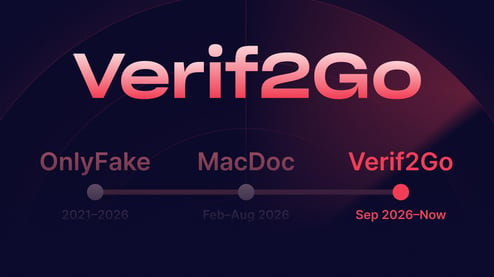
Within the fake document ecosystem, things can change fast. Four months ago, we reported that OnlyFake, the ...

In May 2026, a Dallas resident was convicted of running coin-operated “amusement machines” without a business ...

NEW YORK & PRAGUE – 1 October 2026 – Ocrolus, the AI workflow and analytics platform for lenders, today ...

For a few hundred dollars, sellers on Telegram promise to boost your credit score using someone else's credit ...