
Fake Ohio business licenses can make a company appear authorized to do work it has no legal right to perform.
In September 2026, an Ohio man received an eight-year prison sentence for a $1.9 million construction fraud scheme. He concealed his lack of contractor licensing by using other businesses’ credentials and presented fabricated certificates and lien waivers to obtain payments.
Verifying a business’s credentials in Ohio means navigating different licensing requirements based on what it does and where it operates. But checking those permissions across multiple authorities is difficult to scale, giving fraudulent paperwork more opportunities to make an unqualified business look legitimate.
Publicly available fraud templates, template farms, and AI-generated documents add another challenge: convincing appearances can conceal fabricated evidence, and document generation at scale can make manual checks impractical.
Read on to learn which documents serve as Ohio business licenses, how they can be misused, how to spot a fake, and where AI-powered tools can help.
Check out our “how to spot fake documents” blog to learn about more common document forgeries.
What is an Ohio business license?
“Ohio business licenses” collectively refer to the licenses, permits, and authorizations businesses need to carry out particular activities in the state. The required documents depend on the business’s activities and location, with requirements set by state agencies and local authorities.
Depending on the business, these may include:
- County vendor’s license. Generally required for businesses making taxable retail sales from a fixed place of business, with a separate license for each fixed location under Ohio’s vendor’s-license law.
- Transient vendor’s license. Authorizes qualifying transient vendors to make taxable retail sales in Ohio counties where they do not maintain a fixed place of business. The statutory definition covers several situations, including temporary-event sales, certain leasing activities, and vending machines on land owned by others.
- Food service operation license. Authorizes food-service operations, with separate provisions for mobile, catering, and temporary operations under Ohio law.
- Firm Certificate of Authorization. Required for covered architecture and landscape architecture firms providing services in Ohio, according to the state board’s requirements.
- Local licenses and permits. Additional requirements may apply through the relevant city or county, depending on the activity and location. The Secretary of State’s startup guidance directs businesses to check those requirements separately.
Together, these documents make up the business’s Ohio licensing package. Each has a different purpose, and none proves full authorization on its own.
Applicants may also submit Ohio Secretary of State documents confirming their registration or entity status. The certificate depends on the entity type:
- Good Standing Certificate. Applies to domestic and foreign corporations. Confirms that the corporation is active on the Secretary of State’s records and complies with its filing requirements.
- Full Force and Effect Certificate. Applies to domestic limited liability companies and certain other entities and registrations. For an Ohio LLC, it states the company’s name, formation date, and that it is in full force and effect on the Secretary of State’s records.
- Certificate of Registration. Applies to foreign LLCs, meaning LLCs formed outside Ohio. States the company’s name and confirms that it is authorized to transact business in Ohio.
These certificates establish a business’s status on Ohio’s records, not a universal right to operate throughout the state. Operating licenses can be tied to a particular activity, operator, or location.
For example, Ohio’s vendor’s-license law generally requires a separate license for each fixed location making taxable retail sales. A change in vendor identity or a move to another county requires a new license, while a same-county move allows a transfer through the prescribed process. Temporary-event sales in the county where the vendor holds a fixed-location license do not require a separate transient vendor’s license.
The Ohio Secretary of State’s startup guide provides an overview of these separate registration, tax, and licensing requirements.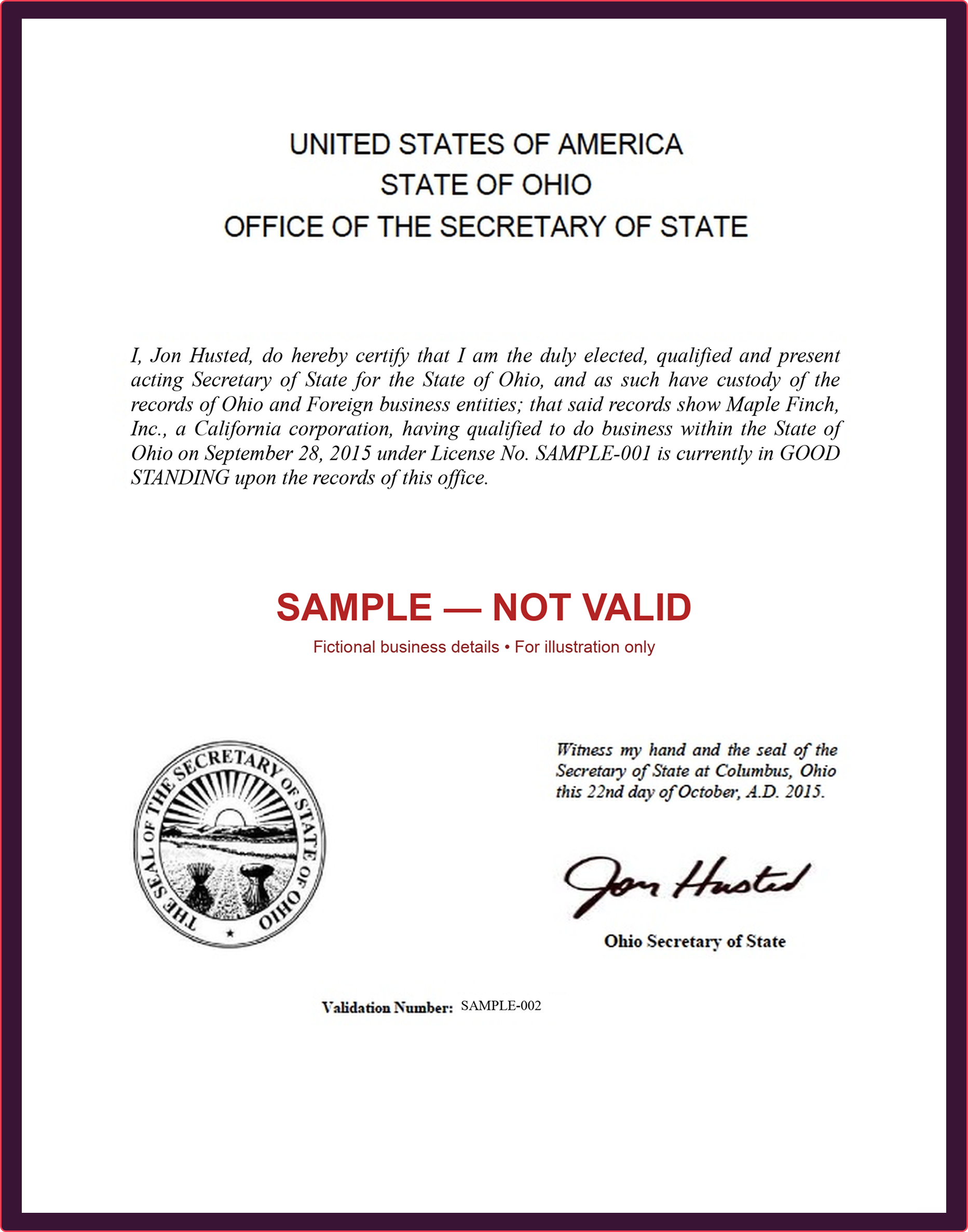
Example of an Ohio certificate of good standing for illustrative purposes only.
Why are Ohio business licenses important?
For onboarding and procurement teams, Ohio business license checks help expose false claims about a company’s qualifications before contracts are awarded or services begin.
Ohio’s mix of state and local requirements means the document package can vary from one applicant to another. One genuine document may establish only part of the authorization a business needs. Treating it as proof of full authorization can let an unlicensed operator through onboarding, exposing organizations to fraud losses, service disruptions, and compliance risks.
Here’s how Ohio business licenses support verification across different industries:
- KYB and merchant onboarding. Teams need to confirm that status documents fit the merchant’s entity type. Ohio issues Good Standing Certificates for corporations and Full Force and Effect Certificates for domestic LLCs. A mismatch warrants clarification before account approval.
- Commercial real estate and leasing. Landlords can check that a retail tenant’s county vendor’s license is active and identifies the premises being leased. A license tied to another address does not establish sales-tax authorization for the proposed location.
- Procurement and vendor onboarding. Buyers need to establish that contractors hold the trade credentials required for the work being awarded. The Ohio Construction Industry Licensing Board licenses contractors in specific commercial trades. Checking the applicable credential helps buyers avoid awarding regulated work to an unlicensed supplier.
- Marketplace trust and safety. Platforms need to confirm that credentials apply to the current operator. For example, Columbus Public Health requires new owners of retail food businesses in Columbus and Worthington to obtain a new license before sales begin. A previous owner’s license does not establish the new seller’s authorization.
These documents are trusted because they provide official evidence of a business’s status or specific permissions. They connect a named holder to an issuing authority and a defined status or authorization, giving reviewers concrete details to verify. That trust depends on the document being authentic, current, and applicable to the business presenting it.
Understanding the limits of each document helps verifiers identify risks and request the full set of credentials needed for the applicant’s activities and location. Together, those records provide a clearer picture of the business and its authorization to operate.
Ohio business license law
Ohio business licensing is split across entity registration, sales-tax licensing, professional regulation, and local permissions. The document package depends on what the business does and where it operates.
For example, businesses making taxable retail sales generally need a vendor’s license under Ohio law. That sales-tax authorization does not replace the local or industry-specific permissions their activities may require.
However, in Cincinnati, those additional permissions include activity-specific licenses for peddlers, antique dealers, rooming houses, and amusement-game exhibitors. The city’s municipal business-license directory directs applicants to different offices depending on the activity. Vendor’s licenses go through the Hamilton County Auditor, while food licenses go through the health department.
Columbus shows how state and local requirements can overlap. An electrical contractor must hold the required state trade license before completing the city’s contractor application process. The city also distinguishes General Contractor, Home Improvement General Contractor, and Home Improvement Limited Contractor credentials, each with its own permitted scope of work.
Food businesses face another combination of requirements. Columbus Public Health licenses food operations in Columbus and Worthington. Mobile food vendors operating within Columbus also need a Mobile Food Vending license. Private-property vending requires city approval of the location and a signed permission letter from the owner or authorized personnel. A health license alone does not establish that these requirements have been met.
The Ohio Secretary of State’s startup guide provides a starting point for identifying these separate obligations.
For regulated activities, eLicense Ohio provides license information from participating state boards and agencies, including those overseeing architecture, engineering, and cosmetology. The Ohio Department of Commerce’s Look Up a Licensee directory directs users to industry-specific searches, including financial institutions and fire-related credentials. Neither covers every Ohio business license or permit.
The relevant county auditor, city licensing office, health department, or professional regulator can then clarify the requirements for the particular business.
So, as you can see, understanding the requirements where a business operates is just as important as collecting its documents. Reviewers need to know which approvals apply before deciding whether the submitted package is genuine, current, and complete.
Ohio business licensing process
Ohio’s business licensing process combines registration, tax accounts, and approvals tied to the business’s activities and location. The order depends on the activity. Some licenses require inspections or professional qualifications before approval. Here’s how the process works:
- Register the business where required. Corporations, LLCs, and other filing entities complete the appropriate formation or registration filings with the Ohio Secretary of State. Businesses formed outside Ohio should check foreign-registration requirements. Sole proprietors and general partnerships may still need a business-name filing even when entity formation is unnecessary.
- Register any additional business name. Ohio distinguishes a registered trade name from a reported fictitious name. A trade name provides exclusive use of the registered name in Ohio. A fictitious name does not. Both are business-name filings commonly described as “doing business as” (DBA), but Ohio gives them different protections.
- Obtain an employer identification number if needed. Apply to the IRS for an employer identification number (EIN) where the business’s legal structure, employees, or tax obligations require one. The Ohio Secretary of State does not issue EINs.
- Set up Ohio tax accounts. Businesses making taxable retail sales apply for the appropriate vendor’s license. County vendor’s licenses can be obtained through the county auditor or the state’s registration process. Transient vendor’s licenses are issued by the Ohio Department of Taxation.
- Check local and premises requirements. Contact the relevant city, county, zoning, building, health, or fire office before opening or modifying premises. Requirements depend on the address and proposed use.
- Obtain activity-specific licenses. Apply to the regulator responsible for the work. Covered architecture firms need a Firm Certificate of Authorization. Contractors may need both state trade credentials and local registration or licensing.
- Complete employer requirements. Businesses hiring employees should establish applicable withholding and unemployment accounts, report new hires, and arrange workers’ compensation coverage. The Ohio Bureau of Workers’ Compensation states that Ohio employers with one or more employees must carry coverage.
- Maintain each record separately. Keep business names, addresses, statutory-agent details, tax accounts, and licenses current, following each issuer’s reporting, renewal, and change-of-information rules. Changes in ownership, business identity, or location may require a new credential rather than a routine update.
Threat intel: Template data about Ohio business documents
Our Threat Intelligence Unit collects data about template farms which make and distribute fake document templates for fraudulent purposes.
During our research we haven't yet cataloged many Ohio business license documents, however, they are still available online. A simple search on Pinterest.com (a well known template hub) reveals a wide selection of Ohio state and ID documents.
The subject matter was broad, the certificates were not just Ohio based. However, usable templates surfaced on the first page.
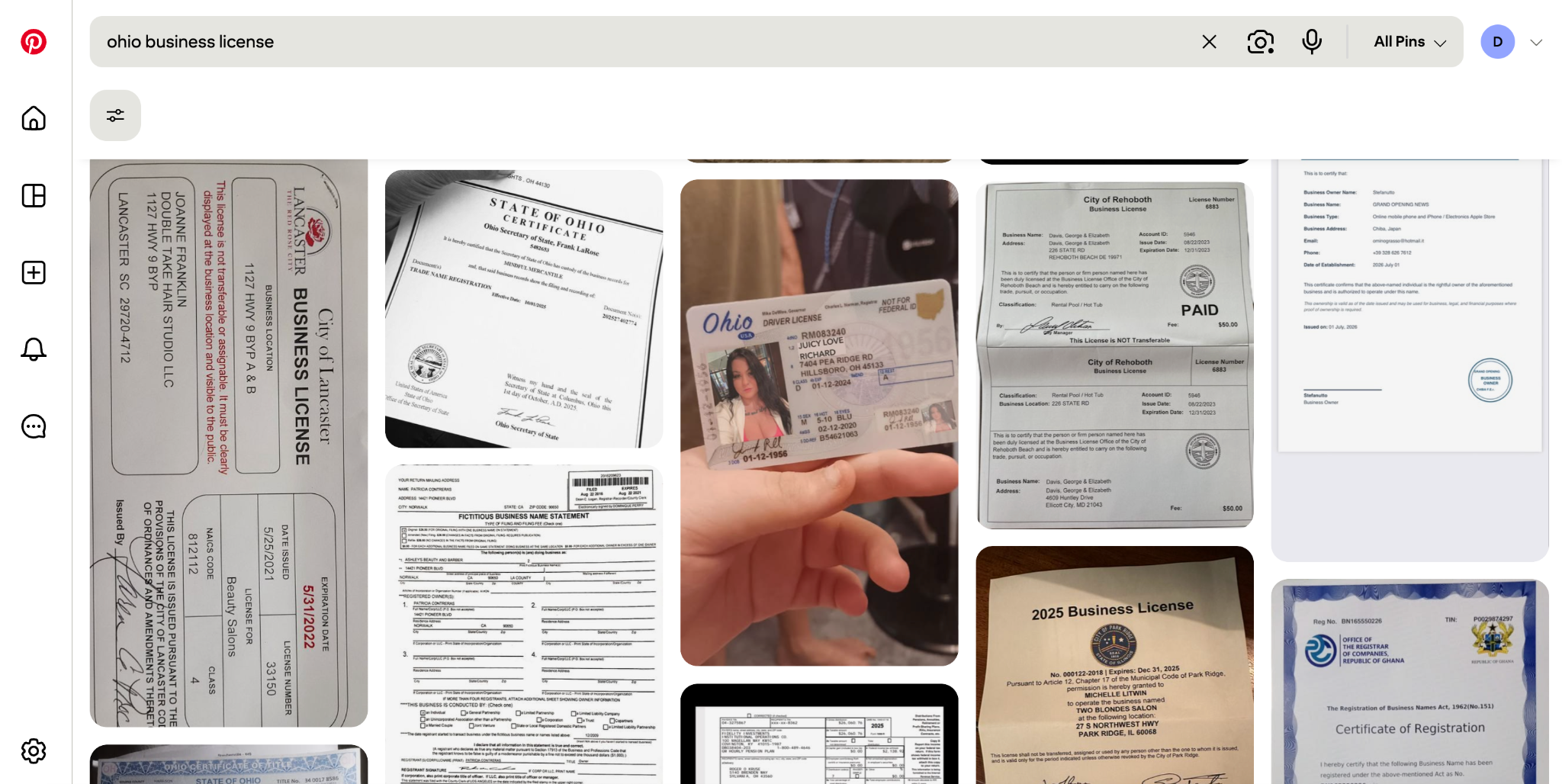
Threat level: We recommend medium suspicion for submissions linked to an unofficial template source. Ohio business documents serve different purposes, and an application template may be legitimate even when it appears on a third-party site. The concern increases when that file is presented as an issued credential.
5 signs of a forged or fake Ohio business license
Missing a fake Ohio business license can expose customers to scams and other criminal activity. For organizations subject to anti-money laundering (AML) and countering the financing of terrorism (CFT) obligations, failures in business verification can also create compliance risks.
Manual reviewers need to know what each Ohio credential proves and which details belong on it. That becomes harder when one applicant submits several documents, each governed by different rules.
When reviewing an Ohio business license package, watch for these warning signs. Each warrants investigation, not an automatic finding of forgery:
1. Inconsistent formatting
Formatting problems can expose changes to an Ohio credential or conceal details needed to authenticate it. Look for missing certificate content, cropped validation details, and text that appears to have been replaced.
- Cropped certificate authentication details. Ohio’s Secretary of State (SOS) provides a certificate-validation service that uses a validation number. A submitted status certificate with its validation-number area cropped, obscured, or overwritten prevents authentication through that feature.
- Missing required LLC certificate content. An Ohio LLC’s Full Force and Effect Certificate must state the company’s name, formation date, and status on the SOS’s records. A certificate that omits these details lacks content required by R.C. § 1706.175.
- Missing reverse-side content. Ohio requires a mobile food service operation license to show the operation’s layout, equipment, and menu on the reverse. A front-only submission leaves that information unavailable.
- Isolated changes around identifying fields. On a vendor’s license or status certificate, a business name, address, or number that sits on a different baseline, has a rectangular background patch, or is noticeably sharper than the surrounding text can indicate replacement text.
2. Incorrect or misleading information
An official-looking Ohio document can name the wrong issuer or claim permissions its credential type does not provide. Its wording should fit the authority, license category, and registration rules it claims to represent.
- Secretary of State named as the vendor-license issuer. The Ohio SOS explicitly says it does not issue business or vendor licenses. A purported vendor’s license naming that office as its issuer should be investigated.
- County auditor named as the transient-license issuer. Ohio’s vendor’s-license framework assigns transient-license issuance to the tax commissioner. A document specifically identifying a county auditor as the issuing authority for a transient vendor’s license needs clarification.
- One county vendor’s license claiming multiple fixed locations. A document explicitly authorizing several fixed business locations under one county vendor’s license conflicts with Ohio’s general requirement for a separate license for each fixed location.
- Invalid statutory-agent address. Ohio’s Articles of Organization instructions require the agent’s address to be in Ohio and prohibit private mailbox service addresses. A P.O. box alone is not acceptable, but one listed with a rural route number is allowed.
3. Bad math and uncharacteristic figures
Dates and license terms can expose errors that a convincing layout hides. Ohio sets specific limits for name registrations, delayed LLC effective dates, and temporary food-service licenses.
- A permanent trade-name or fictitious-name registration. Under R.C. § 1329.04, a trade-name registration or fictitious-name report has a five-year term and can be renewed. A document claiming a single permanent or ten-year registration term conflicts with that rule.
- An LLC filing with an excessive delayed effective date. Ohio allows an LLC filing to specify a future effective date, but it cannot be more than 90 days after the SOS receives the filing. A later date conflicts with the Articles of Organization instructions.
- A temporary food-service license exceeding five days. Ohio generally limits these licenses to five consecutive days. Longer terms require an event organized by a county or independent agricultural society and a holder residing in a county that society serves. Both conditions must apply under R.C. § 3717.43.
4. Ohio business license inconsistencies
An Ohio business’s document package should tell a consistent story. Conflicting names, entity types, or claims of authorization can reveal altered details or a genuine credential being presented for the wrong purpose.
- Application language on an alleged issued license. Form ST-1 is the “Application for Vendor’s License to Make Taxable Sales.” A file presented as the issued credential while retaining that application title does not establish issuance. Hamilton County’s guidance distinguishes the two documents.
- Conflicting LLC names within one formation filing. Ohio’s Articles of Organization repeat the LLC name in the formation and statutory-agent appointment sections. Different legal entity names in those fields, without an explanation, raise questions about whether pages were combined or details replaced.
- Contractor category contradicting the claimed scope. A Columbus General Contractor credential claiming permission to perform hands-on structural work on existing one-, two-, and three-family homes conflicts with the city’s published contractor scopes. That work requires the applicable Columbus Home Improvement Contractor license.
- Certificate type conflicts with the entity type. Ohio issues Good Standing Certificates for corporations and Full Force and Effect Certificates for domestic LLCs. A certificate whose title conflicts with the entity type stated in its body calls for clarification under the Secretary of State’s certificate guidance.
- Conflicting formation states. An Ohio Certificate of Registration for a foreign LLC confirms permission to transact business in Ohio, not formation in Ohio. If the same document identifies another state as the LLC’s formation state but also says it was formed in Ohio, those claims conflict.
5. Metadata discrepancies
Ohio credentials may arrive as portal downloads, scans, or screenshots. File properties can provide clues about how they were produced, but legitimate printing, scanning, and conversion can also change metadata.
- Editing traces around credential details. In a PDF, forensic analysis may reveal changes to a holder’s name, license number, address, or validity dates.
- Screenshot replacing the original file. A screenshot removes access to the source document’s metadata and file structure, limiting analysis. For example, Ohio allows holders to save their county vendor’s license through OH|TAX eServices, making a complete saved copy available instead.
- Image-editing software in file properties. An image editor or design platform listed as the creator of a supposedly untouched government PDF can indicate processing after issuance. This applies, for example, to an Ohio Secretary of State or Department of Taxation download.
Disclaimer: Manual review can expose contradictions, but it depends on knowing the rules for each Ohio credential and recognizing how legitimate copies are produced. Well-made forgeries may avoid visible errors entirely. AI-powered document-fraud analysis can support review at scale, alongside separate issuer checks to establish current authorization.
How to verify an Ohio business license
In Ohio, what a reviewer checks depends on the document and the decision it supports. KYB analysts and underwriters may review Secretary of State status certificates or vendor’s licenses. Procurement teams hiring contractors need trade credentials and any local approvals, while marketplaces onboarding food businesses may need health and municipal licenses.
Verification combines document-authenticity checks with confirmation that the business holds the required permissions. These checks can involve manual review, automation, or both.
Manual review requires analysts to inspect each Ohio credential for signs of fraud, a workload that grows with submission volume. AI-powered analysis can examine file structure, metadata, and subtle signs of manipulation at scale, helping teams identify suspicious documents that visual inspection may miss.
Still, manual verification remains part of many onboarding and compliance workflows, making the correct source for each Ohio credential essential.
Manual verification of Ohio business licenses
Start with the document level checks above, then use these resources to verify the credential’s details and status:
- Ohio Secretary of State. Use the Business Search to confirm entity registration details and the certificate-validation service to authenticate supported status certificates using their validation numbers. These services establish registration or certificate details, not tax, professional, or local authorization.
- County auditors and the Ohio Department of Taxation. Check county vendor’s licenses with the issuing county auditor or fiscal office. Hamilton County, for example, publishes vendor-license files. Contact the office to confirm a specific license’s current status. Contact the Ohio Department of Taxation for transient vendor’s licenses.
- Professional regulators and local licensing offices. Use eLicense Ohio for credentials such as architecture and cosmetology licenses, or the Department of Commerce’s directory for industries it regulates. Contact the relevant city office or health department for local permits and food licenses. Neither state directory covers all Ohio licenses.
Keep in mind: Each additional credential can require another system, office, or response from an issuer. That workload grows with submission volume, and a matching registry record does not establish that the submitted file is unaltered. Document-fraud analysis helps examine those files at scale, alongside issuer checks that establish current authorization.
Using AI and machine learning to spot fake Ohio business licenses
Ohio’s mix of licensing systems makes it harder for reviewers to spot fraudulent credentials, giving convincing fakes more opportunities to pass checks. AI-powered document-fraud analysis can help catch them by examining how files were built and detecting signs of manipulation that visual review may miss.
Benefits include:
- Analysis across Ohio’s licensing systems. Document-agnostic detection can assess county vendor’s licenses, Secretary of State status certificates, and municipal permits without requiring a dedicated template for every issuer.
- Checking beneath the surface. Structural and image analysis can reveal traces of replaced business names, altered license numbers, or inserted validity dates, even when the finished credential looks convincing.
- Connections across submissions. A credential reused under different business names or similar files submitted by unrelated applicants can reveal coordinated fraud. Cross-submission analysis helps surface patterns that reviewers assessing one Ohio applicant at a time may miss.
Automation vs. AI
Rules-based automation speeds up processing, but a forged credential with complete, plausible details can pass its checks. Rules that are too rigid can also flag legitimate documents simply because their formats vary by issuer.
AI goes beyond rules to assess structural and visual signs of manipulation across different Ohio document formats. Models and detectors can be updated as new forgery techniques emerge, helping teams identify suspicious files without relying solely on fixed checks or familiar layouts.
Conclusion
Fake Ohio business licenses can turn false claims of authorization into approved applications, contracts, and access to customers. A matching issuer record does not establish that the submitted file is authentic.
Resistant Documents examines document structure and connections across submissions to help expose manipulation and reused files that isolated checks can miss. Bring that analysis into your business onboarding process before fraudulent paperwork gets the stamp of approval.
Scroll down to book a demo.

Fraud awareness, examples, and lessons
Learn more about fraud in specific industries, best practices, and targeted documents.
View all
Male premade
A business registration confirms that a company exists, but it doesn’t always show who owns it. In September 2026, ...

Application fraud in 2026 is easier to attempt: accessible tools and services help applicants turn false claims ...

Within the fake document ecosystem, things can change fast. Four months ago, we reported that OnlyFake, the ...

In May 2026, a Dallas resident was convicted of running coin-operated “amusement machines” without a business ...