
Male premade
Male 💎
Age 26💎
2 Trades on it 💎
Employment verified ✅
Been aging for a min 💎
Never been touched 💎
This might look like a snippet from someone’s dating profile, only thing missing seems to be their height, but it is actually an offering for something much less romantic, and entirely illegal: a new credit identity.
Other ads are somewhat more self-explanatory.
Car Package (Base 30K): $850  ($1250 Normal Price)
- Apply in 4 weeks.
Movein package ready !
“Just smacked another Corvette off that CPN and plaid logs”
The promise behind these ads goes beyond improving an existing credit score, they are selling a so-called credit privacy number (CPN) that would give you a loan, house and car that you would not otherwise qualify for.
So, a quick recap from our previous investigation: a credit score reflects a person’s credit history: how reliably they pay, how much they owe, how much credit they use, and how long they’ve had it.
If you haven’t been using credit for a long time or have had trouble paying off your loans before, your score might be tanked and you might not only have trouble getting a new loan but also a car or an apartment.
But look no further, as this is where credit boost fraud steps in with offers to fix those problems quickly for just a few hundred dollars.
The main - but completely illegal - attraction: CPNs
CPN sellers market “Credit Privacy Numbers” or “Credit Profile Numbers” as an alternative to Social Security Numbers (SSN). The promise is a clean slate for people with poor or nonexistent credit.
In practice, there is no such thing as a legal CPN. It is a synthetic SSN: a number generated to match the format of an SSN or a stolen number. It is still given to a real person in order to create a parallel, clean credit history.
We analyzed 21 Telegram channels offering different credit-boosting schemes, scraping more than 13,900 messages. Most of the channels are relatively new, with the bulk of their activity dating to 2026.
We also found similar offerings on dedicated websites and Facebook groups. The websites tend to be older, while new Facebook groups appear regularly.
Across the market, we found three broad types of CPN offers:
- Blank CPNs. Marketed with a completely new identity.
- Established CPNs. CPN-s with existing credit history that can be merged into a buyer's identity.
- Tutorials. Showing customers how to create their own CPN.
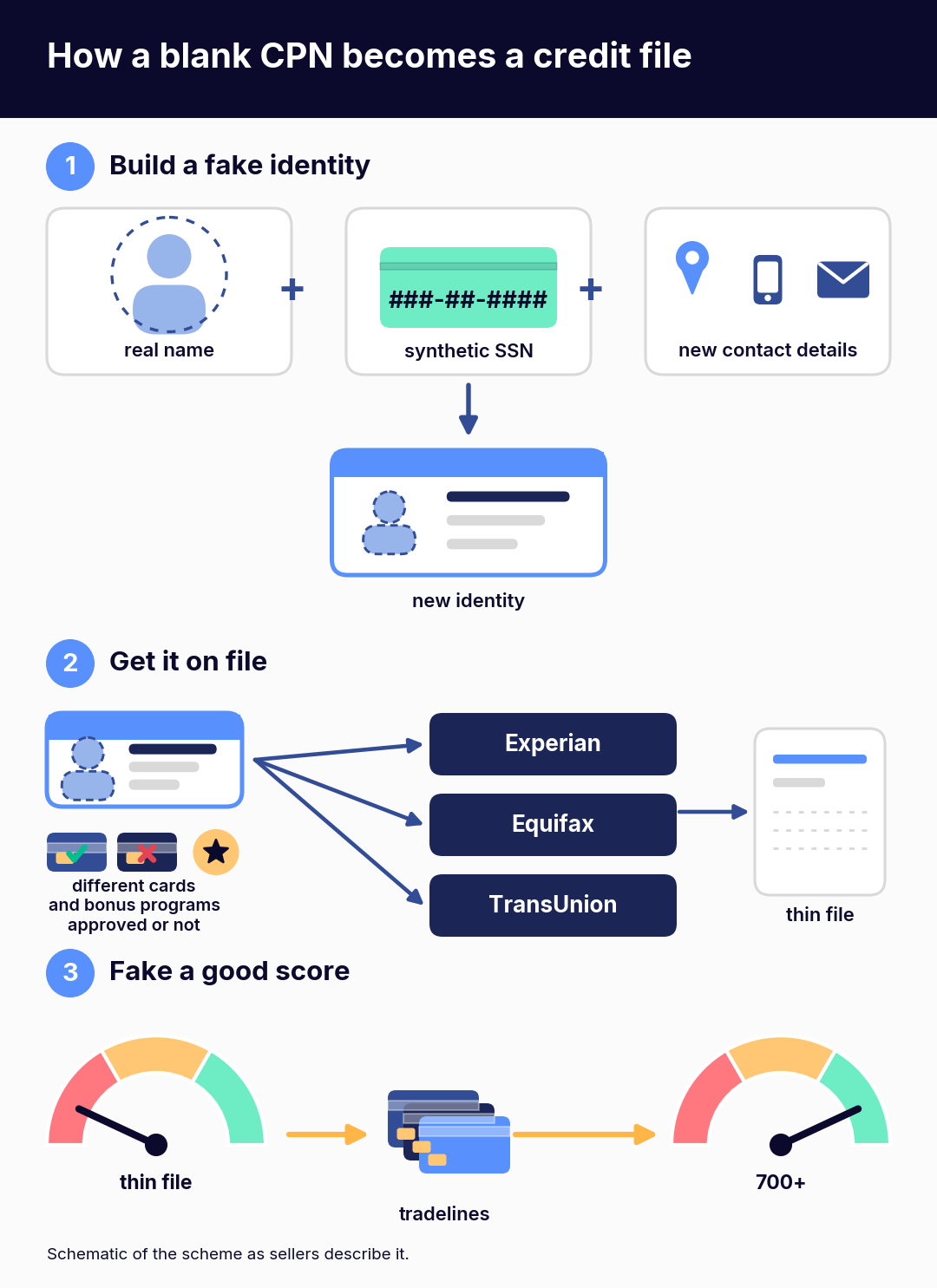
For a new blank CPN you are told to pair the synthetic SSN with a new address, phone number, and email while keeping some connection to your real full name.
The goal is to create a new, thin but usable credit file.
The next step is “tri-merging” the fresh number with the three large credit bureaus: Experian, Equifax and TransUnion, through applications for credit cards, loans or other products.
The applications don't necessarily need to be approved.
The objective is to create a footprint.
Once the file exists, the other credit-boosting products can be used to turn the fresh CPN into what appears to be a good credit score.
But for buyers who don't want to build a credit profile themselves, there is an easier option: pre-made profiles.
The mature version: pre-made CPNs and person packages
These packages may include an already “filled” CPN, credit history, fake SSN cards, pay stubs and other supporting documents. This turns a credit-boosting product into something closer to a full application-fraud kit.
The already-made CPNs usually come with a claimed credit score of 700–750 or over.
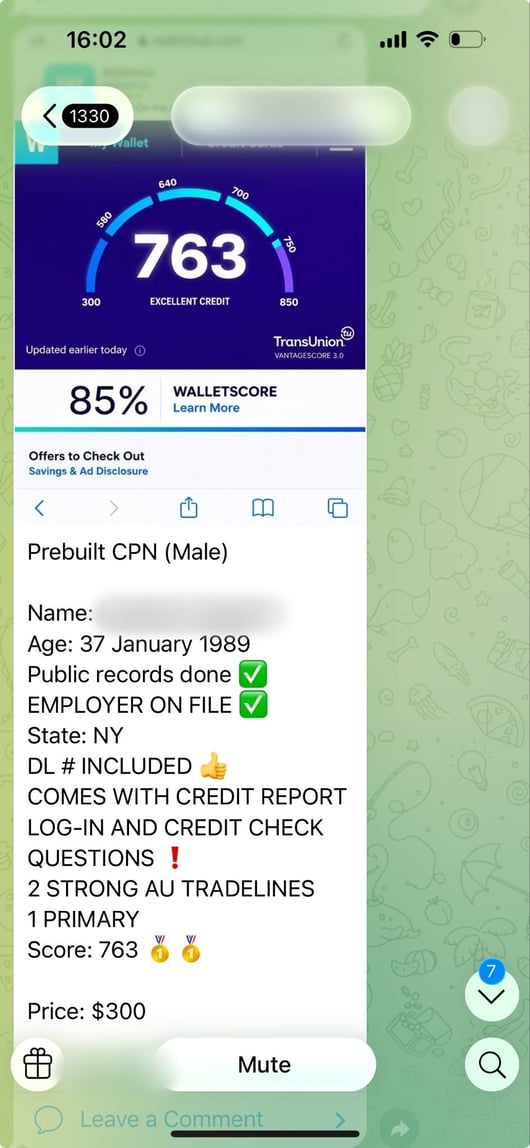
The offers on Telegram range from as little as $50 to up to $3,500, depending on how much credit the CPN in question would, in theory, qualify for.
Premade CPN-s also show how the market becomes more specific.
The product is no longer necessarily a single fraud technique. Instead, sellers package everything together as an approval service.
An average buyer doesn't necessarily want or think about a tradeline, and many of them haven't even heard of CPNs before entering these marketplaces.
What they want is a car, an apartment, a credit card or a loan.
So they are faced with specialized groups advertising apartment approvals, luxury home packages, car-finance packages, and personal or business loan assistance.
The buyer sends the seller a link to the car or apartment they want: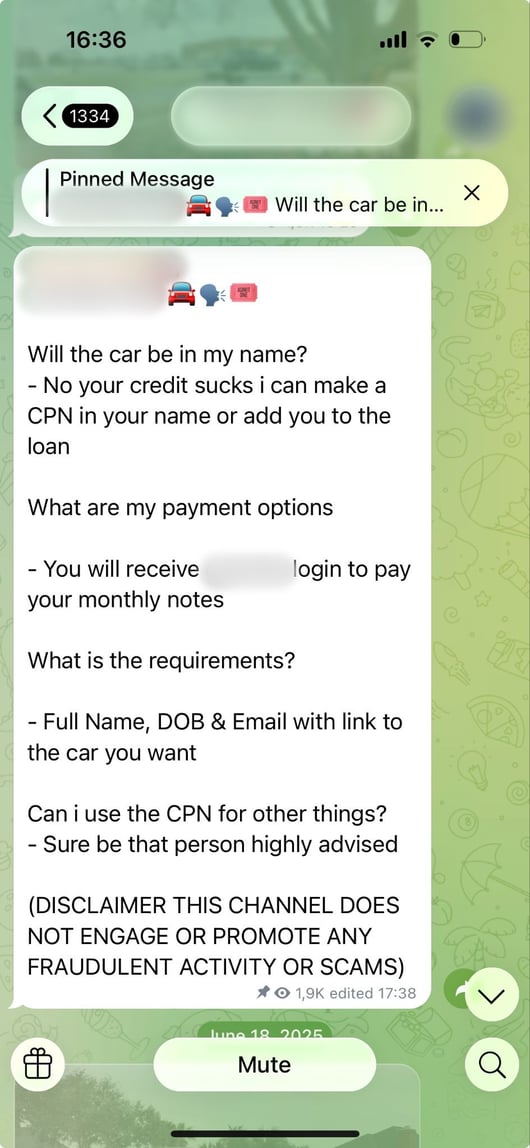
The seller promises to make the application work.
Sometimes prices for car or apartment packages are advertised. Apartments averaged around $83, while cars averaged around $680 in the ads we looked at.
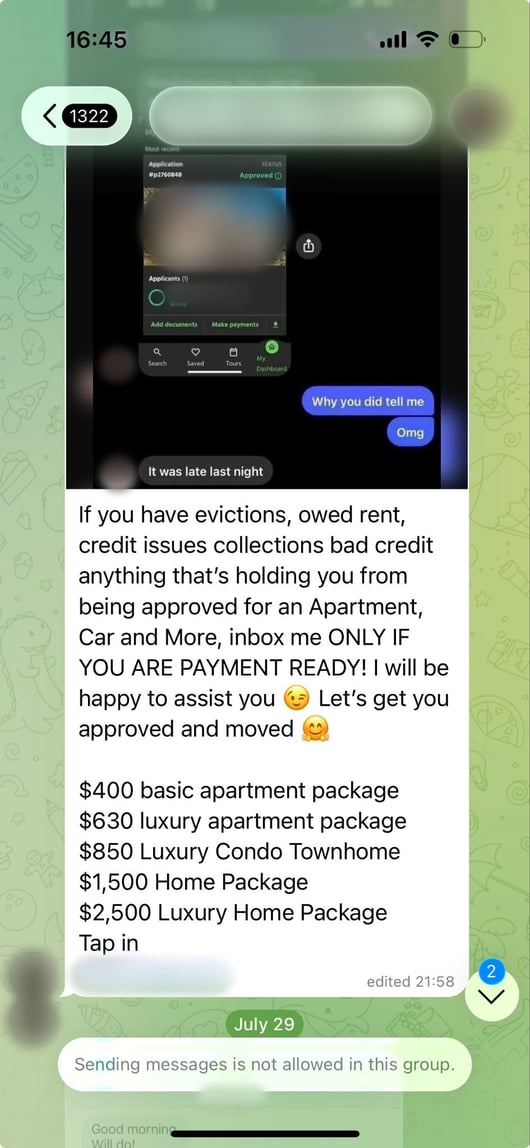
Yet most of these offers skip pricing entirely and sell the result instead, a lot of them just say something like “Got him approved for this Tesla.”
For such car packages, sellers take over the process entirely, promising the buyer only a login and delivery of an approved car once the process is complete. The buyer doesn't even have to understand how the fraud works or what they are risking - they just have to say what they want.
Will institutions even check the SSN?
Does it really take only a few messages and a few hundred bucks to just start anew?
These schemes exploit the fact that institutions run different checks, and not every application is scrutinized.
Some face very few checks at all, especially when it comes to rental properties. If a landlord looks only at the credit score, a CPN might appear perfectly normal and raise no red flags
So why not simply check whether the SSN is even real?
Not so fast, because one cannot simply look it up in a government database.
SSA offers an electronic verification service eCBSV that allows registered organizations to confirm whether an SSN matches a person's name and date of birth, but only when the owner consents to the check.
The institutions need to pay for each verification search. Depending on how many searches it runs, each one can cost roughly $0.20 to $0.50, if full subscription is used. And even with a small number of searches, there is an annual tier-based subscription fee of $5100, just to access the service.
As the cost has increased over the years and the check returns only a yes-or-no result without explaining the reason for a mismatch, institutions may leave it as a last resort when other identity checks are not enough or there is a suspicion already.
Simply put, it is not always worth it.
Instead, companies often just compare the details on an application with what they already know about the person and what they can find online.
Hence a cheaper loan, insurance product or credit card might trigger a shallower check than a mortgage.
So if a CPN is paired with otherwise correct details, or has built up enough history through added tradelines to look legitimate, it can easily get through.
Fresh start...or more like a fresh fraud?
And this is exactly what sellers promise: a fresh start, with fraud hidden underneath.
Targeting those already struggling financially, selling them the hope of access to credit without making clear the risks involved.
And at the same time lenders risk approving applications from people who most likely cannot afford the loans.
And with CPN offers continuing to circulate across online platforms, there is little to suggest that this market is going away anytime soon.

Fraud awareness, examples, and lessons
Learn more about fraud in specific industries, best practices, and targeted documents.
View all
A business registration confirms that a company exists, but it doesn’t always show who owns it. In September 2026, ...

Application fraud in 2026 is easier to attempt: accessible tools and services help applicants turn false claims ...
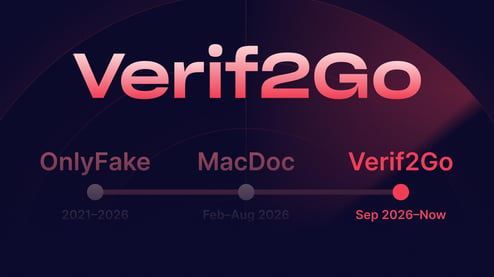
Within the fake document ecosystem, things can change fast. Four months ago, we reported that OnlyFake, the ...

In May 2026, a Dallas resident was convicted of running coin-operated “amusement machines” without a business ...

NEW YORK & PRAGUE – 1 October 2026 – Ocrolus, the AI workflow and analytics platform for lenders, today ...