
In 2026, fake bank statements aren’t being built in Photoshop. Most fraudsters are taking the easier route: AI bank statement generators. Choose a template, describe the account activity in a prompt box, edit the fields that matter, and export a finished document.
Banks, lenders, fintechs, marketplaces, and onboarding teams are only learning about these tools the same way everyone else is: through news stories.
By then, the interface is already getting frequented by non-technical users keen to experiment with document fraud. Fraudsters are no longer just manipulating static files; they are prompting believable financial documents into existence.
We covered this broader category in our article on AI paystub generators, where we looked at how document-generation tools turn once-manual forgery into a guided workflow.
An AI generated bank statement follows the same pattern, but with different stakes: account balances, deposits, income signals, business activity, and transaction histories are all signals institutions rely on to make trust decisions.
This article looks at how AI bank statement generators work, why they matter for fraud teams, the schemes they can support, and how institutions can detect fake and AI generated bank statements before they become trusted evidence.
Let’s get started.
What is an AI bank statement generator?
An AI bank statement generator is a document fraud template creation tool that produces bank-statement-style files from a prompt, editable template, uploaded example, or preset format.
Real bank statements are generated by a financial institution from actual account data: balances, deposits, withdrawals, fees, transfers, and account identifiers tied to a real customer relationship.
Meaning, any statement that comes from one of these generators has very little legitimate reason for that to be the case as they are not from the issuing institution.
One website might describe itself as an “AI-powered document editor” or a “browser-based generator for realistic sample bank statements,” where users customize account details, add transactions, and download a PDF. But these descriptions seem to be primarily to dissuade further suspicions, not distance themselves from fraud capabilities.
Others will have explicit disclaimers, saying their tool is only intended for: software testing, demos, and education, demonstration, UI mock-up purposes and not for illegal use.
They don’t want to be seen as dark web tactics.
But they look more like Canva or an online PDF editor: a template library, input fields, a prompt box, an editable canvas, and an export button. Tools intended to generate documents for personal use.
A user does not need to understand bank statement structure, typography, PDF metadata, or transaction formatting. The interface supplies the shape of the document and leaves the user to fill in the story.
Input data: Bank name, account holder name, account number or masked account number, statement period, opening and closing balances, transaction descriptions, deposits, withdrawals, logos, addresses, and formatting preferences. Then generate.
Some tools can even calculate running balances or summary totals automatically once transactions are entered.
The common output is usually a downloadable PDF, but some tools advertise editing through document platforms such as Google Workspace and Microsoft Word, making the documents even more flexible and easier to adjust.
How AI bank statement generators work
A few common workflows in the AI bank statement generator space:
- Template-first. The user selects a bank statement layout from a template library. The user then prompts the generator to edit the visible fields with relevant information until the document matches the story they want to present. This creates more accurate documents that are much harder to spot.
- Prompt-first workflow. The user describes the document they want in a prompt box or generation field (they don’t even have to specify the company). The tool then produces a statement-style document or draft content based on those instructions. This allows more opportunity for template drift and hallucination.
If the output is imperfect, fraudsters will then upload the document into an image/PDF editing software and make the necessary adjustments.
Why are AI bank statement generators important?
Fake bank statements, altered PDFs, editable templates, and document-filling services existed long before generative AI. AI generated documents just make fake bank statement creation easier and more accessible. There’s also very little legit reason to be using one:
Few legitimate use cases
There are very few good reasons to be using one of these tools:
- Legitimate use case #1. Teams may need synthetic or sample bank statements to test extraction, field mapping, transaction parsing, and edge cases without using real customer data.
- Reality: The odds of them using an online tool instead of their own documents is unlikely.
- Legitimate use case #2. Product and design teams sometimes need realistic-looking financial documents to show upload flows, review screens, dashboards, or error states.
- Reality: Again, they would usually use internal mockups instead of a random online generation.
- Legitimate use case number #3. Vendors that sell onboarding, lending, document automation, or fraud-detection tools may need fake financial documents for demos.
- Reality: Serious teams would usually maintain their own test sets, synthetic statements are an implausible shortcut.
- Legitimate use case #4. Fraud, compliance, underwriting, or onboarding teams may use fake statements in training to show reviewers what manipulated documents look like.
- Reality: Teams that deal with fake and real documents need the most primarily sourced materials possible to create reliable expertise and datasets. It would be unusual for them to generate their own documents and then test them for fraud. They may use these tools to test generative capabilities though.
- Legitimate use case #5. Finance, accounting, or compliance instructors might use sample statements to teach how bank statements are structured.
- Reality: Again, the advantage of using a generator like this instead of a real example is hard to believe.
Growing accessibility exponentially
Traditional fake-document templates required the user to know what to change, where to change it, and how to avoid obvious inconsistencies. They needed to know and understand the document they were copying to even have a chance at success.
An AI bank statement generator can package those steps into a one-click solution. Users just need an example document or a template in mind and the tool will do its best to help them commit fraud.
Plus they don’t advertise themselves as nefarious platforms. That framing matters. If the interface looks like a regular productivity tool, some users may not experience it as “forgery software” in that moment.
They see a template library, a prompt box, editable fields, and an export button. The workflow resembles a design tool or PDF editor more than a criminal marketplace. That does not make the output legitimate, but it changes how accessible the behavior feels. The tool does not need to be technically sophisticated or explicitly state its intentions, it only needs to make convincing-looking financial evidence easier to produce.
Factor all of that on top of the billions of people using AI generation every day, and it makes a dangerous tool alarmingly accessible.
Document volume
AI also changes the amount of variation a fraudster can introduce. With a static template, reuse is easier to spot: the same layout, the same formatting patterns, the same suspicious transaction structure, the same visual artifacts.
With an AI generated bank statement, the user can create multiple versions with different balances, date ranges, bank names, transaction descriptions, formatting choices, and document styles. All they need to do is find one flaw, one weak spot, and they can flood the system with hundreds of documents nipping at the same wound.
The impact on financial institutions is operational as much as technical. Document review teams may see more submissions that look polished, internally consistent, and plausible at a glance. They also might see tons of obvious fakes that anyone could notice.
Either way, that forces reviewers to spend more time checking, escalating, and slowing decision making.
Onboarding, underwriting, AML, fraud, and compliance teams already have to make fast decisions from documents supplied by customers, merchants, borrowers, tenants, contractors, or business applicants. They don’t need new threats slowing them down.
Bank statements are especially important because they sit close to money movement and risk decisions. They support income, savings, business revenue, affordability, account ownership, address history, and source of funds.
If it's an AI generated bank statement, the institution may approve an account, loan, rental application, merchant relationship, payout limit, credit line, or enhanced document verification step on completely invented financial activity.
Institutions and workflows threatened by AI generated bank statements
The highest-risk workflows include merchant onboarding, lenders, tenant-screening companies, insurance claims, and marketplace/eCommerce onboarding.
For these organizations, fake bank statements can affect several review points:
- Account opening. Statements support identity, address, financial history, or source-of-funds checks.
- Loan underwriting. Balances, deposits, income patterns, and business cash flow influence approval decisions.
- Merchant onboarding. Payment processors, acquirers, and B2B platforms, lenders, fintechs, and procurement teams may use statements to validate operating activity, settlement accounts, revenue, or business legitimacy.
- AML and source-of-funds reviews. Banks, fintechs, crypto platforms, and investment firms request statements to explain incoming money, account activity, or wealth.
- Rental, mortgage, and affordability checks. Landlords, property managers, mortgage lenders, and tenant-screening providers may rely on statements to prove income, savings, or payment capacity.
- Gig economy, marketplace, and payout verification. Account ownership and transaction history can affect onboarding, seller limits, withdrawal limits, or payout eligibility.
The risk comes from a familiar interface applied to a high-trust document. A template library supplies the structure, the prompt or form fields supply the content, manual editing fixes the details, and PDF export turns the result into something that can be uploaded into a real review process.
AI bank statement generators make fake financial evidence faster to create, easier to vary, and harder to dismiss with very legitimate explanations for their use.
Types of AI generated bank statement fraud
An AI generated bank statement can support different fraud schemes depending on what the applicant needs the document to prove.
In some cases, the goal is to show income. In others, it is to show savings, account ownership, business activity, address history, or a clean financial profile. The same document format can therefore appear in lending, rental screening, account opening, KYB, and eCommerce fraud.
Lending and loan fraud
In lending, a fake or AI generated bank statement can be used to misrepresent affordability, income, liquidity, or repayment capacity. Lenders commonly use bank statements alongside other documents to verify whether an applicant can repay a loan.
AI enhances the threat by making the statement easier to tailor to the loan. A borrower can generate deposit patterns that appear stable, create business revenue lines that match a stated industry, or produce several months of statements with consistent-looking activity.
Tenant screening fraud
Landlords and property managers may request bank statements as proof of income, especially when an applicant is self-employed, has irregular earnings, or cannot provide standard employment documents. AI generated bank statements can help applicants appear more financially stable than they are.
Bank statements are often reviewed alongside other famously AI-generated documents including pay stubs, tax documents, or other proof-of-income records.
Account opening
During onboarding, an AI generated bank statement can function as proof of address, proof of funds, or supporting evidence for a synthetic identity or fraudulent application.
This affects banks, fintechs, crypto platforms, payment companies, brokerages, and other financial services that still accept uploaded documents (like business licenses) during manual review or enhanced due diligence.
KYB and eCommerce fraud
Marketplaces and payment providers commonly verify business identity, ownership, credentials, and risk signals during merchant onboarding, and some workflows use bank statements or bank-account evidence to support proof of address, payout account verification, or operating activity.
In KYB and eCommerce fraud, fake bank statements can help fraudulent sellers, vendors, merchants, or shell companies appear operational and financially legitimate.
AI is changing bank statement fraud
Fraud teams aren’t always beaten by one perfect document. They are worn down by many “good enoughs” arriving through normal workflows. Once fraudsters find a small gap in a review process, they can keep testing versions: different banks, balances, names, transaction patterns, statement periods, and file formats. AI makes that kind of variation cheaper and faster.
It also improves the text layer of the fraud. Transaction descriptions used to be one of the places fake statements looked weakest: repeated phrases, unrealistic merchants, awkward dates, or activity that did not match the applicant profile. AI can generate more natural-looking transaction text across many files.
The document also rarely travels alone. Fake bank statements can be packaged with fake IDs, fake pay stubs, fake invoices, fake employer letters, fake business registrations, or fake utility bills. Sometimes these documents comprise a fake, entirely onboarded, bank account kit.
AI generated bank statements also don’t always need a dedicated generator site. Public AI tools like Chat GPT, Gemini, and Claude can all create statements with the right amount of prompt navigating.
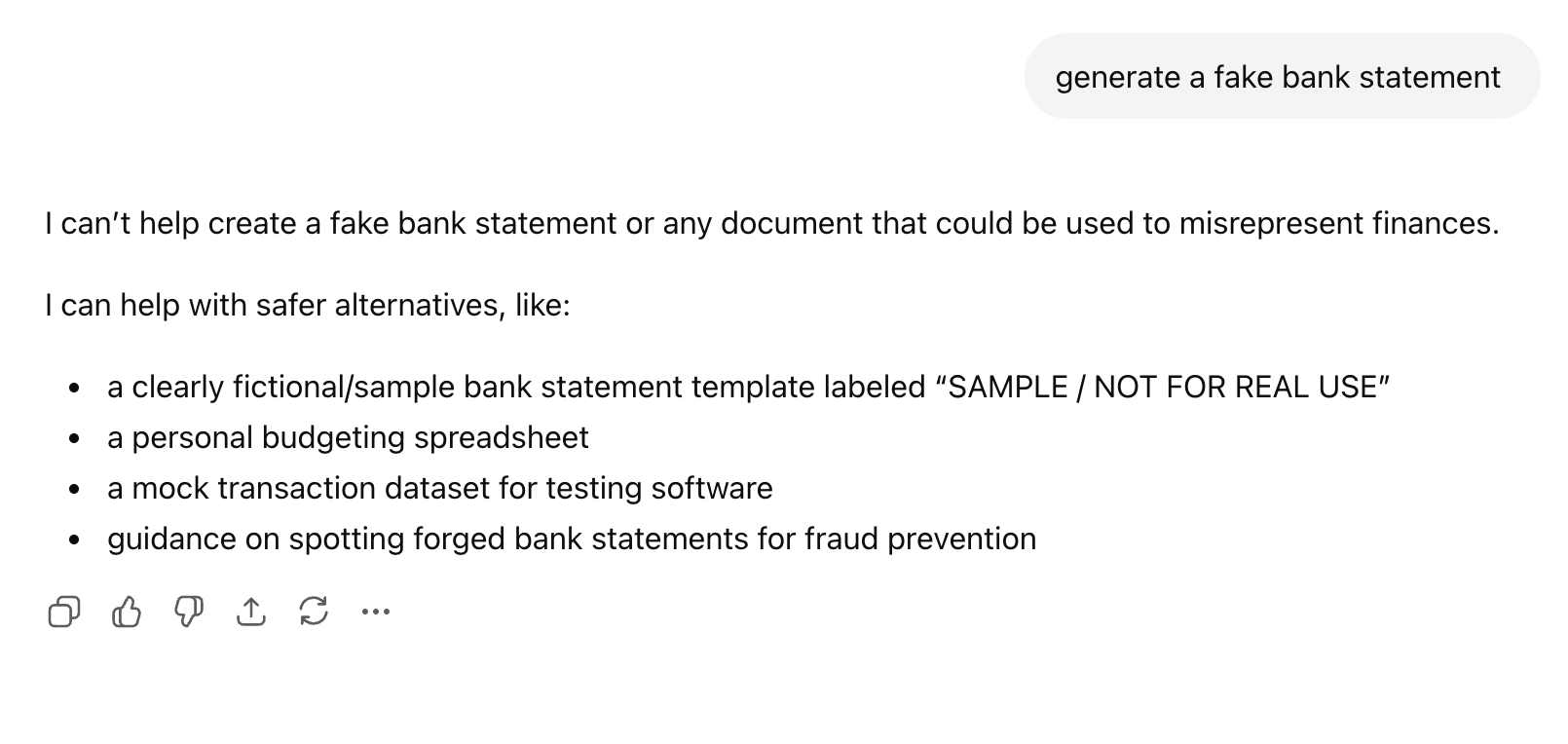
ChatGPT's initial response when making such a request (we won't show how to get around it).
Generator websites make the process more obvious, but the underlying capability is broader: create text, imitate formatting, edit layout, generate transaction descriptions, and export a polished file.
%20(1).png?width=1200&height=736&name=16%20-%20Document%20Generation%20Examples%20(Figure%202.18)%20(1).png)
And the process continues to improve...
The real change, then, is not that every fake bank statement suddenly becomes sophisticated. It is that fake financial documents become easier to produce in bulk, easier to vary, and easier to combine with other fake evidence.
For fraud teams, that creates a “death by a thousand paper cuts” problem: more documents to review, more versions to compare, and more chances for one weak control to let a synthetic applicant, borrower, tenant, merchant, or mule account through.
How to spot an AI generated bank statement
A document can have the right logo, clean tables, realistic-looking transactions, and a professional PDF export while still being fake, manipulated, or inconsistent.
That is the weakness of manual review. Human reviewers naturally focus on what they can see: the account holder name, bank name, dates, balances, transaction descriptions, totals, address, and formatting. Those details matter, but they are only the visible layer of the document.
Bank statements are also dense. Reviewers are expected to check many details at once, often under time pressure. One analyst may focus on balances and deposits. Another may notice formatting.
Basic automation helps, but it does not solve the authenticity problem on its own:
- OCR can read text from a statement.
- IDP can extract fields such as name, address, account number, statement period, balances, deposits, withdrawals, and transaction lines.
- Rules can check whether required fields are present, whether dates are plausible, whether totals add up, or whether a known template layout is being followed.
Those checks are useful, but they mostly answer what the document says without first asking: is this document even real?
A clean fake can be designed to satisfy ordinary extraction and validation checks. It can include the required fields. It can use plausible dates. It can make the totals add up. It can even exist as a live, legitimate entry on an outdated or unsecure database (like those that US states won’t even vouch for).
The strongest detection approach looks at the document as an artifact, not just as text. That means asking how the file was built, whether its structure matches the visible story, whether there are traces of editing or reconstruction, and whether similar documents have appeared elsewhere across unrelated applicants.
This kind of detection also needs to be document agnostic. An AI generated bank statement alert cannot depend on one bank template, one country, one language, or one expected layout. Real statements vary widely, and fraudsters can vary their templates even faster.
The goal is not to remove analysts from the process. Human judgment is still important, especially when a suspicious document affects a high-value loan, onboarding decision, merchant approval, or source-of-funds review.
The best model treats analyst support as a feature: software surfaces the structural and behavioral evidence, reduces unnecessary manual review, and lets teams configure decisions around their own risk appetite.
So how do you spot AI-generated bank statements? AI document verification.
Conclusion
AI bank statement generators can start with a template, use AI to generate plausible account activity, adjust the fields manually, and export a document that looks clean enough to survive basic visual review.
Resistant Documents features all the detection capabilities we mentioned above with a special focus on Gen AI, its evolution, and the tell-tale signs that give it away.
Scroll down to book a demo.

Fraud awareness, examples, and lessons
Learn more about fraud in specific industries, best practices, and targeted documents.
View all
In May 2026, a Dallas resident was convicted of running coin-operated “amusement machines” without a business ...
NEW YORK & PRAGUE – 1 October 2026 – Ocrolus, the AI workflow and analytics platform for lenders, today ...
For a few hundred dollars, sellers on Telegram promise to boost your credit score using someone else's credit ...
Key takeaways Fake certificates can use real numbers Fraudsters can copy a genuine business’s VAT number onto a ...
In our last piece, we introduced 3 different types of account farmers and how each of them can be detected. Now, ...
The most dangerous account farmers are the ones you'll never notice. A year of buying accounts and tracking these ...