
Application fraud in 2026 is easier to attempt: accessible tools and services help applicants turn false claims into convincing applications. Equifax’s September 2026 findings show a 5% year-over-year increase in the overall consumer application fraud rate in Canada in Q2 2026. Methods included identity theft and misrepresentation of income, employment, or assets.
For lenders, property managers, and business onboarding teams, supporting documents help determine who qualifies and on what terms. A manipulated bank statement or fabricated pay stub can turn a false claim into apparently credible evidence.
Verifying supporting documents means checking how they were created or altered, not just what they say. That task is becoming harder as template farms, e-stores selling falsified documents, and AI-generated forgeries make convincing fakes easier to obtain.
In this blog, we’ll explain what application fraud is, how it works, which workflows it affects, and how to detect it.
What is application fraud?
Application fraud is the deliberate use of false information, material omissions, or stolen or fabricated identities to obtain approval or favorable terms for a product or service. It affects lending, tenant screening, insurance, and account opening.
A person can apply under their own identity while inflating income, concealing debts, or submitting fabricated employment evidence.
Consider a borrower applying for a car loan. They earn $3,000 a month but declare $5,000 and submit an altered bank statement showing larger salary deposits. If the lender accepts those figures, it may approve a loan whose repayments appear affordable on paper but exceed what the borrower’s actual income can support.
Application fraud can also involve genuine documents used to support misleading claims. For example, a bank statement may accurately show money in an applicant’s account without establishing where it came from or whether it must be repaid.
In down-payment fraud, a home buyer borrows money for a down payment but declares it as a family gift. The money is real, and the bank statement may be unaltered. But the deception conceals an additional repayment obligation. This gives the lender an incomplete picture of the buyer’s debts and ability to afford the mortgage.
In successful application fraud, the organization grants access or terms it would not have offered on the same basis with accurate information.
How application fraud works
Application fraud works by introducing false information into an approval process. A typical attempt follows four stages. 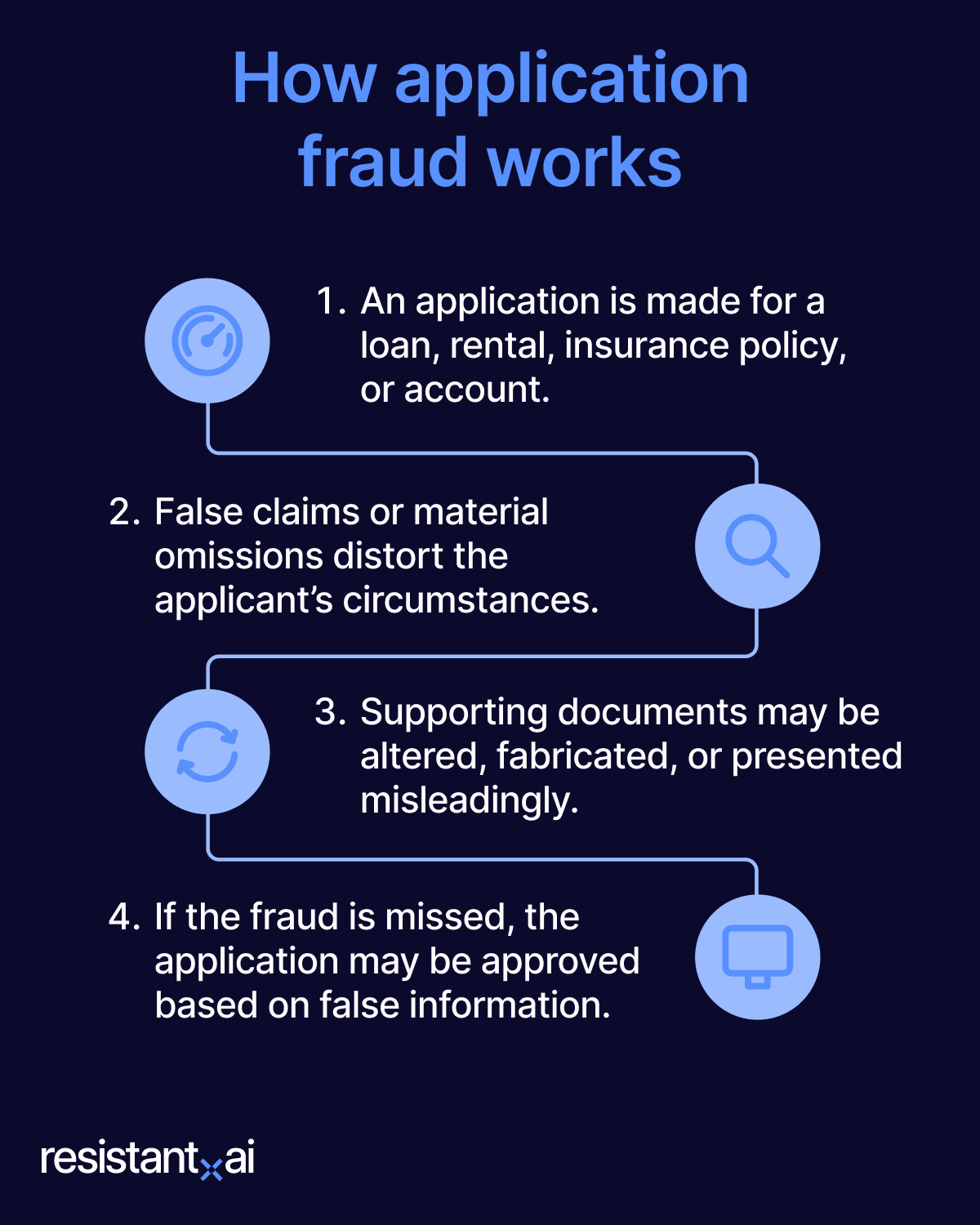
- Start an application. Someone seeks a loan, rental, insurance policy, or account. They may apply directly or through a broker, dealer, or agent.
- Misrepresent an approval-relevant detail. The application includes a false claim or omits required information. For example, a business-loan applicant inflates the company’s revenue.
- Submit supporting evidence. The applicant supplies documents to substantiate the claim. In our example, altered financial statements might support the inflated revenue figure. In other cases, genuine documents are submitted with a misleading explanation.
- Influence the decision. The organization reviews the application. If it accepts the false claim, it may grant approval or terms that the verified facts would not support.
The deceit in application fraud often rests on one or more documents. Fraudsters can alter them with PDF editors, generate them using AI, or create them from templates bought online.
These documents can support false claims about a genuine applicant or help someone impersonate another person. First-party fraud involves applicants using their own identities while misrepresenting their circumstances. Third-party fraud involves applying under another person’s identity without authorization.
Why is application fraud important?
Application fraud creates losses across an institution’s portfolio, consumes investigation capacity, and reveals weaknesses that fraudsters can exploit repeatedly:
- Financial exposure. Decisions based on false information can leave organizations with losses or obligations they did not accurately assess.
- Investigation and remediation workload. Fraud discovered after approval requires teams to revisit evidence, investigate activity, and correct earlier decisions. This can draw resources from underwriting, fraud, compliance, and customer support.
- Unreliable records and risk assessments. False application information can enter customer records, financial models, and risk reporting. Later decisions may then rely on claims that were never properly established.
- Compliance exposure. In regulated financial services, application fraud can reveal gaps in required identity checks, record-keeping, or suspicious-activity reporting.
- Friction for legitimate applicants. Poorly targeted controls can send genuine applications into unnecessary reviews or repeated requests for evidence, increasing delays and the burden on applicants.
The damage goes beyond the initial financial loss. False information can distort how an organization assesses future applications, while controls introduced in response can delay or exclude genuine customers. Effective prevention catches deception without creating unnecessary barriers for legitimate applicants.
Types of application fraud
The following examples show how application fraud affects different products and services:
Loan application fraud
Loan application fraud involves deliberately misrepresenting a borrower’s identity or financial circumstances to obtain credit or terms they would not otherwise qualify for.
Application details that may be falsified include:
- Income. Earnings are inflated through false declarations, altered bank statements, or fabricated pay stubs.
- Employment. The applicant invents an employer, misstates their role, or claims employment that has ended.
- Debts and liabilities. Existing borrowing or repayment obligations are concealed to make additional debt appear affordable.
- Assets. Savings or other holdings are overstated to suggest a stronger financial position.
- Identity. Stolen or fabricated details conceal who is seeking the loan.
The false information can lead a lender to approve more credit than the borrower can afford or price the loan using an inaccurate assessment of risk. When a stolen identity is used, the lender may also struggle to recover funds from the actual perpetrator.
For income checks, compare declared earnings with pay periods and corresponding deposits, allowing for deductions and timing differences. Matching figures across submitted documents are only a starting point: the documents’ authenticity and the source of the payments still need verification.
Mortgage application fraud
Mortgage application fraud involves false statements or material omissions about the borrower, property, or transaction to obtain financing or more favorable terms.
In addition to the borrower’s financial circumstances, mortgage applications include property and transaction details that can be misrepresented:
- Down-payment source. Borrowed funds are declared as a gift, concealing an additional repayment obligation.
- Intended occupancy. An investment property is presented as a primary residence to qualify for different pricing or lending terms.
- Property value. An inflated appraisal makes the property appear to provide more security for the loan than it actually does.
- Existing property loans. Other mortgages or liens are concealed, leaving the lender with an incomplete picture of the obligations secured against the property.
False mortgage information can cause lenders to overestimate what the borrower can repay or what the property is worth. The resulting risk also depends on what the people involved are trying to achieve.
The FBI distinguishes fraud for housing from fraud for profit. A borrower may misrepresent their finances to obtain a home while intending to repay. Profit-driven schemes aim to take money from lenders, sometimes using brokers who falsify paperwork, appraisers who inflate property values, and people paid to pose as buyers.
Because mortgage fraud can involve both the borrower and other parties in the deal, checks need to cover the whole transaction. Trace down-payment funds to their source, check for undisclosed mortgages or liens in property records, and investigate differences between the stated occupancy and supporting information.
Rental application fraud
Rental application fraud involves false information or evidence used to obtain a tenancy by misrepresenting the applicant’s identity, finances, or rental history.
As with loan applications, income and employment can be falsified to meet affordability requirements. Rental screening also relies on details about previous tenancies and the person applying:
- Rental history. Addresses, tenancy dates, or rent-payment records are invented to create a favorable history.
- Landlord references. Contact details lead to a friend or accomplice posing as a previous landlord.
- Identity. Stolen or fabricated details can cause background checks to return information about someone other than the applicant.
False information can lead property managers to approve a tenancy without an accurate picture of affordability or rental history. If problems emerge, they may face unpaid rent, investigation costs, and the expense of resolving the tenancy.
Reference checks need to establish who is responding as well as what they say. Obtain landlord or property-management contact details independently where possible, and confirm their connection to the claimed tenancy.
Business-loan application fraud
Business-loan application fraud involves misrepresenting a company’s finances or the applicant’s authority to obtain business financing.
As with consumer loans, financial information can be inflated or concealed. In business applications, this may include:
- Revenue and expenses. Sales are overstated or costs understated to make the business appear more profitable.
- Assets and liabilities. Equipment, cash, or other holdings are inflated, while existing borrowing is concealed.
- Ownership and authority. An applicant falsely claims to own or represent a company. Business identity theft can involve using a legitimate company’s name and identifiers without authorization.
False financial records can lead lenders to approve larger loans than the business can support or accept assets worth less than claimed. An unauthorized applicant may obtain funds in a real company’s name, leaving the lender to investigate who received the money and how to recover it.
Checks therefore need to establish both the company’s financial position and the applicant’s authority to borrow on its behalf. Registry information can support those checks, but it should not substitute for them.
Registry information also has limitations. New York’s Department of State, for example, warns that it cannot guarantee the completeness or accuracy of information supplied to it:

For U.S. applicants, our state-by-state business verification guide explains what registry records can establish and where additional evidence is needed.
Account-opening fraud
Account-opening fraud involves false customer information used to obtain bank or payment accounts. Criminals seek accounts they can control to receive scam payments, move illicit funds, or sell access to others.
Application details that may be falsified include:
- Identity. Stolen or synthetic identities conceal who is opening the account. Synthetic identities combine genuine and invented personal details.
- Address. Doctored utility bills or other proof-of-address documents support a false residence claim.
- Business details. Fabricated company records or false ownership claims make a business account application appear legitimate.
Once approved, these accounts can receive proceeds from scams, including authorized push payment (APP) fraud, and transfer funds onward. Our money-muling research also describes account farms selling fully onboarded accounts, allowing buyers to obtain payment access without submitting their own applications.
Prevention starts with identity verification, alongside checks on who controls the account and whether the supporting address and business evidence is genuine. After onboarding, transaction monitoring can help identify suspicious activity that was not apparent during the application review.
Insurance application fraud
Insurance application fraud involves deliberately misrepresenting information used to decide coverage and pricing across policies such as auto, commercial liability, and workers’ compensation. It concerns obtaining a policy or favorable terms, rather than seeking payment through a false claim.
Depending on the policy, details that may be falsified include:
- Vehicle use. A vehicle used for business is declared as personal-use only.
- Annual mileage. Expected driving distances are deliberately understated to obtain a lower premium.
- Business activities. Higher-risk work is described as a lower-risk occupation or operation.
- Payroll. An employer deliberately understates payroll on a workers’ compensation application to obtain a lower premium.
False application details can leave an insurer charging too little for the risk it accepts. If the misrepresentation emerges later, it can also trigger investigations and disputes over coverage or claim payments.
Checks should focus on the information that drives the underwriting decision. For example, an insurer assessing a business vehicle can compare its declared use with the applicant’s stated business activities and seek clarification where they conflict.
How are AI and fraud services changing application fraud?
False evidence is becoming easier to produce and harder to assess through appearance alone. Generative AI, issuer-specific templates, and complete onboarding packages give applicants access to capabilities that previously required skilled specialists.
- More credible text and imagery. Generative AI tools can produce readable financial text and realistic document images. Quality varies, but reviewers cannot depend on obvious misspellings or distorted lettering to identify fabricated evidence.
- Greater volume and variation. AI can vary backgrounds, shadows, folds, and other visual details, while some dedicated document generators support batch production, allowing fraudsters to produce a wide variety of fakes en masse.
- Different production methods. Public AI tools generate content from instructions or reference images. Template farms supply editable, issuer-specific documents, while dedicated generators automate production, sometimes without AI. A single application can contain evidence created through several methods.
- Packaged credibility. Fraud suppliers sell supporting documents and, in some cases, accounts that have already passed onboarding. Our investigation into verified-account buying found packages containing account credentials, linked email access, and identity or business documents.
With these tools and services making fraud easier to scale, organizations need a reliable process for detecting application fraud that meets the challenges of 2026.
Detect application fraud: Best practices
Here are practical ways to improve application fraud detection:
Define what each application needs to prove
Match each approval requirement to the evidence needed to establish it. Decide what each document or check can demonstrate, and identify any claims that still need verification.
Set escalation rules around material discrepancies
Decide which discrepancies need further checks and which can be resolved with a simple question. If the income on an application differs from the pay stubs, ask for evidence to explain the difference. An address abbreviation may only need confirmation.
Tell reviewers when to request clarification, seek further evidence, or involve a fraud specialist.
Verify key claims independently
Check that anyone providing a reference is qualified to confirm the information, and find their contact details independently where possible.
For income-dependent applications, compare declared earnings with the relevant pay periods and payment evidence. Resolve discrepancies while allowing for legitimate differences in timing and deductions.
Track material changes before approval
Keep earlier application versions and review changes to income, employment, ownership, or requested credit. Repeated submissions with changing details can warrant investigation into whether someone is testing approval controls.
Learn from patterns across applications
Compare submissions for reused documents, recurring reference contacts, and other relevant connections where lawful. Investigate meaningful patterns while accounting for legitimate explanations, such as shared employers, addresses, or credit shopping.
Use confirmed fraud and resolved false alarms to refine checks, so lessons from one case improve how subsequent applications are reviewed.
How AI helps detect application fraud
Application fraud can stretch investigation capacity as submission volumes grow, especially when convincing fakes show no visible signs of alteration.
Registry checks compare application details with official records, while rules-based systems flag predefined discrepancies or known fraud indicators. Both are useful, but limited. Registry checks depend on the information available, and fixed rules can miss techniques they were not designed to catch.
AI-powered document fraud detection helps teams assess more evidence, handle unfamiliar document formats, and flag suspicious patterns without needing a separate rule for every fraud technique. It works alongside registry checks, rules, and document-processing tools such as optical character recognition (OCR) and intelligent document processing (IDP).
Specific capabilities include:
- Examine evidence beyond appearances. File structure, metadata, and image patterns can reveal alterations that leave a document looking convincing. These checks help assess authenticity even when the text and arithmetic agree.
- Handle varied documents at scale. Document-agnostic analysis examines how files were created rather than depending on a familiar issuer layout. This allows teams to check different document types and formats without manually reviewing every submission.
- Spot new and recurring fraud patterns. Models can flag unusual file or image characteristics, including signs of AI generation, without requiring the exact forgery to have been seen before. Comparing submissions can also reveal shared templates or production patterns across apparently unrelated applications. These signals guide investigation rather than prove fraud.
These findings help reviewers prioritize suspicious applications and understand why they need attention. Identity checks and independent verification remain essential, particularly when genuine documents are used to support false claims.
Conclusion
Application fraud can lead to approvals that create lasting financial exposure. AI-powered document analysis strengthens prevention by examining files beyond their visible contents, handling large submission volumes, and identifying connections across applications.
Resistant AI supports this approach with structural detection informed by threat intelligence into template farms and document generators. See how it can help your team uncover fabricated application evidence before approving a loan, accepting a tenant, or opening an account.
Scroll down to book a demo.

Fraud awareness, examples, and lessons
Learn more about fraud in specific industries, best practices, and targeted documents.
View all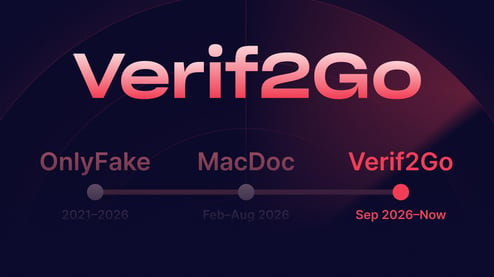
Within the fake document ecosystem, things can change fast. Four months ago, we reported that OnlyFake, the ...

In May 2026, a Dallas resident was convicted of running coin-operated “amusement machines” without a business ...

NEW YORK & PRAGUE – 1 October 2026 – Ocrolus, the AI workflow and analytics platform for lenders, today ...
For a few hundred dollars, sellers on Telegram promise to boost your credit score using someone else's credit ...

Key takeaways Fake certificates can use real numbers Fraudsters can copy a genuine business’s VAT number onto a ...