
In 2026, the US KYB landscape is undergoing some dramatic changes. FinCEN just announced some adjustments to the “2016 CDD Rule,” financial institutions are no longer required to identify and verify UBOs every time a customer opens a new account.
FinCEN cites efforts to modernize the Bank Secrecy Act framework while maintaining strong controls. Risk specialists know that strong controls are still more important than ever.
It’s not just an increase in fraud volume. It’s a fundamental shift in how fraud is executed. Criminals are no longer limited to manual forgery or basic edits. With generative AI and access to online document templates, they can now produce convincing business documents at scale.
Incorporation certificates, tax documents, business licenses, and state certificates can all be fabricated in minutes.
This shift has made KYB one of the most targeted workflows in financial services. Internal analysis shows that 12.5% of documents submitted during business verification fall into a high-risk category.
That makes US KYB workflows one of the most exposed entry points for fraud in the onboarding process. But what can organizations do to keep their documents and institutions safe from fraud? It all starts with knowing what's required and what resources you have at your disposal.
Many assume that KYB is regulated at the state level, with different laws across all 50 states. The reality is more complex. US KYB law is primarily driven by federal regulation, while states control how businesses are registered and what data is available for verification.
This guide breaks down US KYB law as it exists in 2026, starting with the federal foundation, then mapping how state-level differences impact document verification, risk, and fraud exposure across all 50 states.
How KYB law works in the US
US KYB law follows a consistent set of principles, regardless of which state a business operates in. Registration and corporate records are handled at the state level, federal laws establish what institutions must do.
In general, KYB obligations require organizations to:
- Confirm that a business is legally registered and active.
- Identify and verify beneficial owners and control persons.
- Assess the risk profile of the business.
- Monitor the relationship for changes or suspicious behavior.
These requirements apply across all states and form the baseline for any KYB program in the US.
To understand how these requirements came to be and how they apply in practice, we’ll now take a closer look at US KYB legislation, breaking it down law by law.
US federal KYB laws and regulations
US KYB law was developed over time in response to evolving financial crime risks.
The main goals of early regulation were always to fraud detection: track suspicious activity and prevent money laundering. Later updates introduced stricter identification requirements, including verifying the identity of businesses and the individuals behind them.
The result is a cumulative system. Each law builds on the last, expanding what institutions must collect, verify, and monitor. Together, these regulations form the foundation of KYB in the US, defining the obligations that apply across all states.
Below is a breakdown of the key federal laws that shape KYB today, in the order they were introduced and expanded.
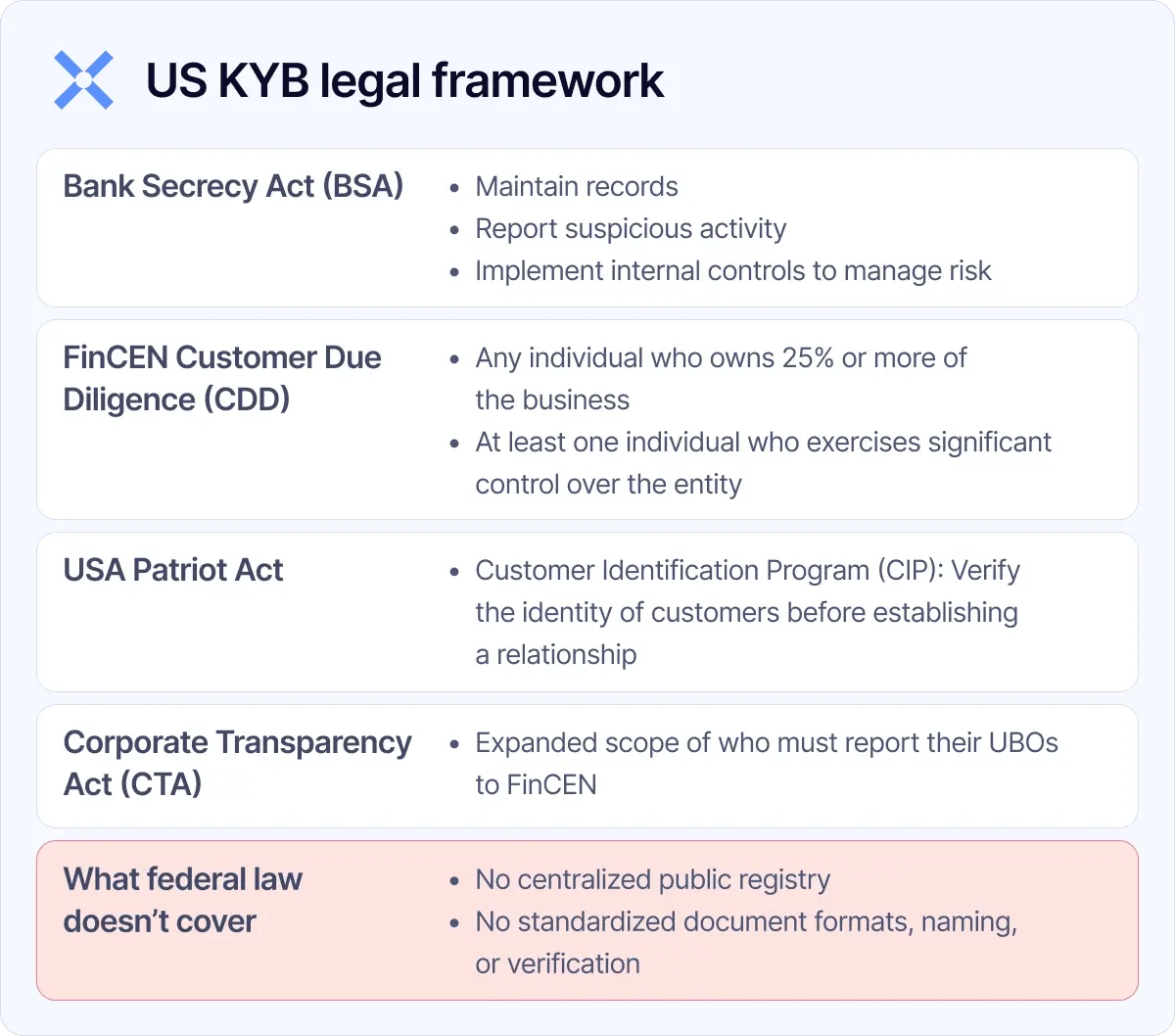
Bank Secrecy Act (BSA)
The Bank Secrecy Act was enacted in 1970 and is the foundation of AML and KYB obligations in the US. It established the requirement for financial institutions to assist in detecting and preventing financial crime.
Under the BSA, institutions must:
- Maintain records
- Report suspicious activity
- Implement internal controls to manage risk.
It does not explicitly define KYB as it is understood today, but it created the framework that all later business verification requirements are built on.
The BSA applies broadly to financial institutions, including: banks, credit unions, and other regulated entities.
USA PATRIOT Act
The USA PATRIOT Act expanded AML controls significantly after 9/11, introducing stricter identity verification requirements.
One of its most important contributions to KYB is the Customer Identification Program (CIP).
Under CIP, institutions must:
- Verify the identity of their customers before establishing a relationship. These requirements also apply to businesses, forcing institutions to collect and validate core business information.
This marked a shift from monitoring transactions to verifying identities at onboarding.
FinCEN Customer Due Diligence (CDD) Rule
The Customer Due Diligence Rule introduced more specific requirements around understanding who owns and controls a business.
Under this rule, financial institutions must identify and verify ultimate beneficial owners (UBOs).
This includes:
- Any individual who owns 25% or more of the business.
- At least one individual who exercises significant control over the entity.
This is often referred to as the ownership prong and the control prong.
The CDD Rule formalized a key part of KYB. It is no longer enough to verify that a business exists. Institutions must also understand who is behind it.
Corporate Transparency Act (CTA) and Beneficial Ownership Information (BOI)
The Corporate Transparency Act is the most recent major update to US KYB-related regulation.
It requires:
- Many companies report their beneficial ownership information directly to FinCEN.
This creates a centralized database of ownership data. However, it is not publicly accessible. Only authorized authorities and certain institutions can access it under specific conditions.
That means most organizations still cannot rely on this data directly in their KYB workflows. The CTA increases regulatory expectations while only partially improving data availability.
What federal law does not cover
Despite these layers of regulation, there are still significant gaps in the US KYB framework:
- No centralized public registry of businesses or beneficial owners. Each state maintains its own registration system, with varying levels of detail and accessibility.
- No standardized document formats or verification mechanisms. Businesses can submit a wide range of documents, often with inconsistent structures and formats.
Institutions must rely heavily on state-level data and submitted documents to meet federal requirements.
Why state-level differences matter for KYB compliance
US KYB law doesn’t change from California to Delaware to Wyoming. What does is how easy or difficult it is to fulfill them. That depends on the quality, accessibility, and transparency of state-level data.
States influence the inputs. Federal law defines the expectations.
This is where many KYB workflows begin to break down. Compliance teams are required to meet federal standards, but they often rely on fragmented, inconsistent, or incomplete data from state registries to do so. That gap is one of the main reasons KYB remains vulnerable to fraud.
States control how businesses are formed, what information is collected, and how that information is made available. As a result, KYB processes depend heavily on the quality and consistency of state-level data.
This varies significantly across the US.
Some states provide detailed, structured, and easily accessible business records. Others offer limited data, outdated systems, or minimal transparency. There is no standard for how information must be collected or shared, which means verification workflows can look very different depending on the state.
These differences typically show up in:
- Registry quality and reliability.
- Data accessibility and searchability.
- Verification standards at the point of registration.
- Transparency around ownership and control.
Certain states also allow relatively anonymous company formation. While this is often legal and intended to support business flexibility, it introduces additional risk when those entities are used to obscure ownership or move funds without clear accountability.
On top of that, delays and inconsistencies in registry updates can create blind spots. A business may appear active when it is not, or newly registered entities may lack sufficient history to assess risk properly. Meanwhile, many state registries display warning messages about unverified data, fraudulent entities in their databases, and their own lack of due diligence.
In practice, this enables a range of fraud tactics:
- Shell companies with little to no operational footprint.
- Nominee structures designed to hide beneficial ownership.
- Fake or manipulated business registrations used to pass initial checks.
That being said, the state-level sources are still useful. They show what each state makes available, where the blind spots are, and which records can support a risk-based KYB review. Below is a state-by-state breakdown so you can judge the quality, reliability, and usefulness of each source for yourself.
Let’s get started.
Alabama
Alabama KYB checks rely on Secretary of State business records, but public ownership visibility is limited and fraud-screening teams should not treat registration alone as proof of legitimacy.
- Registry authority. Alabama Secretary of State, Business Services and Business Entities Division.
- Public data availability. The Alabama Secretary of State Business Entity Records system by entity name, entity ID number, officer / agent / incorporator name, and reservation or registration ID. Other Alabama KYB-relevant statewide resources include UCC Records, Trademark Records, and Notary Public Records.
- Known risks / fraud exposure. The Alabama Secretary of State explicitly warns that it has received complaints about potentially fraudulent business filings present in its registry and that it is not authorized to investigate business fraud. Alabama corporations are also no longer required to file annual reports with the Secretary of State, which can reduce the freshness of registry-based KYB signals.
- KYB impact. Because Alabama corporations no longer file annual reports with the Secretary of State, teams may need fresher corroborating signals from tax, licensing, address, ownership, or business activity records.
- Unique documents. Business Privilege License, county Probate Judge or License Commissioner license, Municipal Business License, Certificate of Existence.
Alaska
Alaska KYB checks require both entity registration and business license review because the state separates corporate records from license, endorsement, and professional records.
- Registry authority. Alaska Department of Commerce, Community, and Economic Development, Division of Corporations, Business and Professional Licensing.
- Public data availability. Public search is available by entity number or entity name, with separate searches for corporations, business licenses,, and professional licenses.
- Known risks / fraud exposure. Alaska warns businesses about deceptive solicitations, and its business license search page states that the department does not verify information provided for a business license.
- KYB impact. Because Alaska separates entity registration from business licensing, teams should check both records and verify any required professional license or endorsement separately. Business license records should be checked, but not treated as verified business information.
- Unique documents. Business License Endorsement, Certificate of Compliance, and Certificate of Good Standing, Business Name Registration instead of DBA.
Arizona
Arizona KYB checks center on Arizona Corporation Commission records, with added attention to filing fraud, statutory agent data, and recently changed entity records.
- Registry authority. Arizona Corporation Commission, Corporations Division; Arizona Secretary of State for trade names, trademarks, Uniform Commercial Code filings, and some partnership filings.
- Public data availability. Public search is available by entity name, statutory agent name, principal name, entity ID, entity type, entity status, name type, and county through Arizona Business Center. Trade names, trademarks, Uniform Commercial Code filings, and partnerships are searched separately through the Arizona Secretary of State.
- Known risks / fraud exposure. The Arizona Corporation Commission says fraudulent filings and business identity theft continue to rise, and it adopted policies including two-form ID checks, signing authority controls, and LLC attestation measures to deter unauthorized filings.
- KYB impact. Arizona’s added ID, signing-authority, and LLC attestation controls make newer filings more reliable for KYB. Teams should focus extra scrutiny on older Arizona records created or amended before those safeguards, especially when legacy entities show new activity, ownership changes, or inconsistencies with onboarding claims.
- Unique documents. Statutory Agent Acceptance, Transaction Privilege Tax (TPT) License (No general statewide business license).
Arkansas
Arkansas KYB checks depend on Secretary of State business records and franchise tax standing, making payment and filing status a key state-specific signal.
- Registry authority. Arkansas Secretary of State, Business and Commercial Services Division.
- Public data availability. Public search supports lookup by corporation type, entity name, fictitious name, registered agent, registered-agent city/state, or filing number. Other Arkansas KYB-relevant statewide resources include Certificates of Good Standing search Corporations Bulk Data Download, and Business Entity Special Request List Builder, and UCC Search.
- Known risks / fraud exposure. Corporations, LLCs, banks, and insurance companies registered in Arkansas must pay annual franchise tax, and failure to pay can lead to fees, penalties, interest, revocation of authority to do business, and restrictions on future filings.
- KYB impact. Franchise tax standing should be treated as a freshness and authority signal because delinquent entities may be revoked or blocked from additional filings, even if an older entity record still exists.
- Unique documents. Certificate of existence, Sales and Use Tax Permit (No general statewide business license).
California
California KYB checks benefit from unusually accessible public filings and Statements of Information, but the business search has entity-type and data limitations that matter for verification.
- Registry authority. California Secretary of State, Business Entities.
- Public data availability. Business Search provides records by entity name or entity number, with advanced filters for entity type, entity status, and initial filing date range. Other California KYB-relevant statewide resources include UCC Search.
- Known risks / fraud exposure. California states that ownership, shareholder, subsidiary, and associated business information is not made part of the Secretary of State record, and required Statements of Information can trigger penalties or suspension/forfeiture if not filed.
- KYB impact. Statements of Information are useful freshness signals, but teams should not treat California filings as ownership evidence and should account for missing entity types, nonpublic ownership data, and possible suspension or forfeiture tied to missed filings.
- Unique documents. “Out-of-State” registration, Certificate of Status, Statement of Information, Seller’s Permit (No general statewide business license), Fictitious Business Name Statement, Agent for Service of Process designation.
Colorado
Colorado KYB checks benefit from searchable Secretary of State records, but filings are saved as registry records, not independently verified proof that the business information is accurate.
- Registry authority. Colorado Secretary of State, Business Division.
- Public data availability. Public search is available by business name, trademark, trade name, ID, or document number; the Business Entity Search also supports lookup by organization name or organizational ID number. Other Colorado KYB-relevant statewide resources include Advanced Search, Business Survey Information Search, and Trademark Advanced Search.
- Known risks / fraud exposure. Colorado has a formal complaint process for fraudulent business filings, and state law treats Secretary of State filings as ministerial records, meaning the office does not independently verify whether a submitted document is accurate.
- KYB impact. Because Colorado explicitly does not verify filing accuracy, teams should treat entity status, trade names, registered agent details, and certificates as registry signals only, then corroborate material business, ownership, address, and document claims independently.
- Unique documents. Statement of Foreign Entity Authority, Periodic Report, Standard Retail License (No general statewide business license).
Connecticut
Connecticut KYB checks are supported by detailed online business search access, including principal, agent, status, and annual report records.
- Registry authority. Connecticut Secretary of the State, Business Services Division, which manages business and commercial filings through Business.CT.gov.
- Public data availability. Connecticut’s Business Records Search supports lookup by business name, business ALEI, or filing number, with exact-name search and advanced search options. Other Connecticut statewide search resources include Lien Records Search, Trade and Service Marks Search, Business Data Portal.
- Known risks / fraud exposure. Connecticut’s principal and annual report records provide stronger relationship and freshness signals than a basic entity search, but they can still become stale between filing cycles or miss recent operational changes, and all present fields are not required to be filled out.
- KYB impact. Teams should use principal, agent, and filing history to check basic details, especially where submitted documents rely on older or inconsistent company information.
- Unique documents. Certificate of legal existence, Connecticut eLicense, Department of Consumer Protection License/Permit, Organization and First Report.
Delaware
Delaware is a major corporate formation hub for US and international entities, but its free public search provides limited verification value on its own.
- Registry authority. Delaware Department of State, Division of Corporations.
- Public data availability. Entity Search returns active and inactive entities, but Delaware states that search results only list business name and file number and are not an indication of current entity status. Separate paid services are available for status, filing history, franchise tax assessment, certificates, and document requests.
- Known risks / fraud exposure. Delaware’s scale and limited free public data create KYB friction, and corporations must file an annual report and pay franchise tax, making status, tax, and filing history checks important beyond name search.
- KYB impact. Teams should not rely on Delaware name search alone. Current status, franchise tax standing, registered agent details, and filing history often require additional Delaware searches, paid requests, certificates, or document orders.
- Unique documents. Delaware has a standard statewide business license and all other documents follow generic naming conventions.
Florida
Florida KYB checks benefit from Sunbiz’s broad search tools, especially for officer, registered agent, address, fictitious name, and document-pattern checks.
- Registry authority. Florida Department of State, Division of Corporations.
- Public data availability. Sunbiz supports searches by entity name, officer or registered agent, registered agent name, trademark, trademark owner, FEI/EIN, document number, ZIP code, and street address, with separate searches for fictitious names, partnerships, judgment liens, and federal liens. It provides information on all of this criteria in addition to the current activity/status of the business.
- Known risks / fraud exposure. Florida says the Division of Corporations is an administrative filing agency and accepts submitted documents “at face value.” The state also warns businesses to monitor Sunbiz records monthly for business identity theft, unauthorized changes, and incorrect entity information.
- KYB impact. Sunbiz is strong for relationship-pattern checks, but teams should treat officer, address, FEI/EIN, registered agent, and annual report changes as user-submitted registry data, not verified facts. Recent amended annual reports, reinstatements, or profile changes should be corroborated against tax, license, ownership, address, and document evidence.
- Unique documents. Certificate of Status, Local Business Tax Receipt (No general statewide business license), Annual Resale Certificate.
Georgia
Georgia KYB checks are supported by officer, agent, and annual registration searches, with annual registration acting as the main freshness signal.
- Registry authority. Georgia Secretary of State, Corporations Division.
- Public data availability. Business Search supports lookup by business name, control number, registered agent name, officer name, or designated agent name, with starts-with, contains, and exact-match options. Other statewide Georgia Secretary of State search resources include Service of Process Search and Trademark Search.
- Known risks / fraud exposure. Every business entity registered or filed with the Georgia Secretary of State must file an annual registration, and the state may administratively dissolve entities that fail to file or fail to maintain a registered agent or registered office.
- KYB impact. Annual registration status, registered agent continuity, and officer-name search are the key Georgia-specific checks. Teams should treat missing registrations, agent changes, administrative dissolution, or officer mismatches as triggers for deeper review.
- Unique documents. Certificate of Existence, Annual Registration, Occupational Tax Certificate.
Hawaii
Hawaii KYB checks run through the Department of Commerce and Consumer Affairs, with business registration, annual reports, certificates, officer data, and trade name records available through state systems.
- Registry authority. Hawaii Department of Commerce and Consumer Affairs, Business Registration Division.
- Public data availability. Business Check has multiple searches for Licensee Name, Licensee Complaint History, Business Name, and Business Complaint History. The most relevant information for KYB is under the “Business Name” search where you can find Name, Status, Registration Date, File Number, Description, and Remarks (from the office).
- Known risks / fraud exposure. Hawaii has reported delays in business registration services during its transition to a new IT system and portal, which can create timing issues when entity updates, filings, or certificates are needed for KYB review.
- KYB impact. Teams should account for possible processing delays and use annual reports, officer data, trade name records, and certificates to confirm whether registry information is current enough for the onboarding decision. During portal migration periods, teams should verify that records and certificates come from official Hawaii systems, and treat sudden filing changes, outdated records, or third-party filing requests as review triggers.
- Unique documents. General Excise Tax License.
Idaho
Idaho KYB checks rely on SOSbiz records, with annual reports and registered agent updates available online but processing delays create potential timing gaps.
- Registry authority. Idaho Secretary of State, Business Services.
- Public data availability. SOSbiz Business Search supports lookup by business name or file number. Business records can show filing type, status, duration, principal and mailing address, initial filing date, registered agent contact information, and filed documents; other statewide Idaho Secretary of State search resources include Trademark Search, UCC Search, Franchise Authority, and Notary Search.
- Known risks / fraud exposure. Idaho recently reported business filing processing times of approximately 15 to 20 business days, which can create a gap between submitted filings and visible registry updates.
- KYB impact. Teams should account for filing-processing lag when reviewing newly formed, recently amended, or recently agent-changed Idaho entities, and should avoid treating absent or outdated SOSbiz records as definitive during the processing window.
- Unique documents. Certificate of Existence, Regular Seller’s Permit (No general statewide business license), Certificate of Assumed Business Name.
Illinois
Illinois KYB checks rely on Secretary of State business records, annual reports, and certificates of good standing as the main status and freshness signals.
- Registry authority. Illinois Secretary of State, Department of Business Services.
- Public data availability. Business Entity Search supports lookup by business name, registered agent, president, secretary, manager, file number, keyword, or partial word. Other statewide Illinois Secretary of State search resources include UCC Search, Trademark/Servicemark Search, Notary Public Search, and other sources.
- Known risks / fraud exposure. Illinois requires annual reports for corporations, not-for-profits, and LLCs, and a certificate of good standing confirms compliance with the Department of Business Services.
- KYB impact. Teams should treat annual report status and good-standing certificates as the key Illinois freshness checks, especially when the entity has late filings, missing annual reports, or status issues in the Secretary of State record.
- Unique documents. Illinois Business Registration (No general statewide business license).
Indiana
Indiana KYB checks are centralized through INBiz, but some business activity, including sole proprietorships and general partnerships, may sit outside the Secretary of State registry.
- Registry authority. Indiana Secretary of State, Business Services Division.
- Public data availability. INBiz Business Search supports lookup by business name, business ID, filing number, registered agent name, incorporator or governing person name, plus advanced filters for entity type, status, name type, street address, city, and ZIP code. Other Indiana statewide registry resources include INBiz public search and UCC Browse.
- Known risks / fraud exposure. Indiana business entity reports are due every two years, and sole proprietorships and general partnerships do not register with the Secretary of State.
- KYB impact. Teams should treat absent INBiz records differently for sole proprietorships and general partnerships, and should use biennial entity reports, governing person or incorporator data, registered agent details, and address filters to spot stale records or mismatched applicant information.
- Unique documents. Certificate of Existence, Business Entity Report, Registered Retail Merchant Certificate.
Iowa
Iowa KYB checks benefit from a deep Secretary of State business database, including previous names, officers, directors, agents, and biennial report history.
- Registry authority. Iowa Secretary of State, Business Services Division.
- Public data availability. Business Entities Search covers active and inactive entities, with access to stock, addresses, previous names, agents, officers, directors, and trademarks. Other relevant searches and services include UCC Search, Trademark Search, and Notary Search.
- Known risks / fraud exposure. Iowa states that the Secretary of State’s Office is only a filing repository, makes no warranty about the correctness or completeness of filings, and does not determine whether a filer has authority to submit information.
- KYB impact. Iowa records are useful for entity history, officer, director, agent, and previous-name checks, but teams should treat new filings, amendments, or profile changes as unverified submissions and review the documents for fraud directly before assuming a business is legit.
- Unique documents. Biennial Report, Iowa Business Permit.
Kansas
Kansas KYB checks rely on Secretary of State records and biennial information reports, making filing history and report timing the main state-specific review points.
- Registry authority. Kansas Secretary of State, Business Services Division.
- Public data availability. Business Entity Search is available by business name or business ID with the ability to view and purchase documents such as information reports and annual reports. Additional searches include Business Name Availability, Trademark Search.
- Known risks / fraud exposure. If a Kansas business misses its information report deadline and remains delinquent for three months, it can move into “forfeited status.” Once forfeited, the business cannot file other documents with the Secretary of State until it submits past-due reports and is reinstated.
- KYB impact. Teams should treat forfeited status, recent reinstatement, or blocked filing ability as stronger Kansas risk signals than report cadence alone, especially when submitted business documents claim the entity is active, recently updated, or authorized to transact.
- Unique documents. Information report, Resident Agent Filing/Change, Kansas Business Tax License, Retailers’ Sales Tax Registration Certificate.
Kentucky
Kentucky KYB checks are supported by searchable Secretary of State records, with bad standing, administrative dissolution, and revocation status acting as the main state-specific risk signals.
- Registry authority. Kentucky Secretary of State, Business Filings.
- Public data availability. Business Entity Search is available by business name or organization number, city name of principal office, and zip code of principal office. Other relevant searches include Registered Agent Search, Name Availability, Current Representative, Founding Representative, Certificate of Existence/Authorization.
- Known risks / fraud exposure. Kentucky entities that fail to resolve annual report delinquency can be placed in bad standing, administratively dissolved, or have their authority to do business revoked. Reinstatement may require the Secretary of State to request good-standing checks from the Kentucky Department of Revenue and, for profit companies, the Division of Unemployment Insurance.
- KYB impact. Teams should treat bad standing, administrative dissolution, revocation, or recent reinstatement as review triggers, especially when submitted business documents claim the entity is currently authorized, operating normally, or in good standing.
- Unique documents. Certificate of Existence, Kentucky Sales and Use Tax Permit (No general statewide business license), Certificate of Assumed Name,
Louisiana
Louisiana KYB checks run through the Secretary of State’s Commercial Division, with geauxBIZ, officer search, agent search, and trade registration records supporting entity review.
- Registry authority. Louisiana Secretary of State, Commercial Division.
- Public data availability. Commercial Search is available by entity name, charter number, trade registration number, name reservation number, officer name, and agent name. Other relevant searches include Uniform Commercial Code Search (for a $30 fee).
- Known risks / fraud exposure. The Louisiana Secretary of State warns businesses about fraudulent mailers from non-government entities that are not affiliated with the office, making solicitation fraud and official-looking document impersonation relevant KYB concerns.
- KYB impact. Teams should be cautious when applicants submit Louisiana “compliance,” “certificate,” or filing-related documents from third parties, and should verify entity, officer, agent, and trade registration details directly through Commercial Search.
- Unique documents. Application for Authority to Transact Business in Louisiana, Occupational license (No general statewide business license).
Maine
Maine KYB reviews depend heavily on Secretary of State filing status and annual-report continuity, but registry records are self-reported filing data and the state separately warns businesses about deceptive compliance solicitations.
- Registry authority. Maine Secretary of State, Division of Corporations, Uniform Commercial Code, and Commissions.
- Public data availability. Corporate Name Search database with search by name (or keyword within the name) and charter number. Maine also advertises an Authentication service and UCC search.
- Known risks / fraud exposure. Maine describes its corporate search as providing only “general entity details,” and the public search is centered on name, charter number, status, and filing history rather than officer, manager, owner, or operating-address visibility. That creates a control-verification gap for LLCs and closely held entities where the registry may confirm the shell but not who actually runs or controls it.
- KYB impact. For Maine entities, a clean Secretary of State result should answer “does this entity exist and appear current?” but not “who controls it?” or “is this the operating business behind the application?” Risk teams should require control evidence from sources that actually name principals, such as annual report details where available, signed onboarding documents, banking records, contracts, regulated-license records, or verified commercial footprint.
- Unique documents. Retailer certificate. Statement of Intention to Transact Business Under an Assumed or Fictitious Name, Maine Revenue Services tax registration.
Maryland
Maryland KYB checks run through SDAT and Maryland Business Express, where entity status is useful but can lag when annual reports and personal property assessments are still being processed.
- Registry authority. Maryland State Department of Assessments and Taxation.
- Public data availability. Business Express supports lookup by business name and Department ID, and the search flow surfaces entity status, good-standing context, resident-agent information, annual-report/personal-property tabs, and document-ordering options. Other resources include: UCC search, verify Certificate of Status, and verify Authentication of Certified Copies.
- Known risks / fraud exposure. Maryland has a meaningful freshness gap around annual reports and business personal property processing: some filings update quickly, but complex Business Personal Property assessments or first-time online filers can take up to 90 days, and payment of a late filing penalty does not guarantee immediate Good Standing.
- KYB impact. For Maryland entities, current SDAT status may not fully reflect recently submitted reports, penalties, or personal property assessments. Risk teams should treat borderline status changes, recent reinstatement attempts, and “pending” annual-report or personal-property claims as timing-sensitive evidence gaps, especially when an applicant says a filing or payment has already been made but SDAT has not yet reflected Good Standing.
- Unique documents. Certificate of Status, Form 1 Annual Report, Business Personal Property Return, Trader’s License, Trader’s Show License.
Massachusetts
Massachusetts KYB checks combine a strong Secretary of the Commonwealth corporate search with a fragmented local DBA layer, so legal-entity verification and trade-name verification may sit in different places.
- Registry authority. Massachusetts Secretary of the Commonwealth, Corporations Division.
- Public data availability. Corporations Search supports searches by entity name, individual name, identification number, or filing number, including begins-with, exact-match, full-text, and Soundex options. Related registry-check tools listed by the Corporations Division include Corporation Card File Search, Corporate Rejected Filings Search, UCC Database Search, Liens Database Search, Trademark Database Search, Name Reservation Search, and E-Certificate Verification.
- Known risks / fraud exposure. Massachusetts DBA verification is decentralized: businesses using a name different from their legal name generally file a business certificate with the city or town where the business is located, rather than only through the state corporate registry. Mass.gov’s DBA resource is organized around local filing points, including a city/town lookup list.
- KYB impact. A Massachusetts corporate-search hit confirms the registered legal entity, but it may not connect that entity to the trade name used with customers, invoices, bank statements, or marketplace profiles. For Massachusetts applicants operating under a DBA, risk teams should identify the municipality tied to the operating location and check the local business certificate record rather than assuming the Secretary’s corporate record covers the public-facing business name.
- Unique documents. Business Certificate (No general statewide business license), Sales and Use Tax Registration Certificate.
Michigan
Michigan KYB checks run through LARA’s MiBusiness Registry Portal, where entity lookup is useful for status and filing review but recent agency-impersonation scams make official-channel verification especially important.
- Registry authority. Michigan Department of Licensing and Regulatory Affairs, Corporations Division.
- Public data availability. MiBusiness Registry Portal business entity search supports lookup by entity name or filing number. The same LARA online-services environment also points users to a trademark search.
- Known risks / fraud exposure. LARA has issued scam alerts about fraudulent emails impersonating agency officials, including messages referencing an “Action Required – LARA Enforcement Notice #83700” and requesting signatures or confidential information.
- KYB impact. Michigan applicants may present emails, notices, or annual-statement demands that look official but originate outside LARA.
- Unique documents. Application for Certificate of Authority to Transact Business in Michigan, Sales Tax License, Michigan Treasury Online business tax registration.
Minnesota
Minnesota KYB checks run through the Secretary of State’s MBLS business filings system, where registry monitoring is unusually relevant because the state explicitly tells businesses to watch for unauthorized record changes.
- Registry authority. Minnesota Secretary of State, Business and Liens.
- Public data availability. Business Filings Online supports business-filing lookup by business name and file number. License holders are handled separately through the Minnesota Department of Commerce, and lien-related searches are available through the Secretary of State’s UCC and CNS search resources.
- Known risks / fraud exposure. Minnesota’s business-data guidance notes that a name search can only return an individual or organization if that name is in the database, and that previous names may not be in the database or may not appear in search results. That creates a historical-name and principal-matching gap when an entity has changed names, reused an assumed name, or presents principals whose names are not captured in the Secretary of State data.
- KYB impact. For Minnesota entities, a clean business-name search should not be treated as a complete negative match on prior identities or related principals. Risk teams should run prior-name searches where available, preserve file-number continuity across name changes, and use non-registry evidence to connect the applicant to principals or earlier operating names when the SOS database does not surface those relationships.
- Unique documents. Minnesota eLicensing license/permit, Certificate of Assumed Name.
Mississippi
Mississippi KYB checks benefit from unusually useful business-search options, including officer-name lookup, but the Secretary of State has also flagged fraudulent entity filings using other people’s personal information.
- Registry authority. Mississippi Secretary of State, Business Services Division.
- Public data availability. Business Search supports lookup by business name, Business ID, officer name, or registered agent, with match options including starting with, all words, any words, sounds like, and exact match. Additional registry-check resources listed by the Secretary of State include Business Reports, Public UCC Search, Search MS Trademarks.
- Known risks / fraud exposure. Mississippi’s Secretary of State warned in June 2025 of an increase in fraudulent business filings, saying scammers were using another person’s name, address, or personal information to create fraudulent business entities; the office also notes that, in most cases, once business documents are filed, it cannot adjust or remove the information from the public record by statute.
- KYB impact. For Mississippi entities, the fraud risk is not just stale status; it is the possibility that the entity record itself was created with misappropriated identity data that may remain visible in the registry. Risk teams should use the officer-name and registered-agent search paths to check whether the same personal details appear across unrelated entities.
- Unique documents. Certificate of Fact, Sales Tax Permit.
Missouri
Missouri KYB checks run through the Secretary of State’s business search, where registered-agent and fictitious-name records are important because Missouri ties loss of agent coverage to entity status consequences.
- Registry authority. Missouri Secretary of State, Business Services Division.
- Public data availability. Business Entity Search supports lookup of registered organizations through business name, registered agent, name availability, and charter number. Registry-check tools available from the Business Services online-services page also include a “verify certificate” tool.
- Known risks / fraud exposure. Missouri treats registered-agent failure as a status risk: if an entity fails to maintain a registered agent, the state can administratively dissolve a domestic corporation, revoke a foreign entity’s authority, or cancel other entity registrations.
- KYB impact. Risk teams should treat missing, recently changed, or inconsistent agent/address records as possible signs of status instability or authority problems.
- Unique documents. Registration Report, Retail Sales License.
Montana
Montana KYB checks run through the Secretary of State’s online filing portal, where the public record is useful for status and filing review but search results are intentionally limited unless narrowed through advanced search.
- Registry authority. Montana Secretary of State, Business Services.
- Public data availability. Business Search supports lookup by entity name or file number, with advanced search available to narrow limited results by status, county, type, subtype, state and registration/expiration date. Other registry-check resources include Liens Search, Trademark Search, Notary Search, and CRA Search.
- Known risks / fraud exposure. Montana’s business search warns that results are limited and instructs users to use advanced search to narrow them; its UCC/lien search similarly caps results at 100 and notes that online lien results are not certified.
- KYB impact. Risk teams should search by file number where available, rerun name searches with advanced filters, and treat uncertified lien-search results as screening leads rather than conclusive lien evidence.
- Unique documents. eStop Business License, City Endorsement, Business licenses are only handled at the county/city level.
Nebraska
Nebraska KYB checks run through the Secretary of State’s Corporate & Business Search, where broad name-matching is useful for entity discovery but document and record completeness varies by filing age, document size, and entity type.
- Registry authority. Nebraska Secretary of State, Business Services Division.
- Public data availability. Corporation and Business Search supports lookup of Name Starts With, Name Keyword Search, Name Sounds Like, Name Exact Match, and Account Number. The same search page also links to Special Requests for batch corporate records, online certificate-of-good-standing validation, and purchasable images of filed documents.
- Known risks / fraud exposure. Online filing images are typically available for post-March 10, 1999 documents within three business days, but older documents and filings longer than 40 pages may not be available online.
- KYB impact. When an applicant has older filings, large filings, or a sparse batch-record footprint, risk teams should treat the missing online image or absent officer/agent data as a Nebraska-specific evidence gap.
- Unique documents. Sales Tax Permit.
Nevada
Nevada KYB checks run through SilverFlume and Secretary of State online services, where entity status, registered-agent data, annual lists, and state business license signals matter because Nevada is both a high-volume incorporation state and a portal-transition state.
- Registry authority. Nevada Secretary of State, Commercial Recordings Division.
- Public data availability. SilverFlume Business Search provides lookup by entity name, entity number, Nevada Business ID number, officer first/middle/last name, registered agent name, mark number, goods and services, or applicant name, with filters for entity type and status. Registry-check resources also include Apostille Verification and Certificate Verification.
- Known risks / fraud exposure. Nevada is actively replacing SilverFlume with ORION, and the Secretary of State has separately warned that commercial-recordings system upgrades affect how bulk business, UCC, and Non-Title 7 business-licensing data are published.
- KYB impact. For Nevada entities, stale portal exports or legacy SilverFlume results should not be treated as equivalent to a current Secretary of State check. Risk teams should re-run high-risk entities in the active Nevada SOS search environment, confirm whether UCC or business-license data has moved to ORION.
- Unique documents. Annual list, Certificate of Business: Fictitious Firm Name.
New Hampshire
New Hampshire KYB checks run through QuickStart, where entity records are accessible and document-heavy, but the Corporation Division frames itself as a filing agency rather than a verifier of business legitimacy.
- Registry authority. New Hampshire Secretary of State, Corporation Division.
- Public data availability. Business Search supports lookup by business name, Business ID, Registered Agent Name, or Filing #, with name-match options such as starts with, contains, exact match, and all words. The QuickStart search environment also includes certificate verification.
- Known risks / fraud exposure. New Hampshire’s Corporation Division states that the division is a “filing agency.” That creates a filing-repository limitation: the state record can show what was filed, but should not be read as state verification of the filer’s ownership, control, operating facts, or business purpose.
- KYB impact. For New Hampshire entities, a QuickStart match should establish the registered record, current status, filing history, and registered-agent footprint, but not who actually controls the business or whether the applicant’s operating story is true.
- Unique documents. Business licenses are industry specific.
New Jersey
New Jersey KYB checks run through DORES Business Records Service, where search coverage is broad across entities, trade names, and marks, but annual-report filing solicitations create a recurring impersonation risk around official-looking compliance demands.
- Registry authority. New Jersey Department of the Treasury, Division of Revenue and Enterprise Services (DORES).
- Public data availability. The NJPortal has a Business Entity Name Search that supports lookup by Business Name, Entity ID, and Keyword. The same search service covers UCC search and business name availability.
- Known risks / fraud exposure. DORES explicitly warns New Jersey businesses to use caution with private companies and individuals offering to prepare or file Articles of Incorporation, professional corporation forms, LLC forms, annual reports, and similar required filings.
- KYB impact. Risk teams should treat third-party filing invoices, private filing-service confirmations, and mismatched annual-report claims as potential impersonation or document-quality signals, then use Business Records Service status reports and standing certificates to confirm the entity’s actual state record.
- Unique documents. Standing Certificate, Business Registration Certificate.
New Mexico
New Mexico KYB checks run through the SOS Enterprise portal, where the live business record is useful for entity and filing review but can lag behind recently submitted filings.
- Registry authority. New Mexico Secretary of State, Business Services Division.
- Public data availability. Business Search supports lookup by Name or File Number with advanced options for “Starts With,” Name Availability, Entity Type, Status, and Registration Date. The same SOS environment also supports Lien, Notary, Trademark, and Service of Process search.
- Known risks / fraud exposure. New Mexico’s Secretary of State website includes a broad accuracy disclaimer, warning that despite good-faith efforts, its pages and databases may contain “inadvertent errors” and that website information is not a substitute for legal research.
- KYB impact. For New Mexico entities, treat the SOS record as a registry baseline rather than a verified-facts source.
- Unique documents. Business Report, New Mexico Business Tax Identification Number (No general statewide business license).
New York
New York KYB checks are unusually important in 2026 because the state now collects beneficial-owner disclosures for covered foreign LLCs, but that limited-access ownership layer sits outside the ordinary public business search.
- Registry authority. New York Department of State, Division of Corporations, State Records, and Uniform Commercial Code.
- Public data availability. Corporation and Business Entity Database supports lookup through the Department of State Public Inquiry system by entity name, type, entity list (Corporation, LLC, LLP, & LP), with a modifier for “Search Functionality (i.e., “Begins with”). Separate Department of State resources include UCC search, Lien Search, and Certificate Authentication.
- Known risks / fraud exposure. New York is one of the few states with a state-level beneficial-owner disclosure regime, effective January 1, 2026, but it is narrow: it applies to non-exempt LLCs formed under foreign-country law that are authorized to do business in New York, and the disclosures are not the same as ordinary public registry records.
- KYB impact. Risk teams should first determine whether the applicant is a covered foreign LLC subject to New York’s Beneficial Owner Disclosure rules; for domestic entities, exempt entities, or records visible only in the public Corporation and Business Entity Database, ownership and control still need to be resolved through non-public onboarding evidence rather than inferred from entity existence, assumed-name filings, or biennial-statement data.
- Unique documents. Application for Authority, Certificate of Authority, Business Certificate/Certificate of Assumed Name (DBA).
North Carolina
North Carolina KYB checks are supported by real-time Secretary of State search tools, but the state’s own warnings make annual-report solicitations and filing-service impersonation a practical fraud concern.
- Registry authority. North Carolina Secretary of State, Business Registration Division.
- Public data availability. Business Registration Search supports lookup options for “Company By Name,” “Starting With (Any, All, Exact Match),” and “Organization Name.” They also have searches for Assumed Business Names, Business Registration Changes, Data Subscriptions for bulk orders, and UBO reporting program.
- Known risks / fraud exposure. North Carolina repeatedly warns businesses about misleading mailings and emails that use company details to appear official, including solicitations tied to annual reports, certificates of existence, and other filing services. The Secretary of State notes that some solicitations charge far more than state filing fees and may reference filings that are not actually required, such as annual minutes.
- KYB impact. Risk teams should treat “priority” annual-report offers, certificate-order forms, and fee demands as impersonation or solicitation signals, then use the live Secretary of State record to determine the actual entity status, report obligation, and filing history.
- Unique documents. Certificate of Registration for Sales and Use Tax (No general statewide business license).
North Dakota
North Dakota KYB checks run through FirstStop, where the Secretary of State makes filed records searchable but does not warrant the accuracy, reliability, or timeliness of the information published through the system.
- Registry authority. North Dakota Secretary of State, Business Services.
- Public data availability. FirstStop Business Search supports lookup through name or system ID number. Registry-check resources available from the same FirstStop page include Trademark, Contractor, Lobbyist, Charitable Organization, and Notary.
- Known risks / fraud exposure. North Dakota’s Secretary of State disclaimer says that, although the office tries to keep information accurate and up to date, the state does not warrant the “accuracy, reliability, or timeliness” of information published through the system.
- KYB impact.. Risk teams should treat conflicting addresses, stakeholder claims, recent annual-report updates, or agent changes as evidence gaps to resolve with source documents and commercial proof that actually ties the applicant to the business.
- Unique documents. North Dakota Sales Tax Permit (No general statewide business license).
Ohio
Ohio KYB checks are supported by searchable Secretary of State filing records and document images, with an unusually explicit business-identity-theft process for unauthorized filings and misused names or addresses.
- Registry authority. Ohio Secretary of State, Business Services Division.
- Public data availability. Business Search supports lookup by business name, exact business name, prior business name, agent/registrant name, incorporator name, business ID, filing number, and document ID. Other statewide Secretary of State search resources include UCC Search.
- Known risks / fraud exposure. Ohio specifically recognizes fraudulent business filings where a person’s name or address is used without consent, or where someone submits a document on an existing business without authority to change the record.
- KYB impact. For Ohio entities, risk teams should verify identities and financial documents independently to see if they match the actual business and if that person knows their name/address is being used.
- Unique documents. Foreign Registration Statement and Appointment of Statutory Agent, Vendor’s License.
Oklahoma
Oklahoma KYB checks run through the Secretary of State’s business entity search, where the registry is useful for entity confirmation but gives only a preliminary lookup before deeper record review.
- Registry authority. Oklahoma Secretary of State, Business Filing Department.
- Public data availability. Search Corporation Entities supports lookup by entity name, with advanced search options like Filing Number, Name Availability, Registered Agent, Name of Person, and specific business types (i.e., banks, churches). Other statewide Secretary of State search resources include Trademark and Name Availability.
- Known risks / fraud exposure. Oklahoma has a state/local operating-authority split: the state business FAQ says some common business activities do not require a state license, but counties and municipalities may still require licenses or permits, and many businesses may need another license, permit, or filing action to operate.
- KYB impact. For Oklahoma entities, risk teams should map the applicant’s activity and operating address to the relevant city, county, or regulator, especially for location-dependent or regulated businesses, instead of treating SOS registration or good standing as evidence of operating permission.
- Unique documents. Certificate of Qualification, Annual Certificate, Sales or Use Tax Permit (No general statewide business license).
Oregon
Oregon’s KYB wrinkle is name ambiguity: the state registry can show an entity or assumed business name, but Oregon itself warns that registration does not equal licensure, exclusivity, or complete coverage of every business using that name.
- Registry authority. Oregon Secretary of State, Corporation Division.
- Public data availability. Business Name Search supports lookup by business name or business registry number; the Active Business Registration Records search can also be performed for more thorough data analysis. Other statewide registry-check resources from the Corporation Division include Trademark Search and UCC search.
- Known risks / fraud exposure. Oregon’s own FAQ makes two KYB-relevant limitations explicit: registering a business name is not the same as getting a license, and registering a name does not necessarily give the registrant the legal right to use it.
- KYB impact. For Oregon entities, a name match in the state registry should not be treated as proof that the applicant is licensed or has exclusive rights to that name. If the business uses an assumed name, risk teams should check where that name is registered, whether the same or similar name appears in other counties, and whether the applicant’s activity requires a separate state, city, county, or industry license.
- Unique documents. No statewide business license equivalent. Businesses must register with the state’s Oregon Business Registry or obtain an “Assumed Business Name.” Oregon Department of Revenue business tax registration.
Pennsylvania
Pennsylvania KYB checks now have a sharper freshness dimension because the state’s new annual-report regime adds recurring status data to a registry that only shows principal information when available.
- Registry authority. Commonwealth of Pennsylvania, Bureau of Corporations and Charitable Organizations.
- Public data availability. Free Business Search supports lookup by business name or entity/file number. Other statewide Department of State registry resources include UCC, Trademark, and CROP.
- Known risks / fraud exposure. Pennsylvania’s business search is explicitly a filing-repository system: the Department of State says website information comes from records submitted for filing, makes no warranty as to accuracy, completeness, reliability, or timeliness, and says a business registration is not an endorsement by the Department.
- KYB impact. Risk teams should use the registry to confirm entity identity, status, filing history, and any available officer or governor fields, then resolve control, address, and operating-activity questions through evidence outside the filing repository.
- Unique documents. Certificate of Subsistence, Pennsylvania Online Business Tax Registration, No general statewide business license.
Rhode Island
Rhode Island gives KYB teams more search angles than many small-state registries, including individual-name, agent, address, purpose, and NAICS searches, which makes it useful for spotting related entities and inconsistently presented business identities.
- Registry authority. Rhode Island Department of State, Business Services Division.
- Public data availability. Corporate Database supports lookup by entity name, individual name, identification number, filing number, agent name, business address, purpose, or NAICS code. Additional statewide registry-check resources include Search Assistant, UCC Public Search and Trademark/Service Mark Search.
- Known risks / fraud exposure. Rhode Island’s search assistance notes that identification number, individual name, filing number, agent, business address, purpose, and NAICS Code searches return results from both active and inactive databases, while the active database is the default unless inactive status is selected.
- KYB impact. For Rhode Island applicants, run more than a simple entity-name search when the risk profile depends on prior entities, repeated addresses, shared agents, or related principals.
- Unique documents. Permit to make sales at retail (No general statewide business license), Business Application for Registration.
South Carolina
South Carolina KYB checks center on Secretary of State entity and registered-agent records, with officer, director, and member verification often requiring evidence from other state, tax, corporate, or operating records.
- Registry authority. South Carolina Secretary of State, Business Entities Division.
- Public data availability. Business Entities Online supports search by business name, and Registered Agent Search supports lookup by full or partial registered-agent name. Other statewide Secretary of State registry resources include UCC Search, Trademark Search, Charities Search, and several other public databases.
- Known risks / fraud exposure. South Carolina’s wider public-data environment is stronger than many states for cross-checking an entity’s footprint. KYB teams can enrich the SOS record against adjacent public databases covering registered agents, UCC filings, trademarks, charities, raffles, professional fundraisers, and business opportunities.
- KYB impact. For South Carolina entities, the best use of public records is not a single SOS lookup but a cross-checking workflow. Risk teams should use the Secretary of State record as the entity anchor, then compare names, agents, addresses, filings, and activity clues across other state databases to identify mismatches, related entities, or missing context.
- Unique documents. Retail license (County level business license if applicable), South Carolina Department of Revenue Business Tax Account.
South Dakota
South Dakota KYB checks benefit from a practical Business Information Search and annual-report records that can add useful management and filing-history context beyond a basic active/inactive result.
- Registry authority. South Dakota Secretary of State, Division of Business Services.
- Public data availability. Business Information Search supports lookup by Name or Business ID, with “starts with,” “contains,” and “active entities only” options. Other statewide Secretary of State registry resources include Name Availability Search, Search for Registered Agents, and a Foreign Beneficial Owner Report (for Agricultural land owners).
- Known risks / fraud exposure. South Dakota’s Secretary of State says owners of corporations and LLCs are not filed with the office; only organizers for LLCs and incorporators or directors for corporations are filed, with limited exceptions for certain shareholder filings. Annual reports can add management or governor information, but the state record is still not a full ownership file.
- KYB impact. For South Dakota entities, use the SOS record to confirm entity status, registered-agent details, and any filed management information, but do not treat it as an ownership record. When ownership or control matters, request current evidence that names the people authorized to manage or represent the business.
- Unique documents. South Dakota Sales Tax License (No general statewide business license).
Tennessee
Tennessee KYB checks get practical lift from officer and registered-agent search, which can help connect entities that share people, agents, or filing patterns across the Secretary of State record.
- Registry authority. Tennessee Secretary of State, Division of Businesses.
- Public data availability. Business Entity Search allows lookup by Business Name or Control Number. Other statewide Secretary of State database resources include Charity Search, Trademark/Service Mark search, certificate verification, UCC search, and several other resources.
- Known risks / fraud exposure. Tennessee does not recognize “DBAs” or fictitious names in the way many states do; it uses assumed names, which are valid for five years and renewable.
- KYB impact. For Tennessee entities, check whether the public-facing business name is an active assumed name, not an informal DBA label.
- Unique documents. Charter (for corporations), Standard Business License.
Texas
Texas KYB checks need a two-system view: Secretary of State filings identify the legal entity, while Comptroller records show franchise-tax standing and public-information or ownership-report data.
- Registry authority. Texas Secretary of State, Business and Public Filings Division; Texas Comptroller of Public Accounts.
- Public data availability. SOSDirect supports business-entity searches through the Secretary of State (but it is one of the only states to require registration and payment to access the database). The Comptroller’s Franchise Tax Account Status Search supports lookup by 11-digit taxpayer number or 9-digit Federal Employer Identification Number. Other statewide company-information resources include Comptroller Taxable Entity databases.
- Known risks / fraud exposure. Texas has an explicit fraudulent-UCC-filing control: under Texas Government Code Section 405.022, the Secretary of State may ask the Attorney General to determine whether a document is fraudulent before filing it in the Uniform Commercial Code records, and the Attorney General can decide whether legal action should be taken against fraudulent filers.
- KYB impact. For Texas entities, UCC records should be reviewed as potential risk signals, not just collateral data. Risk teams should investigate unusual secured-party names, liens against unrelated parties, filings that do not match the applicant’s financing story, or UCC records connected to known fraudulent-filing patterns.
- Unique documents. Certificate of Face — Status, Public Information Report, Certificate of Formation or Assumed Name Certificate (may satisfy business license requirements).
Utah
Utah gives KYB teams a relatively useful principal-search layer inside the Division of Corporations record, making it possible to search both from entity-to-principal and principal-to-entity rather than relying only on a business-name match.
- Registry authority. Utah Department of Commerce, Division of Corporations and Commercial Code.
- Public data availability. Business Entity Records supports lookup by Entity Name, Entity Number, Principal Name, Domicile Name, Assumed Named, and Registered Agent Name with advanced search options for Entity Type, Domesticity, Status, Status Reason, and Entity & Status Date. Other statewide Division of Corporations search resources include Business Entity List, UCC/CFS Search, Trademark Search, and a few other databases.
- Known risks / fraud exposure. Utah draws an important line between entities created by filing and records that are only notice filings. The Division says corporations and LLCs are created by filing with the Division, but “all other filings are notice filings” and those entities can exist without being filed with the Division.
- KYB impact. For Utah entities, use the Division record to confirm filed corporations, LLCs, registered names, principals, agents, and UCC records, but be careful with negative searches on partnerships or other notice-filing categories.
- Unique documents. Utah State Business and Tax Registration (No general statewide business license).
Vermont
Vermont KYB checks can use the state’s unusually flexible business search for principal, agent, filing-number, and record-status review, but the registry still works best as a filed-record map rather than a complete picture of the business.
- Registry authority. Vermont Secretary of State, Business Services Division.
- Public data availability. Business Search can query via business name, record number, record type, record status, initial filing date, principal name, filing number, election types, or registered agent name. Other statewide Secretary of State registry resources include Trademark Search, Amusement rides, and Telemarketers.
- Known risks / fraud exposure. Vermont’s Business Services Division maintains more than standard entity records: it also registers assumed business names, telemarketers, data brokers, fantasy sports operators, amusement ride operators, trademarks, and UCC filings.
- KYB impact. For Vermont entities, start with the business record, then use the relevant adjacent Vermont database only when it matches the applicant’s actual activity.
- Unique documents. Business Tax Account, Sales Tax License (No general statewide business license).
Virginia
Virginia KYB checks have strong document depth through the Clerk’s Information System, including filing history, registered-agent history, and downloadable filing images without requiring a login.
- Registry authority. Virginia State Corporation Commission, Clerk’s Office.
- Public data availability. Clerk’s Information System Business Entity Search supports standard and advanced business-entity searches for Entity Name, Entity ID, Filing Number, Principal Name, Registered Agent Name, & Designee Name. It also has UCC search on the same page, Name Availability, and Certificate Verification.
- Known risks / fraud exposure. Virginia CIS provides filing history, registered-agent history, and downloadable filing images, so the risk is not lack of access but shallow review. A current status check can miss relevant context if prior filings, agent changes, or name changes are not reviewed.
- KYB impact. For Virginia entities, use CIS as a record-history tool, not just a status lookup. Review filing history, registered-agent history, and available filing images when the applicant has recent changes, uses an older certificate, or presents information that does not match the current SCC record.
- Unique documents. Business, Professional, and Occupational License (locally administered, no general statewide business license), Virginia Tax Registration, Sales Tax Certificate.
Washington
Washington KYB checks need the UBI number to travel across systems: the Secretary of State record identifies the legal entity, while business licensing and some operating permissions sit with other state or local agencies.
- Registry authority. Washington Secretary of State, Corporations and Charities Division.
- Public data availability. Corporation Search can search by business name or Unified Business Identifier (UBI) number, with Advanced Search for business type, business status, principal office city, principal office state, expiration date, jurisdiction, formation/registration date, and nature of business. Other statewide Secretary of State registry resources include Charity/Fundraiser/Trust Search, and Trade Mark Search on the same page.
- Known risks / fraud exposure. Washington separates entity registration from business licensing: the state business roadmap says the Secretary of State issues the UBI and formation documents, but businesses must file a Business License Application with the Department of Revenue to be recognized as a Washington business, and may also need city or county licenses depending on where they operate.
- KYB impact. For Washington entities, an SOS corporation search should confirm the legal record and UBI, not the full right to operate. Risk teams should use the UBI to connect the SOS entity record to Department of Revenue business-licensing records and any required city, county, or industry licenses.
- Unique documents. Foreign Registration Statement, Washington State Business License (with relevant City Endorsements).
West Virginia
West Virginia offers one of the more filter-heavy KYB search experiences, letting reviewers move beyond a name match into agent, officer, address, county, status, purpose, employee-count, and ownership-category clues.
- Registry authority. West Virginia Secretary of State, Business and Licensing Division.
- Public data availability. Business Organization Search (same page as business home) supports lookup by organization name and agent/officer/name; advanced search adds Record ID, street address, city, county, state, organization type, secondary organization type, business type, charter type, effective date, active/inactive status, termination, business purpose, employees, West Virginia employees, woman-owned, minority-owned, owner military, veteran / active military owned, and young entrepreneur filters. Other statewide Secretary of State registry resources include UCC search, trademark search, service-of-process status check, business entity data list, and its own AI chatbot assistant.
- Known risks / fraud exposure. West Virginia’s business search carries an explicit data-quality disclaimer: the Secretary of State says it makes reasonable efforts to ensure accuracy, but makes no representation or warranty as to the correctness or completeness of the information. Entity detail pages also state that if information is missing, it is not in the Secretary of State database.
- KYB impact. The West Virginia KYB caveat is that the enriched profile is only as reliable as the underlying state databases: missing fields, stale filings, or inconsistent agent/officer/address data should be treated as evidence gaps to resolve with current operating records, not as facts the state has verified.
- Unique documents. Business Registration Certificate, Trade Name (DBA) Registration.
Wyoming
Wyoming KYB checks carry formation-state risk: WyoBiz makes entity, agent, annual-report, trade-name, and filing records accessible, but the public record remains centered on registration and compliance status.
- Registry authority. Wyoming Secretary of State, Business and UCC Center.
- Public data availability. Business Center Search supports lookup by filing name or Filing ID. Other statewide Secretary of State registry resources include Online Certificate of Good Standing, Commercial Registered Agents roster.
- Known risks / fraud exposure. Wyoming explicitly limits what “good standing” means: it only tells the public that required formation or maintenance paperwork and fees have been filed with the Secretary of State and are current. The state says good standing is not an endorsement of the business and says nothing about the quality of its products or services.
- KYB impact. For Wyoming entities, good standing should be treated as a registry-maintenance signal, not a legitimacy signal. Risk teams should use WyoBiz to confirm status, registered agent, annual-report standing, trade names, and filed documents, then assess the business itself through operating evidence, licensing where relevant, counterparties, transaction history, and commercial footprint.
- Unique documents. Wyoming Sales Tax License (No general statewide business license), Wyoming Internet Filing System for Business tax account.
Methodology: KYB resources state by state
There is no single place to check every entity record, filing, license, tax status, trade name, UCC record, or state-specific business document.
Even within one state, useful KYB data may sit across Secretary of State portals, tax agencies, licensing boards, UCC systems, charity databases, trademark searches, and local business-license offices.
Those sources often live on different domains, use different terminology, require different search inputs, and expose different levels of detail.
Finding the right source has also become harder. Search results are increasingly crowded with SEO pages, private filing services, AI summaries, and unofficial “how to register a business” content that can outrank or obscure the actual government database.
In some states, the official registry pages are poorly labeled, buried inside legacy portals, or missing basic metadata like clear page titles and meta descriptions. For KYB teams, that makes manual lookup slower and riskier: the challenge is not just knowing what to check, but finding the legitimate source quickly and understanding what that source can and cannot prove.
For each state, we reviewed the official business registry and adjacent public databases most relevant to KYB. Our focus was practical: what can a fraud, AML, or compliance team actually search, verify, and use during onboarding or review?
UBO registry note. Most state business registries do not provide public beneficial ownership information. Some show officers, directors, managers, members, principals, incorporators, or registered agents, but those roles do not necessarily identify who ultimately owns or controls the business. For each state, we focused on the registry data KYB teams can actually use: visible roles, search fields, filings, status records, and meaningful limitations.Public data availability. We identified the primary business search database for each state, the search terms it supports, the information it returns, and any other official statewide lookup options useful for KYB, such as UCC searches, trademark databases, charity registries, registered-agent searches, certificate validation, licensing lookups, or public-data downloads.
Unique documents and terminology. We tracked state-specific or uncommon document names, especially around business licenses, tax registration, trade names, and authorization to do business. These vary heavily by state and can create confusion during KYB review. Where terms like “authorization,” “certificate,” “endorsement,” or state-specific license names appear, we included them to support a practical glossary for later use. Unless explicitly stated otherwise, a “business license” or state-level equivalent should be assumed to apply universally statewide.
High-risk US States for KYB
No state is automatically “high risk” for KYB. A Delaware LLC, Wyoming LLC, or New Mexico LLC can be completely legitimate. The risk comes from how certain state formation systems can be used when criminals want speed, low friction, and limited public visibility.
Some states are commonly associated with higher KYB scrutiny because they offer business-friendly formation processes, broad registered agent ecosystems, and limited public ownership information.
Delaware describes itself as a leading domicile for US and international business entities, Wyoming provides fast online formation and filed-document access through WyoBiz, and New Mexico provides public business record searches through its Secretary of State portal.
Those systems are useful for legitimate businesses, but they can also be attractive to fraudsters who want an entity that looks real enough to pass onboarding.
These states tend to matter in KYB because they can support:
Anonymous or low-visibility LLC formation.Registered agent layering.
Shell companies with little operational footprint.
Fast formation before account opening.
Business records that confirm existence, but not real activity.
Limited public visibility into ownership and control.
The state registry tells you whether the business exists on paper. KYB has to answer the harder question: whether the business is real, controlled by the people claiming it, and behaving like the business it says it is.
They generally cannot prove that the company is operational, that the people behind it are the real controllers, or that the documents submitted around the entity are authentic.
That matters because a fraudster can register a real LLC and still support it with fake bank statements, synthetic invoices, manipulated tax forms, fabricated proof of address, or template-based business documents.
Every state lookup works differently. Search fields, terminology, document access, login requirements, database reliability, filing visibility, and update timing all vary from state to state. You have to factor that in as well.
Turning KYB review into a point-and-shoot manual registry slog creates blind spots, and high-risk documents will slip through them.
That is why AI document verification matters: it checks the documents directly, detects manipulation and inconsistency, and connects the evidence back to the applicant instead of forcing teams to jump from registry to registry blindfolded.
Conclusion
US KYB law is not 50 separate compliance frameworks. It is one federal obligation forced to operate through 50 different state registration systems.
That fragmentation is exactly where fraud slips through. A company can be real on paper while the business story around it is fake. Registry checks are necessary, but they are not enough.
Resistant Document AI-powered document fraud detection software checks the documents directly. Instead of jumping from registry to registry and hoping every state database is accurate, available, and current, teams can detect fraud across virtually any document type in under 20 seconds.
From Maryland to Idaho, and everything in between. Faster review, stronger evidence, fewer high-risk documents slipping through.
Scroll down to book a demo

Fraud awareness, examples, and lessons
Learn more about fraud in specific industries, best practices, and targeted documents.
View all
Application fraud in 2026 is easier to attempt: accessible tools and services help applicants turn false claims ...

Within the fake document ecosystem, things can change fast. Four months ago, we reported that OnlyFake, the ...
In May 2026, a Dallas resident was convicted of running coin-operated “amusement machines” without a business ...

NEW YORK & PRAGUE – 1 October 2026 – Ocrolus, the AI workflow and analytics platform for lenders, today ...
For a few hundred dollars, sellers on Telegram promise to boost your credit score using someone else's credit ...

Key takeaways Fake certificates can use real numbers Fraudsters can copy a genuine business’s VAT number onto a ...