
A business registration confirms that a company exists, but it doesn’t always show who owns it. In September 2026, Colorado announced that it had marked 12,693 business entities as fraudulent in the first month after a new law expanded its enforcement powers.
If fraudulent entries can reach a state registry, what about the documents applicants hand to banks?
Applicants often submit a package of business records, such as formation documents, a tax ID, and an assumed name certificate if they use a trading name. A fake assumed name certificate in that package can let a fraudster open an account trading under an established company's name and divert its payments.
These certificates are also easy to forge. PDF editors, publicly available templates, and AI image generators make convincing business paperwork simple to produce. The same tools let fraudsters turn out new versions faster than reviewers can check them by hand.
Read on to learn what assumed name certificates are, how to spot a fake, and how AI-powered tools can help.
Check out our “how to spot fake documents” blog to learn about more common document forgeries.
What is an assumed name certificate?
An assumed name certificate, sometimes called a "doing business as" (DBA) certificate, records that an individual or company operates under a name other than its legal name. It's filed with a state office or county clerk.
Sole proprietors and general partnerships file them most often, since without one they generally have to trade under the owner's own name. Corporations and LLCs use them to run a brand or product line under a name that differs from the one on their formation documents.
Most states require a business to register any DBA it uses, and banks typically ask for the certificate before opening an account in that name. The required details on the certificate depend on the jurisdiction and business structure. Official forms can include:
- Document title. Identifies the type of filing, such as an assumed name certificate or a fictitious business name statement.
- Legal name. Identifies the individual or entity registering the assumed name. For an entity, this must match the name in its formation or comparable filing document.
- Assumed name. States the name under which the business operates.
- Address and location details. May include a principal office, mailing address, business locations, or counties where the name will be used.
- Entity details. For corporations, LLCs, and other formed entities, these may include the entity type, formation jurisdiction, or the entity's state ID number.
- Filing details. Usually completed by the filing office, including the file number, filing date, expiration date or term, and the clerk's stamp or seal.
- Signature. Records who signs the filing, whether the individual registrant or an authorized representative.
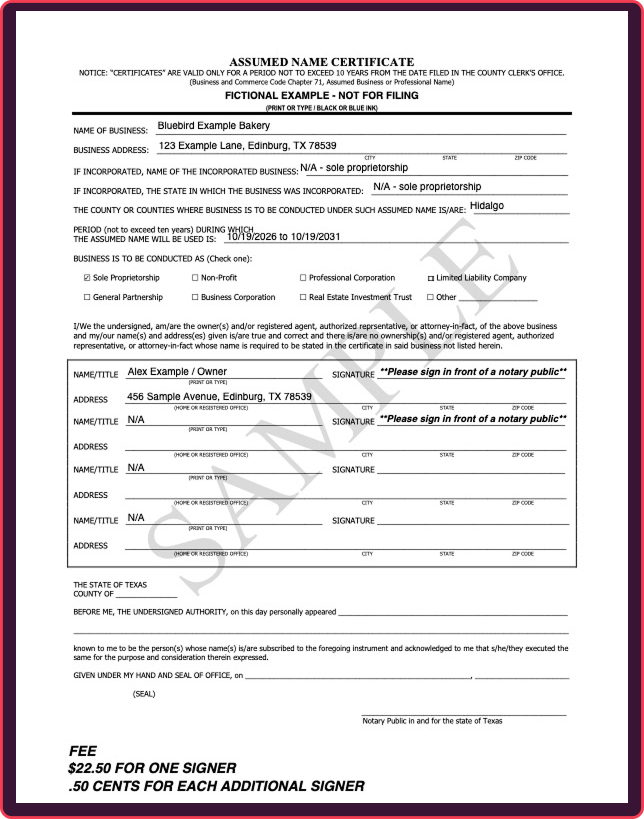
An example of an assumed name certificate for illustrative purposes only.
Some states ask for more than these common fields, such as a set filing term or the names of the business's partners. Even the certificate's name differs. Common labels include assumed name, fictitious name, and trade name. The table below shows the terms used in different states:
| Document name | States | Varieties |
|---|---|---|
| Assumed name / assumed business name | Texas, Minnesota, New York, North Carolina, Oregon | “Assumed name certificate,” “certificate of assumed name,” or “assumed business name certificate” |
| Fictitious name / fictitious business name | California, Florida, Pennsylvania, Virginia | “Fictitious business name statement,” “fictitious name registration,” or similar |
| Trade name | Arizona, Colorado, Delaware, Maryland, Washington | “Trade name registration” or “certificate of trade name” |
| Other state-specific labels | New Jersey: alternate name; Massachusetts: business certificate; Nevada: fictitious firm name | A document title that does not match the state’s usual terminology can be a warning sign |
| County or local filings | Alabama, Georgia, Kansas, Kentucky, Michigan, Mississippi, Nebraska, Ohio, South Carolina, Wisconsin, Wyoming | The correct search location may be the county clerk or register of deeds, not the Secretary of State |
An important note for document reviewers: an assumed name certificate doesn't prove that a company is licensed or in good standing, or even that it was formed.
Registering a DBA also doesn't create a new legal entity or provide liability protection, and it doesn't protect the name. Rights to a business name come from trademark law, and filing offices generally don't check whether a new filing conflicts with another business's trademark.
Still, the certificate is often the document that links a new account to a business name, and fraudsters exploit that.
In one Texas case, an accounts payable employee at a Houston concrete company filed a genuine certificate for "Lasten Energy Solutions," then changed the "L" to an "H" to match one of the company's suppliers. She opened a bank account under the altered name. Over the next 20 months, she deposited 29 forged checks payable to the supplier, totaling $288,846.92.
In another case, forged certificates carrying serial numbers from genuine filings were used to open accounts at three banks, including one in the name of Putnam Investments. The same day, a $184,575 check meant for the real Putnam in Boston was deposited into it.
Why are assumed name certificates important?
A business may use different names across its application, website, invoices, and banking records. Assumed name certificates help reviewers connect those names to the individual or entity that registered them.
For banks, the know your business (KYB) check carries regulatory weight. Under anti-money laundering (AML) rules, US banks generally must identify and verify the beneficial owners of legal entity customers. The certificate tells them which entity to start with, so a forged one undermines that check from the first step.
Reviewers across industries rely on these certificates:
- KYB and merchant onboarding. When a business applies under its assumed name, onboarding teams use the certificate to identify the registered business or owner behind it. Chase, for example, may ask for one to open a business account under a DBA name.
- Lending and underwriting. Lenders use the certificate to link an assumed name to the legal entity or individual applying for credit. That link tells underwriters whose financials, credit history, and tax records to review.
- Procurement and vendor onboarding. Buyers use the certificate to identify the legal entity or individual operating under a supplier's assumed name. Texas DFPS, for example, contracts with an entity under its legal name and may include an assumed name as a DBA when the name has been appropriately filed.
- Crypto and digital asset platforms. Exchanges use the certificate to tie a business account's trading name to its legal entity. For instance, Kraken may ask for one when a business account's name differs from its legal name.
Verifiers trust the certificate because it comes from a government office. It usually carries a filing or recording number and sits in a public record, so it reads as independent confirmation of the applicant's story.
That trust is also what makes it worth faking.
Importantly, a genuine certificate shows that a name was filed and often identifies the filer and filing date. It can't show whether the applicant has authority to act for the business, can repay a loan, or will deliver on a contract.
Threat Intel: Template data about fake assumed name certificates
Our Threat Intelligence Unit collects data about template farms that make and distribute fake document templates for fraudulent purposes.
During our research, we haven't yet cataloged many assumed name certificates, but templates are widely available online.
A simple search on Scribd (a well-known template hub) returns over 589,000 results for this document, and a search for doing business as certificates returns over 2 million. Results spanned several countries and document types, but usable templates appeared on the first page of both searches.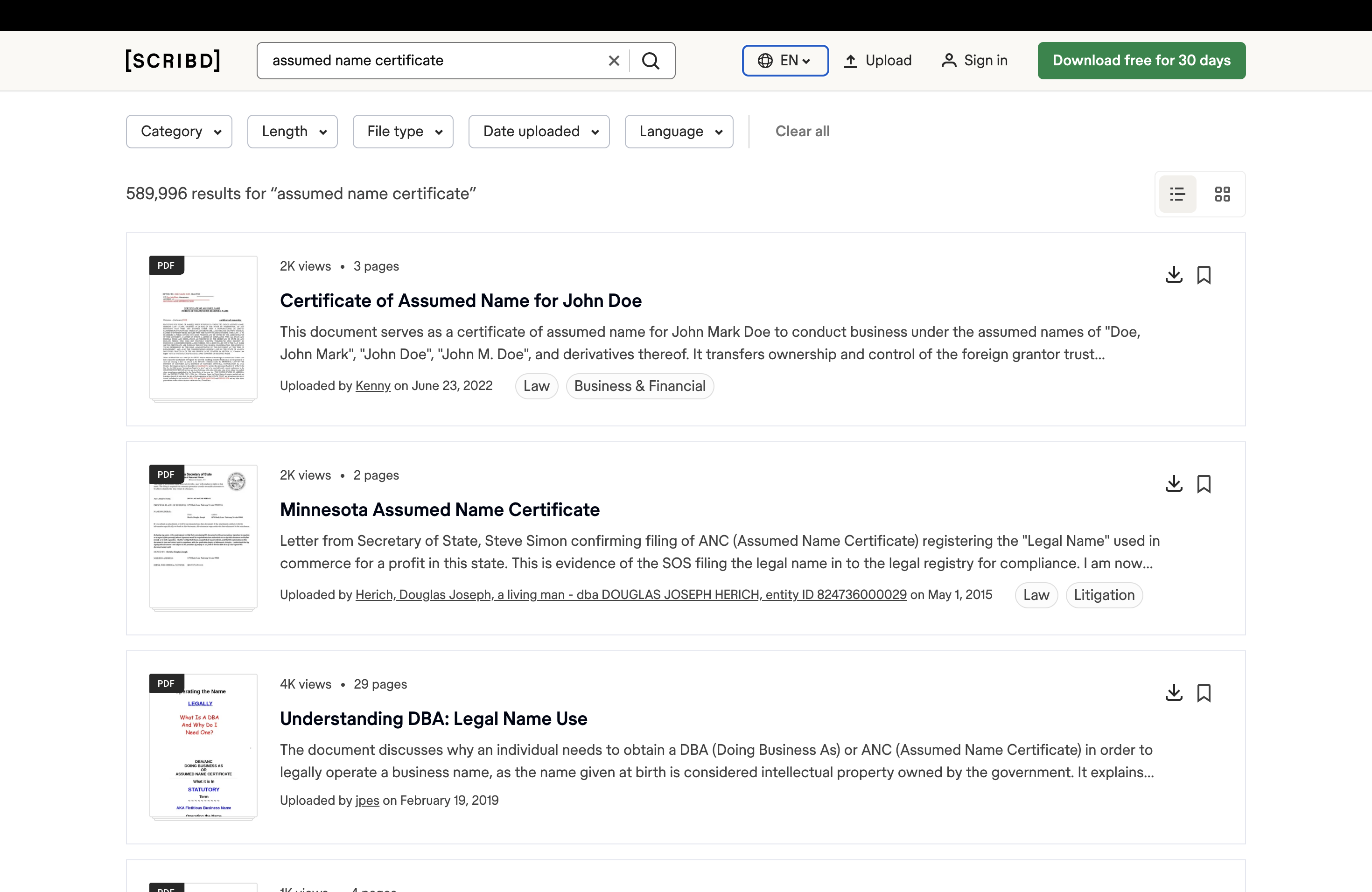
Threat level: Because some states, like New York, don’t require filers to use their official form, there are legitimate use cases for submissions containing data from a known template hub. Treat these submissions with a medium level of suspicion.
5 signs of a forged or fake assumed name certificate
Red flags work best on altered or forged certificates. When someone edits a genuine filing, the changes leave traces on the file.
First-party fraud is harder to catch. Here, fraudsters file the certificate themselves, registering an established business's trading name in their own name, and the clerk stamps it. The certificate is genuine, so the warning signs sit outside the document.
How much a genuine filing tells a reviewer depends on the state. Some states, like Minnesota, check new names against existing ones. Others, like Texas, treat the certificate as a simple notice, so several certificates can carry the same name.
In states that don't check, reviewers also need to confirm that the registrant is connected to the business, using the checks in the How to verify section below.
Wherever a certificate is filed, it should go through these red flags:
1. Inconsistent formatting
Layout rules vary by state, and official forms aren't always required, so the certificate's own details are a more reliable guide.
- Wrong filing office. Some states route filings by business type. In Texas, sole proprietors file with the county clerk, while corporations and LLCs file with the Secretary of State. A sole proprietor's certificate issued by the state office came from the wrong place.
- Filer entries in clerk-only fields. Many county forms keep fields like the file number, filing date, or expiration date for the clerk to fill in. Oakland County, Michigan, tells filers not to enter the expiration date. A certificate with that field in the same handwriting or font as the filer's entries may indicate that someone other than the clerk filled that field.
- Form revised after the filing date. Many official forms print a revision date, like New York's "DOS-1338-f (Rev. 03/17)." A certificate filed before its form's revision date was completed on a form that didn't exist yet.
2. Incorrect or misleading information
Each state sets its own rules for what goes on a certificate. An entry that breaks the named state's rules suggests the document never went through that state's filing office.
- Mismatched terminology. States use different names for this filing. Pennsylvania calls it a fictitious name, so a Pennsylvania document titled "assumed name certificate" uses another state's term.
- Identical names. An assumed name exists to differ from the legal name. A filing that lists the same name in both fields doesn’t establish an alternate business name.
- Entity designators that don’t match the registrant. Corporate terms can be reserved for corporations. Florida, for example, bars fictitious names containing "Corporation," "Incorporated," or their abbreviations unless the registrant is a corporation. In states with similar rules, a certificate that pairs one of these terms with an individual or LLC registrant breaks them.
- P.O. box as the principal place of business. The business's main location may need to be a physical address. California, for example, requires the street address of the principal place of business, so a P.O. box or private mailbox doesn't qualify. In states with similar rules, a certificate that lists one there fails the filing requirements.
- Address and filing-venue mismatch. Where assumed names are filed with a county, the right county usually depends on where the business is located. California requires the filing in the county of the principal place of business. Where a state follows the same rule, a certificate filed in one county that lists an address in another doesn't match the county where it was filed.
3. Bad math and uncharacteristic figures
The math on an assumed name certificate comes down to time. Many states limit how long a filing lasts, either with a cap on the term the filer chooses or with a fixed term set by the state. Dates that don't follow the named state's rule are a red flag.
- Term that doesn't fit the state's rule. Texas caps terms at ten years, while California and Florida set five-year terms. A 15-year Texas term, or a California statement filed in March 2024 that expires in 2030, doesn't add up.
- Renewal outside the expiration year. Florida only accepts renewals filed between January 1 and December 31 of the year the registration expires. A renewal dated in 2027 for a registration expiring in 2028 was filed too early.
- Signature after filing. A filer signs a certificate before submitting it, so a signature date later than the filing stamp puts the steps in the wrong order.
4. Assumed name certificate inconsistencies
A genuine certificate is built around its registrant. Missing sections, or sections that don't fit the business registering the name, suggest the certificate was made for someone else.
- Entity registrant without its registration details. In states like Florida, a business entity registrant must give its state document registration number. A Florida registration listing an LLC as registrant with no document number leaves out a required detail.
- Missing partner names. Partnerships often have to list their partners. North Carolina requires partnerships other than LLPs and LPs to list each general partner, or five of them if there are more. If the state where the company does business has similar rules, a certificate without them is incomplete.
- Signer capacity that doesn't fit the registrant. Some forms ask signers to state their role. The New York form offers fixed options, such as officer of the corporation or member of the LLC. An LLC's certificate signed as "Officer of the Corporation" pairs the registrant with the wrong role.
- Missing state-specific sections. A filed certificate should include everything the state requires, even if it’s using a generic DBA template. Texas county certificates, for instance, must be acknowledged, typically before a notary. A certificate from a state with similar laws with a county filing stamp but no notary block is missing a step the law requires.
5. Metadata discrepancies
An assumed name certificate is either filed electronically and exported from a state system, or filed on paper and scanned at a county office. Edits made afterwards often show up in the file's properties and structure.
- File dates that conflict with the certificate. A PDF's creation date, stored in its metadata, shouldn't come before the filing or renewal it shows. A file created in May 2025 that carries a June 2025 filing stamp, or one created in 2023 that shows a 2025 renewal, predates the record it claims to copy.
- Unexpected software in the file properties. Copies from state filing systems and county scanners often identify the office’s software or a scanning tool. File properties that name an image editor or PDF editor instead suggest the file was built or changed after it left the office.
- Partially selectable text in a scan. A scanned county filing is usually a flat image. If only the assumed name, address, or date can be selected, those fields may have been added or changed after scanning.
Disclaimer: These examples span multiple states, each with its own rules and terms. Verifiers need to check each certificate against the rules of the state it names, often across high application volumes. Keeping up at scale takes AI-powered document fraud detection that analyzes how a file was built, whatever state's form it imitates.
How to verify an assumed name certificate
Assumed name certificates are checked by KYB and onboarding analysts at banks and payment providers, by underwriters reviewing business loans, and by procurement teams vetting new suppliers. Each can verify the document by hand, with automated tools, or with a mix of both.
Manual review has limits. A convincing fake may start as a genuine filing with the registrant or address changed. PDF editors and AI image tools make those changes hard to see, particularly in a scanned document. The same fake can also turn up across several applications, and a reviewer who sees one file at a time is unlikely to notice the repeat.
AI-powered document fraud detection applies the same checks to every submission in seconds. It flags manipulation at the pixel and file-structure level, and detects duplicate submissions.
Many teams still rely on manual review because of legacy workflows or compliance requirements. For those teams, the checks below make the process more reliable.
Manual verification of assumed name certificates
The red flags above stay on the document itself. The checks below go further, to the records and people behind the certificate.
- Search the issuing office's records. Look up the filing with the office named on the certificate, using the assumed name, registrant, and file number. State-level filings are often searchable online. County filings may require contacting the clerk or requesting a certified copy.
- Match the registrant to its formation record. For an entity, compare the legal name, entity type, formation jurisdiction, and state ID number with the state's business entity record. Even small differences in the name or suffix need explaining.
- Look for the publication record. Some states, like California, require filers to publish the statement in a local newspaper and file proof with the county clerk. A statement with no affidavit of publication on file may mean the filing was never completed.
Keep in mind: Each check relies on a different source, such as a state database, a county clerk, or a formation record. That's taxing for review teams, especially as application volumes grow. AI-powered document fraud detection can screen every certificate as it arrives and escalate suspicious ones for manual review.
Using AI and machine learning to spot fake assumed name certificates
There's no single assumed name certificate to check against. Formats and rules vary by state and county. A review process trained on one layout struggles with the next. AI-powered document fraud detection handles that variation by learning what genuine certificates look like across issuers and flagging what doesn't fit.
Benefits include:
- No layout library needed. Depending on the state and the type of business, an assumed name can be filed with a state office or a county clerk. California alone has 58 counties, and each one issues its own fictitious business name statement. Forensic analysis evaluates an unfamiliar county statement the same way it evaluates a Texas certificate filed with the Secretary of State.
- Every certificate gets the same scrutiny. Manual review slows as volumes rise, and small details like a filing in the wrong county are easy to miss deep in a queue. AI checks each document the same way, so reviewers can focus on the cases that need a closer look.
- AI-generated fakes don't slip through. GenAI tools can produce a county certificate, complete with a seal and filing stamp, for a filing that doesn't exist. Resistant AI’s GenAI detectors catch the visual and structural traces of image generation, with a false positive rate under 1%.
Automation vs. AI
Automated checks work well on a certificate's individual fields. They can confirm the file number format, check that the expiration date hasn't passed, and match the assumed name against state records.
Each rule is written for a specific layout, such as where the file number sits or what the clerk's stamp looks like. When a county redesigns its stamp or the state revises its form, someone has to rewrite those rules by hand.
AI-powered document fraud detection looks at how the file was put together, including edited text, mismatched fonts, and changes made after export, so a new layout doesn't need a new rule.
Conclusion
When reviewing assumed name certificates, assume nothing. A certificate can carry a real county stamp and match a name in the state's records, yet the registrant may have no connection to the business. It might be a genuine filing in an established business's name, an altered copy of a real one, or a fake with no filing behind it.
Resistant Documents works on the file itself, analyzing how each certificate was built, whether it shows signs of editing, and whether the same file or template has appeared in other submissions.
Scroll down to book a demo.

Fraud awareness, examples, and lessons
Learn more about fraud in specific industries, best practices, and targeted documents.
View all
Application fraud in 2026 is easier to attempt: accessible tools and services help applicants turn false claims ...
Within the fake document ecosystem, things can change fast. Four months ago, we reported that OnlyFake, the ...
In May 2026, a Dallas resident was convicted of running coin-operated “amusement machines” without a business ...

NEW YORK & PRAGUE – 1 October 2026 – Ocrolus, the AI workflow and analytics platform for lenders, today ...
For a few hundred dollars, sellers on Telegram promise to boost your credit score using someone else's credit ...