
For a few hundred dollars, sellers on Telegram promise to boost your credit score using someone else's credit history. We mapped out the fraud schemes behind this growing market:
“250k mortgage primary backdated 15yrs paid and closed cost $1500, reports to all three bureaus. Takes 14 days to report”.
“🔷 AMEX 1
💳 $22.8K Limit
📆 10 Years Old
📉 2% Utilization
📅 Closing Date: 8/26
💵 $200
👥 3 Slots Available”
For $190 on average, sellers will rent you a stranger's decade-old credit history.
Telegram and Facebook groups are flooded with ads like these.
A Barclays card opened in 2005.
A Chase card with a five-figure limit.
An American Express line with near-zero utilization.
“Slots are limited. The next closing date is approaching. Don’t wait, add them to your credit now.”
Then come the testimonials: a client approved for a better apartment, someone driving away in a new Range Rover, another gets a loan approved, and someone else claims their score went up by 30 points.
But these groups are not really selling credit cards, cars, or rentals.
They're selling the appearance of being the kind of person who can afford them.
Paying for your credit score
A credit score reflects a person’s credit history: how reliably they pay, how much they owe, how much credit they use, and how long they’ve had it.
Lenders use it to judge how likely you are to repay and landlords might use it as a reliability factor when looking into tenants. So having a higher credit score can open a lot of opportunities in many aspects of life.
To “help out,” some of these criminal groups promise a temporary boost to an existing credit score. Others offer to give you a new credit identity from scratch. Some claim to remove negative records. Others package fake documents, credit privacy numbers - something we will cover more in depth next week - , tradelines, and target-specific instructions into a ready-made deal designed to get their client a specific car, apartment, credit card, or loan.
We call this system “credit boost” fraud.
The products vary, but the basic idea stays the same: manufacture the appearance of a stronger credit profile and use it to access something the buyer might not otherwise qualify for.
So far we have not found a comprehensive overview of all different types of credit boosting schemes, so we started to map it out in this two part article series.
We analyzed 21 Telegram channels offering different credit-boosting schemes, scraping more than 13,900 messages. Most of the channels are relatively new, with the bulk of their activity dating to 2026.
We also found similar offerings on dedicated websites and Facebook groups. The websites tend to be older, while new Facebook groups appear regularly.
The market is very much alive.
- Tradelines. Of the more than 13,900 scraped Telegram listings, the most common product is the "tradeline": a paid slot as an authorized user on someone else's real, aged credit-card account. The median price is $190 to add a fabricated credit line worth $22,800 (the original card holder’s credit limit) to a buyer’s credit report – buyers pay roughly a cent for every dollar of fake credit history they’re getting.
- Credit privacy numbers. The same channels sell Credit Privacy Number (CPN) identity packages marketed as a synthetic Social Security number (SSN), forged SSN cards and driver's licenses, workarounds for auto-loan approvals, and services that dispute or erase negative items from real credit reports.
- Chase Bank alone appears in 1,500 posts, while TransUnion, Equifax, Citi, Discover, Experian each show up hundreds of times.
- The same sellers and phone numbers resurface across differently branded channels.
For this first part, we focus on the products designed to manipulate an existing credit profile: tradelines, primary tradelines and credit sweeps.
The cleanest product: Authorized-user tradelines
Almost half of our analyzed posts were offers for tradelines – a record on someone’s credit report showing any loans or credit cards. Simply put, a tradeline shows you have been trusted with a loan before.
Sellers offer “slots” on established credit cards, advertising them almost like financial inventory: the issuer, credit limit, account age, utilization, statement date, closing date, number of available slots and price.
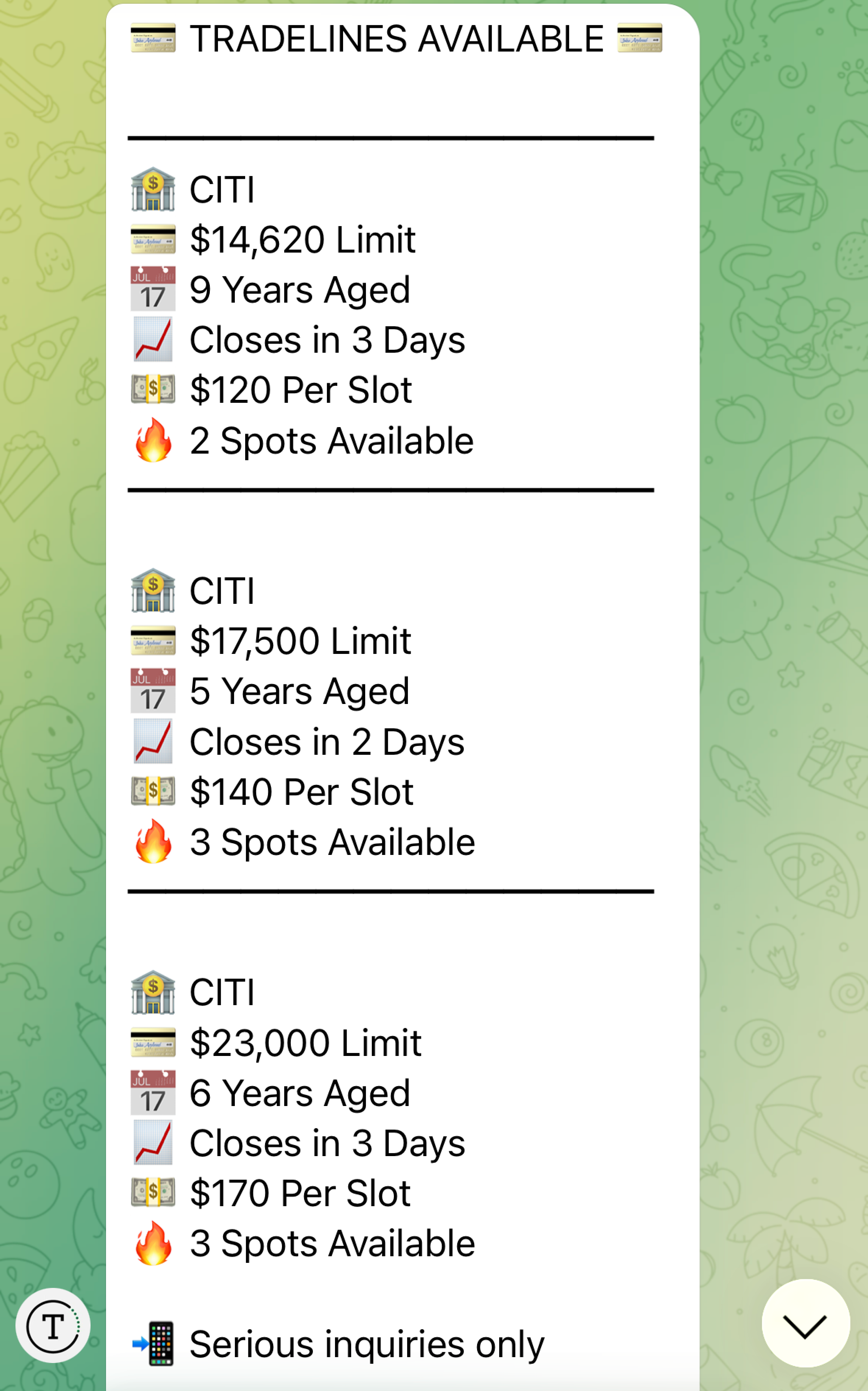
The pitch is simple: after adding you as an authorized user to someone else's strong card, it will increase your own score. The hope is then to use that stronger score to get a real credit card, a car loan, apartment, or car financing before the authorized-user line drops off.
A typical slot costs $100–$200, but if the credit limit is higher and the account is older, expect to pay much more.
| Credit Limit on the account offered | Average price on Telegram for a slot on the card |
| $5k-10k | $119 |
| $10k-20k | $151 |
| $20k-30k | $172 |
| $30k-50k | $206 |
| $50k+ | $261 |
Unlike many other schemes we cover later, nothing is inherently illegal here.
Parents often add their kids to their credit cards as authorized users just to give them a bit of credit history and help boost their score. It’s probably not going to get them a mortgage, but it could help with things like renting an apartment or getting a credit card, where having a higher score can make a difference.
It enters a legal grey area when buyers use it to get credit, housing or financing they otherwise wouldn’t qualify for, the lender is essentially lied to and they’re risking giving out credit to people who would not normally qualify.
Is the result guaranteed?
While fraud charges for buyers are unlikely, the lender might close an account or decrease credit limit after the temporary authorized user window closes.
It is also risky, if you don’t know what you’re buying. What if the cardholder is not even aware their card is out there doing rounds. If that’s the case, it is no longer just about manipulating a credit profile. It can cross into identity theft.
And even if the tradeline boosts your credit score, there are no guarantees: a lender looking at the full credit report can see what is actually behind the score, rather than taking the number at face value. But not every decision works that way. If all that matters is the score itself, a higher number could still make a difference, for example when applying to rent an apartment.
Despite all these risks, the channels are still full of offers for slots of the most common bank accounts.
The riskier, more expensive and completely illegal offer: Primary tradelines
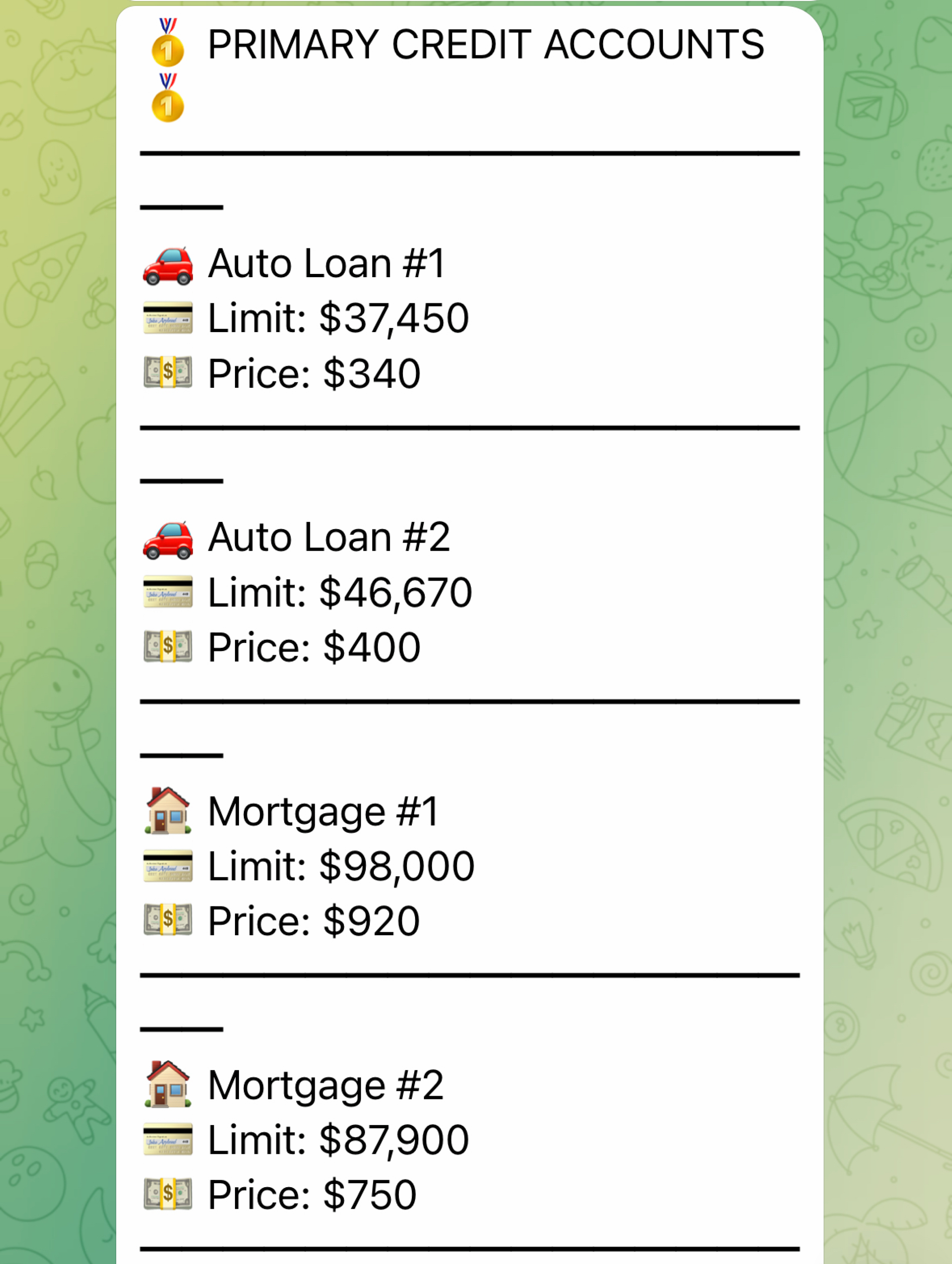
Unlike authorized users, primary tradelines go further by promising buyers a tradeline in their own name – a credit card, paid off car loan, or even mortgage, personal, or student loan. Compared to authorised users, primary tradelines hold much more weight in lending decisions.
There is one small but important catch however: if a primary tradeline belongs to a real person, how can you buy one? Wouldn’t getting one be the same as trying to get a loan legally and if so, what is the point?
This is where data furnishers and zombie debts come into the picture.
- Data furnishers are companies or people that report client information to credit bureaus. In the fraud scheme it is a brilliant loophole, because there is no need for a middle man. Once the tradeline information reaches credit bureaus from data furnishers it is already “clean” and there are no red flags to look for.
- Furnishers claim to have a bunch of credit cards at hand that can then be reassigned to the buyers name as tradelines.
- Others use so-called zombie debts: old loans that can no longer be legally enforced, but that collectors can still try to collect in the hope that you will pay. While collectors buy these debts to try to recover money from them, data furnishers buy them to reassign them to the buyer’s credit profile as an already paid off tradeline. And voila! Suddenly the buyer looks like someone who successfully handled a large loan in the past.
Compared with authorized-user offers, primary tradelines are harder to find. In the ads we looked at, they accounted for about one in five tradeline offers.
They also cost more, with the main advertiser selling his primaries for $350 and other prices on Telegram ranging mainly from $200-$999.
Deleting the bad
Not every seller wants to add positive history, some promise to remove negative things instead.
Credit sweeps, deletions, and public-record removal services target negative information: collections, evictions, unpaid rent etc.
There is a legitimate version of credit repair: consumers can dispute inaccurate information. The fraud part starts when this process is done in bulk while disputing accurate information for a temporarily cleaned report, while the disputes are being investigated.
Sweep prices can range from $100 to $1500, but most of the time the prices are not advertised upfront, buyers are often told to DM for a quote instead.
How can it all work?
Well, unsurprisingly, it depends.
Adding an authorized user to a credit card is not illegal in itself. If a lender decides mainly on the credit score, there is nothing to flag.
If a primary tradeline is reported to credit services by a - seemingly legitimate - data furnisher it works in essence like money laundering – by the time it is reported on your credit report, it is already “clean”.
But not every decision works that way.
If all that matters is the score itself, a higher number could still make a difference, for example when applying to rent an apartment. Tradelines really matter when changing what another party sees when they look at a person's credit profile.
But this is only one side of the credit-boosting market.
Because while tradelines and sweeps manipulate the credit history a person already has, another group of sellers promises something much more radical: a new credit identity altogether.
That is where CPNs come in and what we will focus on in Part 2, next week.
This is “Credit Privacy Numbers” sold as a fresh start or sometimes even an amazing pre-made start with identities and document packages built around them, and how sellers turn them into a broader application-fraud service for cars, apartments, credit cards and loans.
Enjoying our Threat Intelligence content? Subscribe to the "Threat Radar" (sign up also available on the left).

Fraud awareness, examples, and lessons
Learn more about fraud in specific industries, best practices, and targeted documents.
View all
Application fraud in 2026 is easier to attempt: accessible tools and services help applicants turn false claims ...
Within the fake document ecosystem, things can change fast. Four months ago, we reported that OnlyFake, the ...

In May 2026, a Dallas resident was convicted of running coin-operated “amusement machines” without a business ...

NEW YORK & PRAGUE – 1 October 2026 – Ocrolus, the AI workflow and analytics platform for lenders, today ...

Key takeaways Fake certificates can use real numbers Fraudsters can copy a genuine business’s VAT number onto a ...