Document Fraud 201: Turn detections into decisions
What was covered:
- Which signals are always a decline.
- How to tell tampering from fraud.
- Industry-specific risk profiles vs. personalized precision-tuning.
- Why "approve, decline, review" may be the wrong decision set entirely.


A global institution runs its operations on the same detection stack. In one department, finding Photoshop in a document’s metadata means a hard decline. In another, it’s how their main customer creates documents. The departments serve different customers, products, and risk profiles. The same signal calls for different decisions.
In this follow-up to our original Document Fraud Fighting 101 webinar, Senior Solutions Engineer Nico Martinez and Product Marketing and Threat Intelligence Director Joe Lemonnier explored anonymized cases from live deployments across banking, retail, trade finance, and insurance, including the rules customers requested and the ones that backfired.
What we covered:
- Which signals warrant a decline and which require a decision about risk appetite.
- How legitimate processes, including e-signatures, translations, and annotations, complicate the distinction between tampering and fraud.
- How document risk policies support automation, with decisions tailored to your industry and institution.
- When to reconsider the standard “approve, decline, review” workflow.
- How to explain rejections without revealing your controls to fraudsters.
Some more interesting results from the webinar:
We asked attendees how mature their document risk policies were. Here’s what they told us: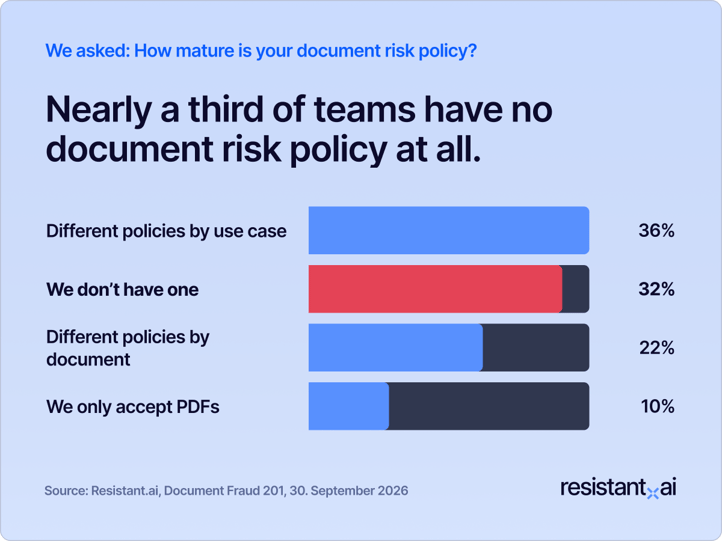
Whether you’re building your first document risk policy or refining an existing one, the session gives you four practical steps: set your goal, assess document format and quality, account for document type and use, and define your decision workflow.
Watch the full recording to put those steps into practice.