
Fake Massachusetts business licenses are becoming more valuable than ever in 2026, especially with their booming marijuana industry set to expand its business license possibilities, including new licenses for on-site consumption, event-based use, and research.
But the danger expands far beyond unwarranted access to the weed market.
These documents play a critical role in KYB, vendor onboarding, commercial leasing, and regulatory compliance. When falsified, organizations run the risks of document fraud: onboarding illegitimate businesses, enabling financial crime, or failing compliance checks.
At the same time, publicly available templates, online document resellers, and AI generated documents make it easy to fake Massachusetts business documents in just a few minutes.
Read on to learn what Massachusetts business licenses are, how they’re governed under state and local laws, how they relate to document fraud, how to spot a fake, and how AI-powered tools can help.
Check out our “How to spot fake business licenses” blog for a universal guide on how to spot fake documents of this type.
What is a Massachusetts business license?
A Massachusetts business license is not a single, standardized document. It is an umbrella term used to describe several different records and approvals that allow a business to legally operate within the state.
Business authorization is split across local business certificates, state entity registrations, and industry-specific licenses. That complexity creates confusion and gives fraudsters room to exploit gaps in verification.
That means “having a Massachusetts business license” entails a combination of filings at the state level, local level, and sometimes industry-specific regulatory level rather than one universal certificate.
The most common Massachusetts business authorization documents include:
- Business certificate (DBA). A local filing made with the city or town clerk when a business operates under a name different from its legal name. “Doing business as…” It identifies the individuals behind the business and the location where it operates.
- Business entity registration. Filed with the Secretary of the Commonwealth for corporations, LLCs, and partnerships. This confirms the legal existence of the business but does not authorize all activities on its own.
- Professional or trade licenses. Issued by state regulatory bodies (such as the Division of Occupational Licensure) for specific industries like construction, cosmetology, or real estate.
- Local permits and approvals. Issued by municipalities for zoning, health, signage, or operational compliance depending on the business type and location.
- Tax registrations and employer filings. Federal and state tax identifiers required for operating a business, including Employer Identification Numbers (EINs) issued by the IRS and Massachusetts tax registrations for payroll, sales tax, and employer obligations.
- Additional documentation. Depending on the business, this may include alcohol permits, health department certificates, or industry-specific approvals tied to regulated activities.
Unlike states that issue a single general business license (like Nevada), Massachusetts distributes authority across these different documents and agencies.
Together, these records confirm that a business legally exists, is properly registered in its jurisdiction, and is authorized to carry out its specific activities.
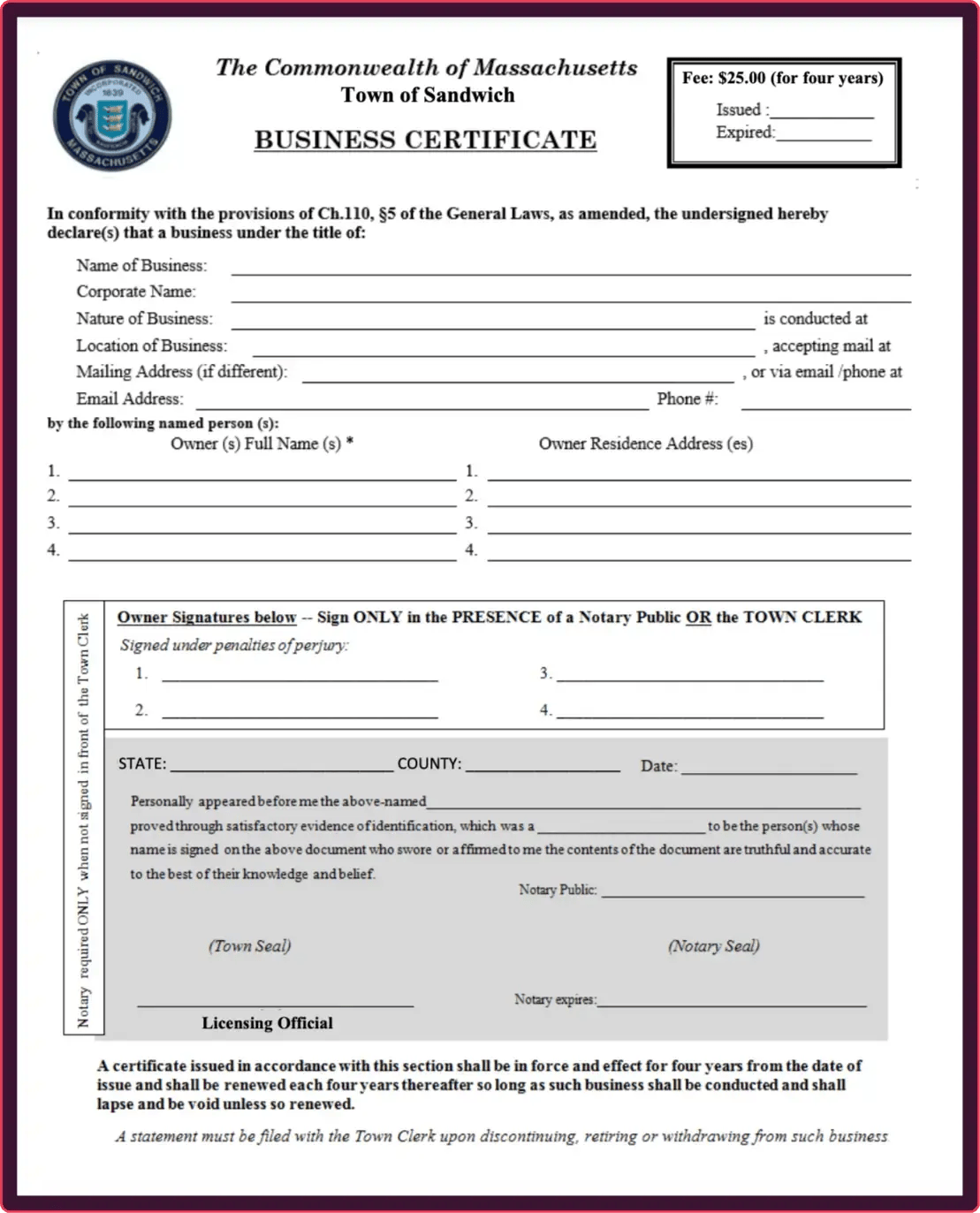
Example of a fake Massachusetts business certificate (not business license) for illustrative purposes only.
Why are Massachusetts business licenses important?
Massachusetts business licenses and related filings are a core part of business verification, helping organizations confirm that a company is legally established, properly registered, and authorized to operate in a specific location and industry.
Here’s how Massachusetts business licenses are used for document verification:
- KYB in financial services. Banks and fintech platforms use Massachusetts business certificates, entity registrations, and licenses to verify that a company is legitimate before opening accounts, issuing credit, or enabling transactions.
- Commercial real estate and leasing. Landlords and property managers rely on local business certificates and registrations to confirm that tenants are authorized to operate at a specific address and comply with zoning requirements.
- Marketplace and platform onboarding. E-commerce platforms and marketplaces (an especially vulnerable target to serial fraud) review business documentation to ensure sellers are real, traceable entities and not part of fraud rings or shell operations.
- Procurement and vendor management. Enterprises verify supplier documentation to confirm that vendors are properly registered and licensed before entering into contracts or issuing payments.
Because Massachusetts distributes business authorization across local, state, and industry-specific documents, these records are often treated as trusted proof of legitimacy across use cases.
Massachusetts state business license law
As we already mentioned, legal authority for Massachusetts business licenses is split across local filings, state registrations, and industry-specific licenses, each governed by different rules and processes.
Understanding how these pieces fit together is critical for both compliance and fraud detection.
Local business certificate (DBA) requirements
For many small businesses, the most relevant “license-like” document in Massachusetts is the business certificate, often referred to as a DBA.
If a business operates under a name other than the owner’s legal name (or the exact registered entity name), a business certificate must be filed with the city or town clerk in every municipality where the business has an office or physical presence.
The filing typically lists:
- The business name.
- The full names and residential addresses of the owners.
- The business address.
- Validity period of four years (and must be renewed to remain active).
These filings are public and, by law, a copy should be available at the business location and provided to customers upon request.
State business registration (Secretary of the Commonwealth)
Separate from local DBA filings, businesses formed as legal entities (Corporations, LLCs, LLPs, and other formal entities) must register with the Massachusetts Secretary of the Commonwealth to confirm the legal existence of the business and its structure.
To register you must:
- File formation documents (e.g., Articles of Organization).
- Maintain good standing through periodic filings (such as annual reports).
- List registered agents and official business addresses.
This registration does not replace a business certificate if the company operates under a different trade name.
Industry-specific licensing and permits
Agencies such as the Division of Occupational Licensure, Department of Labor Standards, and Alcoholic Beverages Control Commission offer registration and licenses for specific trades and professions like construction, cosmetology, real estate, food service, and alcohol sales.
Massachusetts licensing and permit process (for specific regulated industries):
- Application to the relevant board or agency.
- Proof of qualifications, training, or certifications.
- Ongoing compliance, renewals, and inspections.
Many of these licenses can be checked through official state lookup tools.
Local permits and operational approvals
Beyond licenses and registrations, businesses may also need municipal approvals depending on their activities.
For example:
- Zoning approvals
- Health department permits
- Signage permits
- Fire safety inspections
These documents are issued and enforced at the city or town level, often alongside the business certificate process.
Understanding the legal structure behind these documents is the first step in spotting when something doesn’t add up.
Threat intel: Template data about Massachusetts business documents
Our Threat Intelligence Unit collects data about template farms which make and distribute fake document templates for fraudulent purposes.
Below, you'll find an infographic containing data about all the fake Massachusetts business documents we've found: their availability, their distributors, the institutions or "issuers" whose documents have been exposed, and how much it costs to buy one.
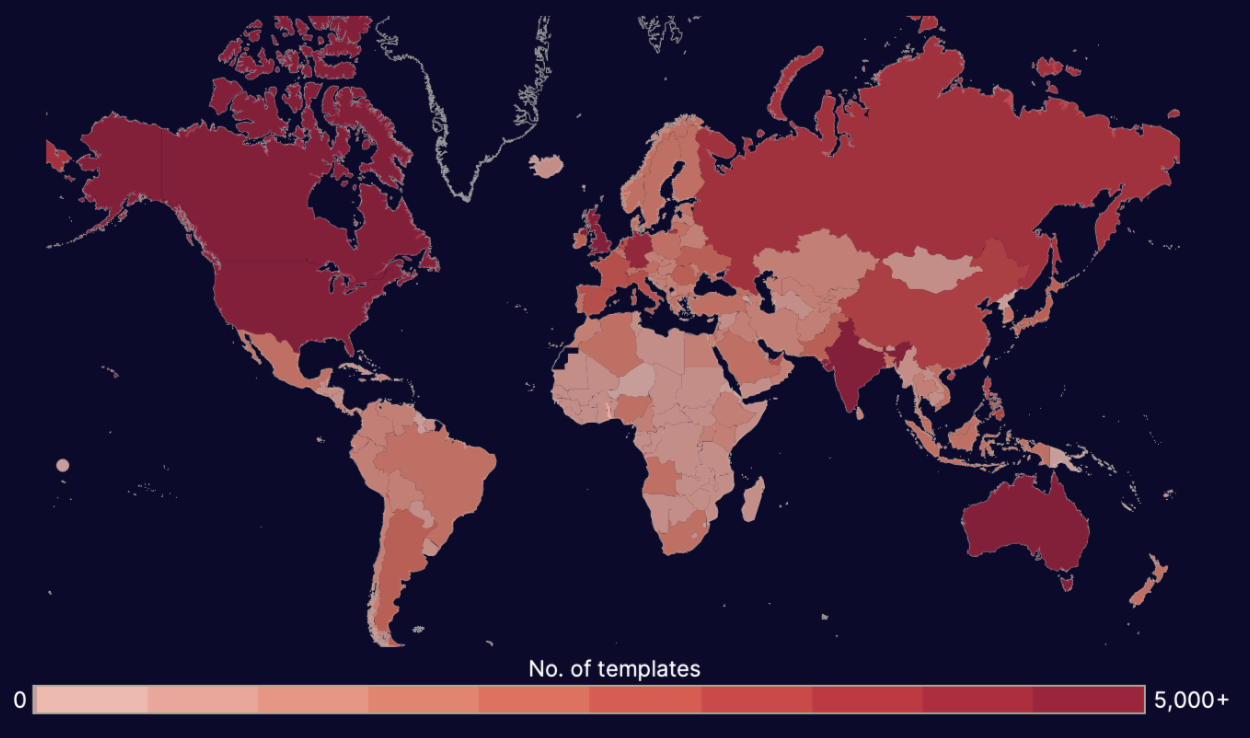
Threat intel stats: Massachusetts business documents
Find more information about the threat these farms pose in our threat intel blog and webinar content.
5 Signs of a forged or fake Massachusetts business license
Fake “Massachusetts business licenses” often try to collapse all requirements into a single, official-looking document that does not actually exist in the real regulatory framework.
Spotting fakes is less about spotting one bad submission and more about understanding how the system actually works.
Here’s what to watch for:
1. Inconsistent formatting
Massachusetts business documents don’t follow a single statewide template. That makes “overly standardized” documents just as suspicious as sloppy ones.
- Wrong styling/document type. A DBA pretending to be an industry-specific permit, or any of the documents in the Mass business registration process pretending to be something they’re not.
- Overly complex design. Local business certificates are often simple clerk filings. Documents with elaborate seals, layered graphics, or multi-agency branding can be misleading.
- Missing municipal identity. A legitimate business certificate should clearly tie back to a specific city or town clerk.
- Generic statewide labels. Terms like “Massachusetts general business license” or “statewide operating license” are not typical for local DBA filings.
- Inconsistent document hierarchy. Mixing elements from different document types (for example, combining corporate registry formatting with local permit language).
2. Incorrect or misleading information
Fraudsters often misunderstand how Massachusetts structures business authorization, leading to subtle but critical errors.
- Claims of a single universal license. Presenting one document as full authorization to operate across all activities and locations.
- Wrong filing location. A business certificate tied to a municipality where the business does not operate or omitting location-specific requirements entirely (for example, Boston requires DBA filings through the City Clerk with its own process, while Worcester handles filings separately).
- No customer-facing copy. In Massachusetts, business certificates are public-facing. Inability to produce a proper copy on request is suspicious.
3. Bad math and uncharacteristic figures
Massachusetts-specific timelines and requirements make numerical inconsistencies easier to spot.
- Incorrect validity period. Business certificates in Massachusetts are typically valid for four years.
- Perpetual or undefined expiration. Claims that the document does not expire or does not require renewal.
- Uniform statewide fees. Presenting licensing costs as standardized across Massachusetts when many are set locally.
4. Business license inconsistencies
This is where Massachusetts fraud really stands out. Most fake documents fail to respect how fragmented the system is.
- Single-location filings for multi-location businesses. Only one municipality listed despite claims of operating across multiple towns elsewhere in the documentation.
- Mismatch between name and registration. A business using a trade name without evidence of a corresponding DBA filing.
5. Metadata discrepancies
Even when documents look correct, the underlying footprint can tell a different story.
- Editing software traces. Files created or modified using design tools instead of originating from standard administrative workflows.
- Author mismatches. Documents attributed to individuals rather than a clerk’s office or official system.
- Screenshots, image-based files, and scans. Massachusetts entity filings are typically downloadable as structured PDFs from the Secretary of the Commonwealth, while local business certificates originate as clerk-recorded filings that can be certified or reissued, and many professional licenses are verifiable through official online portals. Documents submitted as screenshots or images (like JPEGs) when a more authoritative format should exist it is inherently less trustworthy and may indicate manipulation or reuse.
Disclaimer: Manual inspection can catch obvious issues, but Massachusetts’ layered system makes verification increasingly complex. Fraudsters exploit confusion between local, state, and industry documents, and modern tools allow them to generate convincing fakes at scale. Relying on visual checks alone is no longer sufficient.
How to verify a Massachusetts business license
Checking if a Massachusetts business license is fake is a process typically handled by compliance teams, financial institutions, marketplaces, and procurement departments either manually or through automation.
Manual verification is still widely used, but it comes with limitations. Fraudsters now understand the system well enough to fabricate documents that look plausible across all three layers. With purchasable templates and generative AI, even inexperienced actors can produce convincing fakes that pass surface-level checks.
AI-powered document verification addresses this by analyzing how documents are constructed and how they relate to other submissions, making it far more effective at scale.
That said, many organizations still rely on manual review due to legacy workflows or regulatory expectations.
Manual verification of Massachusetts business licenses
If you’re verifying Massachusetts business documents manually, here are practical steps to follow:
- Search the Massachusetts corporate database. Use the Secretary of the Commonwealth’s public registry to confirm that the business entity exists, is active, and matches the submitted details. Visit our USA KYB guide to learn more.
- Check local city or town clerk records. For DBA or business certificates, verify filings with the relevant municipality where the business operates.
- Cross-check addresses and operations. Ensure the listed business locations align with filings, zoning expectations, and land rights by using a resource like Massachusetts property records.
Keep in mind: Manual verification in Massachusetts requires checking multiple documents belonging to multiple systems across different jurisdictions. This is time-consuming, inconsistent, and difficult to scale.
Using AI and machine learning to spot fake Massachusetts business licenses
AI-powered document verification improves Massachusetts business license checks by analyzing structural patterns, detecting inconsistencies across submissions, and identifying manipulation signals.
Key benefits include:
- Document-agnostic detection. Works across local certificates, state filings, and industry licenses without needing predefined templates.
- Cross-document intelligence. Identifies reused templates, linked submissions, and coordinated fraud attempts across multiple documents.
- GenAI detection. Flags signs of AI-generated or synthetically created documents that mimic legitimate records.
- Adaptive decisioning. Adjusts fraud thresholds based on your organization’s risk appetite and compliance requirements.
Automation vs. AI
Traditional automation relies on fixed rules. For example, checking whether a license number exists or whether a date falls within a valid range.
AI systems use pattern recognition and anomaly detection to spot when something doesn’t align.
This makes AI far more effective at detecting modern, large-scale document fraud.
Conclusion
Fake Massachusetts business licenses are a direct entry point into vendor fraud, KYB failures, and onboarding risk. Fraudsters exploit the complexity of the Massachusetts business registration process by presenting documents that look plausible in isolation but don’t hold up when viewed as part of the full system.
Resistant Documents can analyze fake Massachusetts business documents in hundreds of ways, spotting unseen signs of fraud and speeding up review times to 20 seconds or less.
Scroll down to book a demo.

Fraud awareness, examples, and lessons
Learn more about fraud in specific industries, best practices, and targeted documents.
View all
Application fraud in 2026 is easier to attempt: accessible tools and services help applicants turn false claims ...

Within the fake document ecosystem, things can change fast. Four months ago, we reported that OnlyFake, the ...

In May 2026, a Dallas resident was convicted of running coin-operated “amusement machines” without a business ...

NEW YORK & PRAGUE – 1 October 2026 – Ocrolus, the AI workflow and analytics platform for lenders, today ...
For a few hundred dollars, sellers on Telegram promise to boost your credit score using someone else's credit ...

Key takeaways Fake certificates can use real numbers Fraudsters can copy a genuine business’s VAT number onto a ...