
Starting a business in Florida can be a tax dream (a dream that just eliminated most local business taxes). It can also be a complicated process when it comes time to getting a Florida business license (or local business tax receipt).
Perhaps that’s why so many fake Florida business licenses are popping up in 2026 KYB workflows. Fraudsters are taking advantage of the sophisticated, jurisdiction based system and using local differences to bypasse document checks.
If your company relies on KYB and anti money laundering (AML), or you’re a procurement managers, on a vendor risk team, a marketplace reviewer, or a commercial leasing agent, you need to be aware of this threat.
A document may look official while still being document fraud.
Publicly available templates, document sellers, and generative AI tools have made those fakes easier to create and harder to catch manually.
The risk is onboarding the wrong vendor, approving an unlicensed contractor, accepting a fake marketplace seller, or missing a business that is misrepresenting where and how it is allowed to operate (exposing you to money laundering and fraud).
Read on to learn what Florida business licenses are, how they are being forged, how to spot a fake Florida business license, and how AI-powered tools can help.
Check out our “how to spot fake business licenses” blog for a universal guide on how to spot fake documents of this type.
What is a Florida business license?
In most ordinary verification workflows, the document people call a “Florida business license” is often a Local Business Tax Receipt issued by a city or county.
For Florida, the word “tax” can be misleading. A Local Business Tax Receipt is not just a casual payment record. It is the local document many counties and cities use to show that a business has registered for the privilege of operating in that jurisdiction for a specific tax year.
Most Florida business-license checks involve a mix of local business tax receipts, state entity records, tax registrations, and professional or regulated-industry licenses. But the main document is Local Business Tax Receipt sold by the appropriate tax collector beginning July 1, are due on or before September 30, and expire on September 30 of the following year.
There’s also Sunbiz, Florida’s Division of Corporations search system that confirms entity or registration information, to consider. Sunbiz lets users search corporation, limited liability company, partnership, trademark, fictitious name, and lien records by fields such as name, officer or registered agent, FEI/EIN, document number, ZIP code, and street address.
And it’s not always one document for each jurisdiction. Local authorization can be separate. In Miami, every business must obtain a City of Miami Business Tax Receipt to operate in the city, and also a Miami-Dade County Local Business Tax Receipt.
That makes it business-license-like, but it does not automatically prove entity formation, professional qualification, statewide authority, or approval to operate in every Florida municipality.
Florida business authorization is usually split across several document types:
- Local Business Tax Receipt. A city or county document showing that a business has paid the local business tax for a specific location, business activity, classification, and tax year.
- City Business Tax Receipt. A municipal version of the local business tax receipt. In some places, a business may need both a city receipt and a county receipt.
- Florida Department of Revenue tax registration. A tax registration used when a business needs to collect and remit Florida sales and use tax or obtain documents such as a Florida Annual Resale Certificate for Sales Tax.
- Sunbiz entity filing. A Florida Division of Corporations record showing that an entity exists or is registered in Florida. Examples include Articles of Organization for a limited liability company or Articles of Incorporation for a corporation.
- Fictitious name registration. A Sunbiz record used when a business operates under a name that differs from its legal entity name.
- Professional or regulated-industry license. A separate license issued by the relevant Florida agency when the business activity is regulated. Examples can include construction, real estate, cosmetology, lodging, food service, agriculture, consumer services, alcohol, or health-related activities.
Unlike states that issue a single general business license (like Washintgon), Florida distributes authority across these different documents and agencies.
Together, these documents help confirm that a business has some form of local registration or tax-based operating credential in Florida, but they should always be checked against the business’s entity record, location, and activity.
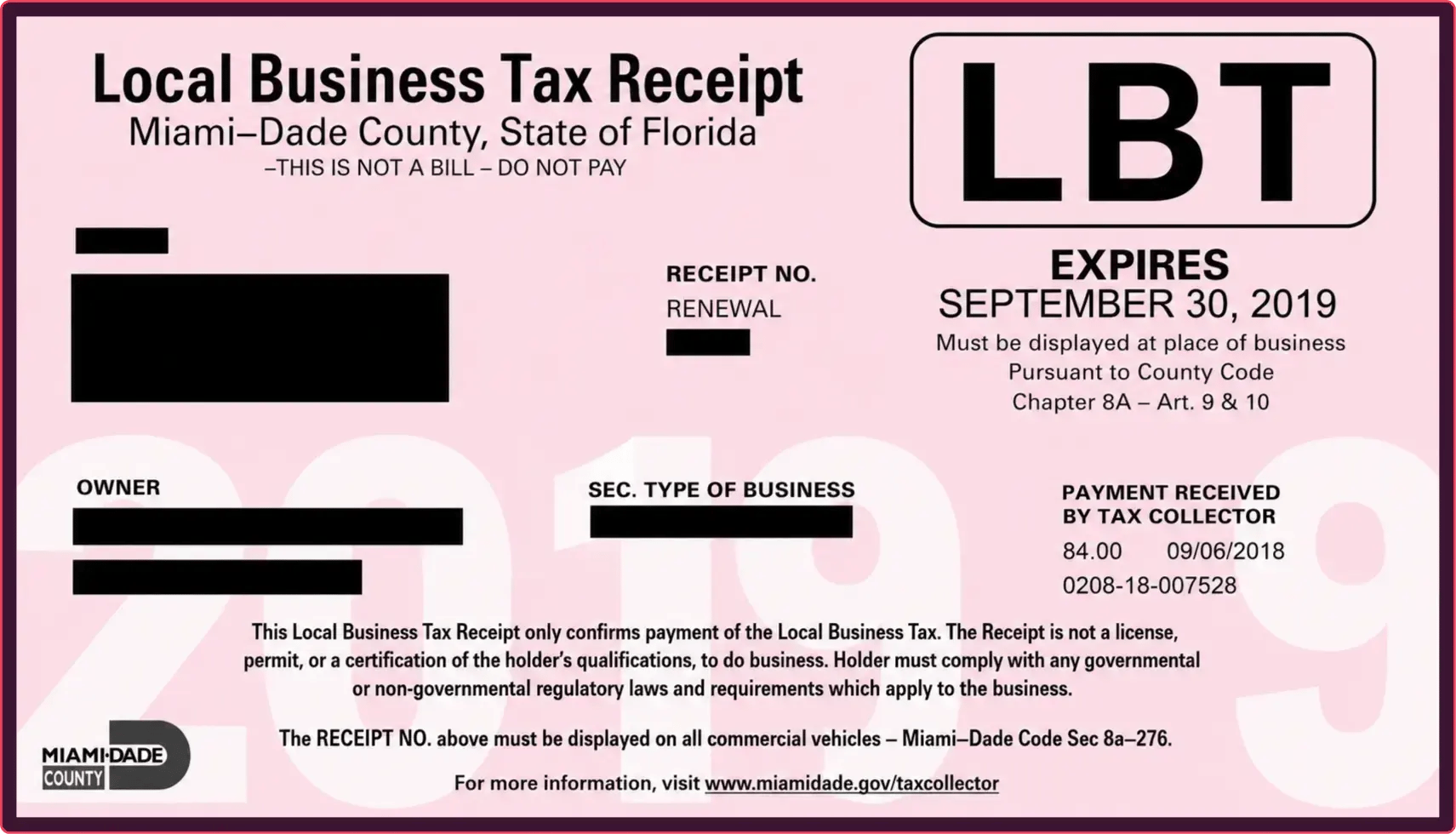
Example of a fake Florida Local Business Tax Receipt (not business license) for illustrative purposes only.
Why are Florida business licenses important?
Florida business licenses matter because they help reviewers understand whether a company is registered, locally authorized, and properly licensed for the activity it claims to perform.
One verification tip: A single Florida business document document rarely tells the full story.
A Sunbiz record may confirm that an entity exists. A Local Business Tax Receipt may show local tax registration for a county or city. A DBPR or FDACS license may show permission to perform a regulated activity.
Here’s how Florida business licenses are used in document verification across industries:
- Lending. Business lenders, fintech lenders, and commercial credit teams use Florida business documents to confirm that an applicant exists in Sunbiz, operates from the claimed location, and holds the local or regulated approvals needed for its stated activity.
- Insurance. Commercial insurance teams review Florida Local Business Tax Receipts, DBPR licenses, FDACS records, and related documents to confirm that the business activity, location, and licensing status match the risk being insured.
- Tenant screening and commercial leasing. Property managers, landlords, and commercial leasing teams check Florida business documents to confirm that a tenant can operate from the proposed location and that the receipt matches the business address, classification, county, and municipality.
- E-commerce marketplaces. Marketplace onboarding and trust and safety teams verify Florida business documents to detect fake sellers, misclassified service providers, expired local receipts, or businesses using Sunbiz records as if they prove operating authority.
- Procurement and vendor onboarding. Procurement, vendor risk, and supplier compliance teams check Florida business licenses to confirm that vendors have the local receipts and regulated-industry licenses needed before contracts, purchase orders, or service agreements are approved.
Florida business licensing documents are trusted because they come from government systems and local issuing authorities. They’re used universally as “proof of authorization to do business in Florida”.
Florida business license law
Florida business license law is mostly grounded in local business tax rules, not a single statewide licensing requirement for every company.
Under Florida’s Local Business Tax Act, local governments can charge a business tax for the privilege of engaging in or managing a business, profession, or occupation within their jurisdiction. Municipalities may levy this tax by ordinance or resolution, and counties have their own authority under the same chapter.
For businesses, that means the legal requirement often depends on location. A company operating in Florida may need a county Local Business Tax Receipt, a city Business Tax Receipt, or both.
Jacksonville/Duval County, for example, says businesses must obtain a Local Business Tax Receipt and notes that the document was known as an occupational license before 2007.
Entity formation is separate. Filing Articles of Organization through Sunbiz creates a Florida limited liability company, but it does not replace local business tax receipts, Florida Department of Revenue tax registration, or regulated-industry licenses.
Some businesses also need additional state or professional licensing. Contractors, real estate professionals, cosmetologists, lodging operators, food businesses, agricultural businesses, alcohol-related businesses, and other regulated categories may need separate approval from the relevant Florida agency before they can lawfully operate.
The business licensing process in Florida
Here is the basic process for getting a business properly set up:
- Check with the county tax collector. Florida’s own starting-a-business guidance tells businesses to check with their county tax collector to see if they need a license. This is where the Local Business Tax Receipt question usually starts.
- Confirm city or municipal requirements. If the business operates inside a municipality, check whether the city requires its own Business Tax Receipt in addition to the county Local Business Tax Receipt.
- Register with the Florida Department of Revenue. Businesses may need to register with the Department of Revenue for tax purposes, including sales and use tax, reemployment tax, or other Florida tax accounts depending on the business activity.
- Register with the Internal Revenue Service. Businesses may need a federal employer identification number or other federal tax registration depending on structure, employees, and tax obligations.
- Register the entity or fictitious name with the Florida Department of State. Corporate entities and fictitious name registrants should register with the Department of State through the Division of Corporations. This is the Sunbiz layer.
- Check regulated-license requirements. After the local, tax, federal, and entity steps, check whether the business activity requires a separate professional or regulated-industry license from the relevant Florida agency, such as DBPR, FDACS, health, alcohol, lodging, construction, or another regulator.
- Keep renewal dates aligned. Local Business Tax Receipts generally follow the Florida local business tax cycle, with receipts due by September 30 and expiring September 30 of the following year.
Threat intel: Template data about Florida business documents
Our Threat Intelligence Unit collects data about template farms which make and distribute fake document templates for fraudulent purposes.
Below, you'll find an infographic containing data about all the fake Florida business documents we've found: their availability, their distributors, the institutions or "issuers" whose documents have been exposed, and how much it costs to buy one.
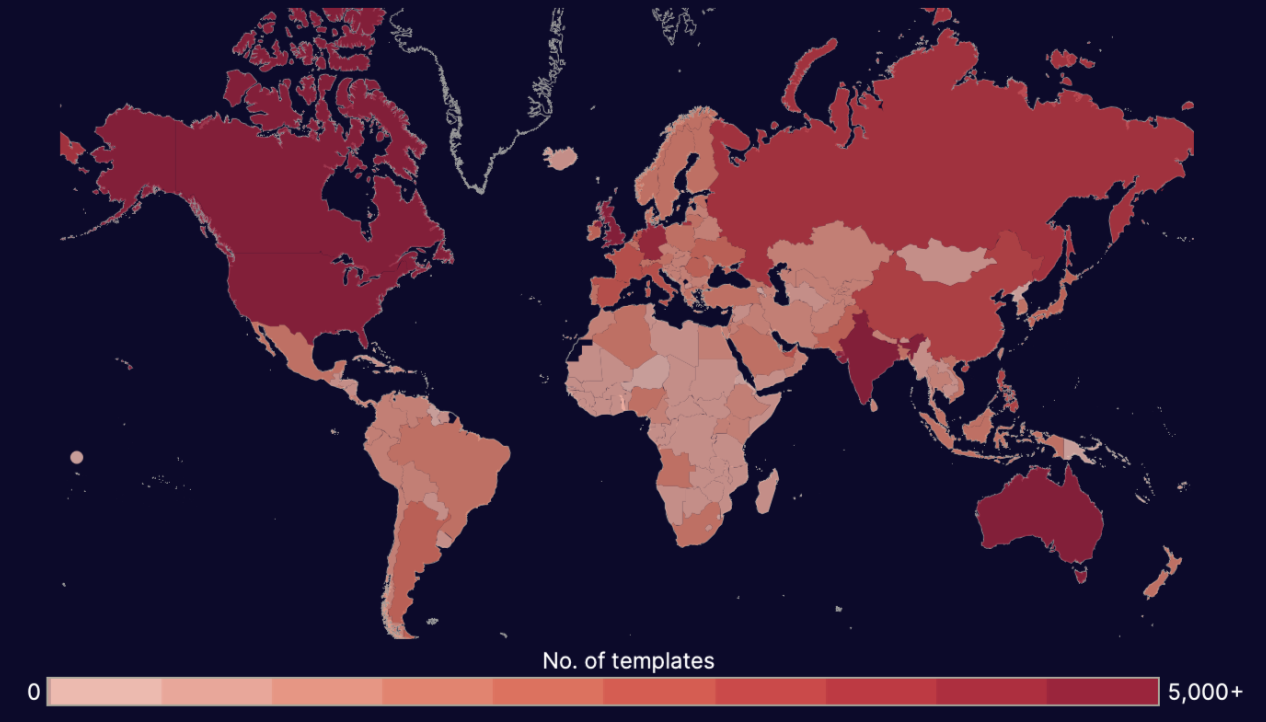
Threat intel stats: Florida business documents
Find more information about the threat these farms pose in our threat intel blog and webinar content.
5 Signs of a forged or fake Florida business license
A Local Business Tax Receipt, a City Business Tax Receipt, a Sunbiz filing, a Florida Annual Resale Certificate for Sales Tax, and a DBPR license can all look like legitimate documents but still be fraudulent.
Forged versions, altered fields, expired records, or real documents being presented as something they are not, it happens all the time. Keeping track of visual clues can make the difference in spotting a fake.
Here’s what to look for:
1. Inconsistent formatting
Florida business documents vary by issuer, but real records still follow the logic of the issuing system. A fake often blends local tax receipt language, Sunbiz entity records, Department of Revenue tax documents, and professional-license elements into one artificial certificate.
- Entity record styled as operating approval. If a record has been reformatted with language such as “licensed to operate,” “business license approved,” or “statewide authorization,” it is using entity-registration formatting to claim authority the record does not provide.
- Tax certificate and local receipt elements mixed together. A fake may combine resale certificate language, local receipt labels, and business-license terminology into one hybrid document that does not match either source.
2. Incorrect or misleading information
Florida business license fraud often appears when the document presents information incorrectly or in a misleading manner.
- Local receipt presented as a statewide certificate. A document redesigned as a generic “State of Florida business license” collapses Florida’s local licensing structure into a certificate that does not exist.
- Department of State record used as a business license. A Sunbiz filing should not be accepted as local operating permission.
- Annual Resale Certificate used as local authorization. A Florida Annual Resale Certificate for Sales Tax supports tax-free purchases or rentals for resale or re-rental does not prove city or county business authorization, local zoning approval, or professional licensing.
3. Uncharacteristic figures
Florida business license fraud often gets the renewal and number logic wrong. Dates, receipt numbers, certificate numbers, and payment fields should reflect the specific document type.
- Local Business Tax Receipt expires outside the Florida cycle. A local receipt showing an unrelated expiration month, permanent validity, or multi-year authorization should be checked directly with the issuing authority.
- Resale certificate number appears where a local receipt number should appear. Florida Department of Revenue resale certificates use tax-certificate identifiers. Those identifiers should not be repurposed as a city or county Local Business Tax Receipt number.
4. Florida business license inconsistencies
A convincing fake may use real Florida document names, but combine them in a way that breaks Florida’s layered licensing structure.
- City business missing the county layer, or county business missing the city layer. In some Florida jurisdictions, businesses may need both county and municipal business tax documents. A package with only one layer should be checked against the actual operating address rather than accepted as complete.
- Local receipt reused for a different address, trade name, or activity. Local business tax receipts are tied to specific local records. A receipt issued for one address, trade name, or classification should not be accepted for a different storefront, office, owner, or service category without verification.
- Local receipt used outside its jurisdiction. A Local Business Tax Receipt is tied to the issuing city or county. A business in Orlando shouldn’t be using a document from Tampa.
5. Metadata discrepancies
Metadata should support the fraud finding, not replace document verification. In Florida, metadata is most useful when the file origin contradicts the document’s expected source or when a portal record has been turned into an unverifiable image.
- Printable receipt presented as inherently suspicious. A Florida Local Business Tax Receipt is not fake just because it is printed from an online portal. Many Florida tax collectors and local portals allow online payment and printing.
- Department of Revenue certificate renamed as a license. A resale certificate downloaded or printed from a tax system should not appear in a file package as “Florida business license,” “operating license,” or “statewide business permit.” The file name alone is not proof of fraud, but it can show how the document is being misrepresented.
- Scan or photo submitted when a printable receipt should be available. Florida Local Business Tax Receipt delivery varies by city and county, but many jurisdictions let businesses pay, renew, and print receipts online. A phone photo, cropped scan, or low-quality image should warrant extra scrutiny when the issuing locality provides an electronic or printable receipt.
Disclaimer: Manual review can catch obvious Florida business license scams, but it struggles when fraudsters use real documents in misleading ways. At scale, reviewers need systems that can analyze document structure, compare submissions across cases, and flag document-function mismatches that are easy to miss by eye.
How to verify a Florida business license
Florida business license verification is usually performed by KYB analysts, anti money laundering (AML) compliance officers, procurement managers, vendor risk managers, commercial leasing agents, marketplace trust and safety reviewers, insurance underwriters, and fraud investigators.
Manual verification is possible, but it requires checking the document against the specific Florida system it claims to come from.
A Sunbiz record, Local Business Tax Receipt, City Business Tax Receipt, Florida Annual Resale Certificate for Sales Tax, and Department of Business and Professional Regulation (DBPR) license each prove different things and need to be checked in different places.
This drains times and makes you reliant on registries that can be outdated and incomplete.
AI-powered document verification is better suited to scale because it can analyze document structure, detect manipulation patterns, and connect suspicious submissions across customers or cases.
Manual review still matters in many compliance workflows, but reviewers need to verify the document’s role, issuer, location, tax year, and license category before trusting it.
Manual verification of a Florida business license
If you’re reviewing Florida business licenses manually, start with the warning signs mentioned above, then you can check the sources below.
- Sunbiz entity search. Search the Florida Division of Corporations records to confirm the legal entity, fictitious name, officer or registered agent, registered agent name, FEI/EIN, document number, ZIP code, or street address. For a complete guide of all US business registries, visit our USA KYB guide.
- DBPR license search. Use the DBPR license search for regulated professions and businesses. DBPR’s system provides information about applicants and licensed individuals for professions and businesses regulated by the department, so it is useful for checking categories such as contractors, real estate, cosmetology, food and lodging, and other DBPR-regulated activities.
Keep in mind: Manual verification becomes slow because Florida business authorization is layered. A reviewer may need to check Sunbiz, a county tax collector, a city business tax office, DBPR, the Department of Revenue, and sometimes a separate regulated agency before reaching a reliable conclusion. That works for one suspicious file, but it does not scale when fraud teams are reviewing hundreds or thousands of documents.
Using AI and machine learning to spot fake Florida business licenses
AI document fraud detection can strengthen Florida business license verification because the risk is not limited to obvious forgeries. Many suspicious submissions involve real-looking documents with invisible artifacts as the only clues to their manipulate.
Rather than relying on database lookups or fixed templates, AI document verification systems analyze how a document was built and how it relates to other documents and submissions.
Key benefits include:
- Construction analysis. AI can inspect how the document file was assembled, helping flag altered receipt numbers, pasted business names, edited expiration dates, inconsistent object layers, or rebuilt screenshots of local tax records.
- Cross-document intelligence. AI can compare submitted documents across the same customer or wider submission set, helping detect a Sunbiz entity name that differs from a receipt name, a DBPR license tied to another business, or the same local receipt reused across multiple applications.
- Adaptive decisioning. Customizing output based on your appetite for risk. Configure the system to meet your desired outcome.
Automation vs. AI
Automation can confirm whether a receipt number field is present, whether an expiration date is filled in, whether a document says “Local Business Tax Receipt,” or whether a submitted file includes a business name and address. These rules are useful for completeness checks, but they are easy for fraudsters to satisfy.
AI goes further. It can learn from document structure, manipulation patterns, and cross-document context. Instead of only checking whether a Florida Business Tax Receipt has the expected fields, AI can identity patterns of fraud review team may have never even thought of.
Conclusion
Fake Florida business licenses are real-looking records with the power to create a false picture of where a business operates, what it is allowed to do, or whether it holds the right local and regulated approvals.
Manual review is increasingly difficult difficult. A Sunbiz filing, Local Business Tax Receipt, City Business Tax Receipt, DBPR license, or Florida Annual Resale Certificate for Sales Tax may each be valid in its own lane, but none should be accepted as a universal proof of business legitimacy.
Resistant Documents doesn’t need to know what the document is or what its used for. It can spot fraud without getting lost in state, city, and county level nuances.
Scroll down to book a demo.

Fraud awareness, examples, and lessons
Learn more about fraud in specific industries, best practices, and targeted documents.
View all
Application fraud in 2026 is easier to attempt: accessible tools and services help applicants turn false claims ...

Within the fake document ecosystem, things can change fast. Four months ago, we reported that OnlyFake, the ...

In May 2026, a Dallas resident was convicted of running coin-operated “amusement machines” without a business ...

NEW YORK & PRAGUE – 1 October 2026 – Ocrolus, the AI workflow and analytics platform for lenders, today ...
For a few hundred dollars, sellers on Telegram promise to boost your credit score using someone else's credit ...

Key takeaways Fake certificates can use real numbers Fraudsters can copy a genuine business’s VAT number onto a ...