
In 2026, HM Revenue & Customs (HMRC) put the UK VAT gap, the difference between the value-added tax (VAT) it should collect and what it actually receives, at £12.1 billion for 2024–25. Fraud could be one of the primary drivers behind that gap.
For example, a fake VAT registration certificate is how a business can appear VAT registered while avoiding the tax altogether. It’s also often how a supplier, merchant, or business customer can open the door to other kinds of financial crime like false invoices, unrecoverable input tax, and missing trader fraud.
Procurement teams, marketplaces, business lenders, insurance claims handlers, and Know Your Business (KYB) reviewers can all end up with one of these certificates in front of them to verify. HMRC expects them to check who they're dealing with to ensure the company they’re transacting with isn’t committing VAT fraud.
The trouble is that producing a fake UK VAT registration certificate that survives an onboarding check is easier than ever. Fraudsters have their pick of templates available online, sold in estores, and generated with AI.
Read on to learn what UK VAT registration certificates are, how they're being forged, how to spot a fake, and how AI-powered tools can help.
Check out our "how to spot fake documents" blog to learn about more common document forgeries.
What is a UK VAT registration certificate?
A UK VAT registration certificate is an official document from HMRC (known as Form VAT 4) that confirms a business is registered for VAT. As of June 2026, HMRC no longer routinely issues it on paper. Instead, businesses access the certificate through their VAT online account. Reviewers may receive it as a printout, a saved PDF, or a screenshot.
Key elements of a UK VAT registration certificate include:
- VAT registration number (VRN). Nine digits, for example 123 4567 89. For cross-border supplies, the number must be written with a "GB" prefix, and businesses operating under the Northern Ireland Protocol use "XI" in place of GB with the same nine digits.
- Effective date of registration (EDR). The date from which the business is registered and liable to account for VAT.
- Registered business name. The entity HMRC holds the registration for.
- Principal place of business. Where the business is actually run.
- First VAT return period and payment date. When the first return and payment are due.
These details confirm that HMRC registered the business for VAT from the stated effective date and assigned it a VAT registration number. The business uses that registration to charge VAT on taxable supplies, issue compliant VAT invoices, submit VAT returns, and reclaim eligible input tax.
According to HMRC, a VAT registration certificate has no legal significance beyond communicating whether a business has been registered for VAT. It does not authorize the business to operate, prove that it holds any licenses required for its activities, or confirm that it is meeting its VAT obligations.
It therefore serves a different purpose from a document like a business license, which may authorize a specific activity in a particular jurisdiction. A VAT registration certificate only confirms registration with HMRC.
This distinction can be exploited in missing trader VAT fraud. A business can register for VAT, collect VAT on taxable sales, and then disappear without paying it to HMRC. A genuine or fabricated certificate may help the business appear legitimate and pass onboarding checks, but it does not prove that the business is actively trading or meeting its VAT obligations.
Visual checks are also difficult because one submission may look different from another. Certificates may be submitted as downloaded PDFs, browser printouts, or screenshots. An old-looking template is not necessarily suspicious, as genuine certificates may retain legacy details after HMRC updates its systems.
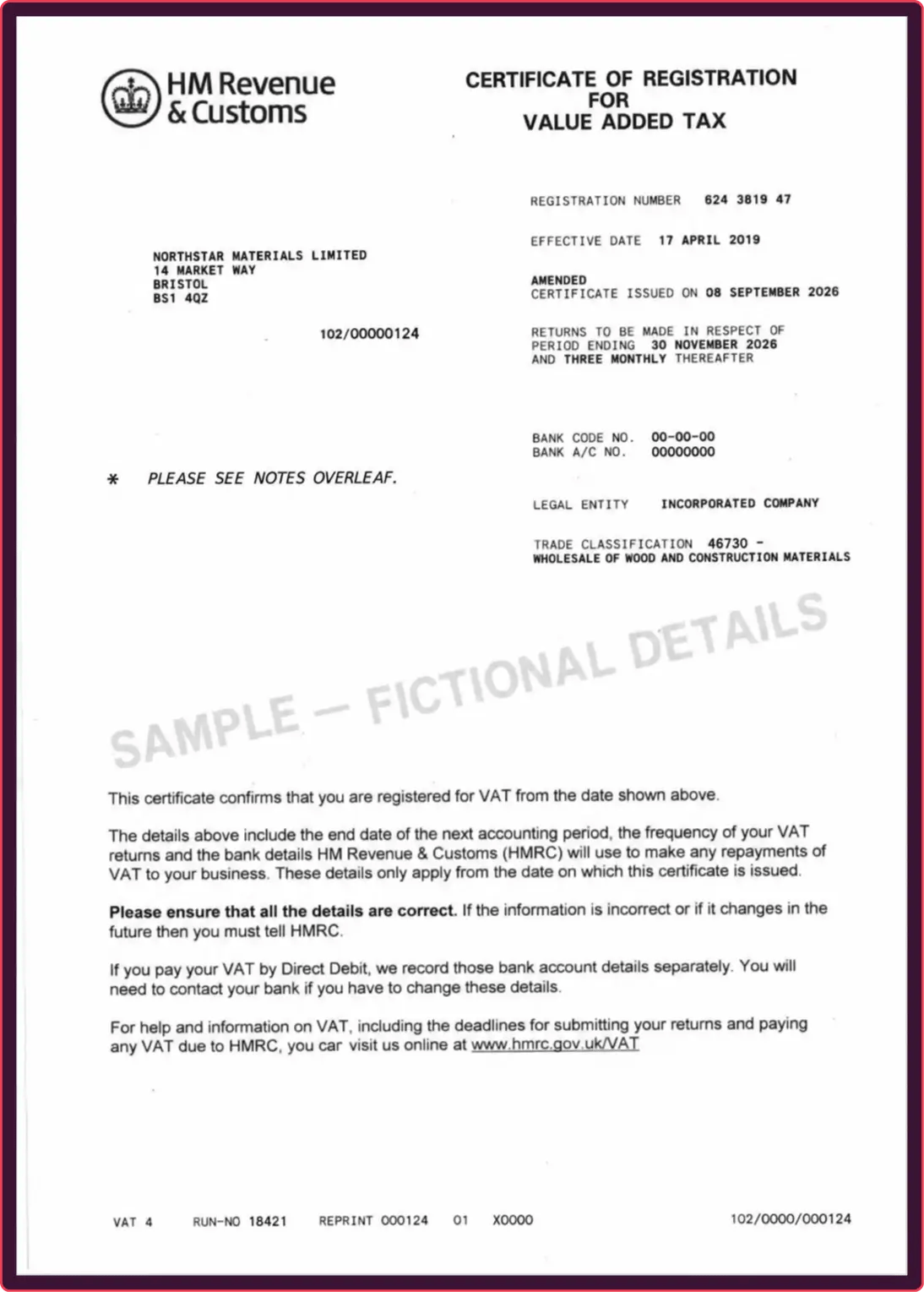
An example of a UK VAT registration certificate (HMRC's Form VAT4) for illustrative purposes only.
Why are UK VAT registration certificates important?
A UK VAT registration certificate gives finance, tax, and onboarding teams evidence of a counterparty's VAT status. It's the document a business is asked for when someone needs to see that its VAT registration exists, when it took effect, and which legal entity the registration belongs to.
Here’s how UK VAT registration certificates are used across specific industries:
- KYB and merchant onboarding. Payment providers require VAT evidence before activating a live merchant account, and may request the certificate when an automated check on the VAT number fails.
- Lending and underwriting. Lenders may request a VAT registration certificate as supporting evidence of an applicant’s claimed VAT registration when reviewing a business loan application.
- Procurement and vendor onboarding. Teams may use a supplier's VAT registration certificate as supporting evidence when setting up its tax details and preparing to process VAT-bearing invoices.
- Marketplace trust and safety. Operators can be held jointly and severally liable for unpaid VAT where an overseas seller should have registered for UK VAT and failed to, and the platform knew or should have known. Seller verification teams collect VAT evidence to show that question was taken seriously.
A VAT registration certificate is trusted because it links a business to an official HMRC record. Reviewers can check the business name, VAT number, and registration date against HMRC’s records to confirm that the registration belongs to that business. But that trust can be exploited by fraudsters.
An altered or fabricated certificate can make a false business identity or VAT status look like something HMRC has on record. And VAT carries an unusual exposure: if a transaction turns out to be connected to VAT fraud and HMRC establishes that you knew or should have known, you can lose the right to reclaim the input tax on it.
HMRC gives general guidance on spotting VAT fraud, such as assessing whether a deal makes commercial sense. But it will not publish a comprehensive checklist because doing so "would merely enable fraudsters" to work around it. To reduce the risk of costly VAT fraud, familiarize yourself with the types of document fraud and incorporate checks into your KYB process.
Threat Intel: Template data about fake UK VAT registration certificates
Our Threat Intelligence Unit collects data about template farms which make and distribute fake document templates for fraudulent purposes.
During our research, we did not catalogue many UK VAT registration documents. However, they remain prevalent online. A simple search on Scribd.com (a well-known template hub) returns 31,500+ results for this document, suggesting a high demand for online templates.
The results were not limited to UK certificates, but usable templates appeared among the first two. 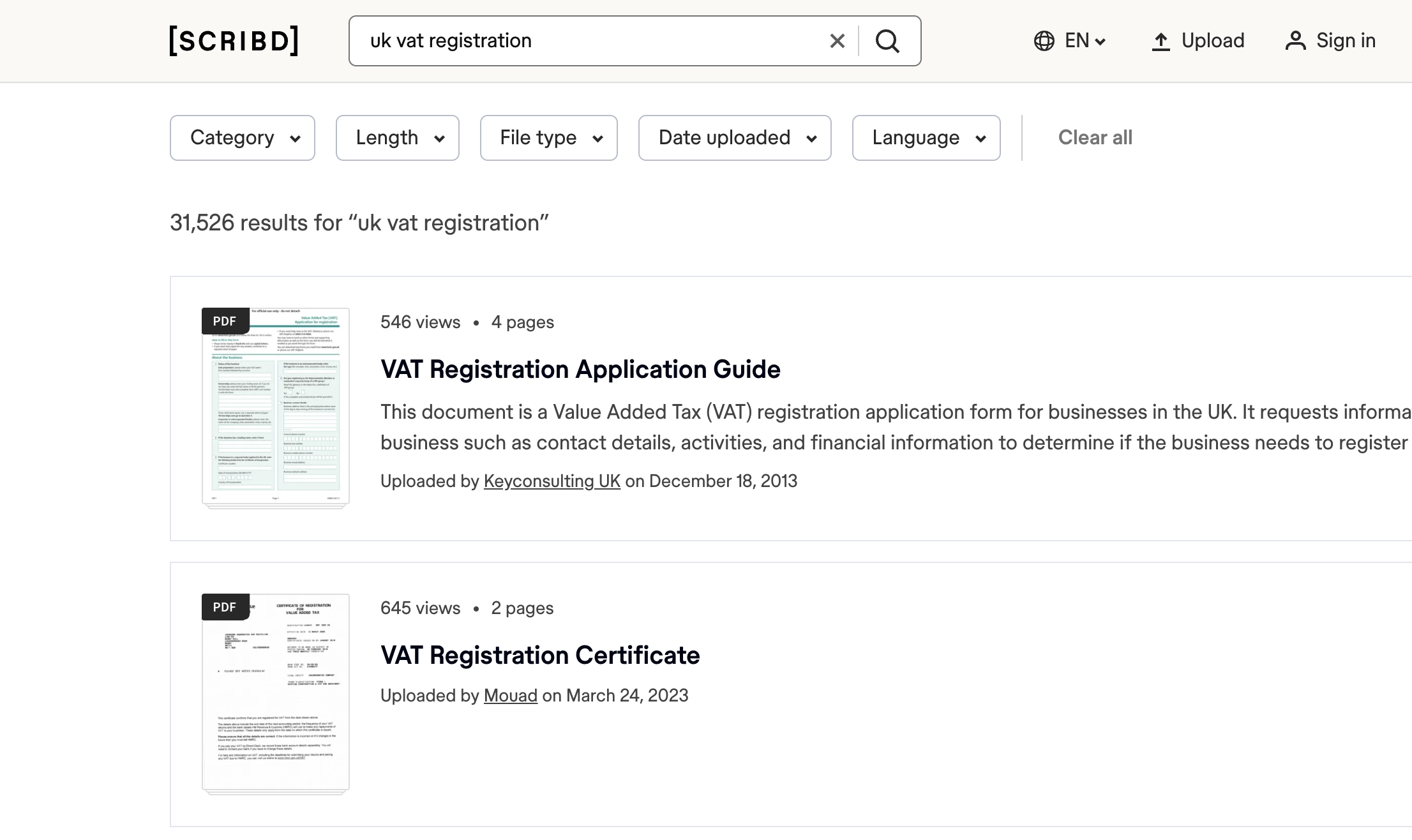
Search results for "UK VAT registration" on Scribd.
Threat level: HMRC’s VAT portal issues official PDFs for this document. Any submission containing data from a known template hub should be treated with a high level of suspicion.
5 Signs of a forged or fake UK VAT registration certificate
A fake UK VAT registration certificate can be tricky to spot visually. The same registration can reach you as a downloaded PDF, a browser print, or a screenshot, so the file in front of you may look nothing like the last one you saw and still be genuine.
Convincing fakes often start from a real screenshot, so appearance alone won’t distinguish them. The evidence sits in the document itself and whether its dates and codes follow the logic HMRC's systems apply when generating them.
Here’s what to watch for:
1. Inconsistent formatting
A VAT 4 is generated by HMRC, so there should be consistency between the various fields on the document. Fields edited after the fact rarely sit cleanly in the document around them.
- Header inconsistencies. The HM Revenue & Customs logo and the certificate's title are positioned together at the top. A logo that's been stretched, redrawn, or pasted at a different scale from the text beside it suggests a rebuilt header.
- Fields that don't match each other. The labeled details are generated together and share one typeface, size, and alignment, whatever output method delivered them. A registration number or date differing from its neighboring fields in font, weight, spacing, or baseline is the clearest single sign of an edit.
- Invalid VAT registration number. A UK VAT registration number is nine digits long, with or without spacing. A number of any other length can't be valid.
2. Incorrect or misleading information
Fabricated certificates are often built by someone working from a description rather than the real thing, and the language gives it away before the layout does.
- Incorrect terminology. The document's own title is "Certificate of Registration for Value Added Tax," and it labels its fields "REGISTRATION NUMBER" and "EFFECTIVE DATE." And HMRC's service guidance explicitly rejects "VAT number" and "VAT identification number."
- Trading name in place of the legal name. A trading name is the public name a business uses, while its legal name identifies the person or company responsible for it. The certificate should show the legal name. A trading name in its place may indicate an alteration.
- Issuing authority. All certificates are issued by HMRC for England, Scotland, Wales, and Northern Ireland. A certificate showing an issuing authority that does not match its stated jurisdiction suggests a fabrication.
- Incorrect trade classification code. The certificate carries a five-digit classification with its description printed beside it. Those pairings come from the published SIC list, so a code that doesn't exist, or a real code attached to the wrong description, can be checked directly on the document.
3. Bad math and uncharacteristic figures
A UK VAT registration certificate contains no financial calculations, but its dates and codes are generated by HMRC systems and have to agree with each other. Fabricated certificates tend to break that internal logic.
- Return period that doesn't fit the stated frequency. HMRC allocates tax periods in stagger groups: monthly, or quarters ending March, June, September and December, or April, July, October and January, or May, August, November and February. A quarterly certificate whose period ends mid-month, or whose frequency doesn't match the period given, doesn't match how the schedule is assigned.
- Check digits that don’t add up: A genuine UK VAT number is generated using a specific algorithm: the modulus-97 checksum or the later 97-55 variant. If the final two digits do not satisfy either formula for the first seven digits, the number may be fake or entered incorrectly.
- Unexpected renewal or expiry dates: HMRC does not assign VAT 4 certificates a fixed validity period or periodic renewal date. A certificate containing fields such as “valid until,” “renewal due,” or “next renewal” may therefore have been fabricated or altered.
4. UK VAT registration certificate inconsistencies
Some submissions are inconsistent with what this document actually is, before any individual detail is examined.
- Missing key information. A certificate without a registration number or an effective date can't function as proof of VAT registration.
- Wrong document submitted. A C79 import VAT certificate, VAT66 certificate of status, postponed import VAT statement, or VAT invoice cannot replace a VAT 4 as proof of registration. Each document serves a different purpose.
- Mismatched business name and entity type. The registered name should match the type of business shown. For example, a limited company would normally include “Ltd” or “PLC” in its name. Any mismatch should be flagged.
5. Metadata discrepancies
A recently created file or a screenshot origin is expected rather than suspicious, but the file details should still be free of the following signs of manipulation.
- Editing-software provenance. VAT registration certificates are available as PDFs directly from HMRC's VAT account portal, so metadata should reveal signs specific to that origin rather than editing software or other programs potentially used to doctor the file.
- Personal author tag. A file printed or saved from the VAT online account carries a browser or print driver, not an individual's name.
- Screenshots lacking important details. Screenshots can crop important fields, remove metadata, and make the document’s origin or editing history harder to assess. Instead of screenshots, request the complete certificate saved or printed from the business’s HMRC account and verify its details independently.
Disclaimer: Manually checking every field is slow and could lead to errors, especially at scale. For teams reviewing supplier evidence at high volumes, AI-powered document verification reviews every certificate and flags files that have been altered, fabricated, or submitted before. Faster checks mean more time for your team to review complex cases.
How to verify a UK VAT registration certificate
Anyone who asks for a VAT 4 for document verification ends up doing one of two things: checking the details by hand or running the file through automated analysis. That includes procurement and finance teams, marketplaces, business lenders, insurance claims handlers, and KYB reviewers.
Manual verification hits a roadblock unique to this document. While HMRC's VAT number lookup is an authoritative check, it reports on the registration rather than the document. A stolen VAT number from a real trading business can come back clean, even if the document itself is fraudulent.
On the other hand, AI-based verification examines how the file was assembled, including the traces left by editing software and layers that remain after manipulation. It also compares each submission with previously reviewed documents to flag duplicates quickly. This provides a scalable and more accurate method of document fraud detection.
That said, manual review remains common, and the following checks can help reviewers get more from it.
Manual verification of UK VAT registration certificates
If manual checks are part of your workflow, the red flags above cover the file itself. The checks below start with what you were actually sent, then work outward.
- Check the UK VAT registration number. Use the GOV.UK VAT checker to confirm the number is valid and that the returned name matches the certificate. You'll need the number itself since the service can't find a business by name.
- Check Companies House. You can check that a company exists with Companies House, the UK government agency that incorporates companies and maintains the public register. It can confirm a company’s legal name, number, registered office, directors, filing history, status (e.g. “Active”), and incorporation date.
- Align the VAT 4 with invoices and online presence. Verify that the VAT registration number and legal name on the VAT 4 appear consistently on invoices, quotes, and the company’s website. Missing VAT numbers on taxable invoices or different numbers across documents warrant further checks.
Keep in mind: Manual review holds up at low volumes, but it's slow, inconsistent, and repeated in full for every supplier you onboard. With increasingly sophisticated fake certificates out there, it’s difficult for hand-by-hand checks to keep pace and scale.
Using AI and machine learning to spot fake UK VAT registration certificates
The potential blend of real and fake details complicates the process for checking UK VAT registration certificates. AI can help by looking past what the document says and focusing on how it’s built.
A human reviewer may check the VAT registration number and look for obvious document issues. AI-powered document fraud detection checks for alterations, whether the same document has been submitted before, and whether it matches templates seen in other forgeries.
Benefits include:
- Structural analysis vs reading the document. Data privacy is important, especially when dealing with personal and financial details. AI-powered document checks focus on a document's fraud markers rather than its contents.
- Cross-submission context. With AI, each assessed file is compared against every other document seen in your environment. Certificates reused across applicants and templates from e-stores or generators are automatically flagged.
- Detection of AI-generated documents. AI detectors analyze both the visual textures and the structural patterns of a file to spot the signatures of current-generation tools. Use AI to detect AI, with a false positive-rate under 1%.
Automation vs. AI
Basic automation can confirm a VAT registration number is nine digits long and other general formatting rules. This can catch obvious errors, but an altered certificate built around a genuine VAT number can still get past every other fraud check.
As fraud techniques evolve, AI can adapt in real-time to patterns associated with new editing tools, reused certificate templates, and emerging generation techniques. For UK VAT registration certificates, that shifts the focus from whether the number looks valid to whether the submitted file shows evidence of manipulation, fabrication, or reuse.
Conclusion
A fake UK VAT registration certificate can cost you the input tax on any transaction HMRC decides you should have questioned. But simply checking the validity of the registration number isn’t enough. A real VAT number copied onto an edited certificate can pass a registry check, so the file has to be examined rather than just read.
Resistant Documents looks into metadata, internal structure, context, image consistency, backgrounds, fonts, and more. It weighs each file against fraud templates circulating online, flagging documents that have been altered, fabricated, or submitted before. Ready to see what it finds in your own supplier evidence?
Scroll down to book a demo.

Fraud awareness, examples, and lessons
Learn more about fraud in specific industries, best practices, and targeted documents.
View all
In May 2026, a Dallas resident was convicted of running coin-operated “amusement machines” without a business ...

NEW YORK & PRAGUE – 1 October 2026 – Ocrolus, the AI workflow and analytics platform for lenders, today ...
For a few hundred dollars, sellers on Telegram promise to boost your credit score using someone else's credit ...

In our last piece, we introduced 3 different types of account farmers and how each of them can be detected. Now, ...

The most dangerous account farmers are the ones you'll never notice. A year of buying accounts and tracking these ...