
In May 2026, a Dallas resident was convicted of running coin-operated “amusement machines” without a business license, according to the Texas Comptroller. The penalty was six months of community supervision, a $500 fine, and $310 in court costs. Two months later, a Houston resident was arrested on the same charge after seven unlicensed machines were found at his business.
Despite the risk, many operators still elect to fake a Texas business license instead of obtaining legitimate permits. A convincing document costs far less than the license, the inspection, or the charge that follows getting caught without them.
The risk also extends to reviewers, including lenders, procurement managers, marketplaces, and insurers. Approving a fake can mean fraud losses, compliance failures, and customers left dealing with an operator that should never have cleared verification.
Online template farms, e-commerce stores selling falsified documents, and generative AI have made those files easier to produce. So verifiers need to be more vigilant to avoid criminals or other unauthorized people passing through.
Read on to learn what Texas business licenses are, how they are being forged, how to spot a fake, and how AI-powered tools can help.
Check out our “how to spot fake business licenses” blog for a universal guide on how to spot fake documents of this type.
What is a Texas business license?
A Texas business license is an informal term for all of the registrations, permits, and approvals a business may need to operate legally. Texas does not issue one universal statewide business license. Instead, a package of state and local documents together functions as what would be referred to as a “Texas state business license.”
The required documents in the package depend on what the business does, where it operates, how it is structured, whether it uses a trade name, and whether it has employees.
The Texas Business Permit Office helps businesses navigate these requirements but does not issue or administer licenses or permits.
A Texas business license package can include:
- Certificate of formation or registration. Creates a domestic Texas filing entity, such as a corporation or LLC. A business formed outside Texas may need a foreign registration before operating in the state.
- Employer Identification Number. Provides a federal tax identifier for corporations, partnerships, businesses with employees, and other qualifying entities.
- Assumed Name Certificate. Registers a trade or “doing business as” name. The appropriate filing office depends on the business structure.
- Texas Sales and Use Tax Permit. Required for businesses that sell, lease, or rent taxable goods, provide taxable services, or meet certain requirements for taxable sales into Texas.
- Texas Alcoholic Beverage Commission license or permit. Required for businesses that manufacture, distribute, transport, or sell alcoholic beverages.
- Texas Department of Licensing and Regulation license. Required for regulated activities and establishments such as electrical contracting, air-conditioning and refrigeration work, towing, vehicle storage, and barbering or cosmetology.
- Local permits and premises approvals. Required when a city or county regulates the physical location through zoning, occupancy, building, signage, health, or fire requirements.
-
Employer and federal registrations. Required when a business hires employees or operates in a federally regulated activity such as aviation, firearms, or interstate transportation.
Together, the documents relevant to a particular business can function as its Texas “business license.” They are not interchangeable, and no single document proves that the business has every approval it needs.
The Texas Business Permit Office notes that a certificate of formation or an Assumed Name Certificate may serve as the general proof of registration sometimes requested as a business license. But keep in mind, these documents do not replace tax permits, professional licenses, industry approvals, or local permits.
A certificate of formation establishes a domestic legal entity (most commonly an LLC or a corporation). It typically includes:
- Document title and issuer. Identifies the entity type and the Texas Secretary of State as the filing authority.
- Legal business name and entity type. Shows the registered name and whether the business is an LLC, corporation, limited partnership, or another filing entity.
- Secretary of State file number. The unique number assigned after the filing is accepted.
- Registered agent and office. Names the person or organization receiving legal notices and provides the registered Texas address.
- Governing and organizer information. Identifies the initial managers, members, directors, or organizers involved in forming the entity.
- Effective date. Shows when the entity’s formation takes effect.
- Status and authentication details. Filing evidence may be verified through state records, while current standing should be checked through SOSDirect or a certificate of fact - status.
An Assumed Name Certificate records the use of a trade name. It commonly includes:
- Document title and filing authority. Identifies the record as an Assumed Name Certificate filed with the Texas Secretary of State or a county clerk.
- Assumed and legal names. Connects the trade name to the individual or entity responsible for it.
- Entity type and file number. Identifies the business structure and, where applicable, its Secretary of State file number.
- Principal office address. Shows the main business address associated with the filing.
- Jurisdiction or geographic area. Identifies where the entity was formed or the Texas counties where the assumed name will be used.
- Filing period. States how long the assumed name will be used, up to 10 years on the Secretary of State form.
- Signature and authentication details. Identifies the authorized signer and provides filing information that can be checked with the accepting office.
While these two documents can help verify a business’s identity or registration, neither confirms every license, permit, or approval required for its specific activity and location.
Reviewers should also separate entity status from franchise tax standing. The two are easy to conflate, since both have been called a certificate of good standing. A Texas SoS Certificate of Fact - Status confirms an entity’s legal name, formation or registration date, and current filing status. A Texas Comptroller Certificate of Account Status addresses the entity’s franchise tax account standing.
Like California or New York, reviewing a Texas business license is complex because the exact document package depends on the business’s activities, location, structure, and regulatory obligations.
The Texas Business Licenses and Permits Guide is the best starting point for identifying state-level requirements. Reviewers may also need to consult the relevant city, county, or specialist regulator. For example, businesses that sell, lease, or rent taxable goods or provide taxable services generally need a Texas Sales and Use Tax Permit.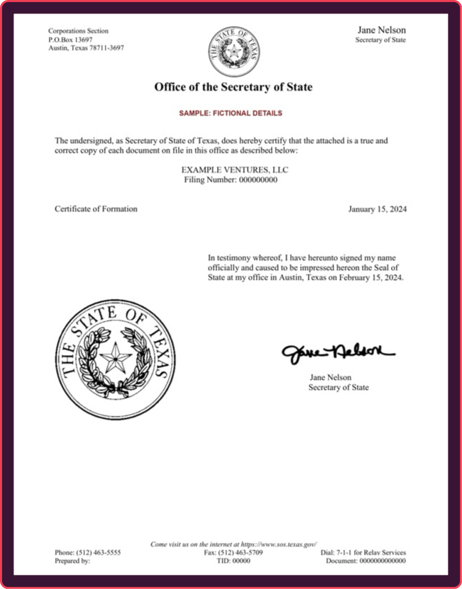
Example of a certified copy of a Texas certificate of formation for illustrative purposes only.
Why are Texas business licenses important?
Texas business license documents help reviewers assess whether a business is registered and appears to hold the approvals its activities and locations require.
Because the Texas package is assembled from state, county, city, and industry sources, knowing which record answers which question separates a properly authorized applicant from one relying on partial proof.
Merchant onboarding teams, lenders, procurement managers, marketplace reviewers, and insurers all encounter these documents, and no two packages arrive the same way. Each reviewer still has to confirm that the records on the desk cover the exact activity and address being claimed.
Here’s how Texas business licenses are used for document verification:
- KYB and merchant onboarding. Analysts review the applicant's legal entity, trade name, address, sales-tax registration, and regulated services to assess whether the business is authorized for the activity it claims, at the location it claims.
- Lending and underwriting. Lenders use formation, tax, and licensing records to establish the borrower's business identity and judge whether it holds the authorization needed to generate the revenue stated in its application.
- Procurement and vendor onboarding. Procurement teams may need evidence that a contractor or supplier is registered and appropriately licensed before approving the vendor, particularly for regulated trades and on-site work.
- Marketplace trust and safety. Marketplaces draw on sales-tax and activity-specific records when reviewing sellers in taxable or regulated categories. Texas generally requires a sales-tax permit for each active place of business, with a separate outlet number assigned to each location.
- Insurance underwriting. Underwriters read licensing and premises information to establish the applicant's business activity, operating location, and regulatory category.
These documents are trusted because they come from official state, local, and industry-specific authorities, including the Texas Secretary of State, Texas Comptroller, Texas Department of Licensing and Regulation, Texas Alcoholic Beverage Commission (TABC), and city and county offices.
But they only work as a set. A single record answers a single question, so the review has to establish that the documents on the desk cover the exact registration, activity, and address being claimed.
Texas business license law
Texas business licensing is split across four layers: entity registration with the Secretary of State, tax permits from the Comptroller, licenses from industry regulators, and approvals from the city or county where the business operates. Each layer has its own statute, its own issuing office, and its own renewal cycle.
For many businesses, the most important state-level document is the Texas Sales and Use Tax Permit. It is issued by the Texas Comptroller of Public Accounts and is required of anyone selling, leasing, or renting taxable goods or services. That makes it the closest statewide equivalent to a business license for retail, e-commerce, wholesale, and goods-based businesses.
But the sales tax permit does not cover every business. The Governor's Business Permit Office states directly that the State of Texas does not require a general license, and that all entities transacting business in Texas must register with the Secretary of State.
Most large Texas cities issue no baseline business license either. The City of Houston says plainly in its new business guide that there is no general business license issued by the city. Cities instead issue permits tied to a specific activity or building, each from their own office.
Houston's permitting center issues alcoholic beverage licenses, game room licenses, dealer permits, coin-operated machine registrations, street vendor permits, and food dealer permits. Dallas requires a certificate of occupancy for almost any non-residential use, including a change of tenant. San Antonio layers a city alcohol license and a separate Bexar County alcohol license on top of the state TABC permit. El Paso runs a One-Stop Shop Business Licensing Center covering lodging houses, secondhand dealers, motor vehicle dealers, and tattoo and body piercing artists.
For fraud review, the first question regarding a Texas city document is often whether it should exist at all. A document titled "City of Houston Business License" or "City of Dallas General Business License" describes something those cities do not issue.
Jurisdiction is the other thing worth pinning down, because the office that issued a Texas permit should match the address on it. The Texas Department of State Health Services regulates retail food establishments only where no local health agency already does. In the Houston area alone, a restaurant may be permitted by the city, by Harris County Public Health, or by the state, depending on its exact location.
Businesses with fewer licensing steps are usually remote, service-based, non-public-facing, and not selling taxable goods. A freelance designer working from home in El Paso may have a lighter path than a restaurant in Houston, a bar in San Antonio, a used-vehicle dealer in Dallas, an electrical contractor in Lubbock, or an oil and gas operator near Midland.
Texas business licensing process
The Governor's Small Business Resource Portal organizes requirements by location and circumstance, which makes it a useful reference for working out what a given business should have filed. Registration comes first, then industry-specific approvals. Here's how the process works:
- Register the business with Texas. Corporations, LLCs, limited partnerships, and other filing entities submit formation documents to the Texas Secretary of State. Businesses formed elsewhere may need foreign registration before transacting business in Texas.
- Register any trade name. A business operating under a name other than its legal name files an Assumed Name Certificate. The filing office depends on the business structure and may be the Secretary of State, a county clerk, or both.
- Set up tax registrations. Most entities obtain an EIN from the IRS and fall under Texas franchise tax obligations. Businesses making taxable sales register separately for a sales and use tax permit, with a separate outlet number for each active location.
- Check local and premises requirements. Before opening, the business contacts the relevant city and county about zoning, occupancy, construction, health, fire safety, signage, and home-based business rules.
- Obtain industry and federal approvals. Applications go through the regulator responsible for the activity, such as TDLR, TABC, TxDMV, or the Railroad Commission of Texas. Some licenses add exams, background checks, insurance, or bonds.
- Complete employer requirements. Businesses with employees register with the Texas Workforce Commission and set up federal payroll accounts, new-hire reporting, and any insurance their industry or contracts require.
- Keep everything current. Entity and location details get updated, the registered agent and office stay in place, tax reports are filed, and assumed-name filings, licenses, and permits are renewed before they expire.
Threat intel: Template data about Texas business documents
Our Threat Intelligence Unit collects data about template farms which make and distribute fake document templates for fraudulent purposes.
Below, you'll find an infographic containing data about all the fake Texas business documents we've found: their availability, their distributors, the institutions or "issuers" whose documents have been exposed, and how much it costs to buy one.
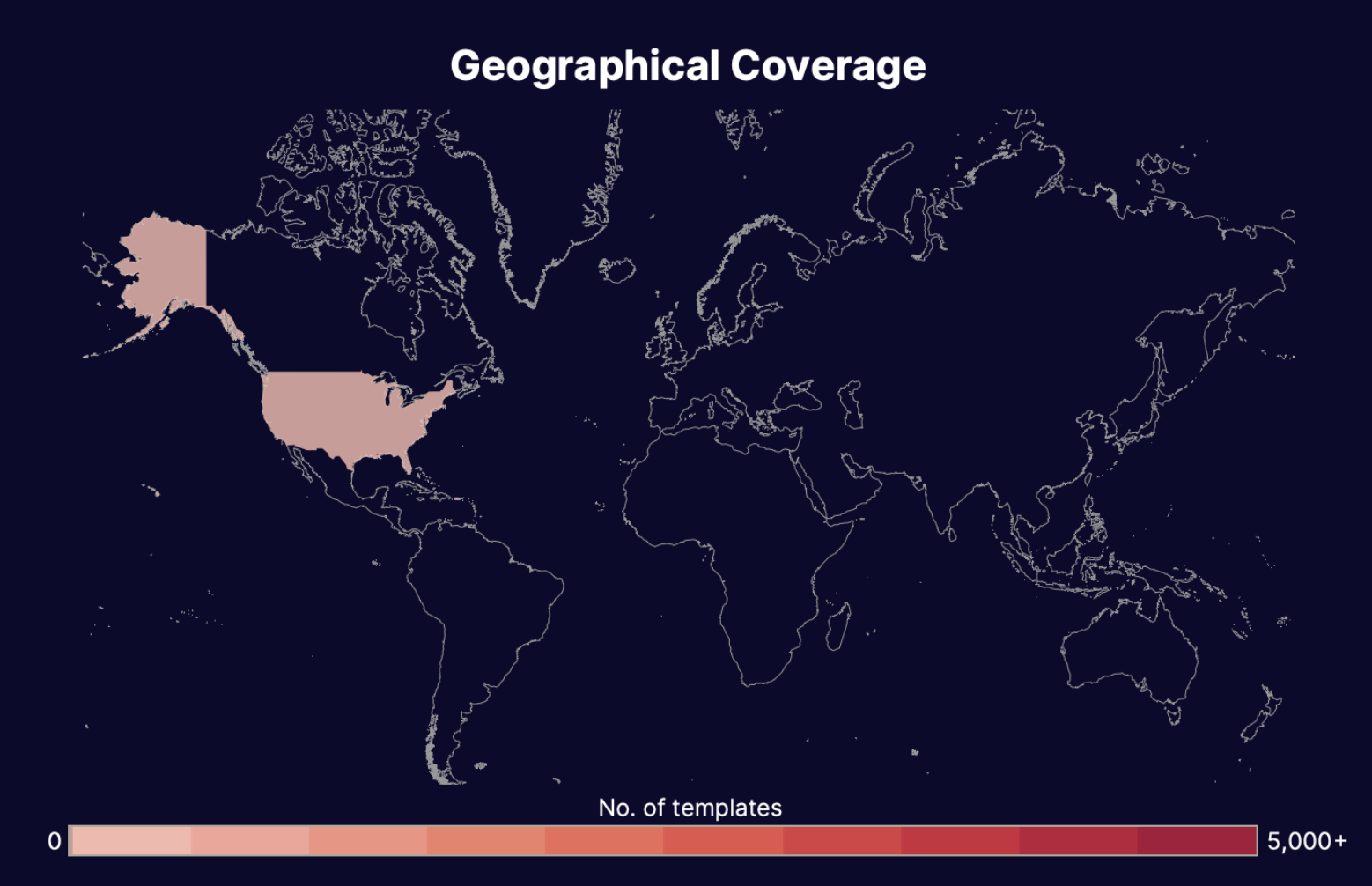
Threat intel stats: Texas business documents
5 signs of a forged or fake Texas business license
Missing a fake Texas business document during verification can mean approving a business that is operating without the required licenses or permits, exposing customers and partners to financial, legal, and public-safety risks. It can also put you in violation of state and national level AML and CFT laws. An incomplete or fabricated licensing package can therefore carry consequences far beyond a failed onboarding check.
Manual review is difficult because genuine Texas business documents come from multiple state agencies, counties, cities, and industry regulators. Each document can have a different purpose, format, and verification process.
When reviewing a Texas business license package, watch for these red flags:
1. Inconsistent formatting
Formatting problems matter most when the document does not match how that specific Texas record is issued. A certificate of fact - status, a sales-tax permit, and a TABC license each arrive in a set form, so borrowed layouts and missing standard elements stand out.
- Secretary of State certificate with no document number. Certificates of formation, certificates of fact - status, and certified copies carry a document number at the bottom of the page, which the SoS’s Certificate Verification service uses to confirm the office issued that exact certificate. A certificate with no document number, or one placed somewhere other than the foot of the page, does not match how these records are produced.
- TABC license missing official elements. A license printed through AIMS shows the license type, an AIMS license number, and a QR code. Generic state branding with no license type, holder, or status in sight does not match anything TABC issues.
- Local permit without a named issuing office. Premises-based approvals, such as certificates of occupancy, zoning approvals, and health or fire permits, come from a specific city or county department and name one approved location. Generic Texas branding in place of the local office points to a template.
- Placeholder number patterns. Sequential runs, repeated digits, or the same number appearing in two unrelated fields point to a template that was never populated with real data.
2. Incorrect or misleading information
A fake Texas business license often reads like the real thing until you check what it claims to authorize. With formation, tax, local, and industry records all in play, fraudulent documents may use wording from the wrong agency.
- Wrong issuing authority. Each Texas record comes from one specific office. Sales tax permits come from the Comptroller, certificates of formation from the Secretary of State, alcohol permits from TABC, etc.
- Invalid registered-agent details. The registered office must be a Texas street address where the agent can be served during business hours, so a P.O. box or private mailbox does not satisfy the requirement. The agent must also be an eligible Texas resident or authorized organization, and an entity cannot name itself.
- Misleading assumed-name filing. A genuine Texas assumed name certificate names both the trade name and the owner behind it. A document that shows only the trade name, with no underlying individual or entity named on the form, is missing the detail that makes the filing meaningful.
3. Bad math and uncharacteristic figures
Texas business documents rarely contain calculations, but their dates and terms follow statutory limits. An effective date, expiration, or license term that falls outside what Texas allows is a sign the document was filled in rather than issued.
- Assumed name certificate with a term longer than 10 years. A Texas Assumed Name Certificate must state a fixed duration of no more than 10 years from its filing date. Watch for a state filing marked "permanent" or "indefinite."
- Certificate of formation with a delayed effective date beyond 90 days. A Texas certificate of formation cannot take effect more than 90 days after signing. Compare the signature date, the effective-date election, and the file stamp.
- TABC license with an implausible term. Many TABC licenses and permits are valid for two years from the issue date, but some temporary or special permits have different terms. A license showing a term that does not match any known TABC permit type for that activity should be questioned.
- TDLR license showing a status its dates do not support. The status and expiration date printed on a TDLR license have to agree. An active status alongside a long-past expiration is a contradiction on the face of the document.
- Incorrect sales-tax number. A Texas Sales and Use Tax Permit should identify the Texas Comptroller and tie the permit holder to a sales-tax account at a named address. The taxpayer number runs 11 digits and begins with 1 or 3, so another length or leading digit was not issued by the Comptroller.
4. Texas business license inconsistencies
Texas authorization arrives as a package from several offices, so the records should agree with each other on names, numbers, addresses, and dates. Contradictions between documents often surface faster than flaws in any single one.
- One sales-tax permit covering several locations. Texas issues a separate permit for each active place of business. A single permit presented as authorization for multiple sites, with no outlet numbers or outlet addresses, does not match how the Comptroller registers locations.
- Tax identifiers conflict. The document presents the Comptroller taxpayer number where the Secretary of State file number belongs, or uses one number in both roles.
- Entity details conflict. A document that shifts between LLC, corporation, and sole proprietorship, or appends a designator the entity never registered, may signal fraud.
- License category conflicts with the approved activity. A license may identify one category in the title, then describe a different regulated activity in the body, such as a TABC retailer permit that later refers to manufacturing or distribution.
- Filing language conflicts with the issuer. A county-issued certificate should not claim it was filed with the Secretary of State.
5. Metadata discrepancies
Texas records reach a reviewer through several channels, from SOS portal downloads to agency PDFs and printed licenses. Metadata checks work best when the file history matches how that particular document is issued.
- Government document edited after issuance. A Secretary of State, Comptroller, TABC, TDLR, or local government PDF shows traces of later editing in design software, image editors, or consumer PDF tools.
- Metadata source does not fit the issuing pathway. A file claiming to come from a Texas agency while naming a personal author, design platform, or template tool in its properties did not come off that agency's system.
- Screenshot-only submission of a verifiable record. Texas records carry features that screenshots often lose, including SOS document numbers and TABC QR codes. A cropped screenshot should not be treated as the strongest available evidence.
Disclaimer: While manual review is a start, it struggles to scale across Texas licensing, where one business may hold records from the Secretary of State, the Comptroller, a county, a city, and several industry regulators, each with its own expected format.
How to verify a Texas business license
Texas business license verification is no easy feat, considering the array of documents that may arrive at the desk of KYB analysts, onboarding teams, underwriters, and fraud investigators.
There are two general approaches to assessing whether a Texas business document is real or fake: manual review and automated review.
Because Texas business authorization is scattered across state, local, and industry records, manual review is error-prone. Verifiers need to be familiar with a range of documents and how they relate to one another, while keeping up with changing layouts and processes. Fraudsters also build fakes from stolen details, so the names and numbers a reviewer cross-checks can all come back clean.
No two businesses submit the same package, so running that check on every submission becomes a demanding task that can sideline verification teams.
AI document verification scales where manual review stalls. It inspects the file itself for editing-software traces and leftover manipulation layers, applying the same forensic standard to every document that arrives.
However, manual review still has a place in legacy workflows, checklist-based onboarding, and human escalation for high-risk submissions.
Manual verification of Texas business licenses
Always start with the red flags above, then work through the resources below:
- Confirm the entity record. Legal name, entity type, and filing status come from the Secretary of State's business filing system, which requires an account. For a complete guide to US business registries, visit our USA KYB guide.
- Check franchise tax standing. The Comptroller's free Franchise Tax Account Status search shows whether the entity’s franchise-tax account is in good standing.
- Verify a Secretary of State certificate. Certificates of filing and certificates of fact can be checked through the Certificate Verification service using the document number printed on the certificate.
Keep in mind: Each Texas lookup covers one program, so a single business may take five or six separate searches to clear. Some require an account and some local offices publish nothing online. That effort is tough to scale across an onboarding queue, and even a completed check can miss a well-made forgery.
Using AI and machine learning to spot fake Texas business licenses
With multiple verification touchpoints, spotting fake Texas business licenses is difficult. AI fraud detection helps by assessing how a Texas business document was built, rather than what it claims or whether its data matches a registry.
That matters because accurate content proves very little on its own. Fraudsters can lift real entity names and file numbers from public records, then pair them with stolen addresses and personal details on a fabricated license. Every field checks out while the document itself is fake. Analyzing construction surfaces the manipulation that content checks cannot reach.
Key benefits include:
- No template required. Texas spreads business records across state agencies, 254 counties, and more than 1,200 municipalities, so no template library can cover every format a reviewer might see. Forensic analysis evaluates an unfamiliar county certificate the same way it evaluates a Comptroller permit.
- Works where registries do not. Many local permits have no public lookup, and entity searches sit behind an account with fees on some requests. AI forensic analysis still produces a finding on documents no registry can speak to.
- Reads the package as a whole. A Texas submission arrives as a set, and reused seals, shared addresses, repeated layouts, and recycled outlet numbers only surface when the documents are compared against each other and against prior submissions.
- Recognizes recycled documents. Fraud rarely stops at one submission. A certificate that has already been seen under a different business name, or a layout that keeps reappearing across unrelated applicants, points to a template farm rather than a one-off attempt.
Automation vs. AI
A rules engine checks what it was told to check. It can confirm an 11-digit taxpayer number, a Texas address, and an expiration date that has not passed, and every one of those fields can be correct on a document that was assembled overnight in a design tool.
The harder problem is that Texas formats keep changing. New portals, reissued certificate layouts, and agency rebrands all break a rule set that has to be rewritten by hand each time. AI reads the layer beneath the fields, where editing history and structural anomalies live, and it carries what it learns from one submission into the next.
Conclusion
Texas reviewers first must verify what businesses should have submitted in the first place, because the required set changes with the entity type, the activity, the county, and the city.
Then comes the checking. Entity records and certificate verification sit in separate Secretary of State systems, each regulator covers only its own program, and local coverage varies widely from one city or county to the next. Some Texas documents arrive with no source to compare them against.
Resistant Documents works on the file itself, analyzing construction, editing history, and reuse across submissions to detect potentially fraudulent manipulation that no registry lookup would reveal.
Scroll down to book a demo.

Fraud awareness, examples, and lessons
Learn more about fraud in specific industries, best practices, and targeted documents.
View all
Application fraud in 2026 is easier to attempt: accessible tools and services help applicants turn false claims ...

Within the fake document ecosystem, things can change fast. Four months ago, we reported that OnlyFake, the ...

NEW YORK & PRAGUE – 1 October 2026 – Ocrolus, the AI workflow and analytics platform for lenders, today ...

For a few hundred dollars, sellers on Telegram promise to boost your credit score using someone else's credit ...

Key takeaways Fake certificates can use real numbers Fraudsters can copy a genuine business’s VAT number onto a ...