
Cities in Washington state are constantly reminding businesses they need a valid business license and city endorsement to operate. Perhaps that’s due to the rising threat of fake Washington business licenses in 2026.
If your institution or marketplace relies on KYB onboarding or electronic documents to approve vendors, partners, and customers, you may have already come across one of these fakes.
Did your system spot it?
Publicly available templates, online document resellers, and AI-generation have made Washington business license fraud harder to spot and easier to execute.
Missing just one document fraud can allow criminal companies into your network and open the door to copy cat fraudsters seeking the same endgame.
Read on to learn what Washington business licenses are, how they’re issued, how fake Washington business licenses are created, how to spot one, and how AI-powered tools can help.
Check out our “how to spot fake business licenses” blog to learn more about business license fraud.
What is a Washington business license?
A Washington business license is an official authorization issued through the Washington State Department of Revenue’s Business Licensing Service (BLS) that allows a business to legally operate within the state.
Unlike states such as Massachusetts and Georgia, where business authorization is split across multiple local and state systems, Washington uses a more centralized approach. Businesses apply through a single system, receive a Unified Business Identifier (UBI), and manage many of their licensing requirements in one place.
That said, a Washington business license is not a blanket approval to operate in any capacity. It often works alongside entity registration, city endorsements, and industry-specific licenses depending on the business activity.
A typical Washington business license includes:
- Document title. Identifies the record as a “Business License.”
- Business name and trade name. Lists the legal entity name and any registered “doing business as” (DBA) names.
- Unified Business Identifier (UBI). A 9-digit number assigned to the business that is used across Washington state systems for identification and compliance. It also has two extensions:
- Business ID. 3-digit number that represents the business (usually 001).
- Location ID. 4-digit number that represents location.
- Expiration date. Indicates when the license is no longer valid and must be renewed (often tied to endorsement cycles).
- Endorsements. Lists any state or city endorsements that authorize specific activities or locations.
- Business address. Shows the primary place of business or registered location.
- Issuing authority. Typically references the Washington State Department of Revenue and the Business Licensing Service.
A valid UBI confirms that a business is registered, but it does not guarantee that the business is authorized to operate in a specific city like Seattle or Tacoma without the appropriate endorsements.
Some of these cities, like Port Angeles, have streamlined their licensing process. Others have slower wait times that businesses need to take into consideration. Others issue their own licenses entirely, like Bellevue, WA (but still require a state license as well).
In Washington, the system is centralized, but authorization is still conditional depending on where you operate. If your jurisdiction is not included in this list of 200 towns and cities, you will have to contact local authorities or resources to find out what’s necessary. If it is there, you can apply for the endorsement and license at the same time.
Together, these details confirm that a business is registered in Washington, can be identified through official systems, and has obtained the necessary approvals tied to its operations.
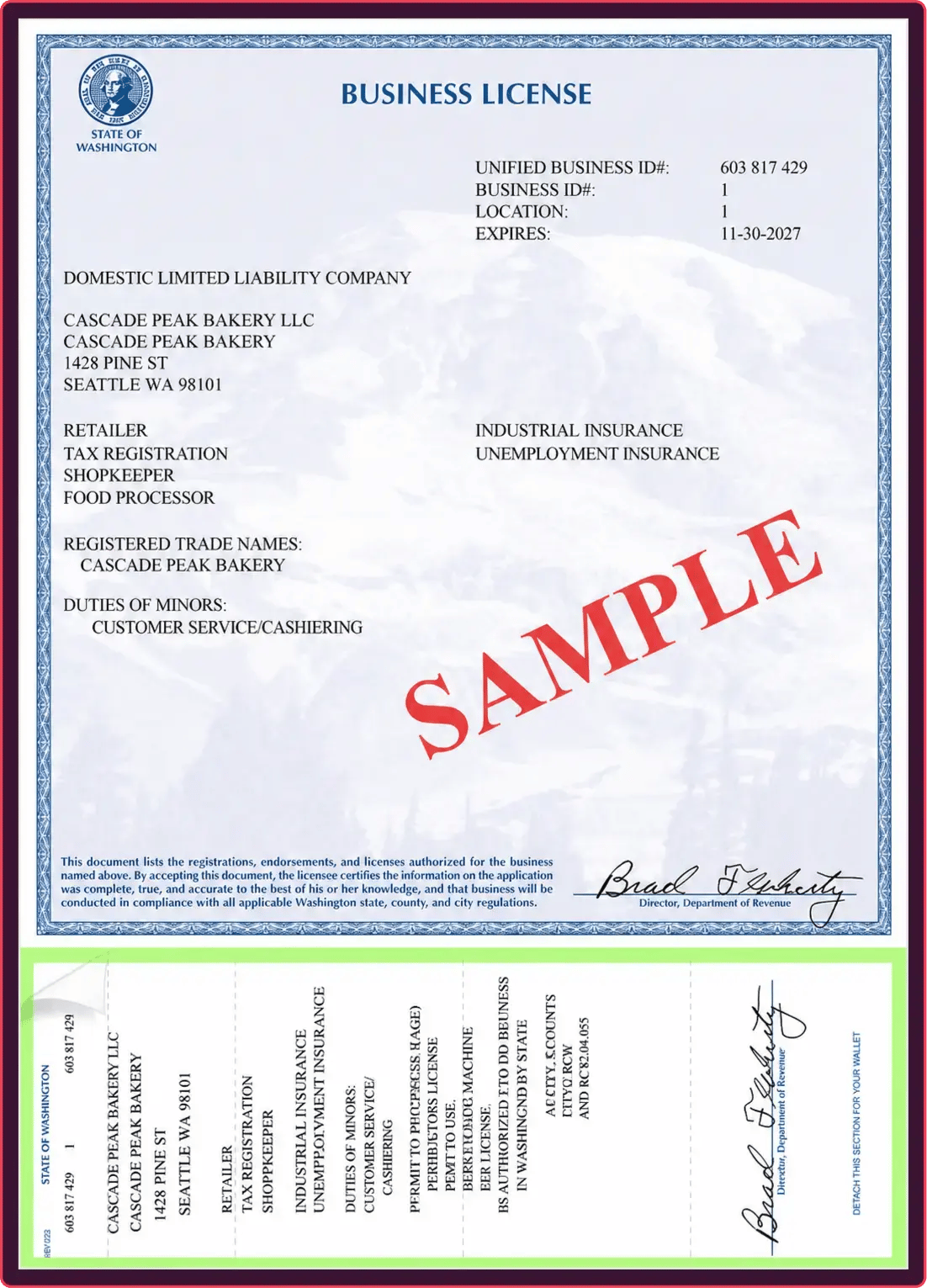
Example of a fake Washington state business license for illustrative purposes only.
Why are Washington business licenses important?
A Washington business license plays a central role in business verification in the state of Washington, helping organizations confirm that a company is registered, identifiable, and authorized to operate within the state’s regulatory framework.
Here’s how Washington business licenses are used for document verification across different contexts:
- Financial services and fintech. Used during KYB checks to confirm that a business exists, is registered under a valid UBI, and can legally open accounts or access financial products.
- Commercial real estate and leasing. Landlords and property managers rely on business licenses and city endorsements to ensure tenants are authorized to operate at a specific location and comply with local requirements.
- Procurement and vendor management. Companies verify business licenses to confirm that suppliers are properly registered and eligible to enter into contracts or receive payments.
- Marketplaces and platform onboarding. E-commerce platforms and digital marketplaces review business licenses to validate sellers and prevent fraudulent or shell businesses from joining.
Washington business licenses provide “proof of business authorization.” When trust is misplaced due to a fake or misused license, it can lead to onboarding illegitimate businesses, compliance failures, and exposure to fraud and financial crime.
Washington state business license law
Washington law requires most businesses operating in the state to obtain a business license through the Department of Revenue before conducting commercial activity. This requirement applies to businesses that meet specific thresholds, such as earning revenue, collecting sales tax, hiring employees, or operating under a trade name.
Most licenses and endorsements require regular renewal, typically on an annual basis, with expiration dates tied to the specific endorsements or business activity. Failing to renew or maintain good standing can result in the business losing its legal authority to operate.
However, not all businesses are treated equally under Washington law.
- Small or low-revenue businesses may still be required to register depending on their activity (such as collecting tax or hiring employees), even if they operate informally.
- Regulated industries (such as construction, healthcare, or food services) must obtain additional licenses beyond the standard business license.
- Location-based requirements also apply, as businesses operating in cities like Seattle, Spokane, or Tacoma may need city endorsements to legally conduct business there.
Washington’s centralized system makes the process more straightforward, but it also means each component has a clearly defined role. Understanding those roles is essential for identifying when a document doesn’t reflect how the system actually works.
Let’s take a look at how business licensing works in Washington and how the legal framework translates into real documents.
The business licensing process in Washington
Starting and operating a business in Washington typically involves the following steps:
- Choose a business structure. The owner must decide whether the business will operate as a sole proprietorship, partnership, limited liability company (LLC), corporation, or another structure.
- File formation documents with the Washington Secretary of State. Corporations, LLCs, and certain partnerships must file state formation documents, a Certificate of Formation, to establish legal existence. These documents prove the entity exists, but they do not authorize the business to operate on their own.
- Apply for a Washington business license. Businesses register through the Department of Revenue’s Business Licensing Service, which issues the Washington business license and assigns a Unified Business Identifier (UBI).
- Add state and city endorsements. Depending on the business activity and location, the business may need endorsements for specific cities or regulated activities. Many of these can be added through the same Business Licensing Service application.
- Register for taxes. Businesses are enrolled for relevant tax accounts, such as sales tax or employer taxes, through the Department of Revenue as part of the licensing process.
- Apply for professional or industry licenses. Regulated professions, such as contractors, healthcare providers, or trades, require additional licensing through agencies like Labor & Industries or the Department of Health.
- Secure local permits and approvals. Businesses may still need zoning approvals, health permits, signage permits, fire inspections, or other municipal requirements depending on where and how they operate.
Threat intel: Template data about Washington business documents
Our Threat Intelligence Unit collects data about template farms which make and distribute fake document templates for fraudulent purposes.
Below, you'll find an infographic containing data about all the fake Washington business documents we've found: their availability, their distributors, the institutions or "issuers" whose documents have been exposed, and how much it costs to buy one.
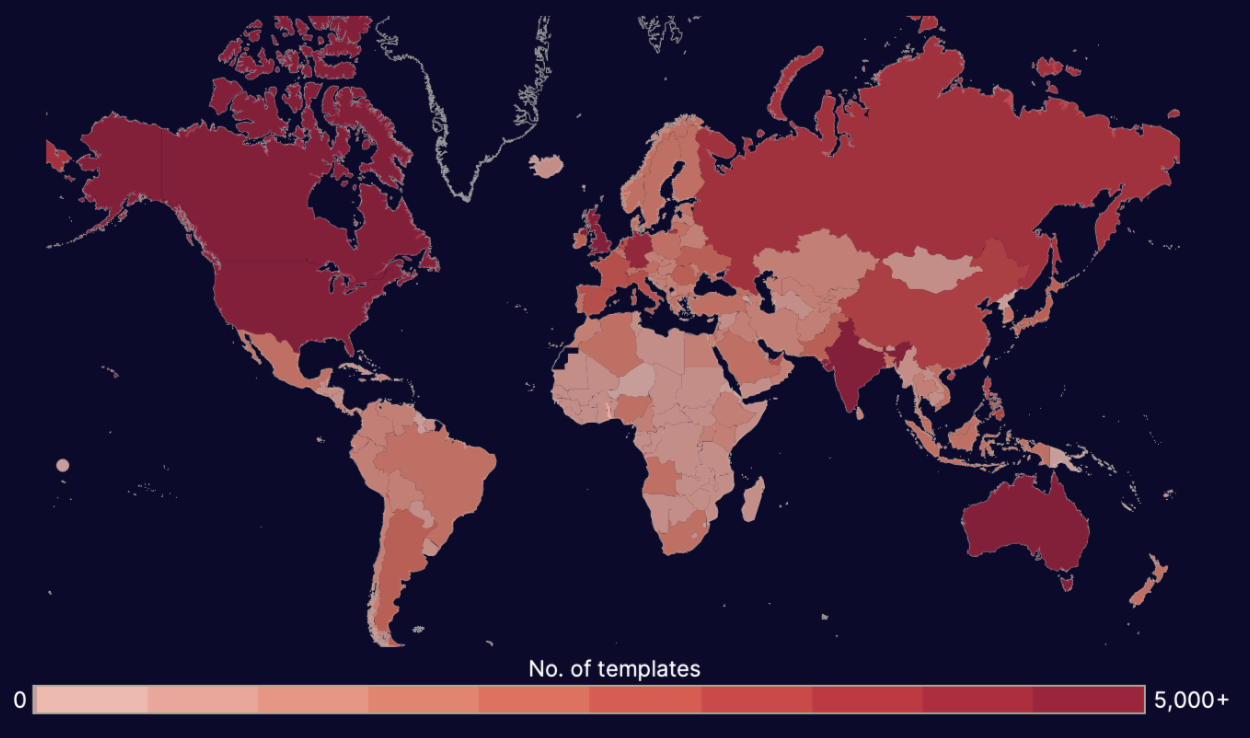
Threat intel stats: Washington business documents
Find more information about the threat these farms pose in our threat intel blog and webinar content.
5 Signs of a forged or fake Washington business license
Detecting fake Washington business licenses manually requires more than a quick glance. Because the system is centralized and standardized, legitimate documents tend to follow consistent rules around identifiers, endorsements, and issuing authority. When something deviates from those rules, it stands out.
Here’s what to watch for:
1. Inconsistent formatting
Since Washington business licenses are issued only through the Department of Revenue’s Business Licensing Service, they follow a relatively clean, administrative format.
- Misuse of the UBI field. The Unified Business Identifier should be clearly labeled and on one line. Only 9 digits.
- Misuse of UBI sub-fields. The “Business ID” and “Location ID” should be on separate lines below the UBI, not all on one line or in a different part of the document.
- “Washing State Business License.” In official examples, the document only says “business license” with the Washington state crest in the corner.
2. Incorrect or misleading information
Incorrect data or missing fields often reveal a misunderstanding of how the license actually works.
- Missing endorsement section. Legitimate licenses include endorsement details. Even without an endorsement that field is left blank. If it's missing entirely it's indicative of a fake.
- Invalid city claims. A business claiming to operate in Seattle, Spokane, or Tacoma without any corresponding city endorsement listed.
- Wrong signature. Washington business licenses are signed by the Director of the Department of Revenue (currently Drew Shirk). Licenses claiming to be signed by the Secretary of State or a city clerk (such as King County or Pierce County) should be discarded.
- Missing business description. Should contain all licenses, operations of the business, insurance, and the duties of minors who may be working there (if applicable).
3. Uncharacteristic figures
Washington licenses follow predictable renewal and endorsement patterns. Numerical inconsistencies can expose fakes.
- Unrealistic validity periods. Licenses presented as valid for five or ten years (most endorsements requiring annual renewal).
- Tear-off portion. Presenting the tear off portion (meant for use on person) as the official license.
4. Business license inconsistencies
This is where Washington-specific fraud becomes more obvious. The structure of the license itself must reflect how the system works.
- Overstated authorization. A standard business license presented as proof of contractor licensing (which should be verified through Labor & Industries) or healthcare authorization (which falls under the Department of Health). These details can be listed on the license but don’t serve as proof of the actual permissions.
- Entity mismatch. The business name on the license does not match or is spelled differently in different fields.
- Business and licensing mismatch. When a business claims to be in a regulated field (i.e., gambling) without the necessary licenses listed on the document.
- Multi-location claims. A business claiming operations across multiple cities (e.g., Tacoma, Bellevue, and Everett) but only showing a single endorsement.
5. Metadata discrepancies
The information inside the file itself can reveal signs of tampering.
- Editing software. Files created or modified using tools like Photoshop, Canva, or Word instead of standard administrative systems.
- Creation date conflicts. File metadata showing the document was created after the listed issue date.
- Missing system-generated metadata. Official Washington business licenses are typically downloaded from state systems as electronic documents. Files that lack standard system-generated metadata (such as consistent creation patterns or digital origin indicators) should be treated as suspicious.
- Screenshot-style submissions. Cropped images, mobile screenshots, or JPEG files instead of structured documents suggest the original source may be obscured.
Disclaimer: Manual checks can catch obvious inconsistencies, but they struggle to pick up near-perfect fakes. Criminals can create Washington state business licenses that have none of the visual cues listed above but are still fraudulent.
How to verify a Washington business license
Whether you’re a financial institution performing KYB checks, a marketplace reviewing sellers, a procurement team validating vendors, or a commercial leasing team confirming tenant eligibility, you can verify Washington state business licenses in two ways: automated or manual.
Manual verification is increasingly limited. Fraudsters can now generate realistic documents using templates and AI tools, often including valid-looking UBIs and plausible business details.
These documents routinely pass surface-level checks, especially when reviewers rely on a single source of truth.
AI-powered automation analyzing how documents are constructed, identifying inconsistencies across submissions, and detecting manipulation signals that humans might miss. It scales across high volumes and adapts to evolving fraud patterns.
If your organization still relies on manual verification, we highly recommend you switch. But sticking with manual reviews isn’t as rare as you’d expect 2026.
Manual verification of Washington business licenses
If you are verifying Washington business licenses manually, here are practical steps to follow.
- Check the Department of Revenue business lookup. Use the UBI to confirm the business name, status, and associated details in the official Washington system.
- Verify entity registration with the Secretary of State. Confirm that the business exists as a legal entity and that its status is active and in good standing. Use our USA KYB guide to find the appropriate search and registry.
- Confirm city endorsements. If the business claims to operate in cities like Seattle, Spokane, or Tacoma, verify that the appropriate endorsements are listed.
Keep in mind: Even with a centralized system, manual verification requires checking multiple sources and interpreting how they fit together. This process is time-consuming, inconsistent across reviewers, and difficult to scale.
Using AI and machine learning to spot fake Washington business licenses
Instead of relying on surface-level checks, AI document verification analyzes how a document was constructed, identifying inconsistencies that are invisible to the human eye and difficult to replicate at scale.
Key benefits include:
- Document-agnostic detection. Works across Washington business licenses, endorsements, and related documents (or any document from any country or region) without needing predefined templates or state-specific training.
- GenAI fraud detection. Can more reliably detect Gen AI fakes with hundreds of detectors (not just surface-level metadata checks).
- Template mapping. Instantly recognize publicly available templates and flags them for review.
Automation vs. AI
Traditional automation can check things like whether a UBI is present, whether a date falls within a valid range, or whether required fields are filled in. These checks are useful for basic validation, but they can be easily bypassed when fraudsters understand the rules.
AI learns from thousands of Washington business license submissions, spotting inconsistencies in structure, alignments, and identifying subtle inconsistencies across the entire data set.
Instead of validating isolated fields, AI evaluates the document as a whole and in context, making it far more effective against modern, large-scale fraud.
Conclusion
Fake Washington business licenses are used to bypass onboarding checks, misrepresent business activity, and gain access to financial systems inside and outside the state of Washington.
Manual checks can catch obvious issues, but they struggle to keep up with the scale and sophistication of modern fraud.
Resistant Documents makes the difference by analyzing the structure of documents rather than relying on templates or databases, it can detect manipulation, reused artifacts, and AI-generated fakes across any document type.
Scroll down to book a demo.

Fraud awareness, examples, and lessons
Learn more about fraud in specific industries, best practices, and targeted documents.
View all
Application fraud in 2026 is easier to attempt: accessible tools and services help applicants turn false claims ...

Within the fake document ecosystem, things can change fast. Four months ago, we reported that OnlyFake, the ...

In May 2026, a Dallas resident was convicted of running coin-operated “amusement machines” without a business ...

NEW YORK & PRAGUE – 1 October 2026 – Ocrolus, the AI workflow and analytics platform for lenders, today ...

For a few hundred dollars, sellers on Telegram promise to boost your credit score using someone else's credit ...

Key takeaways Fake certificates can use real numbers Fraudsters can copy a genuine business’s VAT number onto a ...