
Global trade depends heavily on accurate origin documentation, and, with tariff rates exploding in 2026, fake certificates of origin are now a hot commodity on the “grey” market. Some forgers are even so brazen that they advertise their services to exporters on social media.
It’s no surprise. Fake documents are easier than ever to produce thanks to publicly available templates and new AI image generators like Nano Banana.
Tariff rules are only going to get tighter while rights and sanctions regimes continue to expand. Even a single falsified certificate of origin (COO) can trigger compliance breaches, stalled cargo, and significant financial exposure for importers, exporters, and banks.
Read on to learn what certificates of origin are, how they’re being forged, how to spot a fake certificate of origin, and how AI-powered verification tools can help strengthen your trade finance controls.
Check out our “how to spot fake documents” blog to learn about more common document forgeries.
What is a certificate of origin?
A certificate of origin is an official trade document that identifies the country where goods were manufactured. It is typically issued by a chamber of commerce or authorized trade body and supports customs clearance, preferential tariff claims, and documentary checks in trade finance workflows.
Although the purpose of a certificate of origin is consistent worldwide, the document itself varies by issuing authority. Chambers of commerce in different countries use their own layouts, numbering conventions, and seal formats.
Some rely on standardized form types such as:
Each has its own structure and terminology. Certificates of origin also depend heavily on applicable trade agreements. Rules of origin differ across free trade agreements and preferential trade programs, which affects how exporters must describe goods and justify their origin status.
As a result, what “looks off” can vary widely: a claim that appears legitimate under one FTA may violate origin rules under another.
Despite the high variance, most certificates of origin include the following elements:
- Exporter name and address. Identifies the business producing or shipping the goods.
- Consignee or importer details. Indicates who is receiving the shipment.
- Country of origin. Specifies where the goods were manufactured.
- Goods description. Details product type, materials, and relevant specifications.
- Harmonized System (HS) codes. Provides standardized classification for customs.
- Quantity or weight. States total units, net weight, or gross weight.
- Invoice reference. Links the COO to the commercial invoice for cross-checking.
- Certificate number. Unique identifier used by chambers for tracking and verification.
- Official chamber seal and signature. Confirms validation by the issuing authority.
- Additional declarations. May include “rules-of-origin” statements or “preferential origin justification” depending on the trade agreement.
Even though these documents vary based on issuing authority and trade agreement, one area that’s especially useful for spotting fraud is the legal terminology tied to preferential origin claims. Many free trade agreements require exact origin declarations or eligibility statements, and these must match the goods, HS codes, and rules of origin for that specific agreement.
Because this section is harder to imitate without understanding the underlying legal requirements, fraudsters often get this wording wrong by using outdated phrases, copying declarations from the wrong FTA, or omitting mandatory language altogether.
Together, these details confirm where goods were manufactured and support customs clearance, tariff decisions, trade financing, letters of credit, and compliance across global trade operations.
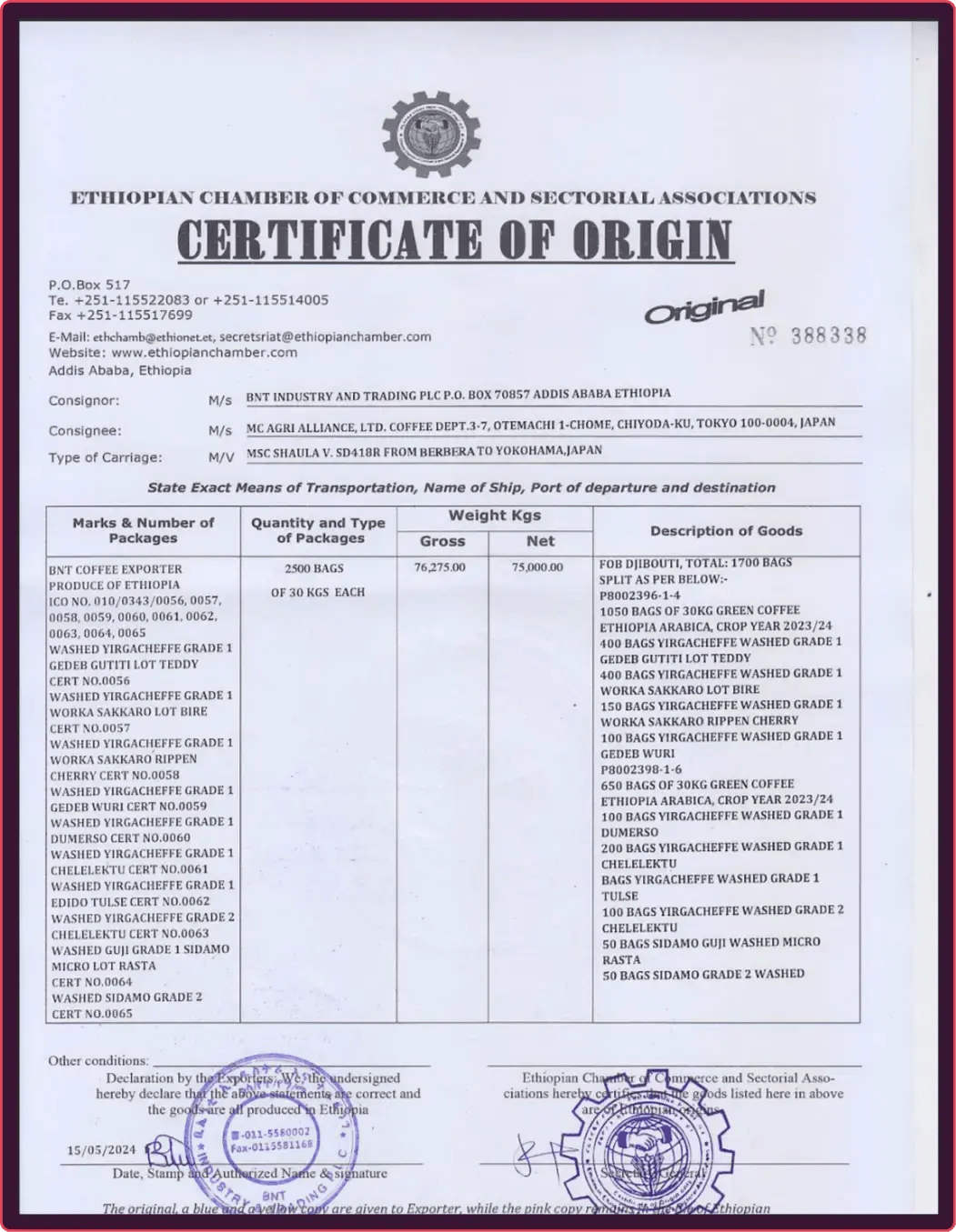
An example of a certificate of origin for illustrative purposes only.
What is certificate of origin fraud?
Certificate of origin fraud does not always look like traditional document forgery. In fact, the most common pattern is when the certificate itself is fully legitimate, issued and stamped by an authorized chamber of commerce, but the information declared on it is false. Exporters can (and often do) misstate the true manufacturing origin, misuse HS codes, or claim eligibility under a free trade agreement they do not actually meet. The document is real. The claim is not.
In fact, obtaining a legitimate certificate of origin with inaccurate information is surprisingly easy. Chambers of commerce rarely verify supply chains or audit manufacturing steps. Instead, they rely heavily on exporter declarations. As long as the form is completed, the business is registered, and the fee is paid, chambers generally stamp the certificate without validating whether the goods truly satisfy rules of origin.
Without thorough investigations by the chamber, manufacturers can misrepresent origin to secure preferential tariffs, avoid anti-dumping duties, or disguise supply-chain risks.
However, certificates of origin do get fully counterfeited as well. Fraudsters resort to complete fabrication when they cannot obtain a legitimate form from a chamber at all. This includes situations where the exporter is not a real company, the goods originate from a sanctioned country, the shipment itself does not exist, or the exporter is not eligible for the preferential COO the buyer or bank requires.
In these cases, criminals recreate chamber seals, invent certificate numbers, copy layouts from real forms, or fabricate entire COO templates to pass customs checks or satisfy documentary requirements in trade finance transactions.
These fully fake COOs pose equal or greater risk than misdeclared ones, because they typically appear in higher-value or higher-risk schemes such as sanctions evasion, fraudulent LC drawdowns, false cargo claims, and trade-based money laundering.
That makes it essential to detect both types of COO fraud: the widespread version involving real documents with false information, and the more deliberate (but highly consequential) version involving entirely forged certificates.
If you’d like to know how fraudsters are creating all these fake certificates of origin, check out our “Types of fraud” blog to learn more about their tactics.
Why certificates of origin are important
Certificates of origin play a central role in global trade, determining how shipments are classified, taxed, and cleared across borders.
Customs authorities, importers, and financial institutions all rely on COOs tariff rates, trade agreement benefits, and compliance obligations.
Here’s how certificates of origin are used for document verification across different industries:
- Customs brokerage. Used to validate country-of-origin claims at the border and determine whether goods qualify for preferential tariffs or face restricted-trade controls.
- Trade finance. Banks review COOs during letters of credit and documentary collection checks to ensure shipment details align across all documents before releasing funds.
- Import operations. Importers rely on COOs to calculate landed costs, claim tariff benefits, and confirm suppliers comply with trade agreements or manufacturing standards.
- Sanctions and export control compliance. Compliance teams use COOs to verify that goods do not originate from prohibited or high-risk jurisdictions.
- Cargo and trade-credit insurance. Insurers may review COOs to confirm that goods originate from approved jurisdictions, comply with policy terms, and aren’t tied to sanctioned or high-risk supply chains that would invalidate coverage.
Certificates of origin are trusted because they are formally reviewed and endorsed by authorized chambers of commerce or government bodies, giving them inherent authority as proof of where goods were manufactured.
Threat intel: Template data about certificates of origin
Our Threat Intelligence Unit collects data about template farms which make and distribute fake document templates for fraudulent purposes.
During our research we haven't yet cataloged many certificate of origin documents, however, they are still very prevalent online.
A simple search on Scribd.com (a well known template hub) reveals over 280,000+ results for this document, revealing a high demand for online templates.
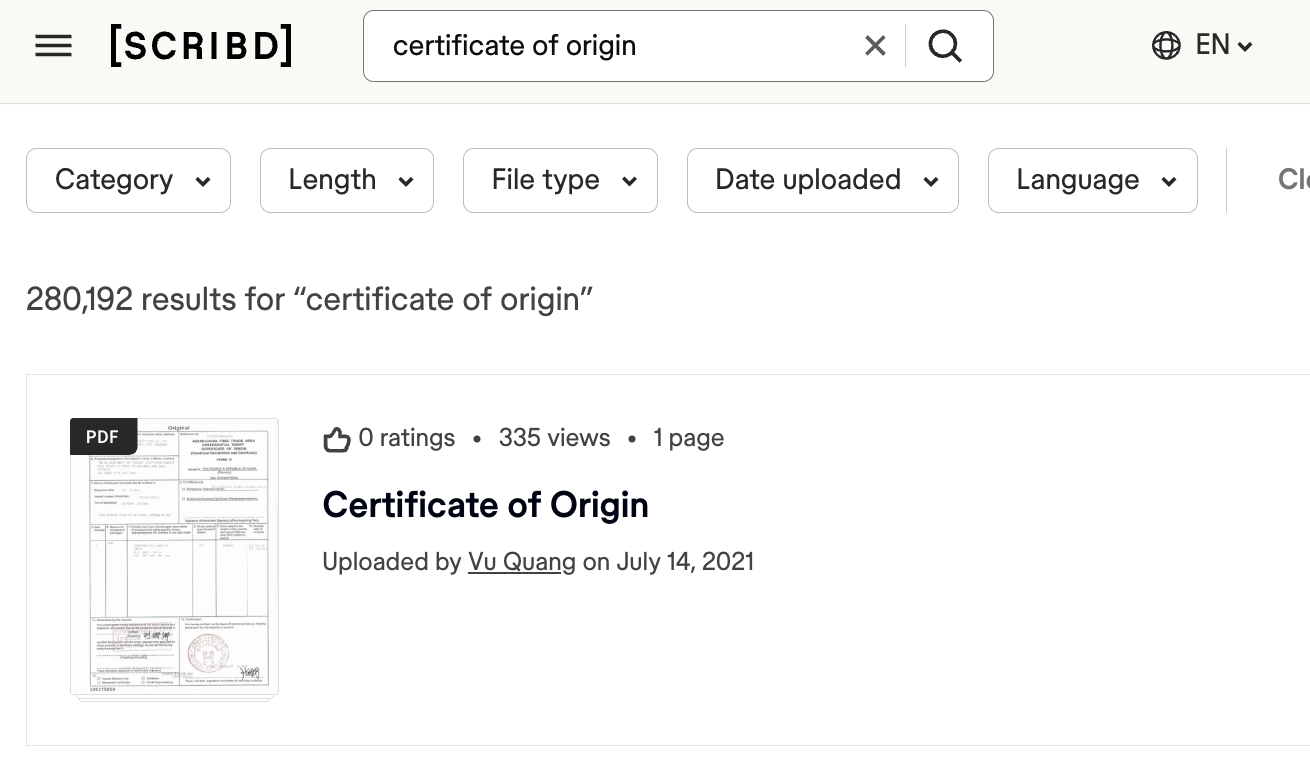
Search results for "certificate of origin" on Scribd.
Threat level: Legitimate Certificates of Origin are issued or endorsed by recognized authorities such as Chambers of Commerce or designated government bodies.
Any Certificate of Origin created using a generic template downloaded from sites like Scribd lacks inherent issuer authority and is therefore high risk when submitted as a final document.
While there are limited edge cases where templates are accessed for educational, drafting, or internal reference purposes, these do not result in a valid certificate without official issuance or verification.
The widespread availability of user-uploaded COO templates means that documents traced to public template sources should be treated with heightened scrutiny or presumed invalid until independently verified.
5 Signs of a forged or fake certificate of origin
Spotting a fake certificate of origin is not the same as catching a misdeclared origin.
Most COO fraud uses real, chamber-issued documents with false information, and the red flags below will not reliably catch those “real document, fake claim” cases.
Instead, these checks focus on fully forged or heavily manipulated certificates where the layout, seals, or legal wording have been recreated outside of official channels.
Still, detecting fake certificates of origin manually demands a close look at how the document is built, which chamber it appears to come from, and how its legal language relates to specific trade agreements. Using common visual cues is only part of the battle.
That being said, here are some of the clearer warning signs:
1. Inconsistent formatting
Because chambers and trade agreements use distinct layouts, the goal is not to compare a COO to some global template, but to compare it to other known examples from the same chamber, country, or agreement. Formatting that breaks those local expectations can be a red flag.
- Overly dense text layout. Authentic COOs are intentionally minimalistic, with wide boxes and short labels. A document packed with long paragraphs, tightly spaced instructions, or unusually verbose headers often indicates that someone recreated the form without understanding its typical structure.
- Unnaturally uniform typography inside free-form boxes. COO boxes are designed for exporter input, which produces natural variation (typed, stamped, sometimes even handwritten). When all boxes contain perfectly uniform text (same size, same alignment, same spacing) it can suggest that the entire page was generated at once rather than filled box by box.
- Seal placement that never changes. Authentic chambers usually place their wet stamp and signature in a consistent area but with natural variation. A fake that shows a perfectly identical seal position and orientation across multiple certificates from different exporters suggests copy-paste reuse.
- Non-standard box structure. Boxes for origin declaration, HS code, and description that are merged or relabelled in ways that do not appear on any other authentic COOs from the same jurisdiction or trade agreement.
- Missing large “blank zones.” Most COOs contain noticeable empty space around the declaration section, certification box, and signature area. A counterfeit form often compresses these or fills them with extra lines or labels to look “official,” losing the
characteristic open spacing. - Over-designed borders or decorative elements. Genuine COOs tend to be plain, functional documents. Elaborate borders, shading, stylized lines, or commercial-design aesthetics usually appear only on recreated templates, not on chamber-issued forms.
2. Incorrect or misleading information
Here, we are not judging whether the underlying origin claim is true (that requires external checks), but whether the information about who issued the document and under which framework makes sense.
- Generic or incomplete chamber names. A certificate that simply says “Chamber of Commerce” without specifying the city, region, or country, where authentic samples from that jurisdiction always include a precise chamber name.
- Invented or hybrid trade agreement names. References to agreements that do not exist or mash up acronyms (for example, “EU–USMCA Agreement”) are a strong sign that someone copied terms without understanding them.
- Incorrect use of FTA codes or references. Mentioning a specific article, annex, or rule from an agreement that does not relate to the type of goods, region, or certificate being claimed, especially when cross-checked against publicly available FTA text.
- Dead or renamed chambers. A chamber name that no longer exists under that title (for example, a pre-merger or pre-reform name) on a document dated long after the change, when all current authentic documents show the updated name.
3. Bad math and uncharacteristic figures
Numbers on a certificate of origin are simpler than on, say, a tax return, but they still need to make sense relative to other shipping documents and basic physical constraints.
- Quantities that contradict linked documents. Item counts or units on the COO that diverge materially from the commercial invoice and packing list for the same shipment, without any explanation or partial-shipment note.
- Unit inconsistencies within the same certificate. Switching between kilograms, pounds, and pieces in a way that makes totals incoherent (for example, total quantity in “pieces” but line items only in “kg” with no conversion factors).
- Invoice references that cannot be reconciled. An invoice number and date that either do not exist in the transaction file or refer to a completely different set of products than those described on the COO.
4. Certificate of origin inconsistencies
Some red flags arise from internal contradictions that do not depend on knowing the “real” origin, but on how the document is supposed to work as a legal instrument.
- Chamber identifiers that don’t match geography. A header such as “City X Chamber of Commerce” paired with a country or address that does not logically line up with that city or region.
- Preferential form with non-preferential wording (or vice versa). A form layout clearly modelled on a preferential certificate (such as EUR.1) combined with generic, non-preferential language, or a non-preferential layout with detailed FTA rule references that do not belong there.
- Declaration clauses that don’t match the box data. A statement asserting that “all goods listed above originate in Country A” when some product lines in the description section explicitly reference another country or mixed sourcing.
- Reused certificate numbers across unrelated shipments. Two different shipments from different buyers or dates sharing the exact same COO number, suggesting that one of them was cloned or altered from the other.
- Mixed language conventions. A COO allegedly issued by a local chamber but using a language combination that is unusual for that country’s trade documents (for example, an exporter and chamber in a non-English-speaking country using only English for all labels and official text when that chamber typically uses bilingual forms).
5. Metadata discrepancies
For digital certificates (PDFs, scans, or images), file-level clues often reveal that the document was built or edited outside official channels, even when the visual design looks convincing.
- Scan expected but PDF is “born digital.” Most chamber-stamped COOs are issued on paper and later scanned by the exporter. Scanned COOs typically show scanner metadata (Canon, Xerox, Ricoh) and contain no selectable text. A COO with editable text layers or creation in design software where a scan is expected suggests reconstruction.
- Missing platform metadata on eCO-issued documents. COOs generated through accredited electronic platforms (essCert, eCertify, chamber eCO portals) normally include platform identifiers, digital-signature objects, and consistent timestamps. A digital COO lacking these markers — or showing creation in Word, Photoshop, or “Print to PDF” — indicates it was built outside official systems.
- Chain-of-custody inconsistencies. COOs are meant to be static once issued. Metadata showing multiple creators, repeated save events, or evidence of intermediate editing software suggests the file was altered after issuance.
Disclaimer: These signs can help you filter out the clumsiest fakes and some more deliberate forgeries, especially when you compare a suspicious certificate against authentic samples from the same chamber, exporter, or trade agreement. But they cannot keep pace with AI-assisted template cloning and highly consistent digital forgeries at scale like AI document verification can.
How to verify a certificate of origin
Certificates of origin are reviewed across multiple parts of the trade ecosystem. Customs brokers, trade finance teams, import operations, and sanctions compliance departments all verify COOs to confirm that the document aligns with accompanying paperwork and meets the requirements of the relevant trade agreement.
Verification can be done manually or through automated tools, but modern fraud patterns make manual checks increasingly difficult to perform at scale.
Fraudsters now use AI-generated templates, high-resolution seal cloning, and realistic digital composites, producing COOs that look structurally sound even when they were never issued by a chamber. AI and automation is much more effective at spotting these warning signs by analyzing the document in thousands of different ways.
Despite these limitations, many organizations still rely on manual review. When manual checks are required, the following techniques can improve the accuracy and reliability of COO verification.
Manual verification of certificates of origin
The best place to start is with the red flags we’ve mentioned above. However, you can also consult these external sources.
- Validate chamber details. Confirm that the chamber name, address, certificate number format, and seal design match information published by that chamber or by the relevant national chamber network. You can find a large list of these chambers and their details on the International Chamber of Commerce (ICC) website.
- Review legal language for agreement-specific accuracy. Ensure that origin declarations and FTA-specific clauses correspond to the correct agreement; mismatched or outdated phrasing is a strong indicator of manipulation (like this example from the USCM trade agreement).
- HS codes. Check that the HS code on the COO matches the type of goods being described. HS codes are the international product-classification system used in global customs, and mismatches can indicate a manipulated or poorly constructed certificate. You can confirm correct classifications using the World Customs Organization’s Harmonized System database (subscription required).
Keep in mind: While these steps can filter out poorly built or cloned certificates, they cannot reliably scale across high-volume trade operations. Modern COO fraud increasingly blends authentic-looking templates with subtle digital edits, making AI-powered structural analysis essential for spotting anomalies when dealing with large submission volumes on a daily basis.
Using AI and machine learning to spot fake certificates of origin
AI significantly enhances the ability to detect structurally fake certificates of origin by analyzing how the document was built rather than relying on external databases or validating supply chain information.
Modern COOs come in countless formats depending on the chamber, the country, and the trade agreement, which makes it extremely difficult for manual reviewers to recognize what “normal” looks like.
AI, however, can learn structural patterns from even a small sample (sometimes as few as twenty authentic documents) and quickly identify when a certificate diverges from the way legitimate COOs from that exporter or chamber are typically constructed.
Because structural analysis focuses on how the document was built rather than relying on thousands of templates or external databases, it works better with COOs from new jurisdictions and chambers that your company may have never dealt with before.
Benefits of AI in spotting certificate of origin fraud include:
- Cross-document intelligence. Flags repeated seals, cloned signatures, reused templates, or document patterns appearing across multiple submissions, helping detect serial fraud attempts.
- Real-time anomaly detection. Surfaces subtle inconsistencies in file structure, embedded assets, or digital editing traces that indicate tampering or template reuse.
- Generative AI detection. Recognizes signs of AI-generated textures, reconstructed backgrounds, or synthetic layout patterns that reveal advanced template fabrication.
- Adaptive learning. Continuously incorporates new fraud signals, emerging template farms, and evolving forgery techniques, strengthening defenses without relying on large training datasets.
Automation vs. AI
Basic automation handles predictable checks such as confirming fields are present or ensuring the document's contents meet expected values. While useful for workflow efficiency, rules-based automation cannot identify advanced forgery techniques, cloned seals, or subtle layout inconsistencies that vary from one chamber or trade agreement to another.
AI learns from structural patterns. It can spot when a certificate of origin seal or signature has been reused across unrelated shipments, when the digital makeup of the file diverges from authentic patterns issued by legitimate chambers, and much more (even if the template looks visually convincing).
Conclusion
Fake certificates of origin present a unique challenge in global trade because the biggest risks come from both fully forged documents and legitimate chamber-issued certificates that contain inaccurate origin claims.
While manual reviewers can sometimes spot obvious inconsistencies, modern forgery tools and AI-assisted template generation make it increasingly difficult to rely on visual inspection or procedural checks alone. These gaps expose importers, customs brokers, and trade finance teams to tariff errors, sanctions breaches, and costly compliance failures.
Resistant Documents doesn’t need to be familiar with your local chamber or (or the chambers of your customers)’s document templates to spot fraud. It analyzes the structural makeup of certificates of origin, detecting hidden anomalies in layout, metadata, context, and hundreds of other indicators the human eye can’t see.
With cross-document intelligence and explainable evidence, teams can investigate COO submissions with confidence while reducing manual workload.
Scroll down to book a demo.
Frequently asked questions (FAQ)
Hungry for more fake certificate of origin content? Here are some of the most frequently asked fake certificate of origin questions from around the web.
Can a certificate of origin be verified online?
Some chambers of commerce offer online verification portals where you can confirm certificate numbers, issue dates, and exporter details. However, not all chambers provide this service and coverage varies by country, so online lookups alone cannot confirm whether the origin claim itself is true.
Do customs authorities always check certificates of origin?
No. Most customs agencies use risk-based sampling, meaning only a portion of certificates are examined in detail. Low-risk shipments may clear without deep scrutiny, while high-risk categories receive more intensive checks.
Can an exporter self-certify origin instead of using a chamber?
Yes, but only under certain free trade agreements. Agreements like USMCA and some EU trade deals allow approved exporters to self-declare origin. In these cases, misdeclaration risk is higher because no chamber validation is involved.
How to spot fake certificates of origin with AI?
Resistant AI document fraud detection software can verify a certificate of origin document in under 20 seconds.
What’s the difference between a certificate of origin, a commercial invoice, and a packing list?
These documents appear together in most trade finance and customs submissions, but each one verifies a different aspect of a shipment: origin, value, and physical contents.
- Certificate of origin. A formal document issued by a chamber of commerce confirming the country where the goods were manufactured.
- Issuer: Chamber of commerce or authorized authority.
- Characteristics:
- Physical or digital seal from an authorized chamber.
- Large, sparse box layout with origin declarations.
- Signature and certification area clearly separated from goods description.
- Issuer: Chamber of commerce or authorized authority.
- Commercial invoice. A seller-issued document detailing the price, terms of sale, and financial identity of the shipment.
- Issuer: Exporter or seller.
- Characteristics:
- Line-item pricing and total transaction value.
- Seller’s letterhead and invoice numbering system.
- Dense formatting with itemized descriptions and payment terms.
- Issuer: Exporter or seller.
- Packing list. A logistics document outlining the quantity, packaging type, and weight of the goods being shipped.
- Issuer: Exporter or freight forwarder.
- Characteristics:
- Item counts, carton numbers, and weight breakdowns.
- Minimal or no pricing information.
- Layout structured around package details rather than financial fields.
- Issuer: Exporter or freight forwarder.
Is there software to detect fake certificates of origin?
Yes. Resistant AI document fraud detection software can spot fraud in any document from any country.
Who needs to check for fake certificates of origin?
Multiple roles within industries rely on accurate certificate of origin documentation:
- Customs brokers. Review certificates to validate origin claims, ensure correct classification, and meet entry requirements.
- Trade finance analysts. Examine COOs during documentary checks for letters of credit and export financing.
- Import specialists. Confirm that origin information supports duty calculations and preferential tariff claims.
- Export compliance officers. Check origin details against sanctions lists and restricted-country rules.
- Freight forwarder documentation clerks. Match COO origin data with shipping paperwork to prevent clearance issues.
Is making a fake certificate of origin illegal?
Yes. Producing, altering, or using a forged certificate of origin is illegal in most jurisdictions. Penalties may include fines, shipment seizure, administrative sanctions, and criminal charges. Even misdeclaring origin on a legitimate COO can constitute customs fraud, lead to tariff clawbacks, and trigger investigations related to sanctions evasion or trade-based money laundering.

Fraud awareness, examples, and lessons
Learn more about fraud in specific industries, best practices, and targeted documents.
View all
Application fraud in 2026 is easier to attempt: accessible tools and services help applicants turn false claims ...

Within the fake document ecosystem, things can change fast. Four months ago, we reported that OnlyFake, the ...
In May 2026, a Dallas resident was convicted of running coin-operated “amusement machines” without a business ...

NEW YORK & PRAGUE – 1 October 2026 – Ocrolus, the AI workflow and analytics platform for lenders, today ...
For a few hundred dollars, sellers on Telegram promise to boost your credit score using someone else's credit ...
Key takeaways Fake certificates can use real numbers Fraudsters can copy a genuine business’s VAT number onto a ...