
EDIT: Since July 2026, the farm’s original domain fakedocshop.com now redirects to psdtem.com, possibly as a direct reaction to us highlighting this specific template farmer. The new domain retained the entire template catalog and capabilities of the original website, so the analysis and investigation below apply the same.
If you've seen as many template farm websites as we have, things start to blur.
Hundreds of sites are selling thousands of fake documents. Similar layouts, identical pricing, the same online shop script. When there are this many farms that look almost identical, it's easy to start paying less attention to details.
We didn't. And this farm is different.
Meet Fakedocshop (aka ”FDS”), the first template farm we found and analyzed that’s running on a subscription model.
No one-time purchases or bulk packages to spend hundreds and hope for the best.
This farm clearly has a loyal customer base and a consistent model of template-mining and re-selling activity, and it has become one of the most consistent document farms feeding scalable fraud operations today.
The origins of Fakedocshop
Fakedocshop has been around for years.
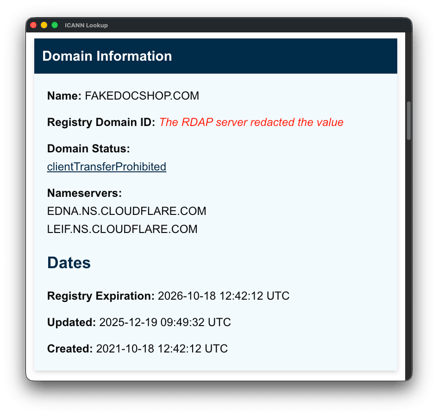
According to WHOIS registration data, the original core domain fakedocshop.com was created in October 2021, with redacted personal information on the registrants themselves (no surprises there).
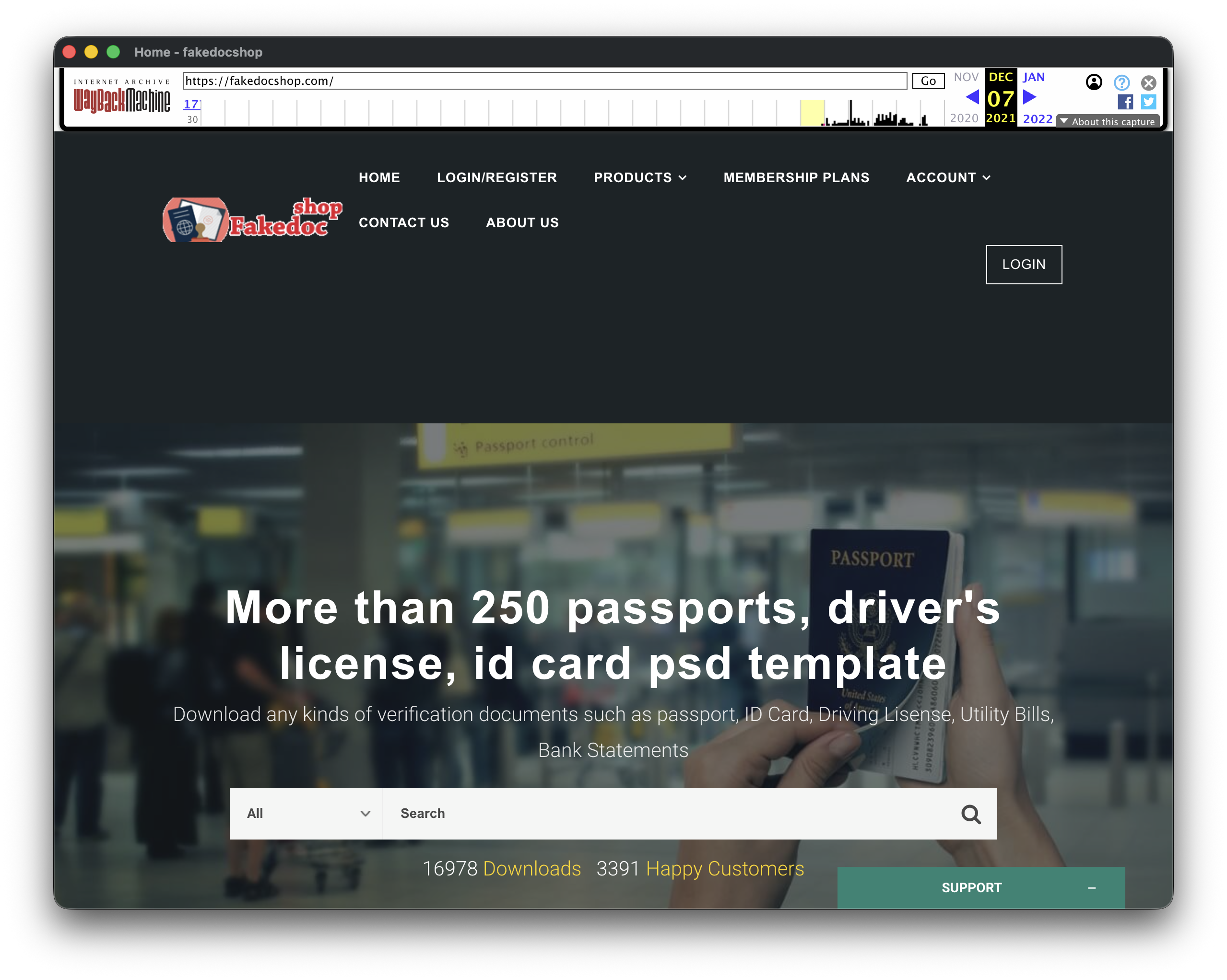
The first Internet Archive (Wayback Machine) capture of the original core domain is from November 2021, and already shows a welcome page similar to the current state of the website:
- An opening claim stating the clear purpose of selling more than 250 passports, drivers’ licenses or ID cards.
- Several featured popular templates to download.
- Sections highlighting newly added templates or templates provided for free.
- Menu links to pages on pricing, creating accounts, and displaying the product catalog.
The farm had several main categories: passports, drivers licenses, credit cards, bank statements and utility bills, with at least 20 templates available in each category.
But little contact information. Only the company e-mail and a form to get in touch. No social profiles or messaging account set up, just a Pinterest profile that no longer exists.
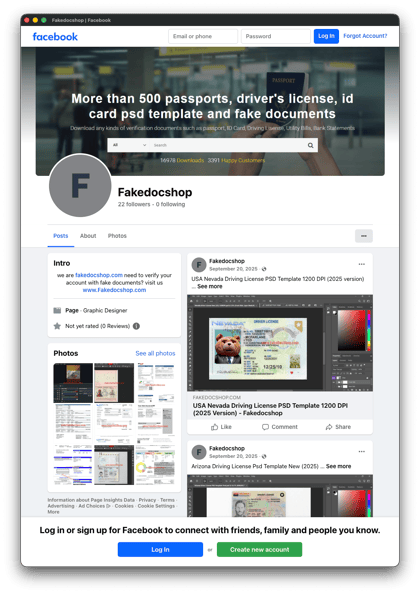
The farm also didn't make a significant digital footprint elsewhere on the web. It set up its own Facebook page, albeit used only sporadically, with the last post published in September 2025.
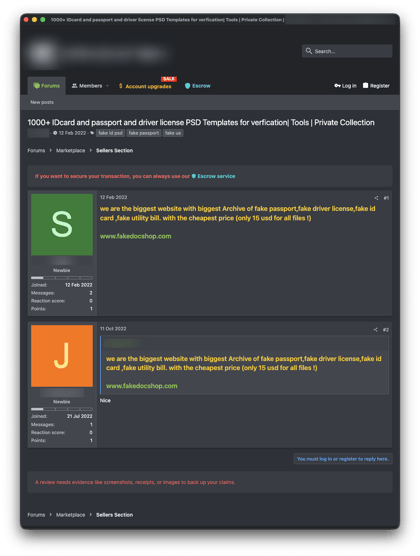
 Add a few mentions of its document catalog on various dark-market-focused web forums, and that’s pretty much it.
That said, even in its nascent stage, the farm would claim to have the biggest archive of fake passports, DLs, IDs or utility bills with the cheapest price.
 We have also identified two other identical "fakedocshop" domains with different TLDs. These have been active since 2024 and 2025, respectively, and while they seem to be functional, they are not getting nearly as much traffic as the main site.
These could either be mirror sites set up as backups, or “parasite domains” that have copied the original site’s content and are designed to steal some of its traffic.
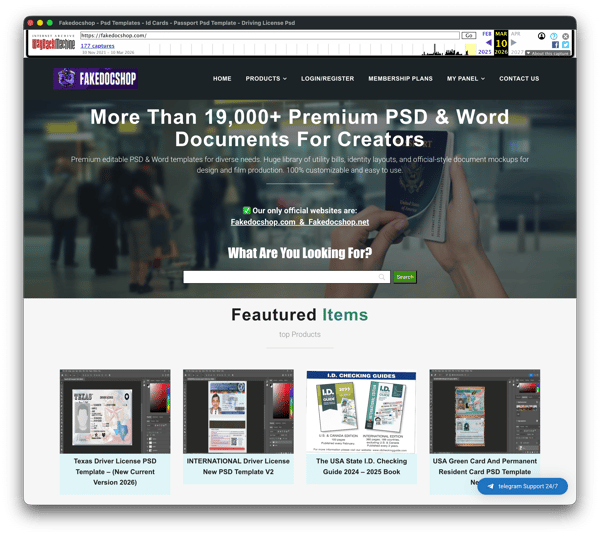
Currently, the original website itself claims that there’s only 2 official domains run by the admins (fakedocshop.com and fakedocshop.net), confirming at least one other domain to likely be a parasite.
Until today, the core structure of Fakedocshop remains the same.
Fakedocshop’s web traffic
Over its first year, Fakedocshop gathered about 50k visits and 28k unique visitors in aggregate. No whopping numbers.
But the traffic total grew from 88k visits in 2022 to 286k in 2023, confirming that the farm was doing something right and that its templates were (and still are) in demand.
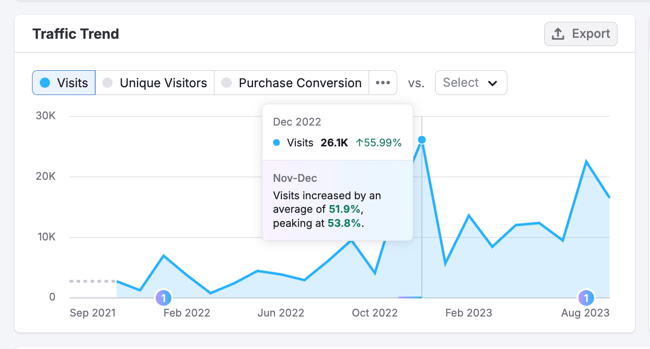
In total, the farm accumulated almost one million visits since its launch in the fall of 2021. Considering that this is a template farm website aimed at selling fraudulent document templates, this is a considerable amount of aggregate traffic.
You won’t stumble on a site like this by accident, or while looking for generic document templates like birthday cards or CVs.
This is supported by the fact that over 70% of the farm’s traffic is direct, with around 22% of the traffic coming via organic search (our well-known template farmer SEO optimization) and the last 8% distributed between referral, organic social, or email.
Country-wise, most of fakedocshop’s customer base comes from the US, with Nigeria, Bangladesh, Pakistan, Mexico or Kenya being other countries with significant traffic to the farm website.
Interestingly enough, a very small share of the traffic is classified as "AI traffic," hinting at the possibility that some AI tools such as ChatGPT (this was the case here) are referring people to template farm sites under the right circumstances.
Currently, the core Fakedocshop domain is getting around 6k–8k monthly visits on average. That is far from its peak months, with the highest 1-month total being over 70k visits in February 2024.
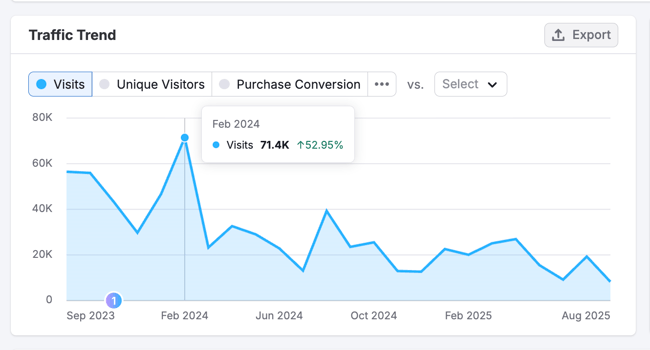
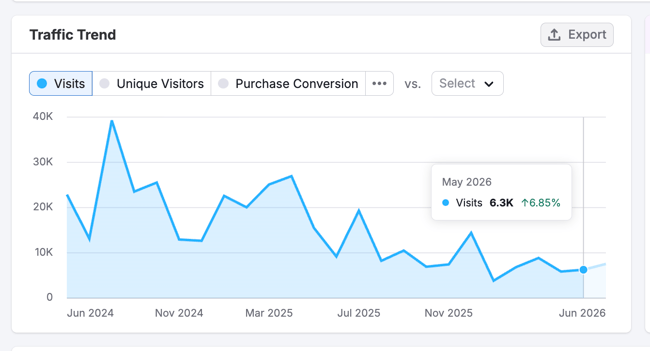
Nevertheless, the traffic itself is not what makes Fakedocshop stand out amongst other template farms. Its pricing model is, and it has been in place since the beginning.
The subscription model and its implications
Originally, Fakedocshop offered three subscription tiers that granted access to all templates on the website, but differ based on how much data you can download. These were priced at $8, $20 (monthly) and $60 (yearly), with the last tier providing annual access.
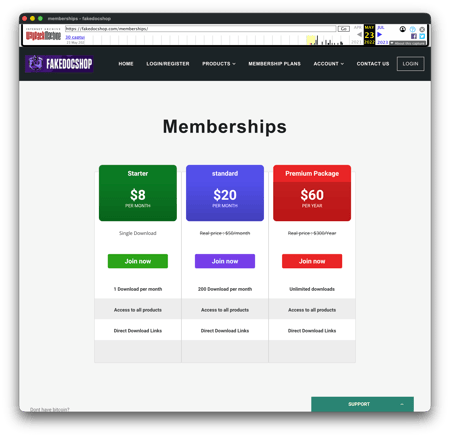
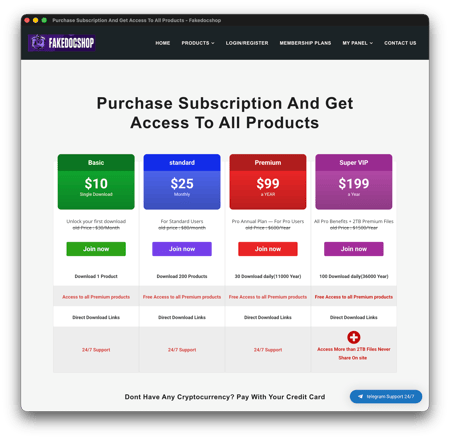
The pricing has evolved, likely due to the significant expansion of the farm’s template catalog (more on that later), and Fakedocshop now offers 4 pricing tiers:
-
$10. Single download.
- $25. Monthly access (capped at 200 "products").
- $99. Yearly "premium" access (30 documents/day).
- $199. Yearly "VIP" access (100 downloads/day or 36000/year).
This kind of business model is completely unique amongst the template farms we've analyzed after 2 years of research.
Almost all the template farms we have seen function by selling individual templates.
Some offer template packages, bundling tens to hundreds of templates (that are often outdated or of lesser quality). Some offer tailored document-editing services in case clients don't want to deal with the edits themselves.
Simple logic also suggests that the one-time purchase strategy might be more profitable. If each template costs anywhere between $10 or $30, each client that buys just a couple templates can quickly yield the template farmer up to $100.
With the subscription model, the math flips. For as little as $25 a month (or even less originally), Fakedocshop offers access to all of its templates. This is a drastic reduction in price-per-template, especially if you aim to acquire a lot.
But Fakedocshop did this on purpose, if only to differentiate from other farms. And returning, loyal customer base paying each year or each month might just be more profitable in the long run than relying on one-off purchases.
But the subscription business model hinges on several factors:
- The farm will be able to keep updating its catalog and add new templates indefinitely, otherwise customers will churn.
- Customers will keep on paying and even refer new potential customers (more fraud-community focused than one-off-purchase-based farms).
- The price-per document difference will easily beat other farms with different pricing strategy provided that the quality of the template catalog is sufficient.
Who does this business model serve best on the side of the fraudsters? Definitely not one-off, amateur criminals who only need to forge a couple documents to commit their crime and call it a day.
On the contrary, this approach caters to serial fraudsters engaged in systematic, regular, repeatable and scalable financial crime activity.
We’ve already seen bundle template offerings that target these professional actors, but the subscription-based template farm like Fakedocshop takes this to the next level.
We’ve also seen some templates being offered for free, which some customers express great satisfaction with in the form of a review (example below).
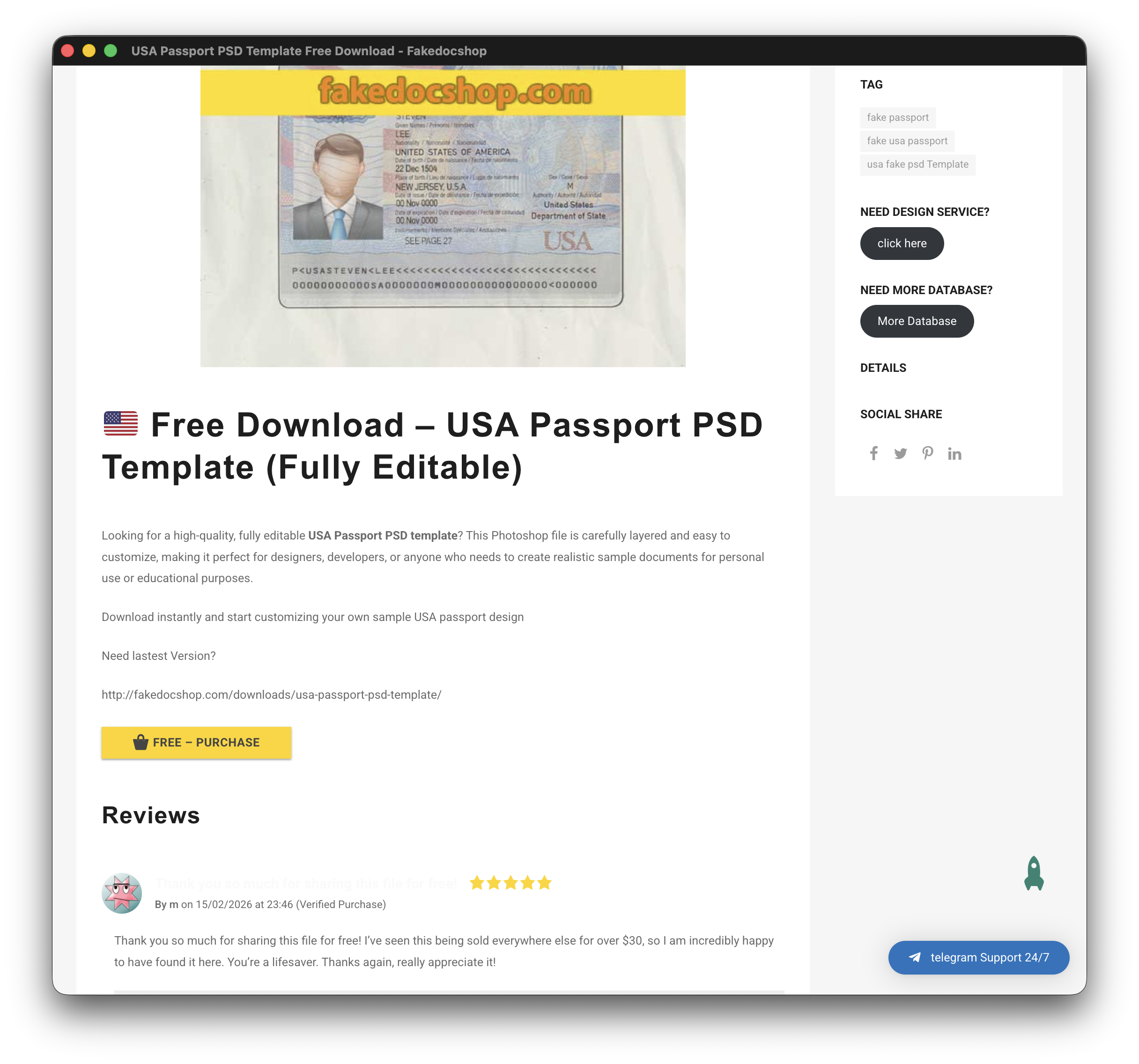 An example of a template review on the farm website,
praising FDS for making some of its templates freely available
Similarly to other template farms, this hints at Fakedocshop pursuing quid-pro-quo relationships and community building among its customers, as it likely offers exchanges of free templates for new authentic documents.
Most importantly, subscription-based pricing implies that you consistently have new stuff to offer your customers. Fakedocshop seems to be doing just that, as it’s constantly informing about new templates being posted within a dedicated Telegram “news” channel (more on that below).
And where are they getting all these documents?
We already know that the farm is actively harvesting Scribd, one of our known template hubs as a source of fresh, often original documents, which adds yet another pool of new files to templatize.
Case in point: one of the more recent templates advertised as a 2026 version concerns a Wise account statement, and an identical version of the document has been uploaded to Scribd in February 2026.
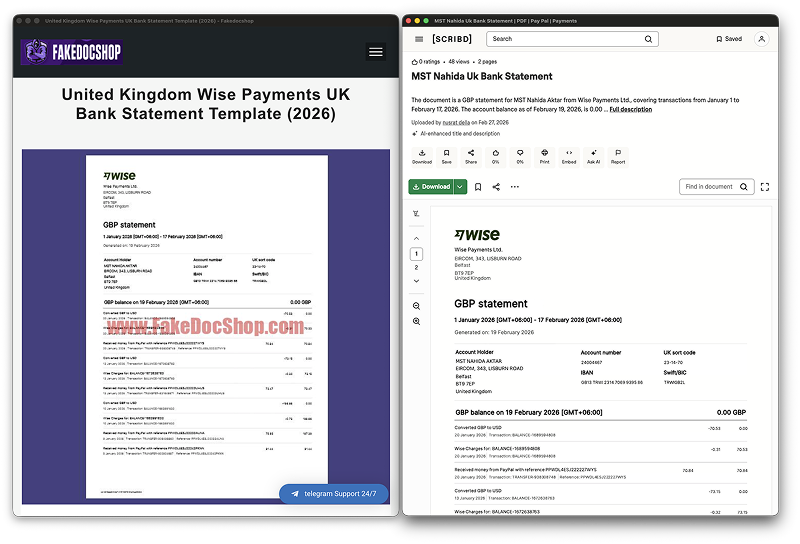
A side-by-side comparison of a template listing made by Fakedocshop and a document freely available on Scribd. Documents are identical, incl. personal details and transactions list.
Combined with the mentioned community building and potential document exchanges, it’s clear that the farm was set up with the intention of leveraging the “lowest price per template” angle knowing it will be able to keep on adding documents, even over a long period of time.
It also shows a sense of hubris. Any business that collects money longterm is not operating in fear. They've been comfortable for 5 years and see no warning signs of the kind of shutdown that recently hit other template farms like VerifTools or OnlyFake.
What’s in Fakedocshop’s template catalog?
At the very beginning, the farm claimed to offer more than 250 templates. In the first few months, that became more than 500, a year later that became more than 1000. Now, they currently claim to offer more than 19,000 documents.
We originally pulled Fakedocshop’s template catalog back in January 2025, as the farm’s pricing model immediately caught our attention. Back then, the farm’s catalog contained 1,200+ templates: an order of magnitude below what the farm claimed, but definitely not negligible.
Back then, the farm specialized in ID documents (national IDs, passports, driver’s licenses) but quickly expanded to other types over its first year. Bank statements, utility bills, paystubs, school diplomas, birth, and death certificates were all listed.
On top of that, the farm added some generic template categories like finance reports, powers of attorney, wills, and resumes.
Our analysis revealed that, as of March 2026, the farm’s catalog contains over 4,500 templates in total, broken down as follows:
This is still a lot, but the 19k figure is marketing, not inventory, and well short of DocJuicer’s 18k template catalog.
Looking at document categories, Fakedocshop’s top three are the same as with most other farms with expanded offering: bank documents, ID documents, utility bills.
The farm also has a pretty comprehensive global coverage, offering templates from 180+ different countries. The USA is leading by a landslide with 1,100+ templates, but there’s plenty of templates related to institutions and document issuers from Canada, the UK, France, Germany or Italy as well.
Format-wise, most templates are sold either as Photoshop-native PSDs (primarily ID documents) or as PDFs (non-ID documents), though there’s usually a combination of formats, often including other options like DOCX and XLSX.
One thing to highlight here: the focus on bank documents as the most represented document category is clear and implies that the farm understands who their customers are, i.e. financial criminals leveraging these for KYC bypassing, fraudulent income verification or loan applications, likely repeatedly and at scale.
Order numbering hints at customer pool size
Access to the farm's website as a paying member revealed an interesting detail hidden into the user panel.
Just like many online shops, they show you purchase history, paid subscriptions and all previously downloaded free template files.
Each of these has a numerical ID that is viewable to a user.
With that, our most recent download has the ID 118xxx, with numbers increasing rapidly as one of our original downloads had the ID 114xxx.
As our own order numbering is not sequential, it’s likely these IDs are issued across subscribers and not separately, and that they might be real.
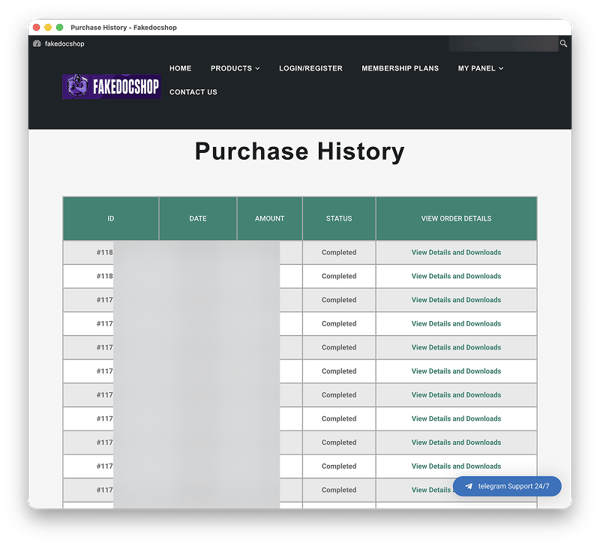
This would indicate that there have been 110k+ subscriptions and free downloads (with that split unknown) logged into the farm’s system. Even if each template is not sold individually, this is still likely generating enough revenue for the farm to keep operating daily.
Tracking the farm’s crypto wallets
We’ve said before that crypto is unsurprisingly the most popular and often preferred mode of payment on the black markets for fake documents and verified accounts.
The same is true for Fakedocshop. The farm even went as far as publishing its Bitcoin crypto wallet address on its website for prospective customers to pay.
This also happens in their comment section where customers publish their emails or wallets to request a paid template or activate the subscription.
(You'd think this is a detail the template farmer would want to keep somewhat hidden to limit the public visibility of its operations).
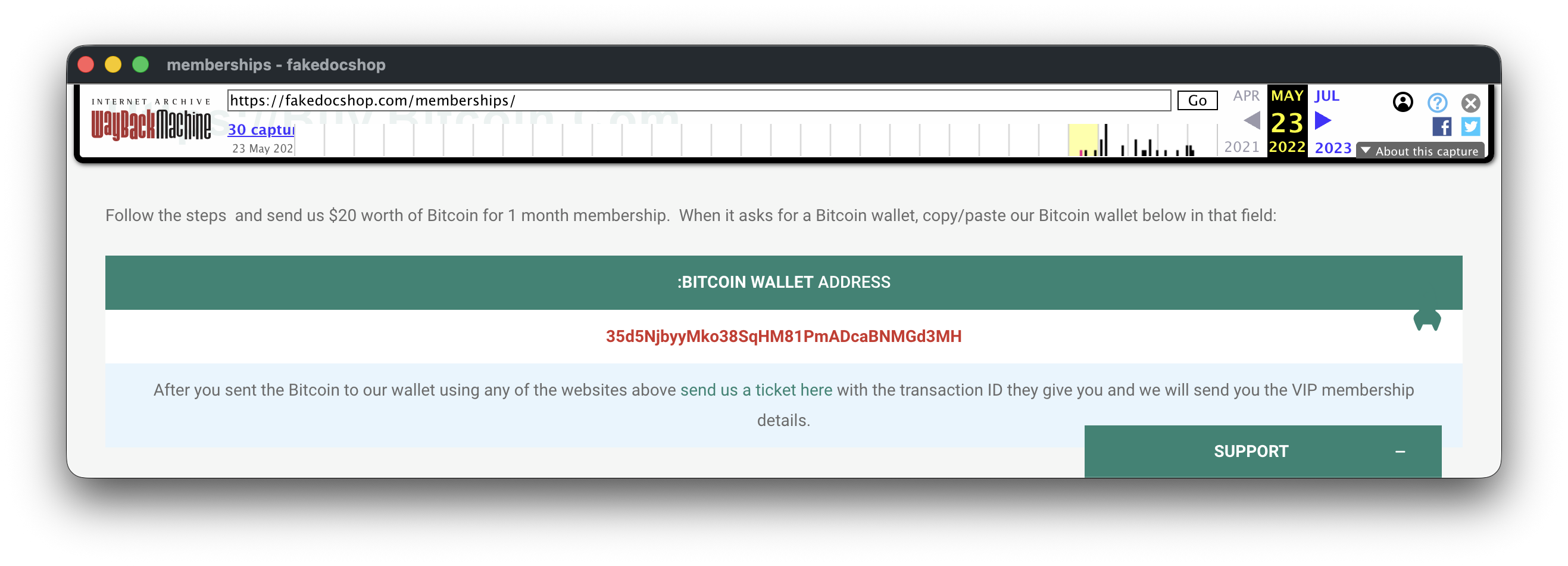 But hey, we’re glad it was published as it already proved to be quite useful analytically.
The wallet's data gives us at least a portion of insight into a template farmer's money flows, and hints at how profitable a business running a template farm might actually be.
The “original” wallet (screenshot above) was active between February 2022 and October 2025, with the last transaction recorded on October 11, 2025. In total, it processed 3,590 transactions worth almost $260,000 in almost four years, sending out and receiving an identical sum of money.
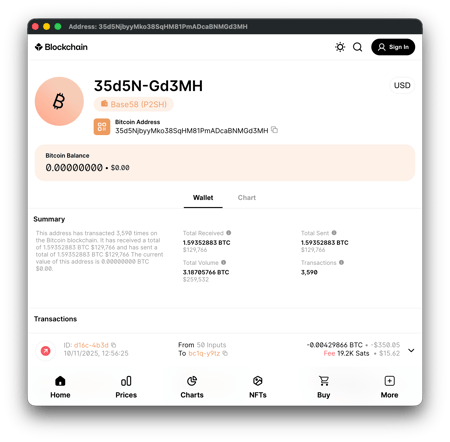 When a wallet moves funds in and out in equal measure without holding anything, it is known as a "pass-through wallet:" one used purely to process payments rather than store earnings.
Think of it less like a bank account and more like a cash register that empties at the end of every shift.
This also tells us something important about the limits of what we can see. A pass-through wallet of this kind is almost certainly one of several operated by the same farmer. Splitting flows across multiple wallets is standard practice for anyone handling meaningful volumes: it’s easier to manage, harder to track, and another layer of separation between operator and address.
Blockchain forensics can hint at which other wallets belong to the same network, but attribution gets noisy fast and exchange-controlled addresses muddy the picture quickly.
Nevertheless, the $260,000 figure is a floor, not a ceiling. The real number across Fakedocshop's full wallet network over five years is almost certainly several times larger, and more than enough to keep the operation running and keep harvesting new templates.
Beyond revenue, a great example of Fakedocshop’s consistent activity is the farm’s dedicated Telegram "news" channel, regularly informing its customers about new catalog additions.
Fakedocshop and its template “news” channel
Fakedocshop is dedicated to informing its loyal customers about new templates added to the catalog.
While it’s by far not the only template farm to have its own dedicated Telegram channel, it’s been especially dedicated to posting new template notifications on a highly consistent basis.
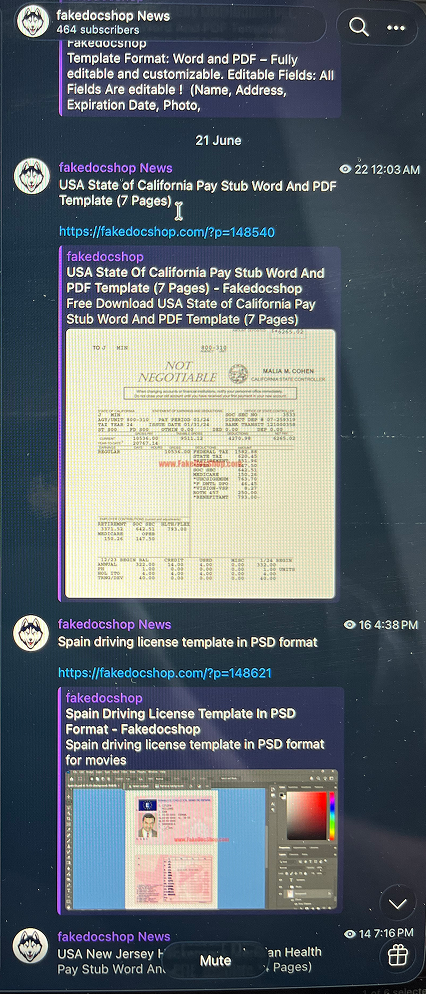
Example of recent posts made by Fakedocshop’s news channel
We analyzed the channel’s entire communication from May 2025 to February 2026, with over 3,000 messages almost solely consisting of new template product notifications. Each message contains a direct URL to the template listing on the farm website, without any additional information.
Around half of these messages were posted within the first month of the channel’s existence. This might not be the original channel. There could have been at least one other iteration corresponding with the existence of the document farm itself.
The channel claims as much itself with a pinned message informing the audience to “stay in the public channel so you’ll know the new address if this one gets reported by rats!”
As we’ve said before, template farms are unkillable and farmers operate under the assumption that their channels or websites might be taken down (even confident ones with subscription based payment models).
They routinely create backups, rotate and re-open websites or channels, or simply launch a new one once the existing one gets flagged and taken down.
After the first month, the news channel posted around 170 new templates each month. Bank statements and utility bills make up most of the postings, but various other documents like insurance certificates or invoices and bills are represented as well in multiple instances.
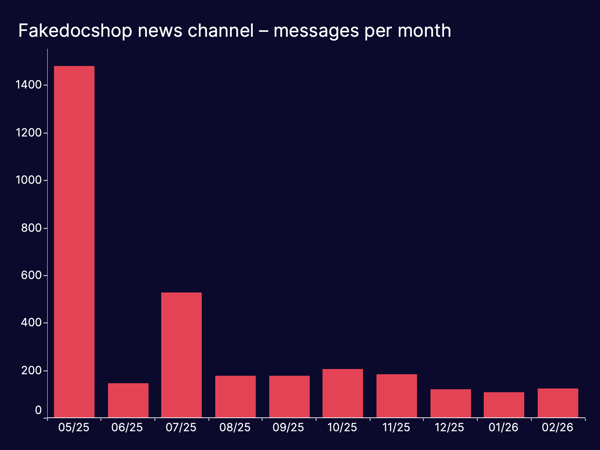
Aside from “product news”, the channel does not contain much else. Fakedocshop’s technical support has its own channel as farmers often create dedicated channels for specific types of communication.
Run by Janet, a character handling technical support as well as billing and subscriptions, the tech support responds promptly, further supporting the notion that Fakedocshop is being managed actively and on a daily basis.
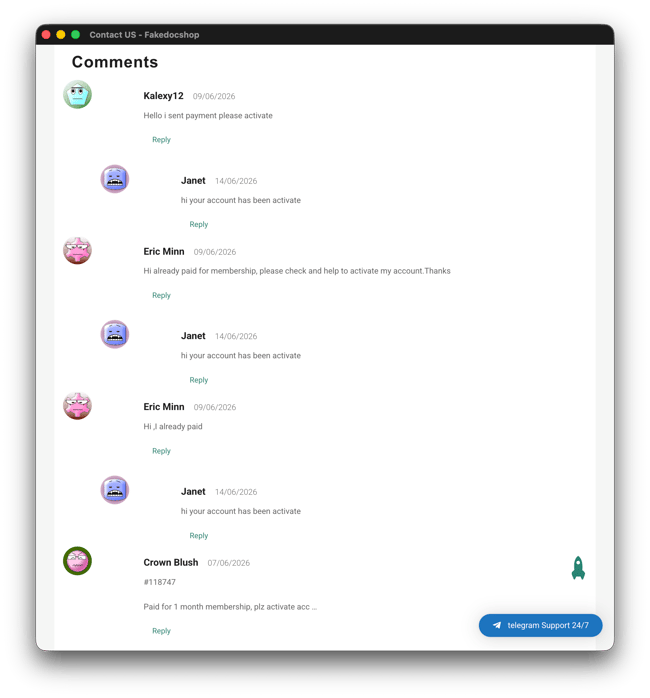
A website and Telegram screenshots of some of the interactions between Janet and Fakedocshop’s customers, showing the regular feedback and communication
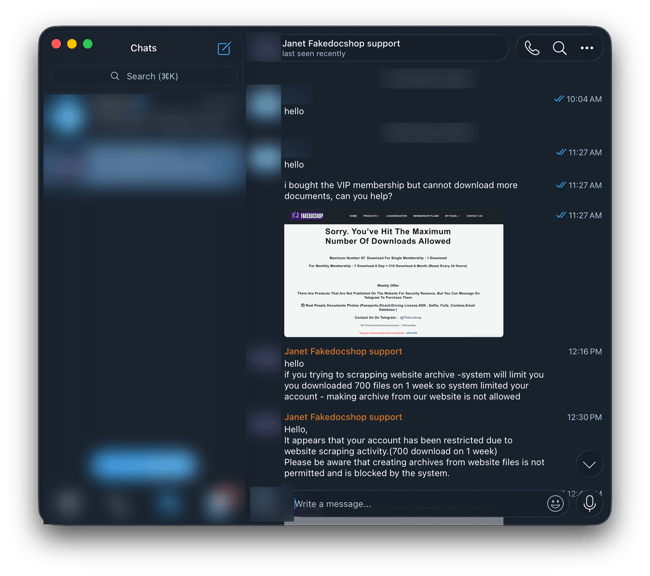
At one point, "Janet" was not even pleased with us trying to harvest the farm’s catalog and blocked one of our accounts while trying to explain that archiving the farm’s template catalog is "not allowed" even when you stay within the subscription tiers advertised by the farm.
That said, there’s one type of offering and messaging present throughout the channel as well as the template farm website itself that deserves a closer look as it has serious implications for the fake document ecosystem as a whole.
Fakedocshop expands beyond fake document selling
Analyzing Fakedocshop’s catalog, there’s one item we don’t usually see with other farms.
In the miscellaneous category, the farm offers an item labelled as Passport and ID Photos Cleaned Pack, describing it as a package of 350 high quality peoples passport and ID photos, ready to use in your fake ID and passports.
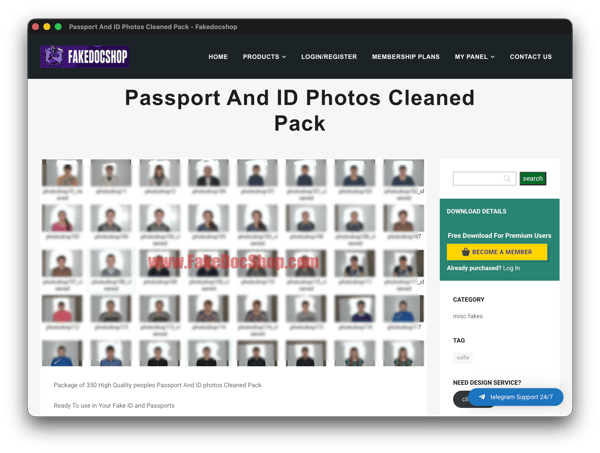
The images are medium-level quality in resolution, and the editing of the background and cropping of the individuals is not at the professional level we’ve come across before.
This is clearly not a document template, but the kind of raw material (albeit lesser quality) needed for extensive and large-scale document fraud operations requiring hundreds or thousands of fake identities.
And it implies that Fakedocshop is more than just another template farm.
We’ve done further research into this, and Fakedocshop is actively branching out into yet another part of the criminal ecosystem where it provides prospective fraudsters with more than document templates to supercharge financial crime activity.
Not just with a single offering like the one above, but with something much more extensive.
But we’ll cover that next time.
Enjoying our Threat Intelligence content? Subscribe to the "Threat Radar" (sign up also available on the left).

Fraud awareness, examples, and lessons
Learn more about fraud in specific industries, best practices, and targeted documents.
View all
Application fraud in 2026 is easier to attempt: accessible tools and services help applicants turn false claims ...
Within the fake document ecosystem, things can change fast. Four months ago, we reported that OnlyFake, the ...
In May 2026, a Dallas resident was convicted of running coin-operated “amusement machines” without a business ...

NEW YORK & PRAGUE – 1 October 2026 – Ocrolus, the AI workflow and analytics platform for lenders, today ...
For a few hundred dollars, sellers on Telegram promise to boost your credit score using someone else's credit ...
Key takeaways Fake certificates can use real numbers Fraudsters can copy a genuine business’s VAT number onto a ...