Fake New York business licenses are risky in 2026. Whether it’s to provide jurisdictional privileges, or renew the operations of a nuclear power plant.
For banks, lenders, marketplaces, procurement teams, and compliance reviewers, a bad license can lead to dealing with the wrong people or authorizing services to criminals.
And now fake New York business licenses are easier to create than ever before. Fraudsters can misuse public registries, download editable document templates, search for PDF editors, or make use of generative AI tools to create entirely fake documents from scratch.
The worst part? Documents can look official but prove the wrong thing. A real company name can be copied into a fake license. A formation document can be presented as permission to operate. A sales tax certificate can be altered and submitted as if it were a general business license.
Read on to learn what New York business licenses are, how they are being forged, how to spot a fake New York business license, and how AI-powered tools can help.
Check out our “how to spot fake business licenses” blog for a universal guide on how to spot fake documents of this type.
What is a New York business license?
A New York business license covers an array of documents ranging from licenses, permits, registrations, and certificates that allow a business to operate legally in New York State, New York City, or a specific local jurisdiction.
New York, like Minnesota, does not have a single statewide document that licenses business throughout the state. Instead, businesses need to obtain multiple documents related to their activity, location, legal structure, and regulated industry.
On average, to begin operating in New York State or New York City you would need at least 6 different documents, and 7 if you plan to hire employees:
- Entity formation documents. Create or register the legal entity.
- EIN. Federal tax identifier. Sole proprietors without employees may be able to use a Social Security number for federal tax purposes, though many still get an EIN for banking, privacy, or vendor onboarding.
- DBA or assumed name filing. Registers a trade name.
- Sales tax Certificate of Authority. Allows taxable sales and sales tax collection in New York.
- Activity-specific licenses. Required for regulated business activities, whether issued by New York State, NYC, a county, or another local authority.
- Premises-specific permits and approvals. Required for the physical location, such as zoning, occupancy, building, signage, health, or fire approvals.
- Employer registrations and insurance. Required if the business hires employees.
- Federal permits or registrations. Required only for federally regulated activities.
Some common physical characteristics among these separate New York state licensing documents may include:
- Document title. The document may be called a license, permit, registration, Certificate of Authority, Certificate of Status, filing receipt, or professional license.
- Issuing authority. The issuer may be the New York Department of State, New York State Department of Taxation and Finance, New York City Department of Consumer and Worker Protection (DCWP), or another state, city, county, or local agency.
- Legal business name. The registered name of the company, limited liability company (LLC), corporation, partnership, or sole proprietor.
- License or registration number. The unique identifier tied to the document or agency record.
- Business address. The physical location, mailing address, or licensed premises associated with the business.
- License type or activity. The specific business activity covered, such as home improvement contracting, retail sales, appearance enhancement, real estate, tobacco retail, or another regulated category.
- Issue and expiration dates. The period when the license, permit, or registration is valid.
- Status or renewal information. Whether the license is active, expired, pending, revoked, amended, or renewed.
- Authentication details. Some Department of State documents issued through eCorps may include authentication details that can be checked through the state system.
Businesses have to think about New York differently from a state like Washington (where they have a single state-wide license) or Florida (where the document goes by a different name but shares the same purpose).
The best way to find out the exact documents and processes you need is via services like Business Wizard for NYC and Business Express for most of the state. You’ll also likely have to reach out to your local Village Clerk’s Office or in the office where your business will be located.
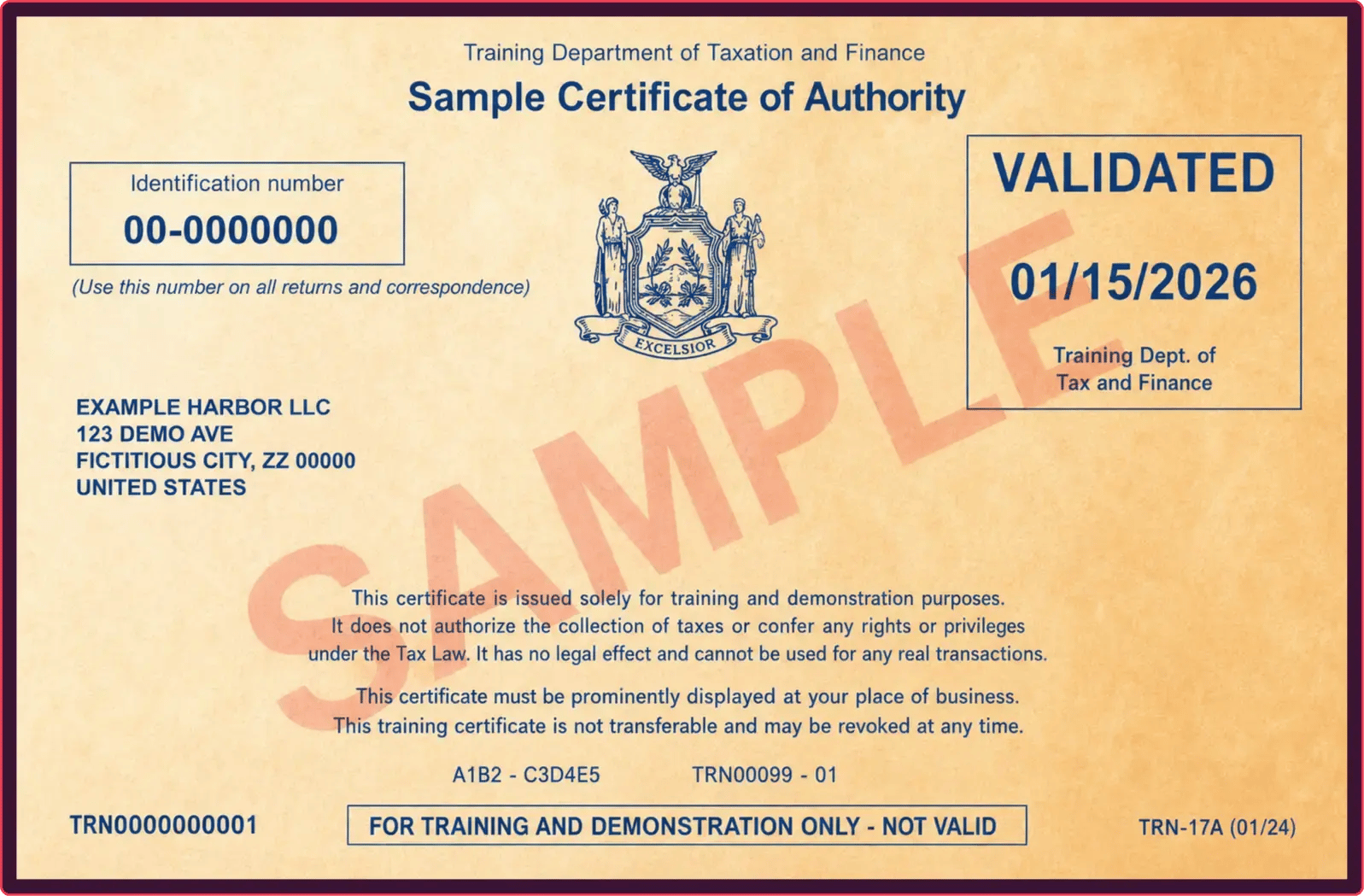
Example of a fake New York Certificate of Authority (not a business license) for illustrative purposes only.
Why are New York business licenses important?
New York business licenses are used to verify that a company is registered, authorized, tax-compliant, and allowed to perform the activity it claims to perform.
In New York’s layered licensing environment, understanding this process can mean the difference between a complete and incomplete applicant. A landlord, marketplace, insurer, or lender can accept one of these documents for specific purposes but cannot treat them as standalone documents when it comes to business authorization.
Here’s how New York business licenses are used for document verification:
- KYB and merchant onboarding. Reviewers check whether a business exists, whether its claimed address is consistent, and whether it has the right authorization for the products or services it offers.
- Lending and underwriting. Lenders use business license documents to confirm that applicants are operating legally before issuing credit, equipment financing, or working capital.
- Procurement and vendor onboarding. Procurement teams verify contractors, suppliers, and service providers before allowing them into a vendor network.
- Marketplace trust and safety. Platforms check business documentation before approving high-risk sellers, service providers, or regulated merchants.
- Insurance underwriting. Commercial insurers review licenses and permits to assess whether the business activity matches the requested policy.
These documents are often trusted because they come from official New York government agencies.
Once you’ve obtained all the necessary documentation, it serves as evidence of your “legal authority to do business in the state of New York.” The package together. Alone, none of these documents serves that purpose.
New York State business license law
New York State business license law works less like a single checklist and more like a branching system. What a business needs depends on where it operates, what it sells, whether customers visit a physical location, whether it hires employees, and whether the activity is regulated.
New York Business Express is the starting point, but it does not replace city, county, town, village, or industry-specific requirements.
The biggest split is New York City versus the rest of the state. NYC businesses often face extra city licensing, zoning, building, fire, health, signage, and consumer protection requirements. The DCWP (Department of Consumer and Worker Protection) licenses more than 45,000 businesses across more than 45 industries.
Outside NYC, the process is usually more local: businesses may need to contact the county clerk, city clerk, town clerk, village office, zoning department, building department, or county health department depending on the address and activity.
Importantly, upstate or suburban businesses do not automatically have fewer requirements. A software consultant working from home in Rochester may have very few licensing steps, while a restaurant in Albany, contractor in Westchester, cannabis retailer in Buffalo, or childcare provider in Syracuse may need multiple approvals.
The real dividing line is not downstate versus upstate. It is whether the business is regulated, taxable, customer-facing, premises-based, or employer-based.
The most heavily regulated New York businesses tend to include food service, alcohol, cannabis, tobacco and vapor products, childcare, healthcare and licensed professions, construction and contracting, real estate, insurance, finance and lending, and several other industries.
Businesses with less red tape are usually remote, service-based, non-public-facing, and not selling taxable goods, although they may still need formation filings, tax registration, a DBA, local zoning clearance, or employer registrations.
NY business licensing process
A New York business should work from state to local, then from general registration to activity-specific approvals.
- Start with New York Business Express. Use the state Business Wizard to identify state-level licenses, permits, tax registrations, and agency requirements.
- Check Department of State requirements. If forming or registering a corporation, limited liability company (LLC), limited partnership, or assumed name, use the New York Department of State filing system.
- Get an employer identification number if needed. Apply through the Internal Revenue Service (IRS) if the business structure, employees, banking needs, or tax situation requires one. Sole proprietors without employees may not always need one, but many still get one for banking and privacy.
- Register for New York tax accounts if required. Use the New York Tax Department if the business sells taxable goods or services, hires employees, deals in tobacco or vapor products, operates in fuel or transportation-related categories, or needs another tax registration.
- If operating in NYC, use NYC Step-by-Step. This creates a customized list of city, state, and federal licenses and permits based on the business activity and address.
- If operating in NYC, check DCWP. Use DCWP resources if the business falls into a regulated city category such as home improvement contracting, secondhand dealing, tobacco retail, car washes, tow trucks, locksmithing, or similar activities.
- Contact local offices. Outside NYC, contact the county clerk, city clerk, town clerk, or village office. In places like Westchester, the answer may depend on the specific city, town, or village, not just the county.
- Check premises approvals. Contact the local zoning, building, health, fire, or code enforcement office if the business has a storefront, office, restaurant, salon, warehouse, home-based location, signage, renovations, or customer visits.
- Check specialized agencies. Go directly to the relevant regulator for alcohol, cannabis, childcare, food service, healthcare, real estate, insurance, lending, transportation, construction, security, or professional services.
- Track renewals by issuer. Formation records, sales tax authority, NYC licenses, local permits, professional licenses, and premises approvals each follow their own renewal rules.
Threat intel: Template data about New York business documents
Our Threat Intelligence Unit collects data about template farms which make and distribute fake document templates for fraudulent purposes.
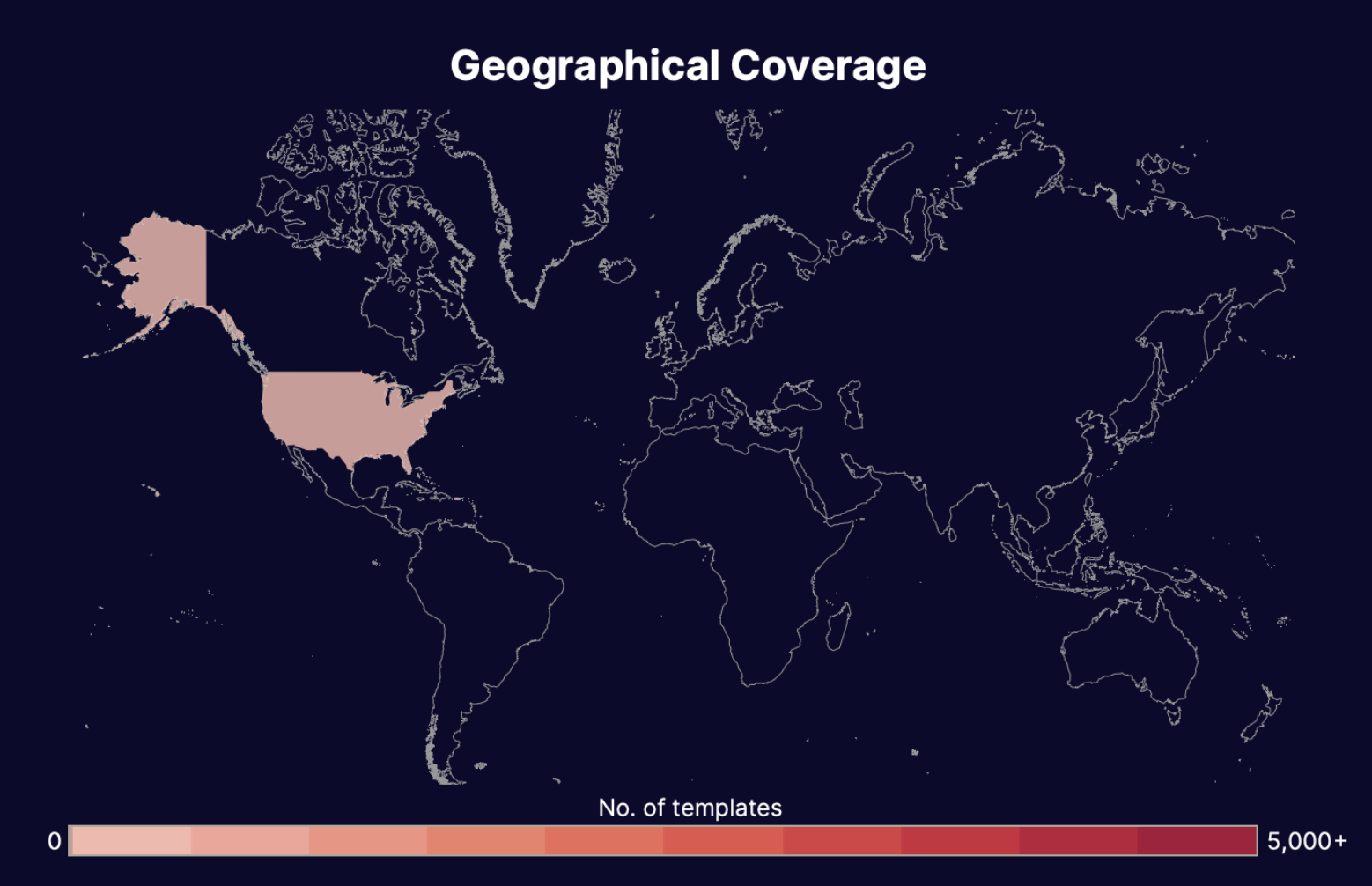
Threat intel stats: New York business documents
5 Signs of a forged or fake New York business license
Missing a fake New York business license can mean onboarding a shell company, approving an unlicensed contractor, financing a business that is not legally authorized to operate, or accepting a document that proves far less than the applicant claims.
Manual review is especially difficult in New York because genuine documents can come from multiple authorities. A reviewer may be looking at a state filing receipt, a sales tax certificate, a NYC license, a local permit, or a professional license, each with different rules and verification paths.
The tell tale sign, once again, is using one of these documents in place of a formal business license. Companies must refuse anything outside the complete business authorization package.
Beyond that, and if you’re still reviewing documents manually, here are the major red flags to watch for:
1. Inconsistent formatting
Formatting problems matter most when they contradict the expected format or delivery method of a specific New York record.
- Department of State eCorps document without authentication structure. New York’s authentication site says only filing receipts, Certificates of Existence, and copy requests issued through eCorps can be authenticated there, and the authentication number appears on the bottom of the filing receipt or Certificate of Existence.
- NYC DCWP license presented as a homemade certificate. A document that uses generic NYC branding but does not clearly identify the DCWP category, license holder, or license status should not be accepted at face value.
- Separate pasted objects inside the file. Business names, license numbers, agency headers, dates, or seal areas that appear as separate inserted objects can indicate that a real document was altered.
2. Incorrect or misleading information
A fake New York business license often uses real terminology in the wrong way. The document may be genuine-looking, but the claim attached to it is false.
- Local premises permit with no premises structure. Zoning, building, health, signage, fire, or certificate-of-occupancy approvals should usually be tied to a specific address or premises. A local permit without location-specific information is weak evidence.
- Certificate of Authority missing sales tax-specific language. If the document does not clearly identify sales tax authority, taxable sales, or the New York State Department of Taxation and Finance.
- Department of State document with impossible entity language. A document that mixes entity types, such as calling the same business an LLC, corporation, sole proprietorship, and partnership in different places.
- Assumed name filing missing the underlying legal entity. A DBA or assumed name document should connect the trade name to the legal business behind it. If the document lists only the assumed name with no clear corporation, LLC, partnership, or owner behind it, the filing may be misleading or fabricated.
- Local permit missing the issuing local office. A local approval should name the city, town, village, county, building department, health department, zoning office, fire department, or other issuing authority. A generic “New York local business permit” is suspicious.
3. Bad math and uncharacteristic figures
New York business licensing documents do not always contain calculations, but dates, fees, license terms, and application timing can still expose false documents.
- Taxable sales before sales tax registration. A claimed sales history that predates the Certificate of Authority.
- DCWP license term does not match the category. DCWP license expiration dates vary by business type. For example, NYC home improvement contractor licenses cover a full two-year license term and expire February 28 in odd-numbered years.
- Renewal timing does not match DCWP behavior. DCWP says it mails renewal packages approximately three months before license expiration, and businesses must renew before expiration to continue operating and avoid fines.
- Formation date and license date. A business claiming long-term regulated operations but showing a recent formation, recent DBA filing, or newly issued license may still be legitimate, but the timeline needs explanation.
4. New York business license inconsistencies
Some fake New York business licenses fail because the information inside a single document does not hold together. The fields may look official on their own, but the dates, identifiers, license terms, business details, and approval language contradict each other.
- Business start date after the issue date. A sales tax Certificate of Authority, local permit, or activity-specific license that shows a business start date after the document’s issue, approval, or effective date.
- Signature date after the approval date. If a local permit, inspection approval, premises license, or agency approval is signed after the document says it became valid.
- License term conflicts with the expiration date. A document may say it is valid for one year or two years, but the issue date and expiration date produce a different term.
- Legal name and trade name are mixed inconsistently. A document may list the legal entity in one field, then treat the DBA or assumed name as the legal entity elsewhere on the same document.
- License category conflicts with the approved activity. A license may identify one category in the title or header, then describe a different activity in the body, such as a retail dealer license that later refers to contracting, food service, or another regulated activity.
5. Metadata discrepancies
Metadata checks should focus on whether the file history fits the expected source and format of the New York document.
- Government portal document edited after download. A Department of State, Tax Department, DCWP, or local government PDF that shows later editing in design software, image editors, or consumer PDF tools.
- Flattened image. If the file is flattened, cropped, or stripped of useful details.
- Screenshot-only submission of a verifiable record. If a DCWP license, Department of State document, or local permit can be checked through an official portal or issuing office, a cropped screenshot should not be treated as the strongest available evidence.
- Metadata source does not fit the issuing pathway. A file claiming to be issued by a government agency but showing a personal author, design platform, template tool, or unrelated creator should be escalated.
Disclaimer: Manual review can catch obvious errors, but it cannot reliably scale across New York’s fragmented licensing system. Fraudsters can copy real registry data, manipulate official-looking PDFs, and generate convincing documents faster than reviewers can check every agency record by hand.
How to verify a New York business license
New York business license verification is usually performed by KYB analysts, onboarding teams, procurement managers, underwriters, marketplace trust and safety teams, compliance teams, and fraud investigators.
There are two ways to approach verification: manual review and AI-powered automation.
Manual verification is still common because many organizations rely on legacy workflows, checklist-based onboarding, or human escalation for high-risk submissions. But it is increasingly strained by New York’s layered licensing structure and the sophistication of modern document fraud.
AI document verification is better suited for scale because it can inspect how a document was built, detect hidden manipulation signals, and compare patterns across submissions without relying only on the visible text.
Still, manual checks remain prevalent throughout many New York business verification workflows.
Manual verification of New York business licenses
Always start with the red flags we mentioned above, then use the resources mentioned below:
- Check New York Business Express. Use New York Business Express to identify which state licenses, permits, and registrations should apply to the business activity.
- Search the Department of State entity database. Confirm the legal entity name, assumed name, entity type, and filing status in the New York State Corporation and Business Entity Database. Remember that this verifies entity records, not every license. For a complete guide of all US business registries, visit our USA KYB guide.
- Check NYC DCWP licensing where relevant. For New York City businesses, use DCWP license search tools and industry checklists. DCWP licenses more than 45,000 businesses across more than 40 industries.
Keep in mind: Manual verification is slow because New York business authorization is not stored in one simple place. A reviewer may need to check state formation records, sales tax rules, NYC licensing tools, local permits, and specialized agency requirements before reaching a decision. That may work for a handful of cases, but it does not scale when fraudsters are submitting polished documents in volume.
Using AI and machine learning to spot fake New York business licenses
AI fraud detection helps by analyzing the construction and context of a New York business document, not just the words printed or its presence in a registry.
A fraudster can copy a real business name from a public registry. They can place stolen address or personal information into a fake certificate. They can also submit a genuine formation document while misrepresenting what it proves.
Key benefits include:
- Any document. New York license documents vary by agency, city, and business activity. A document-agnostic system can evaluate unfamiliar formats without needing a perfect template for every license type.
- Analysis of the whole document set. AI can identify repeated layouts, reused license elements, shared addresses, copied seals, and linked fraud attempts across many submissions.
- Explainable forensic output. Surface the signals behind a suspicious verdict so teams can investigate, escalate, or defend their decisions.
Automation vs. AI
Rules-based checks can be shallow. A fake New York business license can pass a field-presence check while still proving the wrong thing.
AI learns structural norms, detects manipulation patterns, identifies reused document infrastructure, and reasons across submissions.
Conclusion
Fake New York business licenses can help shell companies, unlicensed vendors, fraudulent merchants, and risky borrowers get through onboarding.
Resistant Documents helps institutions detect fake New York business licenses by using structural analysis, cross-document intelligence, GenAI detection, and adaptive decisioning to identify manipulation that manual review can miss.
Scroll down to book a demo.

Fraud awareness, examples, and lessons
Learn more about fraud in specific industries, best practices, and targeted documents.
View all
Application fraud in 2026 is easier to attempt: accessible tools and services help applicants turn false claims ...
Within the fake document ecosystem, things can change fast. Four months ago, we reported that OnlyFake, the ...
In May 2026, a Dallas resident was convicted of running coin-operated “amusement machines” without a business ...

NEW YORK & PRAGUE – 1 October 2026 – Ocrolus, the AI workflow and analytics platform for lenders, today ...
For a few hundred dollars, sellers on Telegram promise to boost your credit score using someone else's credit ...
Key takeaways Fake certificates can use real numbers Fraudsters can copy a genuine business’s VAT number onto a ...