
Whether it’s a forged medical diploma or a suspicious Australian degree used for a Hong Kong visa application, fake diplomas and degrees have been all over the news in 2026.
Academic credential fraud is no laughing matter. A forged credential can affect immigration reviews (as we saw above), but also: hiring decisions, professional licensing, higher education admissions, and regulated roles where qualifications are not optional.
With such consequences at stake, it’s alarming that fake diplomas are easier to produce than ever. Templates are available online, sold in estores, and generated with AI to bypass even heavily secured audits.
When one of these fakes makes it through your defenses, it creates downstream document fraud exposure and liability for employers, licensing boards, universities, financial institutions, and public services.
Read on to learn what diplomas and degrees are, how they are being forged, how to spot a fake diploma or degree, and how AI-powered tools can help.
Check out our “how to spot fake documents” blog to learn about more common document forgeries.
What is a diploma or degree?
A diploma or degree is an academic credential that shows a person has completed a course of study, training program, or formal qualification from an education provider.
In everyday language, “diploma” and “degree” are often used interchangeably. In practice, a degree usually refers to the academic qualification itself, while a diploma may refer either to the physical certificate proving that qualification or to a separate type of credential, depending on the education system.
That ambiguity is the first layer that makes fake diploma and degree detection difficult. Reviewers need to check both the integrity of the document and the credential it actually claims to prove.
This can mean different things depending on the country, institution, subject, and level of education.
Which brings us to the second layer of difficulty: variety of what they verify.
In some contexts, a diploma is a secondary school credential. In others, it is a vocational qualification, professional training certificate, or higher education award. A degree usually refers to an academic qualification such as a bachelor’s, master’s, or doctorate, but the exact terminology varies by education system.
That breadth is what makes diploma and degree verification complicated. These documents can be used to prove education history, professional eligibility, subject-matter expertise, regulatory qualification, immigration eligibility, or simply that an applicant completed a specific program.
With so many different uses and issuing authorities, traditional document fraud detection techniques are hard to apply without universal templates and advanced understanding of the systems where the diplomas and degrees came from.
That said, the sheer volume of these fakes flooding institutions encouraged us to put together some practical tips regardless of the documents origin.
First, a diploma or degree certificate typically includes:
- Document title. The credential type, such as diploma, certificate, bachelor’s degree, master’s degree, doctorate, or professional qualification.
- Student name. The full name of the person who received the credential.
- Institution name. The school, college, university, training provider, or awarding body that issued the credential.
- Qualification awarded. The degree level, diploma type, major, field of study, or program title.
- Award or conferral date. The date the qualification was granted, completed, or formally conferred.
- Issuing authority. The registrar, dean, president, chancellor, examination board, or authorized institutional office.
- Signatures and seals. Official signatures, institutional seals, stamps, embossed marks, or other credentialing features used by the issuer.
- Classification or honors. Academic results such as honors, distinction, merit, first-class classification, or similar achievement markers where applicable.
- Additional information. Campus, department, mode of study, transcript reference, accreditation language, QR code (in some modern examples for easier verification), verification link, or digital credential details.
Together, these details help confirm that a person was awarded a specific academic or professional qualification by a specific institution at a specific point in time.
Depending on what you’re verifying and where the document is from, institutions must adapt their verification strategies so they’re in line with local customs and policies.
For example, terms like “Bachelor’s Degree” may be used commonly in one jurisdiction, but not as much in another. Meaning that a degree carrying that terminology can be indicative of fraud.
Knowing both geographic and institutional customs (i.e., medical vs. law school diploma practices) can help better identify signs of fraud in academic documents.
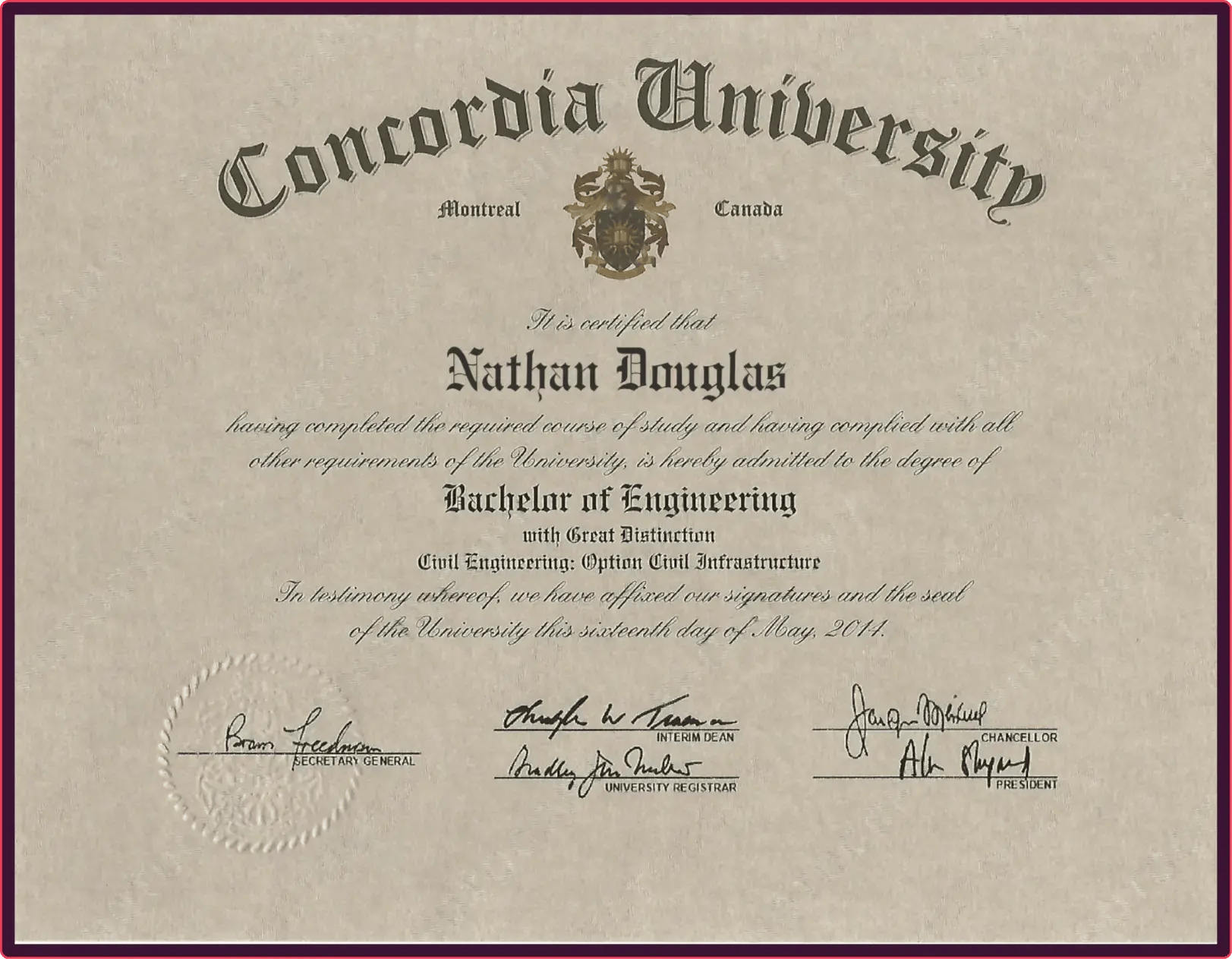
An example of a diploma for illustrative purposes only.
Why are diplomas and degrees important?
Diplomas and degrees help organizations decide whether someone has the education, training, or qualifications needed for a role, license, program, or service.
In practice, these credentials sit inside very different verification workflows such as minimum education and role suitability, regulated professions, admissions or transfer eligibility, skilled worker or student visa claims.
Here’s how diplomas and degrees are used for document verification across specific industries:
- Employment screening. Confirm that applicants meet minimum education requirements.
- Healthcare and professional licensing. Check whether applicants completed the required education before practicing in regulated roles.
- Higher education admissions. Decide whether a student qualifies for admission, transfer credit, scholarships, or postgraduate study.
- Immigration and visa processing. Support skilled worker visas, study permits, points-based immigration systems, and professional recognition.
- Financial services and compliance. Screening employees, assessing fit-and-proper requirements, verifying professional qualifications, or checking credential-based eligibility claims for certain financial roles or investor categories.
Diplomas and degrees are often trusted because they typically come from institutions with formal authority, records, and reputations.
Institutions need to be careful because that trust can be exploited. One-day online universities, fake websites, and entirely fake institutions issue thousands of fake credentials everyday. Review teams should always check the validity of the institution itself as well as the documents.
If you’d like to learn more about how fraudsters create convincing document packages, check out our “types of document fraud” blog.
5 Signs of a forged or fake diploma or degree
As we already mentioned, manually reviewing a fake diploma or a degree is especially difficult because academic credentials vary widely.
A nursing diploma, high school diploma, master’s degree certificate, vocational award, and foreign university degree can look entirely different while still being legitimate.
The goal is not to memorize every possible format. The goal is to identify whether the credential makes sense across the institution, program, timeline, accreditation, transcript, and verification channel.
Here are five signs of diploma fraud and degree fraud to watch for:
1. Inconsistent formatting
Authentic diplomas and degrees are usually produced from controlled institutional templates. The warning sign is not that every school uses the same design. It is that the document does not match the claimed issuer, award year, or credential type.
- Wrong document style for the credential. A bachelor’s degree, postgraduate certificate, professional diploma, and honorary degree may use different wording or layouts, but the submitted document uses one generic certificate format.
- Poor seal or signature reproduction. University seals, registrar signatures, embossed marks, or stamps appear flat, pixelated, cropped, pasted, or visually inconsistent with the rest of the document.
- Mixed design eras. A diploma supposedly awarded years earlier uses modern logos, updated department names, current web branding, or institutional language that did not exist at the time.
- Unusual typography or spacing. The student name, degree title, date, and signature blocks appear stretched, unevenly aligned, or inserted into a blank template.
2. Incorrect or misleading information
A fake diploma or degree can reveal itself by mixing up terminology, numbering, or specific images or leaving them out entirely.
- Institution is not properly accredited. The degree doesn’t have a legible university name, the name has been obscured, or cropped out entirely.
- Mismatched institutional branding. The seal, crest, motto, logo, or color scheme does not match the university’s current or historical branding for the claimed award year.
- Degree title does not exist. The qualification name, major, concentration, or degree level does not appear in the institution’s academic catalog for the claimed year.
- Registrar or president mismatch. The signatory listed on the certificate did not hold that role when the degree was supposedly awarded.
- Location mismatch. The claimed campus, branch, or country does not align with the program, the awarding institution, or the school’s actual operating footprint.
3. Bad math and uncharacteristic figures
For diplomas and degrees, bad math is usually academic math. The timeline, credits, grades, program length, and qualification pathway have to make sense.
- Implausible education timeline. The degree certificate itself may only show the award date, so this usually becomes visible when the credential is compared with the applicant’s resume, transcript, application history, or claimed dates of study.
- Several degrees in the same year. A candidate claims multiple unrelated degrees, or a bachelor’s, master’s, and doctorate in a timeline that does not reflect normal academic progression.
- Professional pathway shortcuts. The credential claims to qualify the holder for a regulated profession, but the program length, supervised hours, clinical placement, or accreditation status does not match the field’s requirements.
4. Diploma and degree inconsistencies
A fake diploma or degree often gives itself away through contradictions inside the certificate itself.
- Institution name inconsistencies. The school name appears in more than one form on the same document, such as “University of Northbridge” in the header but “Northbridge International College” near the seal or signature line.
- Image and institution. The document names one institution, but the seal, crest, stamp, motto, footer (or even a background image of the institution itself) refer to a different school, department, campus, or awarding body.
- Award type and field mismatch. The certificate uses conflicting credential language, such as calling the award a diploma in one place and a bachelor’s or postgraduate degree elsewhere, or naming one field of study in the title while the body text refers to a different discipline.
5. Metadata discrepancies
Digital diploma and degree fraud can leave clues in how the file was created, edited, compressed, or reused.
- Design software traces. The PDF or image metadata shows creation or editing in Photoshop, Canva, Illustrator, online PDF editors, or template tools rather than an institutional document system.
- Unofficial image copy. A scan, photo, or screenshot is suspicious when the institution issues an official electronic version, certified digital credential, or registrar-provided PDF that should be available instead.
- Reused file structure. Multiple applicants submit credentials with identical metadata, object ordering, background texture, scan artifacts, or certificate number patterns, with only names and dates changed.
Disclaimer: Manual inspection can catch obvious mistakes, but fake diplomas and fake degrees are increasingly built to survive a quick visual review. At scale, organizations need fraud detection systems that can inspect document structure, compare signals across submissions, and flag patterns that human reviewers cannot reliably see.
How to verify a diploma or degree
Employers, licensing boards, universities, immigration teams can verify diplomas and degrees in one of two ways: manual or automated.
Manual checks are still common, especially when reviewers need to contact a registrar, confirm accreditation, or assess a foreign qualification, but this gets difficult when fake diplomas are no longer limited to bad spelling and visible mistakes.
Modern diploma fraud can involve cloned university websites, fake accreditation bodies, manipulated transcripts, forged verification letters, convincing PDF files, and generative AI-created document packages.
AI-powered automation is stronger because it can analyze diploma and degree documents how the file was built, detect structural anomalies, compare signals across submissions, and identify patterns that human reviewers are unlikely to notice.
That said, manual review still appears in many education, hiring, licensing, and compliance workflows. If a diploma or degree must be checked by hand, use the following steps.
Manual verification of diplomas and degrees
If a diploma or degree must be checked by hand, compare it against the visual signals we mentioned above. Then, use the following steps:
- Visit the institution website. Check the webpage of the issuing institution to see if it is real, has activity, looks legitimate.
- Use WHED. The World Higher Education Database (WHED) can provide further data on the issuing institutions and the kinds of degrees/diplomas it issues.
- Contact the registrar directly. Use contact details from the institution’s official website, not the phone number, email address, or link shown on the submitted document.
Keep in mind: Every credential may require institution checks, accreditation checks, registrar outreach, program review, transcript comparison, and file inspection, making manual verification scale poorly (especially across dramatically different jurisdictions).
Using AI and machine learning to spot fake diplomas and degrees
AI document verification helps detect fake diplomas and fake degrees by analyzing how the document was built, submitted, and reused across cases. Instead of depending only on visible content or static templates, AI can evaluate structural signals that are difficult for human reviewers to see.
Key benefits include:
- Document-agnostic. Diplomas and degrees vary widely by country, institution, credential level, and time period. Structural AI is not limited to one school template or one region because it focuses on how the file behaves, not just what the document says.
- Cross-document intelligence. AI can compare diploma submissions against transcripts, resumes, licenses, prior applications, and other submitted files to identify reused templates, repeated artifacts, inconsistent credential chains, or linked fraud activity.
- Generative AI detection. Modern fake degrees may include AI-generated seals, backgrounds, signatures, or be entirely AI-generated. AI models can flag visual textures and structural patterns that suggest synthetic document generation.
Automation vs. AI
Rules-based automation can help with basic diploma and degree checks. It can confirm whether required fields are present, whether a graduation date falls within an acceptable range, whether a document includes a signature, or whether a file type is allowed.
AI is different because it can learn from evolving fraud patterns and reason across the structure of the document. Instead of asking only whether a diploma has a seal or a date, AI can detect whether that seal appears pasted, whether the file structure resembles prior fake submissions, whether a transcript and diploma tell conflicting stories, or whether a document package shows signs of generative AI manipulation.
Conclusion
Fake diplomas and fake degrees are entry points into higher-risk fraud involving employment, licensing, admissions, immigration, vendor onboarding, and regulated professional access.
Manual checks can catch obvious mistakes, but they struggle against document fraud that’s invisible to the human eye.
Resistant Documents helps organizations detect diploma fraud with AI without relying on fragile templates or lengthy database lookups.
Scroll down to book a demo.

Fraud awareness, examples, and lessons
Learn more about fraud in specific industries, best practices, and targeted documents.
View all
Application fraud in 2026 is easier to attempt: accessible tools and services help applicants turn false claims ...
Within the fake document ecosystem, things can change fast. Four months ago, we reported that OnlyFake, the ...
In May 2026, a Dallas resident was convicted of running coin-operated “amusement machines” without a business ...

NEW YORK & PRAGUE – 1 October 2026 – Ocrolus, the AI workflow and analytics platform for lenders, today ...
For a few hundred dollars, sellers on Telegram promise to boost your credit score using someone else's credit ...
Key takeaways Fake certificates can use real numbers Fraudsters can copy a genuine business’s VAT number onto a ...