
Identity fraud, benefit scams, and synthetic identity schemes make fake birth certificates a problem in 2026.
As one of the world’s most relied-upon “breeder documents,” a single forged birth certificate can unlock downstream IDs, enable high-value impersonation, or pass eligibility checks that should never have been approved.
As recently as October 2025, a group of forgers were arrested in India for using AI to create these very documents. But these easily accessible online templates and generative AI tools are nothing new. We’ve been following criminals using them to commit birth certificate fraud for years. Their fakes are both scalable and convincing.
For organizations reviewing documents remotely, the risk increases further because most submissions arrive as scanned images or low-resolution PDFs where tampering is harder to spot by eye.
Missing a fake here has serious consequences. A forged certificate can cascade through identity systems, enabling passport issuance, fraudulent reimbursements, or long-term identity takeover before anyone notices.
Read on to learn what birth certificates are, how fake versions are created, how to spot a fake birth certificate, and how AI-powered verification tools can help you detect them at scale.
Check out our “how to spot fake documents” blog to learn about more common document forgeries.
What is a birth certificate?
A birth certificate is an official civil record created by a government vital records authority to document the facts of a person’s birth. It is not issued by hospitals, and it is not a federal document. Instead, it is generated by a local or regional registrar who records the birth event, files it in the jurisdiction’s vital records system, and issues certified copies upon request.
Parents typically request a certified birth certificate copy shortly after a birth to enroll a child in healthcare, obtain a passport, register for school, or apply for government benefits. Throughout adulthood, individuals use their certificates to prove identity, age, citizenship or nationality, and family relationships.
The issuing authority keeps the original record permanently; citizens hold only certified copies or extracts based on that record. That means that any birth certificate submitted for document verification purposes will never be the original document and cannot be checked as such.
Obtaining a birth certificate usually requires submitting an application to the appropriate state, provincial, or municipal vital records office and, in many jurisdictions, providing proof of identity or a legal interest in the record.
Because each authority controls its own format, issuance process, and security standards, the appearance of these documents can vary widely even within the same country. This extreme variability is precisely why template-based or region-specific checks often break down.
A document that looks unfamiliar may still be completely legitimate, while well-crafted fakes can borrow elements from outdated or foreign templates to slip past simple visual comparisons.
That being said, most certified birth certificates contain a consistent set of core elements. These commonly include:
- Child’s full legal name. The name registered at the time of birth.
- Date and time of birth. Used for identity verification and eligibility requirements.
- Place of birth. City or district of registration, often naming the hospital or facility.
- Parent information. Names, birthplaces, and other identifying details for listed parents.
- Registrar details. Date of registration, signature or stamp of the registrar, and certification language.
- Certificate or registration number. A unique identifier assigned by the issuing authority.
- Security features. Vary widely by jurisdiction, but many modern certificates include watermarked paper, microprinting, patterned backgrounds, raised or embossed seals, or other tamper-resistant printing. Older or foreign formats may use fewer or different protections.
Together, these fields confirm the birth event, establish legal identity, and anchor the individual to the civil registry that issued the document.
.png?width=875&height=1212&name=birth%20cert%20demo%20doc%20(1).png)
An example of a birth certificate for illustrative purposes only.
Why are birth certificates important?
Birth certificates are one of the most trusted foundational identity documents used across government, finance, and public services. Anchoring individuals to a specific birth event, jurisdiction, and set of parental relationships, they serve as the starting point for many downstream identity and eligibility checks.
Here’s how birth certificates are used for document verification across specific industries:
- Insurance eligibility and claims. Used to verify the identity, age, or dependent status of minors in family policies or claims investigations.
- Banking and financial onboarding. Used as supplementary identification in KYC or to confirm minor status when opening youth accounts or validating guardianship.
- Special-case lending workflows. Occasionally used to confirm age or identity when applicants lack standard photo IDs
- Immigration and citizenship processing. Immigration authorities review birth certificates to establish nationality, verify family ties in sponsorship cases, and determine eligibility for residency or citizenship pathways.
- Passport and travel document issuance. Passport offices use birth certificates as primary evidence of identity, age, and place of birth before issuing high-trust travel documents.
- Education and child services. Schools, adoption services, and youth programs use birth certificates to verify a child’s age, identity, and legal guardianship.
- Healthcare and social benefits. Public health agencies and welfare programs rely on birth certificates to confirm dependents, determine benefit eligibility, and validate demographic information.
Because birth certificates are usually the first document issued in a person’s life, institutions treat them as authoritative. Their status as “breeder documents” means they enable access to other identity credentials, which is precisely why fraudsters target them — and why organizations must verify them carefully.
Want to learn how fraudsters are creating all these fake birth certificates? Visit our “types of document fraud” blog.
Threat intel: Template data about fake birth certificates
Our Threat Intelligence Unit collects data about template farms which make and distribute fake document templates for fraudulent purposes.
Below, you'll find an infographic containing data about all the fake birth certificate templates we've found: their availability, their distributors, the institutions or "issuers" whose documents have been exposed, and how much it costs to buy one.
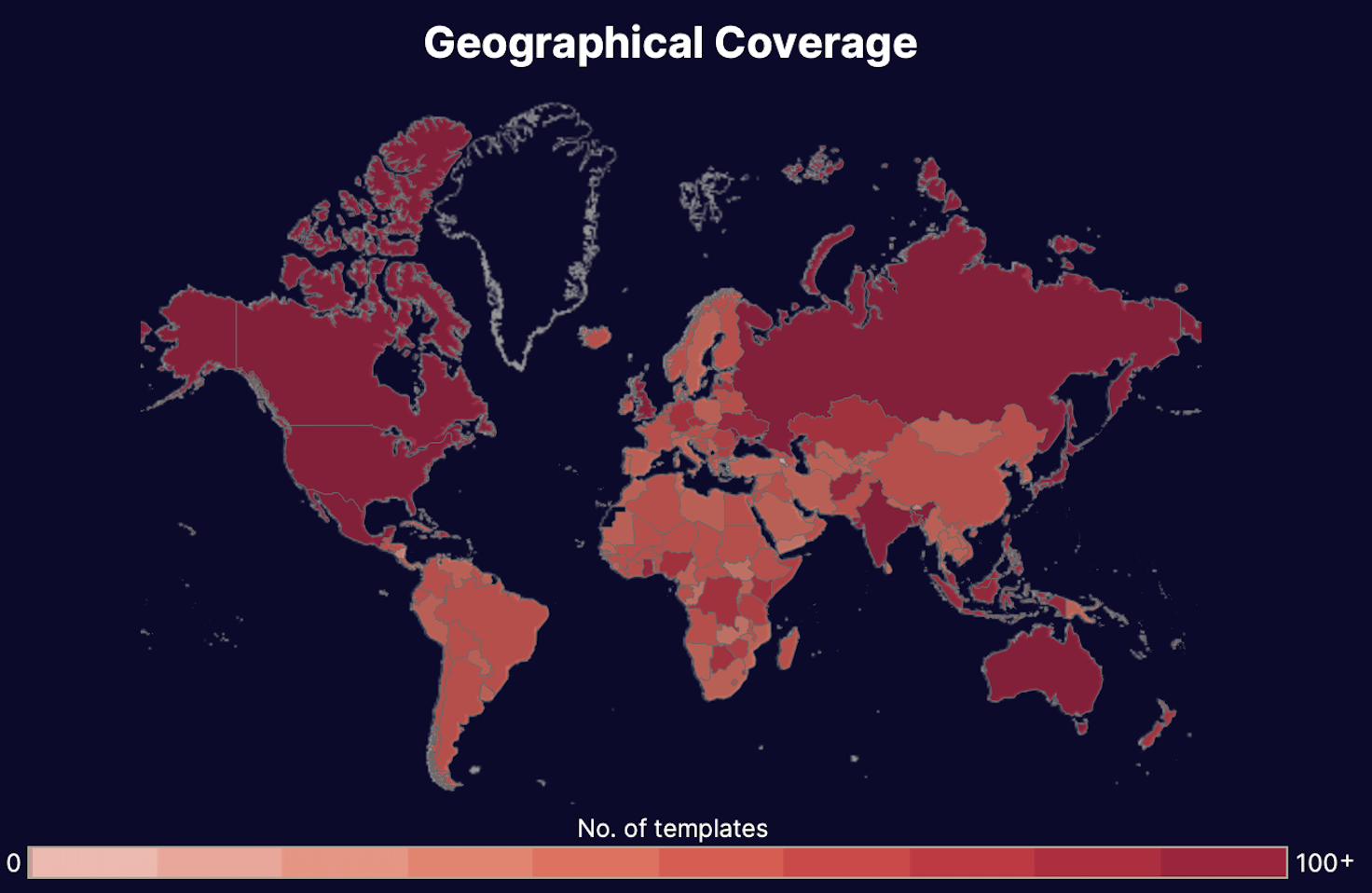
Threat intel stats: Birth certificates
Find more information about the threat these farms pose in our threat intel blog and webinar content.
5 Signs of a forged or fake birth certificate
Missing a fake birth certificate is not a small oversight. Because these documents sit at the root of an identity, a forged version can unlock passports, benefits, bank accounts, and long-term impersonation.
As we said before, manual reviewers often struggle with birth certificates because of all the different formats. Certificates come from thousands of jurisdictions, each with its own rules, compositions, and security features. That diversity makes it easy for forgers to mix elements, exploit outdated templates, or hide edits inside low-quality scans.
Detecting fake birth certificates effectively requires AI-powered document fraud detection that can spot subtle inconsistencies and structural signs of fraud.
Still, if you’re attempting to verify birth certificates manually, here’s what to watch for:
1. Inconsistent formatting
Genuine birth certificates follow strict jurisdiction-specific layouts and designs differ widely around the world. Yet there are a few formatting irregularities that can universally reveal a forgery.
- Incorrect paper characteristics. Genuine certificates typically use security paper with patterned backgrounds, fibers, or watermarking; plain office paper is a red flag.
- Seals that look printed rather than applied. Many jurisdictions use raised, embossed, or foil seals. Flat grayscale stamps or pixelated seals suggest digital fabrication.
- Mixed stylistic eras. A certificate combining a modern color background with legacy typefaces or outdated state seals that no longer exist.
- Font mismatches or changes. For example, parent names typed in a noticeably different typeface from the child’s details, indicating manual replacement. Almost all birth certificates stick to one font type throughout the document.
- Obvious copy-paste artifacts. Miscolored patches, mismatched font smoothing, or text sitting on a visibly different background layer indicate digital insertion.
2. Incorrect or misleading information
Data-level inconsistencies are common in fake birth certificates, especially when fraudsters lack knowledge of local geography, naming conventions, or registration rules.
- Impossible location combinations. Certificates listing a birthplace in a city that does not fall under the issuing registrar’s jurisdiction.
- Hospital or facility names that never existed. Especially common on older-style certificates where forgers guess historical details.
- Incorrect historical details about the parents. Parent information that contradicts basic plausibility, such as listing occupations, nationalities, or titles that did not exist at the time of birth (e.g., job titles from decades later).
3. Bad math and uncharacteristic figures
Birth certificates contain fewer numeric fields than financial documents, but logical relationships still matter. When numbers or timelines don’t add up, something is usually off.
- Dates that break regional formatting. For example, dates with the day listed before the month in a U.S. state birth certificate.
- Parent age impossibilities. A parent recorded as age 5 or age 85 at childbirth is universally impossible.
- Conflicting life events. The individual’s schooling, immigration entry, or employment records imply a different year of birth than the certificate claims.
- Certificate numbers reused across identities. A strong indicator that a template was cloned multiple times.
4. Birth certificate inconsistencies
Internal contradictions or mismatches between certificate types often point to forgery or alteration.
- Different spellings of the same name on the same document. No legitimate civil registry issues a certificate where the child or parent’s name is spelled two different ways.
- Short-form and long-form mismatch. A short-form abstract omits parent information even though the issuing state includes it by default, or conflicts with the long-form version provided elsewhere.
- Issuer details that don’t align. A local registrar’s office printed with an address or name that did not exist at the date of the recorded birth.
5. Metadata discrepancies
Most birth certificates are scanned or photographed before being submitted digitally. The properties of these files often reveal whether the underlying document was tampered with.
- Creation history tied to design software. A “certified copy” PDF showing creation in Photoshop, Canva, or other layout tools instead of a scanning application.
- Image-only PDFs with uneven artifacts. Pasted elements, inconsistent DPI, or stitched backgrounds indicating parts were copied from other documents, or added after photographing.
- Metadata region or language conflicts. For example, a certificate from a European registry tagged with US-English metadata.
- Files with restrictive editing locks. Permissions configured to block zoom, selection, or metadata inspection, often used to conceal manipulation seams.
Disclaimer: Manual inspection can catch obvious mistakes, but it is no longer sufficient against today’s modern certificate forgeries. Fraudsters blend elements from multiple jurisdictions, replicate older designs that still circulate online, and use generative AI tools to produce highly convincing synthetic templates. At scale, human reviewers cannot reliably distinguish a rare authentic format from an expertly crafted fake.
How to verify a birth certificate
Birth certificates are reviewed across immigration case assessments, school enrollment, benefits administration, passport issuance, and KYC onboarding. These checks are typically performed by immigration officers, civil registrars, social-service agencies, educational institutions, and financial compliance teams either manually or with automated tools.
Manual verification has become increasingly difficult. Fraudsters can now access online certificate templates, high-resolution scans, or AI-generated recreations that accurately mimic regional formats.
Many teams must review certificates from dozens (or hundreds) of jurisdictions, each with its own rules for layout, seals, numbering, and security features. Under this variety, simple templated checks fail, and human reviewers struggle to keep pace with both volume and sophistication.
AI-powered automation offers meaningful advantages. Instead of relying on visual familiarity or matching against a fixed template, modern systems evaluate structural signals, metadata logic, field relationships, and document construction patterns that forgers often overlook. These models operate at scale, surface inconsistencies invisible to the human eye, and provide consistent verification even when the document comes from an unfamiliar region or era.
Still, many organizations continue to use manual review due to legacy workflows, regulatory requirements, or lack of direct access to issuing authorities. If you must perform manual checks, the techniques below can help improve accuracy and reduce risk.
Manual verification of birth certificates
The best place to start is always with the five red flags we mentioned above. After that, you can check the following external sources:
- Verify the issuer against official vital records directories. Use the appropriate government directory (for example, a state or municipal vital records office) to confirm the certificate’s issuer, supported formats, and whether the template was valid in the year of birth.
- Cross-check with supporting documents. Compare details like names, parental information, and birth dates against passports, identity cards, school records, or immigration files to detect conflicts.
Keep in mind: Even strong manual techniques cannot solve the core challenge of scale. Birth certificates exist in thousands of formats, many rarely seen outside their jurisdiction. Fraudsters exploit this by mixing elements or generating near-perfect replicas that bypass visual inspection. A single reviewer cannot reasonably maintain expertise across global templates, which is why automated, structural analysis has become essential for reliable verification.
Using AI and machine learning to spot fake birth certificates
AI has become a critical part of verifying birth certificates because modern fraud no longer relies on crude edits or obvious template mismatches. Today’s forgers can mimic genuine documents with near-perfect surface accuracy. Instead of reading sensitive personal information, advanced AI systems analyze how a certificate was built — examining structural patterns, layout logic, and digital fingerprints that reveal whether a file was genuinely produced or synthetically assembled.
AI-powered document verification brings several advantages:
- Deep structural analysis. AI focuses on the construction of the document (layout geometry, element hierarchy, field placement), exposing hidden irregularities that humans and template-based systems miss.
- Cross-document context. By analyzing all documents submitted across customers, AI can detect reused certificate templates, recurring seals, or structural similarities that point to serial fraud activity.
- Generative AI detection. Modern models identify texturing patterns and digital artefacts unique to GenAI-generated documents, even when the fake certificate looks visually correct.
- Format and jurisdiction agnosticism. Because structural analysis does not depend on a known template, AI can evaluate birth certificates from thousands of regions (including rare or previously unseen designs) without retraining.
Automation vs AI
Rules-based automation can verify that fields are present, ensure a certificate’s numbers and naming follow a predictable structure, or confirm that required sections exist. But automation breaks down when a forged certificate satisfies every checkbox on a template, or when the issuer’s design varies from year to year.
These systems cannot detect subtle inconsistencies in structure, reused background elements, or emerging forgery methods.
AI learns from evolving fraud behaviour. It identifies novel manipulation patterns, flags unusual combinations of layout and structure, and adapts as fraudsters shift tactics.
Conclusion
Fake birth certificates are a high-impact threat. When a forged document sits at the foundation of an identity, it can open the door to downstream identity fraud that goes undetected for years.
Manual reviews struggle here because certificates come from thousands of jurisdictions, each with different formats, eras, and security standards — an ideal environment for modern forgers.
Resistant Documents helps close that gap by analyzing the structure and digital makeup of every birth certificate, not just what the text says. Our document fraud detection models detect layout drift, reused template elements, and GenAI-generated patterns that are invisible to human reviewers. The result? Faster verification, fewer manual checks, and stronger protection against identity fraud built on forged birth records.
Want to see how this works in practice? Scroll down to book a demo.
Frequently asked questions (FAQ)
Hungry for more fake birth certificate content? Here are some of the most frequently asked fake birth certificate questions from around the web.
How can I tell if my birth certificate is official?
Most vital records offices issue certified copies on security paper with a registrar seal, official certification wording, and a unique certificate or registration number. If your document is printed on plain paper, missing a seal, or uses terminology unfamiliar to your region, it may not be valid for official identification.
Can someone steal my identity using my birth certificate?
Yes. Birth certificates are foundational identity documents, and fraudsters frequently use stolen or forged copies to build synthetic identities, apply for benefits, or obtain other government IDs. This is why many agencies recommend storing them securely and limiting when you share them.
Are hospital birth records the same as birth certificates?
No. Hospitals may issue “birth announcements” or souvenir documents, but only civil registrars (state, provincial, municipal) issue legally recognized birth certificates. Hospital forms cannot be used for passports, immigration, or benefits applications.
How to spot fake birth certificates with AI?
Resistant AI has AI document forensics and GenAI-detection capabilities that flag patterns associated with birth certificate forgeries.
What’s the difference between a birth certificate, a passport, and a national ID card?
These documents often appear together during identity verification, but each one confirms a different aspect of a person’s identity. A birth certificate records the details of a person’s birth. A passport proves citizenship and enables international travel. A national ID card provides government-issued identification for everyday use, services, and legal transactions.
Birth certificate. A civil record documenting the facts of a person’s birth, including parentage and the jurisdiction where the birth was registered.
- Issuer: Local or regional vital records authority.
- Characteristics:
-
- Paper-based format without a photo.
- Birth information such as name, date, place, and parent details.
- Registrar certification wording, signatures, or stamps.
- Typically limited physical security features compared to modern IDs.
- Paper-based format without a photo.
Passport. A government-issued travel document proving citizenship and enabling lawful international movement.
- Issuer: National government (passport office or foreign affairs ministry).
- Characteristics:
- Booklet format with a polycarbonate data page.
- Holder photo, MRZ, and biometric chip.
- Extensive security elements such as holograms, UV printing, and optically variable inks.
- Used primarily for travel and border identification.
- Booklet format with a polycarbonate data page.
National ID card. A domestic identity document used for everyday identification, public services, and legal transactions.
- Issuer: National identity authority or interior ministry.
- Characteristics:
-
-
Plastic or polycarbonate card with a photo and signature.
-
-
-
Personal identifiers such as national ID number and date of birth.
-
-
-
Embedded chip, QR code, or MRZ depending on the country.
-
-
-
Designed for frequent use in banking, employment, voting, and government services.
-
Is there software to detect fake birth certificates?
Yes. Platforms like Resistant AI use structural analysis to evaluate the internal makeup of a birth certificate, identify tampering, and flag GenAI-generated elements.
Who needs to check for fake birth certificates?
Fraudulent birth certificates affect decisions across identity, eligibility, and security workflows. The following individuals frequently verify them:
- Immigration caseworkers. Review birth certificates to confirm nationality, parentage, and eligibility for residency pathways.
- Passport adjudicators. Validate birth details before approving the issuance of new travel documents.
- Benefits eligibility officers. Verify dependent status and prevent identity misrepresentation in social service applications.
- School enrollment administrators. Confirm a child’s age and legal guardianship during registration.
- Bank onboarding specialists. Use birth certificates as secondary ID when applicants lack standard photo documents.
Is making or using a fake birth certificate illegal?
Yes. Producing, altering, or using a fake birth certificate is illegal in most jurisdictions. Penalties can include fines, criminal charges, loss of immigration status, or imprisonment. In countries such as the United States and the United Kingdom, using forged vital records in identity or benefits fraud can also trigger charges related to document fraud, deception, and identity theft.

Fraud awareness, examples, and lessons
Learn more about fraud in specific industries, best practices, and targeted documents.
View all
Application fraud in 2026 is easier to attempt: accessible tools and services help applicants turn false claims ...
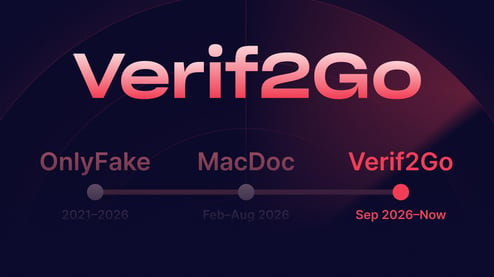
Within the fake document ecosystem, things can change fast. Four months ago, we reported that OnlyFake, the ...
In May 2026, a Dallas resident was convicted of running coin-operated “amusement machines” without a business ...

NEW YORK & PRAGUE – 1 October 2026 – Ocrolus, the AI workflow and analytics platform for lenders, today ...
For a few hundred dollars, sellers on Telegram promise to boost your credit score using someone else's credit ...
Key takeaways Fake certificates can use real numbers Fraudsters can copy a genuine business’s VAT number onto a ...