
In January 2026, the Arizona Corporation Commission launched Arizona Business Center, a new online filing portal designed to streamline business filings, make records easier to navigate, and add stronger protections against fraudulent filings.
That shift is good for legitimate businesses, but it also raises the stakes for document fraud.
Formation records, certified copies, filing updates, and license-adjacent evidence are suddenly easier to access and share digitally, giving fraudsters more opportunity to misuse the records, edit screenshots, and relabel to their hearts content.
For merchant onboarding, vendor onboarding, commercial leasing, and marketplace/eCommerce onboarding, reviewers, the danger is onboarding bad actors, enabling financial crime, exposing customers to scams (and your business to compliance failures).
And the problem just keeps getting more complex. Public templates, online document shops, and AI-generation document tools can turn a tax registration, entity filing, or city permit into something that looks like a universal Arizona business license.
The risk is not just accepting a bad document. It is accepting the wrong document for the wrong purpose. A valid entity record does not prove tax licensing, a transaction privilege tax license does not prove local authorization, and a city or professional license may apply only to a specific activity or location.
Read on to learn what Arizona business licenses are, how they’re being forged, how to spot a fake Arizona business license, and how AI-powered tools can help.
Check out our “how to spot fake business licenses” blog to learn more about business license fraud.
What is an Arizona business license?
For many businesses, the closest state-level equivalent to an Arizona business license is the transaction privilege tax (TPT) license. This is issued by the Arizona Department of Revenue (ADOR) to businesses that sell taxable products or provide taxable services in Arizona.
The TPT license is sometimes casually described as a sales tax license, resale license, vendor license, or tax certificate. But in Arizona, it serves a broader state-level licensing function because transaction privilege tax is imposed on the vendor for the privilege of doing business in the state.
The real threat for businesses is not only fake documents, but accepting the wrong Arizona document for the wrong purpose.
Businesses are verified through a layered system of Arizona Department of Revenue transaction privilege tax licensing, local city or county requirements, separate entity formation records, and professional or regulated-industry licenses.
The state does not simply issue one general permission slip that proves a business can operate anywhere, sell anything, or perform any regulated service. Instead, different agencies control different parts of the business identity:
- Arizona transaction privilege tax license. Issued by the Arizona Department of Revenue for businesses engaged in taxable activity. It helps prove that the business is registered for state-administered transaction privilege tax obligations.
- Arizona entity formation record. Issued or maintained by the Arizona Corporation Commission for limited liability companies, corporations, and foreign entities. It proves that the legal entity exists or is authorized to transact business in Arizona, but it does not prove tax licensing or local operating authority (can be done via Arizona Business One Stop).
- Arizona trade name or trademark registration. Handled by the Arizona Secretary of State. It can show that a business name has been registered, but it does not replace entity formation, tax licensing, or local licensing.
- City, town, or county license. Issued locally when a municipality or county requires a business license, occupational license, permit, or local approval. Requirements vary by location, and some cities regulate only certain business activities rather than issuing one general business license.
- Professional or regulated industry license. Issued by the relevant Arizona board or agency for activities such as contracting, liquor sales, healthcare, real estate, or other regulated services. These licenses prove authority for a specific profession or activity, not general business legitimacy.
Some states use tax licenses instead of general statewide business licenses because the state is regulating tax-triggering activity, not granting universal operating permission.
A tax license can connect the business to taxable categories, locations, filing duties, and revenue reporting. Entity formation, zoning, local permits, professional licensing, and regulated-industry approvals remain separate because they answer different legal questions.
Together, these records help confirm whether an Arizona business exists, is registered for the right tax activity, and has the correct local or industry-specific authorization for the work it claims to perform.
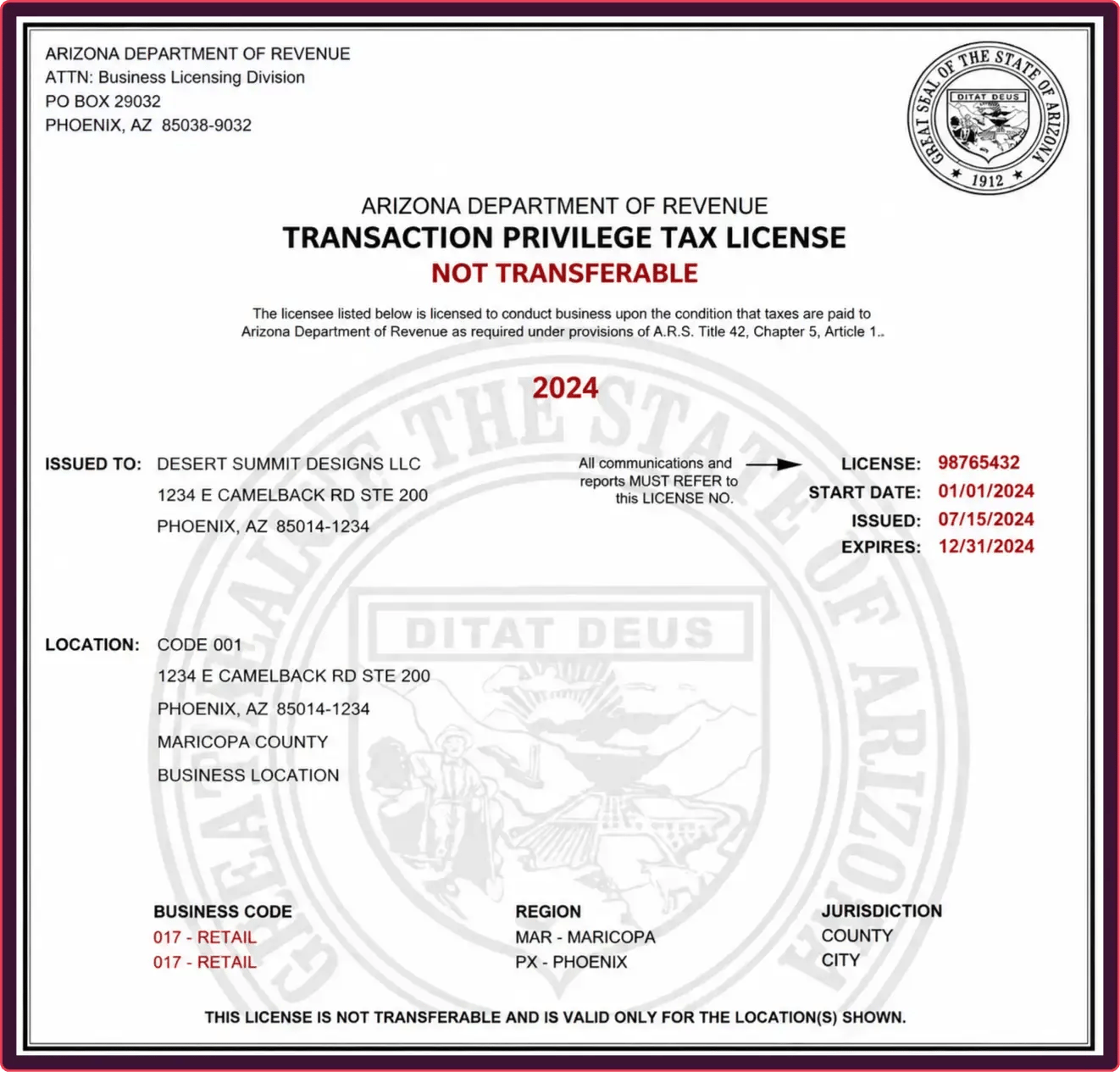
Example of a fake Arizona Transaction Privilege Tax License (not business license) for illustrative purposes only.
Why are Arizona business licenses important?
Arizona business licenses help businesses prove that they are recognized, traceable, and accountable within the state of Arizona or the local jurisdiction where it operates.
Here’s how Arizona business licenses are used for document verification across specific industries:
- Banking and fintech. Arizona business license records support business onboarding, merchant account review, and KYB checks by helping confirm that an applicant is a real operating business with verifiable state or local records.
- Marketplaces and eCommerce platforms. Seller verification teams use business license evidence to screen Arizona merchants, local service providers, and high-risk sellers before allowing them to transact with customers.
- Procurement and vendor management. Companies use Arizona license records to check whether vendors, suppliers, and contractors have verifiable business credentials before they are approved for contracts or facility access.
- Commercial real estate. Leasing teams use license and permit evidence to assess whether a prospective tenant can lawfully operate from the leased location, especially for retail, food service, regulated services, or public-facing businesses.
- Insurance. Commercial insurers use Arizona licensing evidence to evaluate whether the business activity, location, and operating status match the risk being underwritten.
- Construction and home services. Contractor licensing records help confirm that a business is authorized for the type of work it is offering, reducing the risk of unlicensed contracting and consumer harm.
- Government contracting and grants. Public-sector programs use licensing evidence to confirm that businesses seeking contracts, permits, funds, or program access are legitimate and traceable.
Arizona business licenses are often trusted because they are tied to official state, local, tax, or professional records. They are “proof of business authorization” within the state of Arizona.
Arizona business license law
Arizona Commerce states that Arizona does not issue or require a state business license, but most city and town offices issue business licenses, and there is no “blanket state license” that lets a business opt out of local licensing requirements.
For many businesses, the main state-level licensing requirement is the Arizona transaction privilege tax (TPT) license, registered via the Arizona Joint Tax Application (JT-1) for transaction privilege tax, use tax, employer withholding, and unemployment insurance accounts.
Businesses must register before conducting taxable business activity in Arizona, including:
- Selling tangible personal property.
- Selling at special events in Arizona.
- Running multiple Arizona locations or business lines.
- Acting as a remote seller making direct sales into Arizona after meeting the state’s economic threshold ($100,000 in annual gross).
- Operating a marketplace facilitator business with Arizona taxable sales obligations.
Arizona law also makes the renewal logic specific. A transaction privilege tax license is renewed with the municipal privilege tax license renewal process, and there is no state renewal fee for the TPT license.
Municipal privilege tax licenses are valid only for the calendar year issued, may be renewed for the following calendar year, and can carry a municipal renewal fee of up to $50.
Local requirements remain separate. The Arizona Department of Revenue notes that each Arizona city or town where a business operates may require a local business, occupational, or permit license.
Businesses in regulated activities may also need additional licensing beyond entity formation, TPT registration, or local licensing. Contractors, liquor businesses, healthcare providers, real estate professionals, and other regulated operators should be checked against the relevant Arizona board or agency before a license is treated as complete proof of authority.
The business licensing process in Arizona
To get properly licensed in Arizona, a business typically needs to:
- Form the entity, if needed. Register the limited liability company, corporation, or foreign entity with the Arizona Corporation Commission if the business is using a formal legal entity.
- Register the trade name, if needed. File a trade name or trademark with the Arizona Secretary of State when the business uses a public name that differs from its legal entity name.
- Apply for the TPT license. Use AZTaxes, Arizona Business One Stop, or the Arizona Joint Tax Application (JT-1) to apply for the correct tax licenses and registrations.
- Confirm local business, occupational, or permit requirements. Some local governments require broad business licensing, while others regulate specific activities only.
- Check professional or regulated-industry licensing. Verify whether the business activity requires a separate Arizona agency license, such as a contractor license, liquor license, health-related license, or other professional approval.
- Renew on the correct cycle. Treat Arizona TPT and municipal privilege tax licensing as calendar-year-sensitive. A document showing an impossible multi-year validity period, outdated renewal year, or unsupported fee structure should be reviewed closely.
Threat intel: Template data about fake Arizona business documents
Our Threat Intelligence Unit collects data about template farms which make and distribute fake document templates for fraudulent purposes.
Below, you'll find an infographic containing data about all the fake Arizona business documents we've found: their availability, their distributors, the institutions or "issuers" whose documents have been exposed, and how much it costs to buy one.
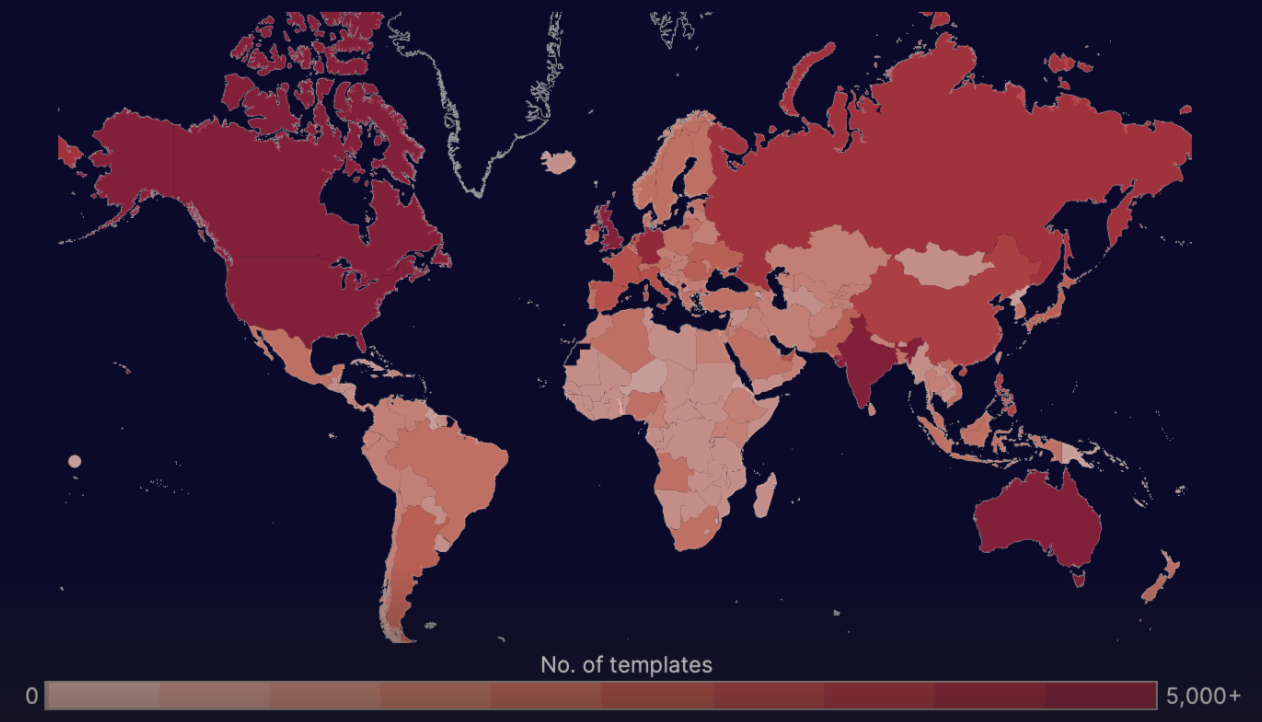
Threat intel stats: Arizona business documents
Find more information about the threat these farms pose in our threat intel blog and webinar content.
5 Signs of a forged or fake Arizona business license
Missing a fake Arizona business license can mean accepting the wrong proof of authority. In Arizona, that often means a document looks official but confuses transaction privilege tax licensing, entity formation, local business licensing, or regulated activity approval.
Manual review gets harder because Arizona does not use one universal statewide business license. Reviewers need to understand which document they are looking at, which agency issued it, and what that record can actually prove.
1. Inconsistent formatting
Arizona business license documents vary by issuer, but real records still follow the logic of the issuing system. A fake Arizona business license often blends design elements from ADOR, AZTaxes, city portals, and professional boards into one artificial certificate.
- TPT license number in the wrong location. ADOR says the eight-digit transaction privilege tax license number appears in the upper-right section of the physical TPT license certificate or under Business Details in AZTaxes.
- JT-1 application used as if it were an issued license. A document that shows application-style fields but presents itself as an approved license may be incomplete or fabricated.
- City and state branding collapsed into one certificate. A document using ADOR branding while claiming to be a City of Tucson business license should be checked against the relevant portal and agency role.
- Missing or incorrect Arizona state seal. Official TPT’s have the state seal/crest in the top right corner and also as the background image of the document.
2. Incorrect or misleading information
Arizona fraud often appears when a document uses a real agency name but gives that agency the wrong function. These errors are stronger than generic visual flaws because they contradict how Arizona licensing actually works.
- Generic certificate title replacing official terminology. A vague title such as “Arizona state company operating certificate” does not match the state’s licensing structure.
- Incorrect license type indicator. If the business has a nonstandard license type, such as “Remote Seller,” that license type should appear on the license certificate. If the business has a standard license type, there should be no license type indicator, but the certificate should show the standard business codes instead.
- Arizona transaction privilege tax described as a true sales tax. TPT is commonly referred to as sales tax, but it is actually a tax on the vendor for the privilege of doing business in Arizona.
- A “blanket state license” claim. Any document claiming statewide authority across all Arizona cities and counties.
- City-specific general business license. Some cities, (like Phoenix) say they do not issue a general business license and only certain activities require a city license, recommendation, or approval.
3. Uncharacteristic figures
Arizona licensing has specific fee, renewal, tax, and location logic. Fake licenses often get these details wrong because fraudsters copy generic business license templates from other states.
- Multi-year TPT validity. ADOR requires licensed businesses to renew their Arizona TPT license annually, and 2026 renewals were due by January 1, 2026.
- Late renewal timing that ignores January 31. ADOR says penalties and late fees apply to 2026 TPT renewals received after January 31, 2026. A document that treats renewal as valid through an unrelated date, such as the business anniversary month, should be checked.
4. Arizona business license inconsistencies
A convincing fake may use real Arizona terminology, but combine it in a way that no legitimate licensing path would. This is where reviewers should compare the document’s claimed authority against Arizona’s layered system.
- TPT license used as contractor authorization. The Arizona Registrar of Contractors issues separate licenses for commercial work, residential work, and dual classifications by trade or construction field.
- Jurisdiction general business license without TPT location support. Some cities (like Mesa) say their general business license requires a valid Arizona TPT license with the city business location added.
5. Metadata discrepancies
Metadata signals should not be the only reason to reject an Arizona business license, but they can support a fraud finding when the file’s construction contradicts the expected document source.
- AZTaxes-style screen shown as a printable certificate. ADOR says TPT License Certificates cannot be printed online. They should be delivered as physical or scanned copies.
- Cropped image of an AZTaxes verification result. A screenshot that hides the search field, result context, or surrounding AZTaxes page can obscure the contents and make them difficult to verify.
- Portal mismatch in the file origin. For example, Tucson’s online business license portal is OpenGov Tax & Revenue, while ADOR handles tax license and TPT matters. A business license file whose metadata or filename suggests a different domain is suspicious.
- Consumer design software in a regulated license file. A contractor license, liquor license, city regulatory license, or TPT certificate submitted as an image exported from Canva, Photoshop, or a mobile editing app.
Disclaimer: Manual review can catch obvious fake Arizona business licenses, but the most sophisticated fraud is much harder to detect with the naked eye.
How to verify an Arizona business license
Arizona business license verification should start with the exact document type in front of you. A transaction privilege tax license, Arizona Corporation Commission entity record, Mesa General Business License, Phoenix regulated activity license, Tucson business license, contractor license, and liquor license are not interchangeable.
Then, KYB analysts, AML compliance officers, procurement managers, vendor risk managers, commercial leasing agents, marketplace trust and safety reviewers, insurance underwriters, and fraud investigators can check them either manually or automatically.
Manual verification is still common, especially when teams need to make a fast vendor, tenant, seller, or merchant onboarding decision. But evolving fraud tactics and near-perfect fakes make visual review risky. A document can look official while still being the wrong record for the business activity, wrong city, wrong license type, or wrong renewal year.
Automation can help standardize parts of the process, catching more fraud and reducing the overhead and bottlenecks of manual review teams.
That said, many risk teams still need to check these documents manually.
Manual verification of an Arizona business license
If you need to check an Arizona business license by hand, start with the warning signs we mentioned above, then use official state, city, and professional lookup sources wherever possible.
- Check the Arizona TPT license number through AZTaxes. Use the Arizona Department of Revenue license verification tool to confirm the eight-digit transaction privilege tax license number. ADOR also says the TPT license number appears on the physical certificate in the upper-right section or under Business Details in AZTaxes, so compare the submitted number against the official lookup result.
- Use Arizona business search. Use the Arizona Secretary of State business search to check the document details against the registry. For a comprehensive guide of all US State business registries (and their reliability) see our US KYB guide.
Keep in mind: Manual verification can confirm obvious mismatches, but it is slow because Arizona business authorization is split across state tax records, entity filings, city and town requirements, county rules, and professional licensing boards. At scale, reviewers may need to check several portals for one business before they can answer a basic question: does this document prove the authority the applicant claims?
Using AI and machine learning to spot fake Arizona business licenses
AI document verification helps reviewers detect fake Arizona business licenses by analyzing how the document was built, not just what the document says.
That distinction matters because Arizona has several documents that prove different elements of business authorization, meaning multiple registry checks, templates to understand, and expected values/patterns to assess.
Rather than relying on hundreds of templates and databases, AI can evaluate whether the submitted document’s construction, layout behavior, embedded elements, and cross-document patterns are consistent with genuine records.
Key benefits include:
- Document-agnostic detection. A document-agnostic system does not need one fixed template for every Arizona issuer because it focuses on construction patterns rather than memorizing one layout.
- GenAI fake detection. Fraudsters can use generative AI tools to create clean, official-looking Arizona certificates or edit screenshots from state and city portals. GenAI detector stack analyzes visual textures and structural patterns to flag signs of AI-generated document creation.
- Explainable review evidence. AI-assisted review is most useful when it gives investigators a clear reason for concern, making escalation easier and providing auditable explanations to decision makers.
Automation vs. AI
Rules-based automation can confirm whether a transaction privilege tax license number field is present, whether a file includes an expiration date, if the tax number has the right digits and format, whether the submitted business name matches a required field, or whether the reviewer has attached a lookup screenshot.
AI is more adaptive because it can learn from document structure, repeated submission patterns, and evolving fraud techniques. Instead of only checking whether required fields exist, it can identify how a file was built, whether document elements appear reused or manipulated, and whether the same suspicious construction appears across multiple Arizona license submissions.
Conclusion
Fake Arizona business licenses are difficult to review manually, especially when fraudsters use templates, screenshots, and AI-generated edits to make the wrong document look like the right proof of authority.
Resistant Documents helps detect this risk through structural analysis, document-agnostic detection, Gen AI detectors, and cross-document intelligence, without relying on fragile templates or treating database lookups as the main line of defense.
Scroll down to book a demo.

Fraud awareness, examples, and lessons
Learn more about fraud in specific industries, best practices, and targeted documents.
View all
Application fraud in 2026 is easier to attempt: accessible tools and services help applicants turn false claims ...

Within the fake document ecosystem, things can change fast. Four months ago, we reported that OnlyFake, the ...

In May 2026, a Dallas resident was convicted of running coin-operated “amusement machines” without a business ...

NEW YORK & PRAGUE – 1 October 2026 – Ocrolus, the AI workflow and analytics platform for lenders, today ...

For a few hundred dollars, sellers on Telegram promise to boost your credit score using someone else's credit ...

Key takeaways Fake certificates can use real numbers Fraudsters can copy a genuine business’s VAT number onto a ...