
Georgia has been issuing a lot of business licenses in 2026. April of this year saw the state add 44 new licenses in Cobb county alone. With all these new issuings, it makes you wonder how many fake Georgia business licenses are going through undetected.
As more businesses move online and KYB verification happens remotely across marketplaces and financial platforms, state business licenses (like those that just got issued in Cobb county) are becoming a valuable vehicle for fraud.
And the consequences of getting it wrong are increasing. Accepting a fake Georgia business license can expose you to document fraud, leading to onboarding fraudulent companies, enabling financial crime, or failing regulatory compliance checks.
Publicly available document templates, online resellers, and generative AI tools double the threat. Now anyone can create convincing Georgia state business documents in minutes.
Read on to learn what Georgia business licenses are, how they’re structured across the state, how fraudsters fake them, how to spot a fake, and how AI-powered tools can help.
Check out our “how to spot fake business licenses” blog to learn about more common document forgeries.
What is a Georgia business license?
In Georgia, the document that serves as a business license is typically an “occupational tax certificate,” and is usually distributed at the city or county level (although many local governments still use “business license” in public-facing language).
The important nuance is that Georgia business licensing sits inside a larger statewide system, but the day-to-day permission to operate is usually handled locally.
That means Georgia business verification usually involves several layers:
- Business entity registration. Corporations, LLCs, and other formal entities register with the Georgia Secretary of State. This confirms legal existence, but it does not automatically authorize the business to operate in every city or county. The state’s business search provides access to entity information of record.
- Local occupational tax certificate. This document serves as an operation “business license” in the state of Georgia but varies by name depending on jurisdiction. Atlanta, for example, requires a “Business Occupational Tax Certificate” for businesses operating within city limits while cities like Savannah refer to it as a “Business Tax Certificate” for the same purpose.
- To find which one applies to you, simply search “tax certificate” and the name of your jurisdiction. If in a city you must apply there, in an unincorporated area you apply through the county.
- Professional or trade licenses. Certain businesses also need state-level professional licensing, depending on the activity. The Georgia Secretary of State handles professional licensing through multiple licensing boards.
- Tax registration. Some businesses also need Georgia Department of Revenue tax accounts, such as sales tax, withholding tax, alcohol, tobacco, or other business-related registrations.
- Additional local permits. Depending on the business, the city or county may also require zoning approval, alcohol licensing, health permits, signage permits, fire inspections, or affidavits tied to local application rules.
- For example: In Fulton County prohibits alcohol licenses for businesses located within:
- 300 feet of a church or school.
- 200 feet of a public library.
- 100 feet of a private residence (in some cases).
In practice, this means a Georgia “business license” is not just about whether a document looks official. It is about whether the document was issued by the correct authority for the business location, activity, and jurisdiction.
These documents aren’t always what they seem.
A valid-looking occupational tax certificate from one Georgia city may not prove authorization in another city.
A Secretary of State registration may prove the company exists, but not that it is licensed to operate locally.
A professional license may prove a person or business is qualified in a regulated field, but not that the business has satisfied local occupational tax requirements.
Together, they help confirm that a Georgia business legally exists, is registered with the appropriate state agencies, and is authorized by the correct local government to operate in the place and industry it claims.
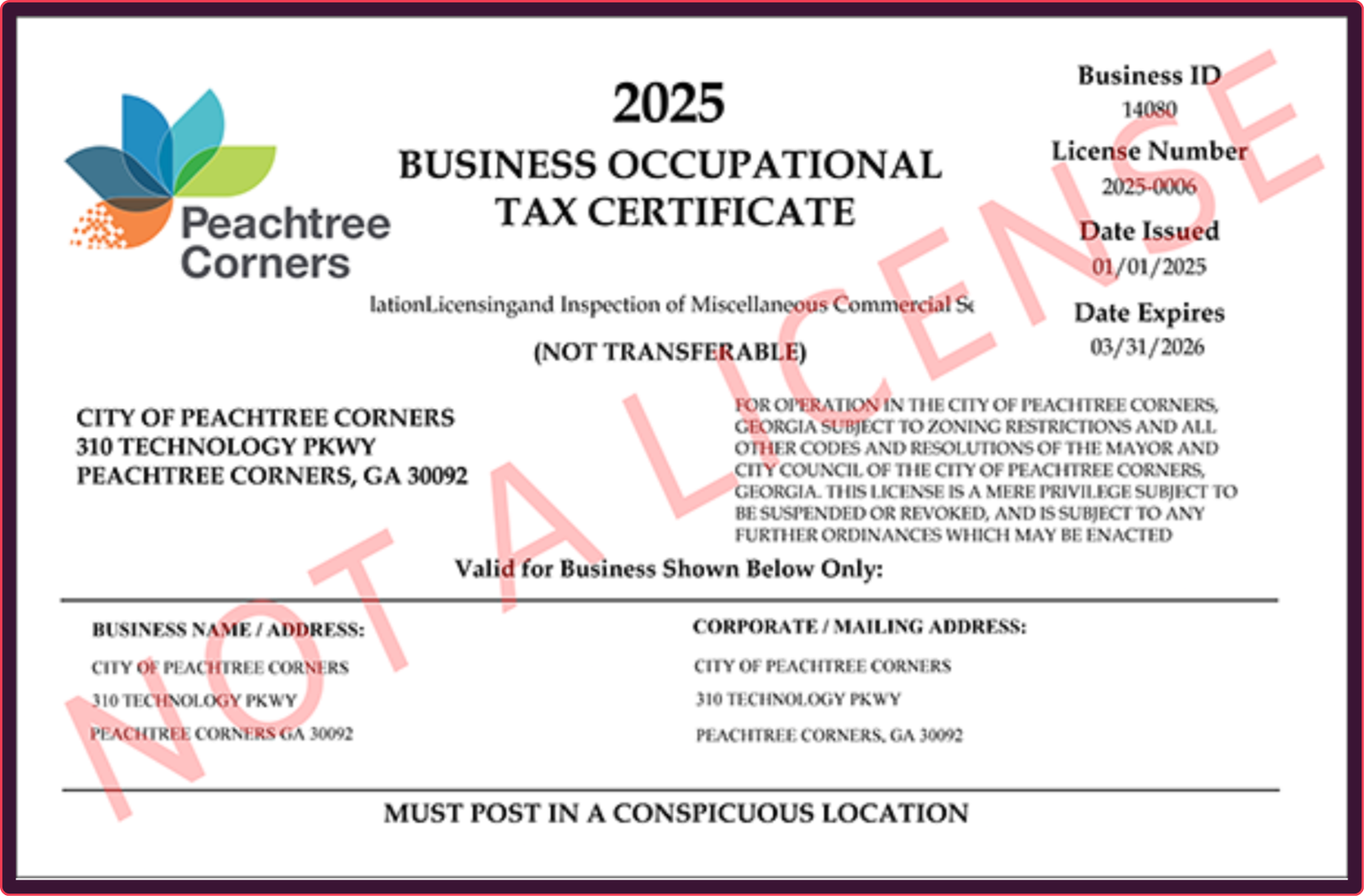
Example of a fake Georgia occupational tax certificate (not business license) for illustrative purposes only.
Why are Georgia business licenses important?
Georgia business licenses and related filings are a critical part of business verification, helping organizations confirm that a company is legally established, properly registered, and authorized to operate in a specific part of Georgia.
Here’s how Georgia business licenses are used for document verification across different industries:
- Financial services and fintech. Platforms rely on Georgia business licenses and registrations during KYB (Know Your Business) checks to confirm that a company is legitimate before opening accounts, issuing credit, or enabling transactions.
- Commercial real estate and leasing. Property managers and landlords use local business licenses to ensure tenants are authorized to operate at a specific address and comply with zoning and municipal requirements.
- Marketplaces and e-commerce platforms. Trust and safety teams review business documentation to verify that sellers are real, traceable entities and not part of coordinated fraud networks or shell operations.
- Procurement and vendor management. Enterprises validate business licenses and registrations to confirm that suppliers are properly authorized before entering into contracts or issuing payments.
These documents confirm the “right to do business” in Georgia. A falsification can lead to onboarding illegitimate businesses, enabling fraud, or failing compliance checks tied to location, licensing, or regulatory requirements.
Georgia state business license law
Understanding Georgia business law starts with recognizing how authority is divided across state and local levels. Legal frameworks are consistent across Georgia, but the way they’re applied depends heavily on where a business operates and what it does.
Let's take a look at the Georgia business licensing process and corresponding laws so we can get a better picture of the system to more effectively identify fake documents.
The business licensing process in Georgia
Starting and operating a business in Georgia involves multiple steps across state and local authorities:
- Register the business entity. Corporations, LLCs, and partnerships must register with the Georgia Secretary of State to establish legal existence.
- Obtain local authorization to operate. Businesses must apply for an occupational tax certificate (commonly referred to as a business license) in the city or county where they operate.
- Register for taxes. Businesses may need to register with the Georgia Department of Revenue for sales tax, withholding tax, or other applicable tax accounts.
- Apply for professional or industry licenses. Regulated industries (such as construction, real estate, or cosmetology) require additional licensing through state boards.
- Secure local permits and approvals. Depending on the activity, businesses may need zoning approval, health permits, signage permits, or fire inspections.
Everything except step 2 is handled at the state level. The Georgia Secretary of State handles business entity registration, the Department of Revenue oversees tax registration, state licensing boards regulate specific professions.
Cities or counties issue the occupational tax certificate that allows a business to operate locally.
Missing any one of these doesn’t necessarily mean a business doesn’t exist, but it can mean the business is not legally authorized to operate in a specific location or industry.
How Georgia law applies to business documents
Because Georgia distributes authority across multiple agencies, no single document represents full authorization to operate.
Instead:
- Entity registration confirms existence. Filing with the Secretary of State proves that a business legally exists, but does not grant permission to operate in a specific location.
- Local licenses authorize operations. Occupational tax certificates issued by cities or counties allow a business to operate within a defined jurisdiction.
- Professional licenses regulate activities. State licensing boards govern who can legally perform certain services or trades.
- Tax registration ensures compliance. Businesses must register for and maintain appropriate tax accounts depending on their operations.
City and county licensing requirements in practice
Since it is implemented in various ways throughout Georgia’s jurisdictions, we’d like to define some of the major city and county processes, terminology, and requirements.
Below are common patterns across Georgia, with examples:
Major cities with dedicated licensing systems:
- Atlanta. Requires a Business Occupational Tax Certificate through its ATLBIZ portal, along with supporting affidavits and regulatory checks depending on the business type.
- Savannah and Augusta. Operate their own local licensing processes with city-specific applications, renewal cycles, and compliance requirements.
County vs city jurisdiction splits:
- Fulton County vs City of Atlanta. Businesses inside Atlanta must apply through the city, while those in unincorporated Fulton County apply through the county.
- DeKalb, Cobb, and Gwinnett counties. Similar splits apply, where cities handle licensing within city limits and counties handle unincorporated areas.
Smaller municipalities and local variation:
- Lilburn, Douglasville, Albany, and similar cities. Issue occupational tax certificates with their own naming conventions, application processes, and renewal timelines.
- For example: Douglasville business licenses expire on December 31 each year, while Lilburn requires renewal by January 31. Albany requires businesses to obtain a certificate for both the city and Dougherty County if applicable. Some cities require notarized affidavits or E-Verify documentation as part of the licensing process.
- Renewal cycles. Many jurisdictions require annual renewal, often tied to the calendar year, but deadlines and enforcement vary.
- Terminology differences. Some jurisdictions emphasize “occupational tax certificate,” while others use “business license” interchangeably.
Threat intel: Template data about Georgia business documents
Our Threat Intelligence Unit collects data about template farms which make and distribute fake document templates for fraudulent purposes.
Below, you'll find an infographic containing data about all the fake Georgia business documents we've found: their availability, their distributors, the institutions or "issuers" whose documents have been exposed, and how much it costs to buy one.
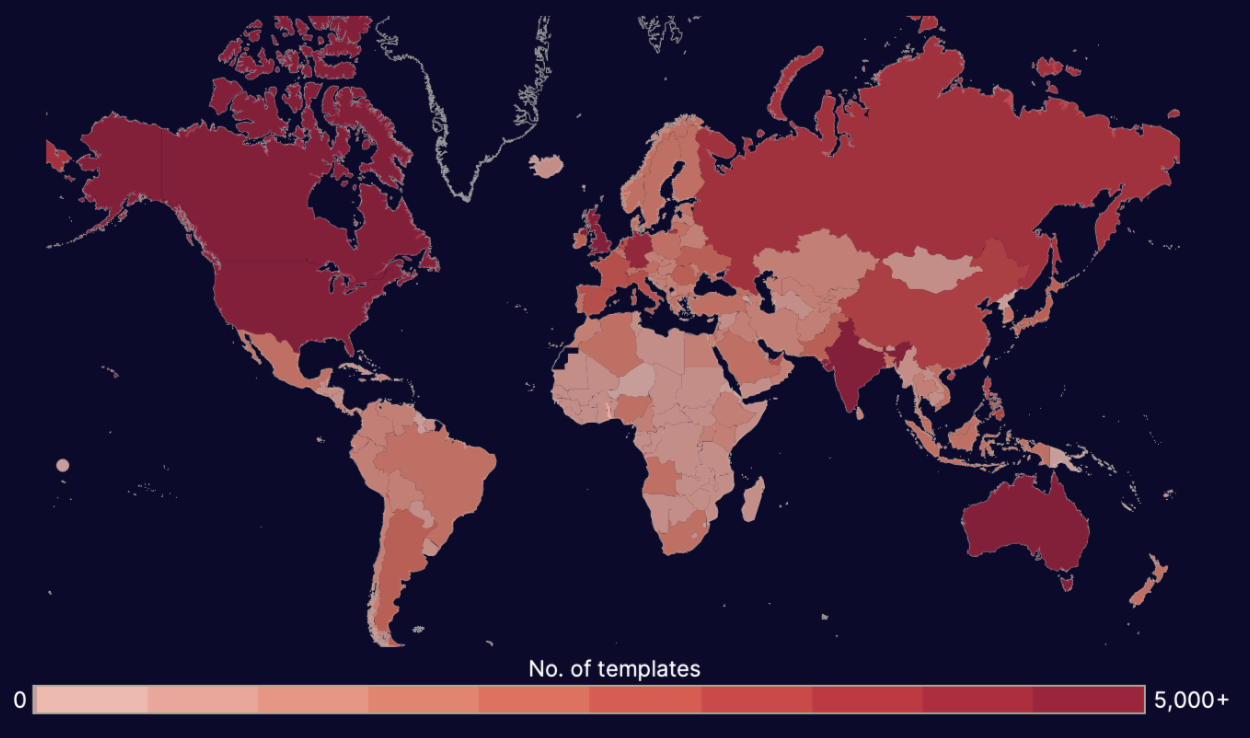
Threat intel stats: Georgia business documents
Find more information about the threat these farms pose in our threat intel blog and webinar content.
5 Signs of a forged or fake Georgia business license
Detecting fake Georgia business licenses requires more than spotting visual mistakes. Because these documents are issued by different local authorities, fraud often shows up in how specific document elements are used, combined, or misrepresented.
Here’s what to look for:
1. Inconsistent formatting
Georgia business licenses are typically issued as occupational tax certificates, and their structure reflects local government formatting rather than state-level standardization.
- Missing seal or stamp. While the location of the seal can vary, it is always present on Georgia occupational tax certificates. It is usually the crest or sigil of the corresponding jurisdiction.
- Two or more page documents. Almost all Georgia occupational tax certificates are single page documents so they can be easily found by inspectors and displayed to patrons.
- Mixed document elements. Combining features from different document types (for example, an Albany/Dougherty county layout with a tax certificate seal and certificate of occupancy heading).
- Incomplete owner or business details. Missing fields such as owner name, business address, or mailing address that are typically required on local certificates.
- Issuance number. Depending on the jurisdiction, this can be a combination of numbers and letters, just numbers, or two number sets separated by a dash. Compare against sample certificates and see if yours matches the correct format.
2. Incorrect or misleading information
Fraudsters often misunderstand how Georgia structures business authorization, leading to errors in key fields.
- Incorrect document title. Use of generic headers like “Georgia Business License” instead of jurisdiction-specific titles such as “Occupational Tax Certificate” or “Business Tax Certificate.”
- Missing issuing authority. A legitimate certificate should clearly name the issuing city or county (e.g., City of Atlanta, DeKalb County). Absence or vague references to “State of Georgia” are suspicious.
- Wrong license type for the activity. A professional license required for regulated activities, presented as authorization in the form of an occupational tax certificate.
- Jurisdiction mismatch. A certificate issued by one city or county listing a business address in another jurisdiction.
3. Uncharacteristic figures
Georgia business licenses often follow local renewal cycles and fee structures, which are reflected directly on the document.
- Incorrect license period. License cycle structures can reveal fraud. Atlanta and Savannah operate on a fixed annual licensing cycle tied to the calendar year, regardless of when the business applies, while others may issue licenses that are effectively prorated within the same annual cycle for new businesses. A document showing a multi-year validity period, a rolling multi-year license, or a structure that doesn’t reflect a single-year operational cycle is highly suspicious.
4. Business license inconsistencies
Georgia fraud often appears when document elements do not align with how licensing works across jurisdictions.
- Single license for multiple locations. One occupational tax certificate listing multiple business addresses across different cities or counties.
- Mismatch between entity and local license. A business name appearing on a local certificate without corresponding entity registration context (e.g., LLC designation missing or inconsistent).
5. Metadata discrepancies
Even when document content appears correct, the way the file is produced can reveal issues.
- Non-standard file formats. Some jurisdictions, like the City of Atlanta, issue occupational tax certificates through online systems (e.g., ATLBIZ) where businesses can download a structured PDF, so low-quality screenshots or files that don’t resemble system-generated documents can be suspicious. However, this varies by jurisdiction. Many cities and counties still issue physical certificates that must be scanned or photographed for verification purposes.
- Reused document templates. Suspicious metadata signals that indicate the document may have been downloaded from an online source.
Disclaimer: Georgia’s locally administered system makes manual verification especially challenging. There is no single template or format to rely on, and fraudsters take advantage of this by creating documents that appear plausible in isolation.
How to verify a Georgia business license
Compliance teams, financial institutions, marketplaces, and procurement departments responsible for onboarding and risk assessment can verify Georgia business licenses either manually or through automation.
The manual process isn’t checking a single registry. Thanks to Georgia’s decentralized licensing framework, checking these documents can involve calling multiple offices to check the legality of the business existence, permission to operate, and permission to perform certain activities (i.e., serving alcohol).
Calling all those offices can take a long time, especially if you’re checking a large volume of documents. AI-powered automation addresses this by analyzing how documents are constructed as opposed to their validity with a certain registry.
That said, manual review is still widely used due to regulatory expectations and legacy workflows.
Manual verification of Georgia business licenses
If you’re verifying Georgia business licenses manually, the best practice is to use the warning signs we listed above. After that, here are practical steps to follow.
- Find a reference document. Determine where the document was issued and find a reliable example on the county or city website. Compare its formatting and layout against the submitted license.
- Search the Georgia Secretary of State database. Confirm that the business entity exists, is active, and matches the legal name shown on the document. For a complete guide of all USA business registries, visit our USA KYB guide.
- Check the local occupational tax certificate records. Local governments post the licenses they issued for every month of the year. For example, here is the list for Harris County.
- Cross-check business address and activity. Ensure the business location aligns with the issuing jurisdiction and that the listed activity matches what the license allows.
Keep in mind: Verifying Georgia business licenses manually requires navigating multiple systems across state and local authorities. Each check must be done separately, often without a single source of truth. Fraudsters exploit jurisdictional complexity and reuse convincing document templates to make their submissions near impossible to detect manually.
Using AI and machine learning to spot fake Georgia business licenses
AI is especially useful for Georgia business license verification because the answer doesn’t always entail whether a document “looks fake.”
You need a tool that can spot fraud beyond surface level analysis.
Key benefits include:
- Structure-first document analysis. AI can examine how the file was assembled. This helps detect signs of editing, synthetic generation, or document reuse without depending on sensitive business details.
- Flexible detection across local formats. Georgia business licenses vary by city and county, which makes template-based review fragile. AI can evaluate occupational tax certificates, Secretary of State filings, professional licenses, and local permits without needing one fixed layout for every jurisdiction.
- Cross-submission pattern recognition. Fraud often becomes clearer across documents than inside one document. AI can identify repeated layouts, reused certificate structures, shared artifacts, or linked submissions that suggest coordinated document fraud rather than a one-off mistake.
Automation vs. AI
Traditional automation relies on fixed rules. For example, checking whether a business name is present, whether a license number follows a specific format, or whether a date falls within a valid range.
AI document verification can adapt to emerging threats in real time, preparing you for attacks you’ve never even heard of. It thrives in the complex, large-scale document systems like Georgia’s.
Conclusion
Fake Georgia business licenses are misused, repurposed, or presented out of context to exploit the state’s locally administered licensing system.
Because authorization is tied to specific jurisdictions, a document that looks legitimate on its own can still be invalid in practice. This makes manual verification difficult, especially as fraudsters take advantage of decentralized processes and increasing document volume.
Resistant Documents can analyze any type of document without prior knowledge. It doesn’t matter if it's a Tax certificate from Athens or License from Savannah, it can spot fraud in hundreds of different ways.
Scroll down to book a demo.

Fraud awareness, examples, and lessons
Learn more about fraud in specific industries, best practices, and targeted documents.
View all
In May 2026, a Dallas resident was convicted of running coin-operated “amusement machines” without a business ...

NEW YORK & PRAGUE – 1 October 2026 – Ocrolus, the AI workflow and analytics platform for lenders, today ...

For a few hundred dollars, sellers on Telegram promise to boost your credit score using someone else's credit ...

Key takeaways Fake certificates can use real numbers Fraudsters can copy a genuine business’s VAT number onto a ...

In our last piece, we introduced 3 different types of account farmers and how each of them can be detected. Now, ...

The most dangerous account farmers are the ones you'll never notice. A year of buying accounts and tracking these ...