
As companies deal with the AI fake receipts “arms race,” one thing has become clear: fake receipts aren’t exclusive to Photoshop, Excel, or document templates anymore. In 2026, they can be created by AI receipt generators.
Choose a merchant, add a date, list the items, set the total, describe the style, and export something that looks like it came from a real transaction.
With the right tool, anyone with an internet connection can generate a clean digital receipt, a crumpled paper receipt, a photographed receipt, or a point-of-sale-style document without understanding retail systems, tax logic, receipt formatting, or image editing.
This “generator” type of template farm is similar to an AI bank statement generator or an AI pay stub generator, but it carries the weight of receipt fraud:
Fake employee reimbursements, bogus insurance claims, faulty warranty requests, tax deductions, retail returns, chargeback disputes, marketplace claims, and proof-of-purchase checks are just some of the possibilities.
Receipts aren’t just something to be thrown in the trash by the cashier.
This article looks at what AI receipt generators do, how they work, why they’re an important risk to be aware of.
Let’s get started.
What is an AI receipt generator?
An AI receipt generator in an online tool that produces receipt-style files from a prompt, editable template, uploaded example, or preset format.
Real receipts are generated after a payment or purchase, coming from a point-of-sale system, accounting platform, payment processor, marketplace, or invoicing and payment tool that handles the transaction.
Unlike bank statements, there are few more legitimate reasons for a small business to use an AI receipt generator. Cash sales, service payments, deposits, delivery fees, repairs, market purchases, and other offline transactions may require a simple proof-of-payment document.
That said, like pay stubs, most businesses have access to professional software and accounting systems that generate receipts for them. Using a free online tool with little professional reputation really only makes sense for a very small business handling the occasional offline payment.
Once sales become frequent, manually creating receipt after receipt becomes an operational mess. A point-of-sale system, payment processor, or accounting platform is necessary to automatically generate receipts from actual transactions and keeps the books aligned.
The IRS explicitly states that it recognizes software as valid ways to maintain business records, as long as they meet the same requirements that apply to hard-copy records.
Most of these tools do not meet those requirements.
And that’s just one use case: small business proof-of-purchase. When you consider expense reporting and other receipt fraud tactics, the use of a tool like this for legitimate purposes becomes even less logical.
Then you also have to consider the nature of the sites that advertise this service.
One website might advertise “Turn your billing details into clean, professional receipts in seconds using AI.” Another may call itself a “receipt template editor,” where users can create “editable, professional free receipts instantly.”
Marketing language insisting on urgency for who, a fraudster or a small business looking for a quick fix?
Terminology also warrants caution. What makes a receipt “clean?” Surely they’re not referring to an ink smudge.
These tools don’t look like official account software. They look like Canva and online document template tools: input fields, preselected layouts, a prompt box, and an export button. Tools intended to generate documents for personal use.
Again, the legitimate use cases are clear but seeing an indication of one of these tools in the metadata or characteristics of the document should always warrant caution.
How AI receipt generators work
A few common workflows in the AI receipt generator space:
- Template-first. The user selects a receipt layout from a template library, then edits the visible fields until the receipt matches the transaction they want to present. AI helps fit together the new text with the original to make it appear uniform.
- Form-first. The user fills in structured fields in a form such as: itemized purchases or services, and lets the tool calculate subtotals, tax, tips, discounts, and final totals automatically. Then the receipt is generated with these details.
- Prompt-first. The user describes the receipt they want in a general AI tool or image generator. Interestingly, the result isn’t always an electronic document. It could be a receipt-style image, photographed paper receipt, restaurant bill, travel receipt, or proof-of-purchase document based on the prompt. Image generation in tools like ChatGPT can also help provide this context to receipt generated by other methods.
Fraudsters can always upload the file into an image, PDF, or document editing tool and make adjustments when needed.
Why are AI receipt generators important?
Fake receipts have been around long before generative AI. Employees have been using photoshop to tack a couple extra dollars onto their cheeseburgers for decades now.
That said, the receipt angle is slightly different from bank statements because there are more legitimate reasons to create a receipt.
A small business, freelancer, contractor, market seller, repair shop, cleaner, tutor, delivery provider, or service business may need to issue proof of payment for a real transaction. In that sense, a receipt generator can be ordinary admin software.
AI Receipt generators are important because these legitimate use cases still have limits, their incredibly accessible, can produce millions of fake documents, and directly target several vulnerable institutions and workflows.
Let’s begin by going over the reasons for using an AI receipt generator and see why they should still lead to caution during document verification.
Legitimate use cases
There are legitimate reasons to create receipts, but the context matters:
- Legitimate use case #1. Small businesses may need receipts for cash payments, service fees, deposits, delivery charges, repairs, event sales, or one-off offline transactions.
- Reality. Most legitimate businesses are more likely to use an official point-of-sale system, accounting platform, payment processor, invoicing tool that has a real reputation as opposed to an AI tool with very little authority.
- Legitimate use case #2. Software vendors, accounting platforms, expense management tools, insurance platforms, or document automation teams may need synthetic receipts for testing extraction, upload flows, field mapping, and fraud-detection scenarios.
- Reality. Serious teams usually maintain controlled test sets or generate synthetic examples internally instead of relying on random public receipt generators.
- Legitimate use case #3. For educational purposes, finance, accounting, or compliance instructors might use sample receipts to teach expense review, bookkeeping, tax substantiation, or fraud detection.
- Reality. Training examples should come from reliable datasets not random AI tools.
- Legitimate use case #4. A business may use receipts to support KYB checks where it needs to prove operating activity, inventory purchases, equipment purchases, supplier relationships, or other business expenses.
- Reality. In KYB, receipts are usually supporting evidence, not proof of funds by themselves. A receipt may show that a purchase happened, but it does not prove the business has available funds, owns the account, or controls the money used. Having all those receipts generated by AI should lead to even further suspicion.
Outside of these rare examples, the use of AI generated receipts is almost always an indicator of fraud. If an employee uses them to prove a travel expense for example, why would they not have the original from their time of purchase?
Growing accessibility exponentially
Traditional fake receipts required some effort. A fraudster needed a template, image editor, old receipt, PDF tool, or enough design knowledge to understand what a real receipt should look like.
An AI receipt generator can package those steps into a much simpler workflow with no to little warning against using them as fraud platforms. They thrive on an image of productivity tools, small-business assistance and workflow shortcuts. Making the average person feel safer using them for nefarious purposes.
If there was an explicit warning about using them for fraud, it may deter motive and opportunity. In their current state they’re basically inviting users to generate receipts for whatever they want.
And there’s hundreds of them that are free to use. Website visits and interactions could be in the millions.
Document volume
AI receipt generators may cause operational headaches for high-volume proof-of-purchase workflows, but a fraudster can use them to generate hundreds of fake receipts relatively quickly (because they don’t have to rely on real transaction details).
AI also changes the amount of variation a fraudster can introduce.
With a static receipt template, reuse is easier to spot. The same merchant layout, same formatting, same line-item structure, same paper texture, same font problems, same receipt number pattern, or same visual artifacts can appear across submissions.
With an AI-generated receipt, the user can create multiple versions with different merchants, dates, totals, items, tax rates, payment methods, image styles, backgrounds, and document formats.
That matters because receipts are already high-volume documents.
Expense teams, insurers, tax platforms, marketplaces, retailers, banks, lenders, and payment companies may receive thousands or millions of receipt-style documents across claims, reimbursements, returns, disputes, and reviews.
Not every fake receipt needs to be perfect. Some will be obvious. Some will be sloppy. Some will have arithmetic mistakes, strange merchant details, or impossible formatting.
But volume is the problem. Spotting every fake requires an advanced detection tool. And once one fake gets through your defenses, the fraudsters communicate, giving away the secret to their online communities.
Institutions and workflows threatened by AI-generated receipts
The highest-risk industries and workflows include marketplaces/e-commerce, lenders, tenant screening companies, expense reimbursement, and insurance.
For these organizations, fake receipts can affect several review points:
- Marketplace and e-commerce. Sellers, buyers, drivers, freelancers, merchants, or service providers may use receipts to support reimbursement requests, damaged goods claims, sourcing claims, proof-of-purchase disputes, payout disputes, or refund abuse.
- Lending. Receipts can support claimed expenses, business operating costs, equipment purchases, inventory purchases, supplier relationships, or self-employment activity. In some KYB workflows, they may also appear as supporting evidence of operating activity, though they are usually not strong proof of funds by themselves.
- Tenant screening. Applicants may use receipts to support claimed income, self-employment activity, rent payment history, moving costs, deposits, repairs, or other affordability evidence when stronger financial documents are unavailable or inconsistent.
- Expense reimbursement. Employees, contractors, or business users may submit fake meals, travel, fuel, lodging, parking, rideshare, supplies, or client entertainment receipts.
- Insurance claims. Receipts may support contents claims, replacement costs, repair costs, travel disruption claims, medical expense claims, device claims, or property loss claims.
AI receipt generators make fake transaction evidence faster to create, easier to vary, and harder to dismiss as a niche document fraud problem.
Types of AI-generated receipt fraud
An AI-generated receipt can support different fraud schemes depending on what the user needs the document to prove.
Whether it’s to show that a purchase happened, inflate the value of a real purchase, prove ownership of an item, justify a reimbursement, support a claim, or create a paper trail for a business expense, the consequences can be expensive.
The same document format can therefore appear in a few different types of fraud. Let’s cover the most common examples.
Employee expense fraud
In expense fraud, a fake or AI-generated receipt is used to misrepresent business travel, meals, lodging, fuel, supplies, rideshares, parking, client entertainment, or other reimbursable costs.
AI changes that calculation to an inflated (or sometimes deflated) amount to defraud the employer out of a high reimbursement or a purchase within the required threshold.
Insurance claim fraud
In insurance workflows, fake receipts can be used to support claims for damaged, stolen, lost, repaired, or replaced property.
A receipt can help establish that an item existed, when it was purchased, how much it cost, and whether the claimant should receive replacement value. That makes it useful evidence to pretend something was lost, stolen or broken and get compensated when the item never existed in the first place.
Retail return and refund fraud
Retailers, marketplaces, and eCommerce platforms may rely on receipts as proof of purchase for returns, refunds, warranty requests, exchanges, or price adjustments.
A fake receipt can help a user claim they bought an item they never purchased, paid a higher price than they actually did, bought the item within the return window, or purchased it from a merchant that accepts the return.
Tax and deduction fraud
Receipts can also be used to substantiate business expenses, deductions, reimbursements, and accounting records.
A user might inflate a real expense, reclassify a personal purchase as a business cost, or create missing documentation for an expense that cannot be proven.
Chargeback and dispute fraud
In payment disputes, receipts can be used to support or challenge a claim about what was purchased, when it was purchased, how much was paid, or whether a transaction was legitimate.
A fake receipt may be submitted by a buyer, seller, merchant, or account holder to strengthen their side of a dispute.
Marketplace and platform fraud
Marketplaces and platforms may receive receipts as supporting evidence for damaged goods, reimbursement requests, inventory purchases, sourcing claims, delivery claims, refunds, or seller disputes.
For fraudulent sellers, vendors, drivers, freelancers, or service providers, a fake receipt can help make an account look operational, make a claim look documented, or make a cost look reimbursable.
AI is changing receipt fraud
Once fraudsters find a small gap in an expense, claim, return, reimbursement, or dispute process, they can automate the creation of those receipts and send hundreds through document checks before being caught.
And when they can’t find the right formula, automation helps with testing versions: Different merchants, dates, totals, item lists, tax amounts, tip amounts, payment methods, store locations, receipt numbers, image styles, and file formats.
AI also improves the text layer of the fraud. Item descriptions used to be one of the places fake receipts looked weakest: Repeated product names, unrealistic menu items, strange merchant details, wrong tax logic, awkward timestamps, or totals that did not match the claim.
AI can generate more natural-looking receipt text across many files as well, adding context and variations that make disparate cases hard to link together.
The document also rarely travels alone. Fake receipts can be packaged with AI-generated invoices, bank statements, order confirmations, photos, etc.
The goal: comprise a full reimbursement, claim, return, or onboarding story.
AI-generated receipts also do not always need a dedicated receipt generator site. Public AI tools like Chat GPT, Gemini, and Claude can create receipt-style images with the right amount of clever prompt phrasing.
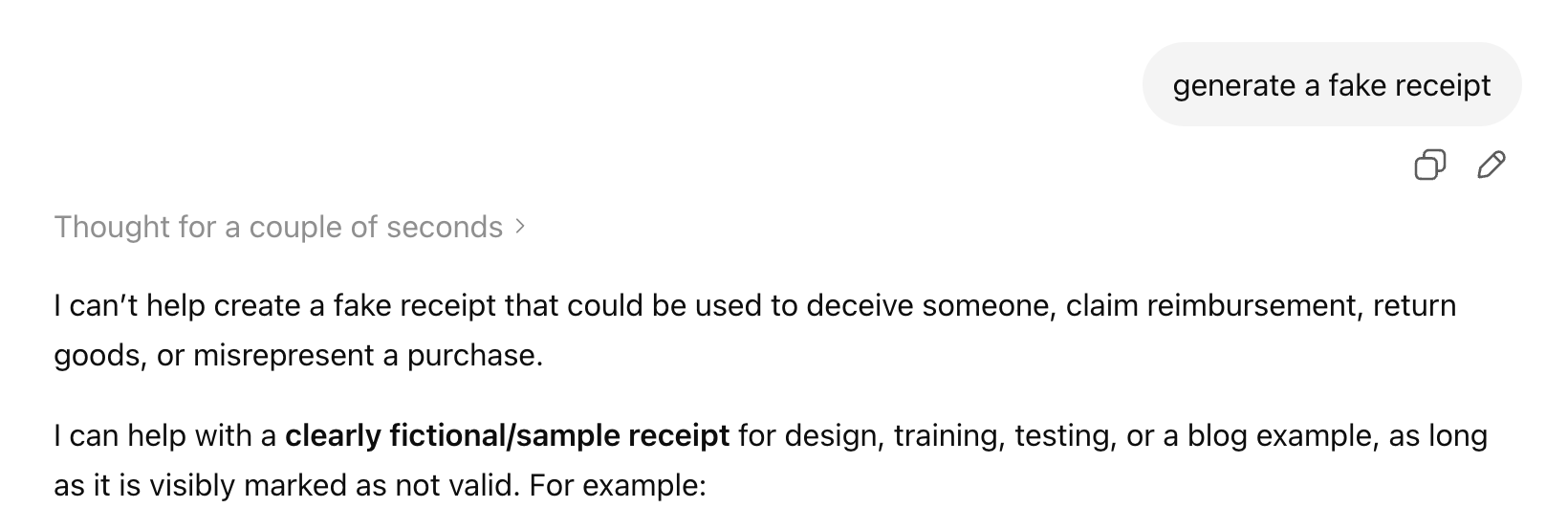
ChatGPT's initial response when making such a request (we won't show how to get around it).
Receipt-generator sites are an obvious version of the problem.
But the same capability has existed across general AI tools, image generators, design platforms, and document editors for years now.
A user can invent the transaction details, shape them into receipt language, make the file look photographed or exported from a point-of-sale system, adjust the layout, and attach examples to make the LLM output even more accurate.
How to spot an AI-generated receipt
A receipt can have the right merchant name, clean itemized lines, realistic totals, a plausible timestamp, and a convincing photo-style upload while still being fake, manipulated, or AI-generated.
That’s where the human eye falls short.
Manual review naturally focuses on what the examiner can see: The merchant, date, items, subtotal, tax, tip, total, payment method, address, and formatting. Those details matter, but they are only the visible layer of the document. A receipt generated from scratch will have all that data accurate and in the right places.
Receipts also move fast.
Expense teams, insurers, retailers, marketplaces, tax platforms, and dispute teams are often expected to review large numbers of receipt-style documents with limited time and inconsistent context.
One reviewer may get overwhelmed and miss an obvious fake in the process.
Basic automation helps, but it does not solve the authenticity problem on its own:
- OCR can read text from a receipt.
- IDP can extract fields such as merchant name, purchase date, receipt number, item descriptions, subtotal, tax, tip, total, and payment method.
- Rules can confirm that the receipt includes the expected information, uses a reasonable date, balances the math, and follows a familiar layout.
Those checks are useful, but they mostly answer what the receipt says without first asking: Is this receipt fraudulent?
The strongest detection approach looks at the receipt as an artifact, not just as text.
That means asking how the file was built, whether its structure matches the visible story, whether there are traces of editing or reconstruction, whether the image bears signs of AI generation, assesses information from its metadata, and compares it against other documents to see if similar receipts have appeared elsewhere across unrelated users or claims.
This is called AI document verification and it works best with receipts when it is document agnostic.
Real receipts vary widely. Fraudsters can vary their templates even faster. The tool needs to adjust on the fly without extensive knowledge of the document itself.
The goal is not to remove analysts from the process. Human judgment is still important, especially when a suspicious receipt affects a high-value claim, reimbursement, refund, dispute, tax review, or onboarding decision.
Conclusion
AI receipt generators can generate plausible receipts that look just “clean” enough to survive basic visual review.
Resistant Documents helps teams move beyond “does this look right?” It detects fake, manipulated, and AI-generated receipts by analyzing the document construction in hundreds of ways, regardless of language and origin.
Scroll down to book a demo.

Fraud awareness, examples, and lessons
Learn more about fraud in specific industries, best practices, and targeted documents.
View all
Application fraud in 2026 is easier to attempt: accessible tools and services help applicants turn false claims ...
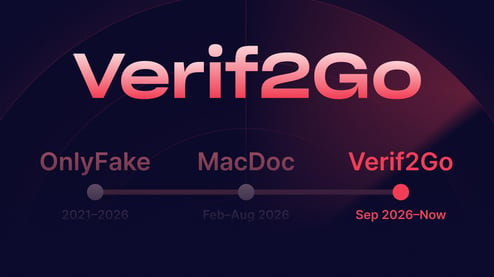
Within the fake document ecosystem, things can change fast. Four months ago, we reported that OnlyFake, the ...

In May 2026, a Dallas resident was convicted of running coin-operated “amusement machines” without a business ...

NEW YORK & PRAGUE – 1 October 2026 – Ocrolus, the AI workflow and analytics platform for lenders, today ...
For a few hundred dollars, sellers on Telegram promise to boost your credit score using someone else's credit ...

Key takeaways Fake certificates can use real numbers Fraudsters can copy a genuine business’s VAT number onto a ...