
Fake marriage certificates are becoming a global issue in 2026, as they increasingly appear in immigration filings, benefits applications, financial onboarding, and identity verification workflows.
A great example is the four forgers that were jailed after producing more than 2000 marriage documents for Nigerian nationals living in the U.K.
But it's not just a British problem. With publicly available templates and generative AI tools, fabricating a convincing marriage certificate that appears to prove a legal relationship is easier than ever before.
Often treated as a high-trust life-event record, these documents play a central role in verifying family status, establishing entitlement to benefits, supporting spousal visa applications, and confirming identity links across a wide range of sectors.
Even a single fake marriage certificate can distort eligibility decisions, undermine compliance, or enable synthetic identity schemes.
Read on to learn what marriage certificates are, how they are being forged, how to spot a fake marriage certificate, and how AI-powered tools can help.
Check out our “how to spot fake documents” blog to learn about more common document forgeries.
What is a marriage certificate?
A marriage certificate is an official civil record issued by a government authority to document the legal marriage between two individuals.
It is not created by religious institutions or wedding venues, and it is not a federal document. Instead, it is produced and maintained by a local or regional civil registrar responsible for recording the marriage event, entering it into the jurisdiction’s vital records system, and issuing certified copies upon request.
Couples typically obtain certified copies after the marriage has been formally registered. These certificates are used to change legal names, apply for spousal visas, update tax status, enroll dependents, access benefits, and verify marital status across financial and government processes.
Obtaining a marriage certificate usually involves submitting an application to the relevant state, provincial, or municipal registrar and, in many jurisdictions, proving identity or demonstrating a legal interest in the record. Some regions require in-person requests, while others offer online access or mailed certified copies.
The issuing authority stores the official record, while citizens receive certified copies or extracts for everyday use. These certified copies follow consistent production patterns within each jurisdiction, which means irregularities in formatting, construction, or digital structure can still reveal when a document has been forged.
Because each jurisdiction controls its own formatting, registration workflow, and security practices, the appearance of marriage certificates can vary dramatically even within the same country. This lack of standardization is one of the primary reasons template-based or region-specific reviews often fail.
A certificate that appears unfamiliar may be perfectly valid for its issuing authority, while a sophisticated fake may borrow elements from outdated designs or foreign templates to evade basic visual checks.
Because each jurisdiction controls its own formatting, registration workflow, and security practices, the appearance of marriage certificates can vary dramatically even within the same country. This lack of standardization is one of the primary reasons template-based or region-specific reviews often fail.
A certificate that appears unfamiliar may be perfectly valid for its issuing authority, while a sophisticated fake may borrow elements from outdated designs or foreign templates to evade basic visual checks.
Because there’s such a wide variety, effective verification relies less on recognising a specific template and more on forensic cues within the document itself (its layering, structure, and digital construction) which remain detectable despite shifts in the certificate’s appearance.
Regardless of jurisdiction, most certified marriage certificates include a consistent set of core elements. These commonly include:
- Names of both spouses. The legal names under which the marriage was registered.
- Date of marriage. The civil date on which the marriage was legally performed or recorded.
- Place of marriage. The city, district, or county of registration and, in some jurisdictions, the ceremony location.
- Officiant or registrar details. Name, signature, official title, and date of registration.
- Witness information. Names and signatures of witnesses when required by local law.
- Certificate or registration number. A unique identifier assigned by the issuing authority.
- Certification language and seals. Wording that certifies the record as an official extract, along with stamps, embossed seals, security paper, or other protections (which vary significantly by era and region).
- Official statement. Declaring the two as married under the relevant jurisdiction and codes/laws.
Together, these details confirm the marriage event, establish the legal relationship between the spouses, and anchor the certificate to the civil registry that issued it.
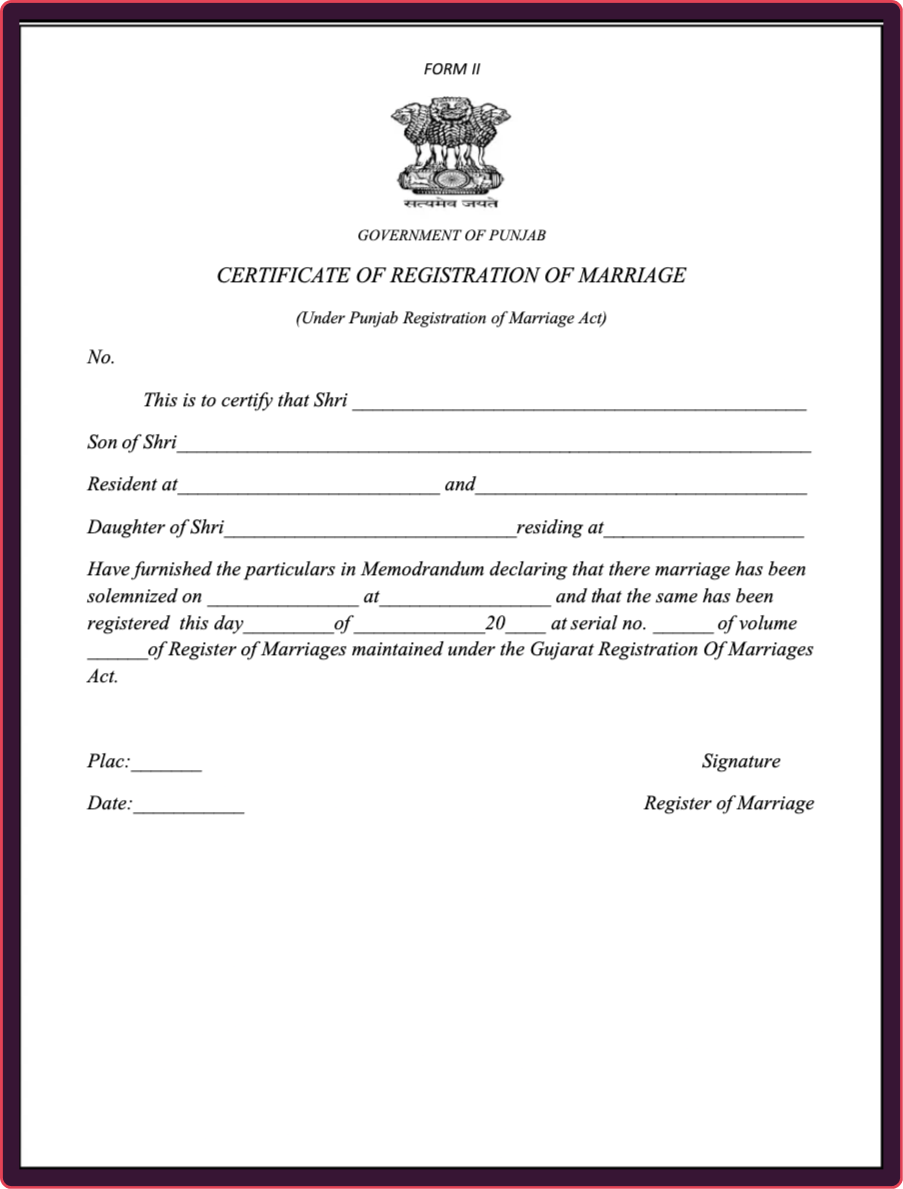
An example of a marriage certificate for illustrative purposes only.
Why are marriage certificates important?
Marriage certificates play a central role in identity-linked verification because they formally establish a legal relationship between two individuals. They help institutions confirm eligibility for benefits, validate family status, and authenticate identity information across a wide range of workflows.
Here’s how marriage certificates are used for document verification across specific industries:
- Insurance providers. Insurers use them to verify spousal eligibility for life, health, and dependent coverage or to assess beneficiary claims.
- Financial institutions. Banks and lenders reference them when opening joint accounts, updating beneficiary information, or evaluating spousal rights during onboarding and compliance checks.
- Tenant screening. Occasionally used to verify household composition or legal name changes, though it is not a primary screening document.
- Government benefits agencies. Marriage certificates are used to determine eligibility for spousal benefits, pension entitlements, tax status changes, and social program applications.
- Immigration services. Marriage certificates support applications for spousal visas, residency status, and family reunification by demonstrating a legally recognized relationship.
Because they serve as a high-trust civil record and unlock access to multiple services, marriage certificates remain one of the most frequently requested and widely accepted proofs of legal relationships. It also makes them a prime target for document fraud.
If you’d like to know how fraudsters are creating all these fake marriage certificates, check out our “Types of fraud” blog to learn more about their tactics.
Threat intel: Template data about fake marriage certificates
Our Threat Intelligence Unit collects data about template farms which make and distribute fake document templates for fraudulent purposes.
Below, you'll find an infographic containing data about all the fake marriage certificate templates we've found: their availability, their distributors, the institutions or "issuers" whose documents have been exposed, and how much it costs to buy one.
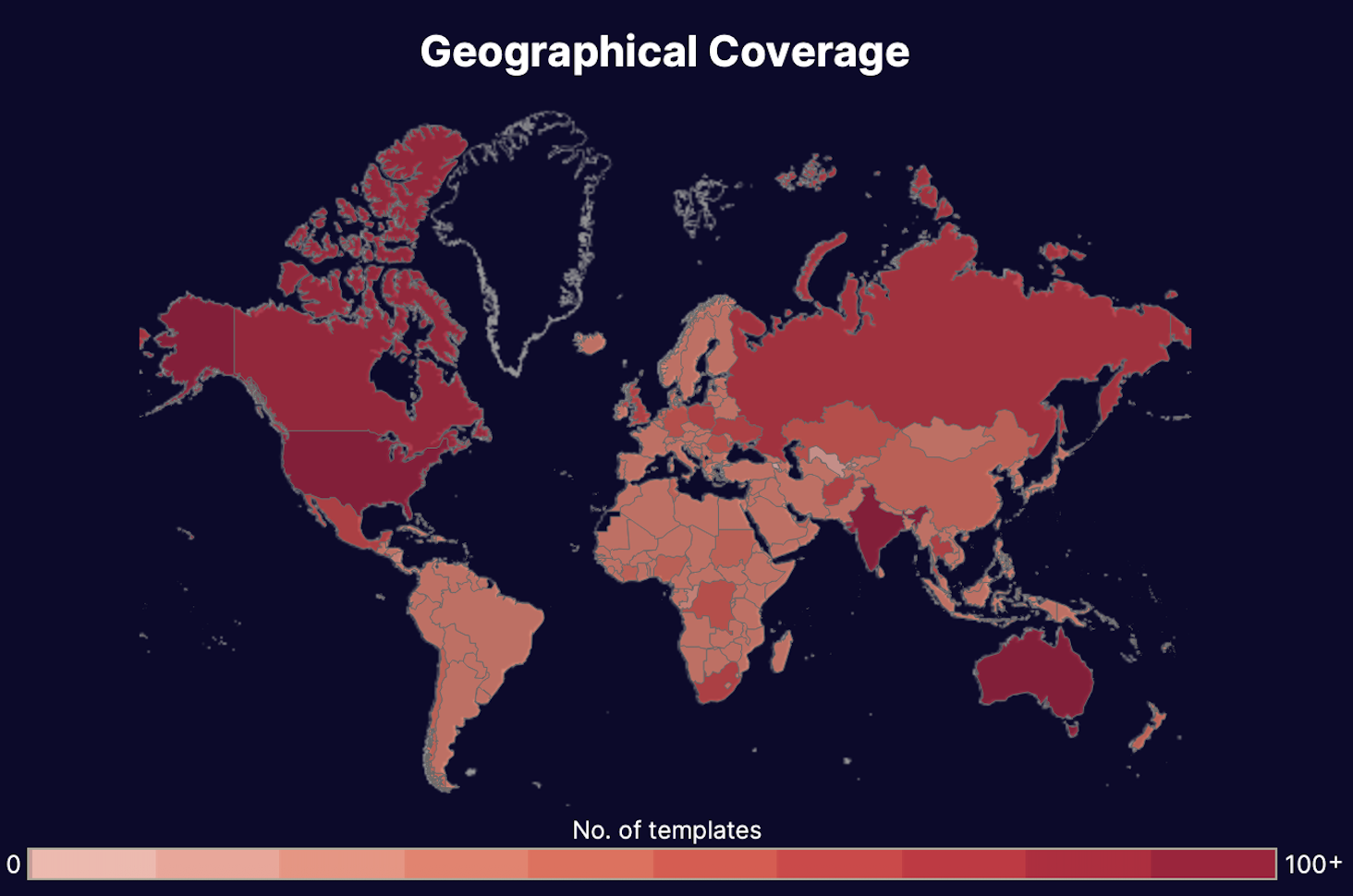
Threat intel stats: Marriage certificates
Find more information about the threat these farms pose in our threat intel blog and webinar content.
5 Signs of a forged or fake marriage certificate
Because these documents vary significantly by jurisdiction, fraudsters often exploit unfamiliar formats, outdated templates, or AI-generated designs to bypass manual checks.
Detecting them requires focusing on structural cues, logical consistency, and document construction rather than template familiarity. Still there are some tell-tale signs of forgery that span across jurisdictions.
Here’s what to watch for:
1. Inconsistent formatting
Formatting issues signal that the document was assembled from multiple templates, edited after issuance, or built using generic online designs:
- Misaligned section layout. Core fields (spouse names, marriage date, registrar area) appear off-center or unevenly spaced in ways that break the document’s internal alignment logic.
- Irregular typography. Mixed fonts, inconsistent font sizes, or spacing irregularities within the same field group suggest manual editing.
- Improper placement or scale of seals or stamps. The seal appears disproportionately large, pixelated, or unusually clean/heavily inked, indicating it was added digitally instead of physically pressed onto the document.
- Inconsistent scan artifacts. Genuine scanned certificates show uniform characteristics (even lighting, consistent grain, and stable edge shadows). Fakes that try to imitate a scan often reveal uneven shadowing around only certain elements — such as the registrar signature block, certification text, or the area containing the official seal. You may also see artificial paper texture applied behind the spouse information fields but not behind the witness section, or pixel grain that stops abruptly around edited marriage details. These mismatches indicate the certificate was digitally assembled rather than truly scanned.
- Low-resolution or layered backgrounds. Security-style patterns appear blurry, stretched, or incorrectly repeated, pointing to copied or AI-generated elements.
2. Incorrect or misleading information
These issues relate to content accuracy and internal data coherence. They involve factual mismatches, impossible details, or other inconsistencies within the document.
- Implausible personal details. Spouse information may include impossible or highly unlikely data, such as misspelled legal names, placeholder text left in form fields, or birthplaces listed as non-existent towns or districts.
- Jurisdiction mismatch. The certificate claims to be issued in a city, county, or district that does not register civil marriages or does not exist.
- Incorrect officiant or registrar details. Fakes often include officiant titles or registrar names that do not align with how civil marriages are recorded, such as using ceremonial titles instead of civil ones, listing officials who do not exist, or assigning roles that are not used in that jurisdiction.
- Event details inconsistent with local practice. The named officiant title (judge, registrar, clerk) does not exist in that jurisdiction or is used incorrectly.
- Certificate numbers that do not resemble that jurisdiction’s format. While numbering systems vary widely, random alphanumeric strings or obviously repeating patterns are common red flags.
3. Bad math and uncharacteristic figures
This category captures numeric and logical inconsistencies, not visual formatting. Although marriage certificates contain fewer numerical fields than financial documents, they still carry structural logic that can break under fraud.
- Illogical sequencing between event date and registration date. Long delays or registration dates that fall outside statutory filing windows where such requirements exist.
- Inconsistent witness counts. Listing a number of witnesses that contradicts the jurisdiction’s minimum or maximum requirements (e.g., zero witnesses where witnesses are mandatory).
- Impossible date combinations. Dates that do not exist on the calendar, contradict local date ordering conventions, or mix formats inconsistently within the same certificate.
- Repeated registration or certificate numbers. Each marriage certificate is assigned a unique registration or certificate number by the issuing authority. If different pages, extracts, or certified copies within the same submission include identical numbers despite being presented as separate issues (or if two spouses submit certificates showing the same number but different marriage details) it can indicate fraud.
- Conflicting issuance details. Some jurisdictions include issuance indicators such as a “date issued,” “date certified,” “copy number,” or a reissue label on certified extracts. If a certificate shows combinations that could not logically occur (such as a reissue date earlier than the original certification date, a “copy number” that resets within the same submission set, or multiple certification dates printed on what is presented as a single certified copy) the document was likely altered or assembled from mismatched sources.
4. Marriage certificate inconsistencies
These issues relate to structural integrity, layout logic, and how the document is constructed as an official extract. They are not about formatting errors but about relationships between elements inside the certificate.
- Implausible registration timing. The registration date precedes the marriage date or occurs on a date when civil offices are typically closed (e.g., national holidays).
- Field groups appearing in the wrong order. Core blocks (spouse information, marriage details, registrar certification) are arranged in a sequence not typical of civil registration documents.
- Incorrect or mixed-language certification text. Fakes may contain certification statements written in a different language (than the official language of that jurisdiction), inconsistent translations, or mixtures of linguistic styles. For example, a French civil certificate containing Dutch or German administrative terminology in the header or certification block.
- Officiant and registrar roles conflated. A document lists the same person as both officiant and registrar when those functions are separate in most jurisdictions.
5. Metadata discrepancies
Digital fingerprints can reveal when a certificate did not originate from an official registry or was altered after issuance. These issues pertain to file properties, not visible content.
- Creation in consumer editing software. Metadata indicating Photoshop, Canva, or other non-government tools suggests the certificate was fabricated or modified.
- Missing text layer. Entire certificate appears as a single embedded image rather than selectable text, a common sign of screenshot-based editing.
- Mismatched language or locale metadata. A certificate issued by a registrar in one country contains file metadata set to an unrelated region.
- Unusual security or permission settings. Overly restrictive PDF permissions intended to prevent inspection of layers or metadata.
Disclaimer: Manual inspection alone struggles to keep pace with modern marriage certificate fraud. High variability across jurisdictions, AI-generated templates, layered image manipulation, and consumer-grade editing tools make it increasingly difficult for human reviewers to determine authenticity by eye. Scalable, AI-powered structural analysis is now essential for detecting the hidden anomalies and construction patterns that reveal sophisticated forgeries.
How to verify a marriage certificate
Marriage certificates are reviewed across immigration services, insurance providers, financial institutions, government benefits agencies, and legal teams that handle name changes or estate matters.
These organizations can verify documents manually or through automated systems. Manual checks, however, are becoming less effective as fraudsters gain access to generative AI tools, outdated certificate templates, and image-editing software that can reproduce realistic seals, signatures, and layouts.
The challenge is amplified by the fact that marriage certificates have no universal format. Each jurisdiction controls its own design, structure, terminology, and security features, and many regions have multiple formats in circulation depending on the year or certificate type.
A document that looks unfamiliar may be entirely legitimate, while a fake can combine believable elements from different eras or countries to appear plausible. This variability makes template familiarity an unreliable defense and significantly weakens pure visual inspection.
AI-powered automation offers a more reliable approach by analyzing structural patterns, document construction, and digital fingerprints that are extremely difficult for fraudsters to mimic.
It can detect anomalies that humans miss, process high volumes instantly, and maintain accuracy even when reviewing certificates from jurisdictions the reviewer has never encountered.
Still, manual review persists across many workflows. If you must verify marriage certificates manually, here are practical steps to increase accuracy and reduce risk.
Manual verification of marriage certificates
The first place to check is the 5 red flags we mentioned above. Then, you can try the following external sources to verify marriage certificates:
- Cross-check details against supporting documents. Compare names, dates, and locations with passports, IDs, or immigration filings to ensure information aligns across all submitted materials.
- Verify the issuing authority. Confirm that the listed city, county, or district is authorised to register marriages and that the certificate type matches how that jurisdiction typically formats vital records (here is a source with vital record information for all 50 states).
- Contact the registrar when permitted. Some jurisdictions allow verification of certificate numbers, registration dates, or officiant details through a public index or by contacting the vital records office directly. In the UK they have a general registrar office that lists most marriage details.
Keep in mind: Even strong manual review techniques struggle with the volume, variability, and sophistication of modern marriage certificate fraud. Calling the civil documents office or digging through registrar records is not scalable and fails quickly when document volumes grow beyond a few checks a day.
Using AI and machine learning to spot fake marriage certificates
AI plays an increasingly important role in verifying marriage certificates because these documents lack a universal format, are easy to imitate with modern editing tools, and often arrive as images or screenshots rather than secure digital files.
Rather than relying on template familiarity or reading personal data, effective AI systems analyze how a document was built (its structure, internal logic, and digital fingerprints) to identify anomalies.
AI document verification has many benefits for spotting fake marriage certificates:
- Privacy-preserving verification. Structural AI authenticates documents without reading or storing personal information, making it suitable for workflows that must comply with strict data-protection rules while still detecting sophisticated forgeries.
- Generative AI detection. Advanced models recognize the subtle artifacts of GenAI-generated certificates, analyzing texture, structure, and layering with a false positive rate under one percent.
- Metadata and file forensics. AI surfaces unusual creation timestamps, editing histories, or software signatures that conflict with how official records are typically produced.
- Real-time risk assessment. AI rapidly flags anomalies across large volumes of documents, enabling faster onboarding, fewer manual checks, and scalable fraud prevention.
Automation vs. AI
Traditional automation can confirm that spouse name fields are filled, that marriage dates follow an acceptable format, or that a certificate or registration number fits a predictable numbering pattern for that jurisdiction.
It excels at rule-based tasks, but it cannot reason about document structure, detect subtle manipulations, or adapt when fraudsters use novel templates or generative AI tools.
AI goes further by learning from evolving fraud behaviour and analyzing the underlying construction of each file.
It recognizes when field groups appear in an unusual sequence, when a seal was digitally inserted, or when a document’s layering does not match how certificates from that jurisdiction are typically generated.
Conclusion
Fake marriage certificates distort immigration decisions, enable benefits fraud, and support synthetic identity schemes across high-risk workflows.
With fraudsters relying on editable templates, generative AI, and reconstructed images, manual checks can no longer keep pace, especially when every jurisdiction uses its own certificate format.
Resistant Documents helps close this gap by analyzing how each document is built, not what it says. Our structural analysis models, combined with cross-document intelligence and GenAI-detection capabilities, surface hidden anomalies that even experienced reviewers miss.
The result is faster verification, fewer manual checks, and stronger protection against increasingly sophisticated forgeries.
Scroll down to book a demo.
Frequently asked questions (FAQ)
Hungry for more fake marriage certificate content? Here are some of the most frequently asked fake marriage certificate questions from around the web.
How to spot a fake marriage certificate with AI?
Advanced models evaluate layout logic, layering, metadata, and construction patterns that are impossible for fraudsters to replicate perfectly. Resistant AI’s document fraud detection can flag marriage certificate inconsistencies in seals, object placement, compression artefacts, and edit histories, allowing institutions to identify sophisticated fakes instantly.
What’s the difference between a marriage certificate, a marriage license, and a certificate of no impediment?
Although these documents relate to the marriage process, they serve entirely different legal functions and appear at different stages. A marriage license authorizes a couple to marry, a marriage certificate records that the marriage legally happened, and a certificate of no impediment confirms a person is free to marry (usually abroad).
Marriage certificate. An official civil record issued after the marriage has been legally registered, serving as formal proof that the marriage occurred.
- Issuer: Civil registrar, vital records office, or local government authority after the marriage is legally registered.
- Characteristics:
-
- Contains the date and place of marriage and the names of both spouses.
- Includes the registrar’s name, signature or stamp, and a certification statement.
- Displays a registration or certificate number linked to the civil registry.
- Issued on certified paper or as an official digital extract, often with seals or security features.
- Never includes an expiration date, because it records a completed event.
- Contains the date and place of marriage and the names of both spouses.
Marriage license. A pre-marriage document issued before the ceremony, granting legal permission for a couple to marry within a specified timeframe.
- Issuer: Local government authority (e.g., county clerk, municipal registrar) before the marriage occurs.
- Characteristics:
- Lists applicants’ names, application date, and the issuing authority.
- Includes an expiration date or validity period (unique to licenses).
- May include required information for the officiant (e.g., instructions for returning the signed document).
- Often contains a tear-off or return section for filing after the ceremony.
- Does not confirm that a marriage took place.
- Lists applicants’ names, application date, and the issuing authority.
Certificate of no impediment (certificate of freedom to marry). A document issued by a civil authority or foreign-affairs body confirming that an individual is legally free to marry, typically for use in international marriages.
- Issuer: National or local civil authority, often a foreign affairs department or embassy.
- Characteristics:
- Lists the individual’s legal name, nationality, and civil status (e.g., single, divorced).
- Includes the issuing authority’s letterhead, signature, stamp, and certification wording.
- May reference the country where the marriage will occur.
- Typically resembles an official letter or attestation, not a certificate tied to a specific event.
- Does not contain marriage dates, officiant details, or spouse information.
- Lists the individual’s legal name, nationality, and civil status (e.g., single, divorced).
Is there software to detect fake marriage certificates?
Yes. Resistant AI uses structural analysis to authenticate documents by evaluating how they were built rather than relying on database lookups or template matching.
Who needs to check for fake marriage certificates?
Fake marriage certificates can distort eligibility decisions, undermine compliance, and enable synthetic identity schemes. These roles are most likely to verify them during high-stakes workflows:
- Immigration caseworkers. Review marriage certificates to confirm spousal relationships during visa, residency, or citizenship applications.
- Insurance underwriters. Validate marital status for dependent coverage, life insurance beneficiaries, and claims involving spousal benefits.
- Bank compliance officers. Confirm legal name changes, joint account eligibility, and spousal relationships during Know Your Customer (KYC) or onboarding checks.
- Government benefits assessors. Determine whether applicants qualify for spousal pensions, tax status adjustments, or household-based support programs.
- Family law and estate clerks. Authenticate marital status for probate, inheritance, name changes, or dissolution proceedings.
Is making or using a fake marriage certificate illegal?
Yes. Producing, altering, or submitting a fake marriage certificate is a criminal offense in most jurisdictions. Penalties can include fines, imprisonment, immigration consequences, and civil liability.
How do scammers use fake marriage certificates in fraud?
Fraudsters use fake marriage certificates to create or legitimise false relationships, often for:
- Immigration scams (spousal visas or residency applications).
- Benefits fraud (pensions, tax advantages, dependent coverage).
- Financial deception (joint account opening, beneficiary manipulation).
- Synthetic identity schemes pairing real and fake identities.
Can fake marriage certificates bypass government verification systems?
Direct government verification systems are strong, but external organizations (banks, insurers, employers, universities, etc.) often do not have access to them. Fraudsters exploit this gap by submitting convincing digital forgeries that never reach a government registry unless formally audited or escalated.

Fraud awareness, examples, and lessons
Learn more about fraud in specific industries, best practices, and targeted documents.
View all
Application fraud in 2026 is easier to attempt: accessible tools and services help applicants turn false claims ...
Within the fake document ecosystem, things can change fast. Four months ago, we reported that OnlyFake, the ...
In May 2026, a Dallas resident was convicted of running coin-operated “amusement machines” without a business ...

NEW YORK & PRAGUE – 1 October 2026 – Ocrolus, the AI workflow and analytics platform for lenders, today ...
For a few hundred dollars, sellers on Telegram promise to boost your credit score using someone else's credit ...
Key takeaways Fake certificates can use real numbers Fraudsters can copy a genuine business’s VAT number onto a ...