





Document fraud detection software is the fastest, most reliable way to check any document for signs of forgery in 2026.
Searches for “document verification” or “KYC software” often lead to limited solutions, forcing users to juggle multiple platforms, repeat uploads, and re-enter the same data.
Risk teams can handle everything from loan applications, customer and merchant onboarding, and insurance underwriting, they need more than one-off IDV tools that only verify a single document type.
The right software works across all document types (and types of document fraud), catching fraud in one centralized place instead of piecemeal.
So, what makes the best document fraud detection software? Today’s best solutions are AI-powered, document agnostic, customizable, and informed by industry experts.
We’ve compiled a list of the 6 best document fraud detection software on the market in 2026.
Read on to find which solution best suits your company.
What is document fraud detection software?
Document fraud detection software automatically analyzes structural layout, formatting, content, metadata, and internal consistency of digital documents, identifying subtle signs of manipulation, forgery, or document fraud in general.
The most advanced solutions use AI to flag subtle anomalies undetectable by human review or rules based automation, factors in behavioral context (such as submission behaviors), and uses cross-document analysis to recognize serial fraud across documents.
Document fraud detection software: Real-world example
During a mortgage application, an AI document verification reviews a tax return alongside multiple supporting documents (bank statement, pay stub, and utility bills) all submitted by the same applicant.
The software spots that the income figures in the tax return don’t align with other elements of the document's formatting, detects that the pay stub layout matches a known forgery template used in unrelated past cases, and finds metadata indicating the utility bill was created using an image editor two weeks after its stated issue date.
By correlating these anomalies across documents, the system flags a coordinated fraud attempt that would have passed both manual inspection and basic automated checks.
Document fraud detection tool: 7 essential features
In 2026, advanced technology empowers fraudsters to create increasingly sophisticated and convincing document forgeries. Your solution needs to tackle these new tactics through equally advanced tactics and tools.
Here are some key features to consider before selecting a document fraud detection solution:
1. Structural analysis > content scanning
The ideal software can rely on both structural analysis and content scanning to verify documents. Each has their strengths, content scanning doesn’t check a document's integrity directly for fraud, it authenticates their contents for internal inconsistencies, inconsistencies against other documents in the application, or inconsistencies against databases to confirm validity.
Structural analysis, on the other hand, does authenticate the document directly, looking at how their built as opposed to what their contents say, along with other benefits such as:
- Protecting privacy. Content scanning reads or stores document contents, leaving your sensitive customer data in the hands of third parties. Structural analysis avoids this risk by verifying authenticity without ever exposing or processing the document’s personal information.
- Maintaining compliance. Some regulations, like GDPR or HIPAA, restrict or prohibit the transfer of personally identifiable information (PII) or protected health information (PHI) to external processors. Structural analysis doesn’t extract or share regulated content, ensuring compliance from the start.
- Verify a wider range of documents with minimal or no training data. Content scanning relies heavily on large, labeled datasets for each document type, meaning it struggles with uncommon formats, new templates, or region-specific layouts and scripts. Structural analysis focuses on the document’s construction rather than its content, allowing it to spot fakes across formats and regions with far less initial data, including documents it has never seen before. However, the size of these datasets may have decreased universally with the onset of LLM technology.
To understand how both work and the differences between the two, here’s how each method would be used to check a bank statement for fraud:
- Structural analysis. Checking a bank statement file to detect mismatched fonts, inconsistent text alignment, metadata or internal structural tampering, unusual pixel artifacts, pasted logos, inserted background scenes, and inconsistencies in document production with past practices from that issuer, indicating digital editing or forgery.
- Content scanning. Reviewing a bank statement to confirm that names, addresses, numerical data, and account numbers are internally consistent, match other documents submitted, and/or match content in trusted databases.
Another element at play is the speed and cost of these solutions. Reading and assessing a document is both more expensive and slower than structural analysis for fraud.
Companies implementing content scanning as a fraud detection layer of existing document automation should fit it into a layered approach that accounts for all variables. Relying on a single point for detection only create a singular point of failure that criminals will exploit.
2. AI-powered detection
Choose software that doesn’t just use AI as a buzzword but genuinely employs advanced machine learning to achieve AI fraud detection.
Truly effective AI adapts, learns, and evolves, separating it from a long list of complicated “if-then” checks, capturing new, evolving, and never before fraud tactics and surface them for human review.
This isn't like LLMs which don't "learn" in the practical sense but expand by building an ever elaborate set of programatic rules to check against (or increasingly elaborate prompts) which act more as harnesses, creating diminishing returns as context limitations and rules accumulate.
Crucially, AI can also look at all documents, identifying patterns, reused fraudulent templates, and linked fraudulent activity across your entire data set, helping catch organized, scalable fraud rings, detecting connections and serial fraud attempts over even thousands of documents.
This creates a review hive-mind that is impossible for any human review team.
3. Explainability
Fraud decisions need to be trusted, defended, and acted on. Explainability turns an analysis into evidence you can review, share, and stand behind, speeding investigations, reducing false positives, satisfying auditors and judicial reviews.
Don’t trust the tool blindly, trust the explanation and reasoning it provides.
Some key explainability features to look for:
- Clear verdicts. Every alert includes ranked signals with plain‑English explanations and affected fields so reviewers know exactly why it was flagged.
- Why “confidence scores” aren’t enough. Confidence scores aren’t explainable. Why would one document be 68% confident while another is 83%. That kind of nuance is better broken down in plain-English than abstract numbers.
- Evidence you can see. Visual overlays highlight layout drift, font swaps, copy‑paste seams, and pixel artifacts.
- Forensic metadata trails. Surface XMP fields, object trees, creator apps, timestamps, and signature results to show how the file was produced and where it diverges from norms.
- Cross‑document narratives. Visualize links across submissions (reused documents or templates, repeated elements like barcodes or content tables, repeated background elements or lighting conditions, device or browser fingerprints) to reveal serial fraud.
- Audit‑ready logging. Immutable logs in exportable PDF format capture model version, configuration, verdicts and timing, creating a regulatory-ready chain of custody.
- Privacy‑preserving detail. Structural evidence describes how the file was built, not what it says, enabling transparent reviews without exposing PII or PHI.
- Human‑in‑the‑loop guidance. Escalation and confirmation of cases to ensure the model is working effectively, deal with novel threats, and adapt the solution to the organization’s specific needs.
Black‑box, score‑only tools create friction and liability; explainable, structural AI provides the proof you need to make confident, defensible decisions.
4. Universal document support
The strongest fraud detection solutions are document-agnostic: they can confidently handle any type of document (receipts from Canada, utility bills from the UK, tax forms from India) without needing to have “seen” them before.
Template-based systems, by contrast, are fragile. They often require tens of thousands of training documents just to become usable, and even then they break when issuers update a template or introduce small variations. Every change means retraining, during which false positive rates spike and legitimate customers are left waiting.
Format matters just as much as document type. Your solution needs to accommodate them. Some solutions only work with PDFs because they are easier to parse as code. But the reality is that many documents arrive as images, screenshots, or scans (and images are far harder to analyze for fraud unless your system is capable of sophisticated forensic checks).
Forcing customers to submit only PDFs doesn’t just increase friction, it can lock entire groups of users out of your service.
A “document-agnostic” universal solution sidesteps these problems. By working across document types, templates, and formats without retraining, it scales naturally as you expand into new markets and customer bases.
You don’t wait for vendor updates. You don’t get blindsided by small design changes from issuers. And you don’t risk alienating customers with arbitrary restrictions. Instead, you can focus on growth, knowing your fraud defenses keep pace wherever the market takes you.
5. Customized risk thresholds
Prioritize software offering “adaptive decisioning,” enabling you to tailor fraud detection alerts and outcomes precisely to your organization's unique risk appetite and compliance standards.
Also called “adjustable risk thresholds,” these can minimize false positives, reducing friction for good customers and stopping your review teams from getting overwhelmed. More importantly, it allows for robust automation capabilities that will reflect your own risk appetite and compliance policies, such as:
- Are you happy to accept documents from one bank but not another?
- Are you willing to take in documents in PDF or images, but not screenshots?
- Are certain document modifications common in your industry and should not trigger red flags?
- Do you need different rules applied to different geographies or lines of business?
Having the ability to adapt outcomes can tighten security for high-value transactions, ensuring that the software's response is perfectly aligned with the specific risk level of any given workflow.
6. Active threat intelligence
The best fraud detection software is backed by dedicated threat intelligence teams actively tracking and analyzing emerging fraud techniques, document generation methods, and forgery trends.
An AI-powered solution already provides keen adaptability, protecting against emerging threats that you haven’t seen before. However, keeping a pulse on the current fraud landscape is still essential for understanding how criminals operate within their ecosystem.
This continuous intelligence guarantees that your security investment remains effective long-term against the ever-changing threat landscape while providing an understanding of the actual activity that necessitates these defenses.
7. Fraud specialists, not generalists
Many platforms offer a tempting suite of features, from document collection to full-stack Intelligent Document Processing (IDP). While these tools are built to optimize workflows, fraud detection is a foundational security function, not a workflow feature. This is serious, high-stakes work that simply cannot be a software afterthought.
When a provider’s primary goal is data extraction or case management, their fraud detection capabilities are inevitably a secondary concern: a "good enough" check designed to catch only the most obvious fakes.
A specialist provider, however, lives and breathes security. Their entire company, from their engineers to their research teams, is singularly focused on the mission of stopping criminals.
This isn't a task to be delegated to a side feature; it requires a dedicated expert who understands that protecting your business is a full-time commitment.
1. Resistant AI
Resistant AI’s document fraud detection software (Resistant Documents) empowers your risk, fraud, and compliance teams with bionic vision, catching nearly-invisible fraud in bank statements, invoices, pay stubs, utility bills, and any type of document you can think of. No matter the country or format.
Did those essential capabilities above sound attractive for your business? Resistant AI stands out by offering every single one of them, effectively combating advanced document forgery by being document agnostic, AI-powered, flexible, threat-informed, and solely dedicated to fighting fraud and stopping criminals.
Specializing in Non-ID documents, the software has processed more than 180M since its launch. Customers don’t have to rely on gut feelings. The tool helps make confident, evidence-based decisions to resist fraud and protect organizations from financial crime.
On top of all that, Resistant AI delivers tangible benefits for your business:
Benefits
Resistant AI is designed for teams that require deeper insight into document authenticity. Beyond speeding up reviews, it focuses on detecting complex fraud patterns and structural anomalies that often go unnoticed.
- Catch up to 3x more document fraud in digital PDFs and image formats.
- Reduce manual reviews by up to 92%.
- Accelerate onboarding and underwriting decisions by 80%.
- Perfectly tune decisions to match your specific risk appetite.
- Identify advanced fraud from:
- Generative AI
- Online document mills or template farms
- Reused document templates
- Organized crime
Key features
Resistant AI focuses on flexibility, scalability, and transparency, ensuring coverage across formats, languages, and jurisdictions without compromising data privacy.
- Document agnostic, fast, and flexible. Run documents in any language and we’ll analyze them. No need to know them beforehand or read them to catch fraud: just look at how they’re built. This allows us to spot fraud without being tied to pre-defined models. More than 80% of the detectors work without document models because they focus on fraud typologies that should be flagged independently of understanding that specific document.
- Workflows that match your risk appetite. Every aspect of the document (its origin, issuer, and any alterations made) is reviewed comprehensively and assigned tailored verdicts precisely aligned with your organization's specific risk policies.
- Advanced fraud capabilities. Detect more than single-document anomalies by uncovering serial fraud patterns, behavioral red flags, and coordinated campaigns. The detectors feed into broader risk models, including transaction monitoring, to expose emerging threats from template farms to generative AI-driven attacks.
- Compatible with any document processing system. Fraud checks spread across different users, workflows, and document types? The tool integrates seamlessly into any document processing stack, whether IDP- or LLM-based, protecting systems whose native fraud detection is often limited to basic format validation or field extraction.
- Explainability. All evidence supporting a verdict is accessible for manual review and available in a downloadable report, making it easy to share findings with regulators, authorities, or other stakeholders.
Notable customers
- Dun & Bradstreet
- PennyMac
- Axa
Case studies
- Payoneer. Used Resistant AI to combat a surge in serial fraud. Were able to automate 82% of fraud checks and achieve a 99.2% verdict accuracy.
- Habito. Integrated Resistant AI to combat document fraud in mortgage applications. Experienced 32% increase in fraud detection, reduced second-line investigation time by 80%, and enabled first-line document assessments in under 3 seconds.
- Verto. Streamlined its global merchant onboarding process. Reduced application review times by 50% and swiftly authenticated documents from numerous countries, facilitating rapid expansion into new markets.
- Close Brothers. Addressed escalating document fraud challenges in vehicle financing. Achieved a 22x return on investment, saving £800,000 in just eight months. Reduced manual review times by half and enabled document fraud detection in under 12 seconds,
Positive feedback
Customers highlight Resistant AI’s ability to detect fraud better than alternatives, accelerate decision-making, and integrate seamlessly into existing onboarding processes, earning a reputation as a critical part of the verification stack while maintaining and prioritizing healthy ongoing customer relationships:
“Probably the best tool in our review flow. Resistant AI are our bionic eyes.”

“Resistant AI identifies manipulated documentation far quicker and far more accurately than we humans can. It also brings us to conclusions faster and with more confidence.”

“The aftercare support from Resistant AI has been unbelievable. We just haven't had that level of support from others previously.”

Company history
Rooted in cybersecurity, the company’s team has spent their careers studying adversaries, reverse-engineering threats, and designing systems that adapt faster than the fraud they face. That same discipline now drives a focus on the hardest challenge in financial crime: stopping fraud and laundering at scale.
2. Inscribe
Inscribe is a San Francisco-based company that began as a document processor with a fraud-detection feature built in.
Originally a fraud-first platform, they've shifted into a more generic “agent-style” content analysis tool, using LLM tools to spin up detector on the fly to capture edge cases.
Coverage doesn't seem to expand far beyond the U.S. bank statements, but they have incorporated utility bills into their offering.
The net effect is a regionally focused tool, primarily useful for straightforward North American workflows, but far less equipped to serve regulated or cross-border enterprises that require rigorous, real-time fraud defense.
Benefits
Inscribe prides itself on fin-tech expertise and an approachable user interface.
- Fintech-focused reputation. Inscribe has established a strong brand within the US venture-backed fintech community (thanks to its investors and as a Y-combinator alumni), making it a familiar name for companies operating in that specific ecosystem.
- Polished user interface. The platform offers a clean and user-friendly interface for manual review teams, underscoring its role as a workflow enhancement tool.
Key features
Inscribe’s feature set is built around automating the manual review of financial documents.
- AI risk agents. Inscribe divides its product pages into “AI Risk Agents” that perform onboarding and underwriting tasks.
- AI fraud analyst. This is their document verification tool, emphasizing actionable insights and manual review automation.
- AI compliance analyst. KYB focused verification that does document analysis and database look-ups.
Notable Customers
- Ramp
- Plaid
- BlueVine
Positive feedback
Inscribe is often praised by its customers for streamlining workflows in underwriting and onboarding.
- “With Inscribe, we uncover things we normally wouldn’t be able to find using traditional methods.”
- Preston Miller (Airbase).
Negative feedback
Inscribe does not currently have user reviews on third-party websites like Trustpilot, Reddit, Capterra, or G2.
Company history
Inscribe was founded in 2017 by Ronan Burke and Conor Burke. They focused on building a platform to digitize and analyze these documents, positioning themselves as a modern alternative to manual review teams and legacy systems within the lending and financial services industries.
Resistant AI vs. Inscribe
Inscribe offers a capable workflow automation tool for North American fintechs that need to speed up manual document reviews. However, teams handling sensitive financial documents may be cautious about relying on LLM-powered review workflows where data privacy, model governance, and regulatory exposure are unclear. Resistant AI has a global focus and can work with any document from anywhere in the world, giving fraud and risk teams automation without compromising control.
Here’s how Resistant AI compares:
Resistant AI |
Inscribe |
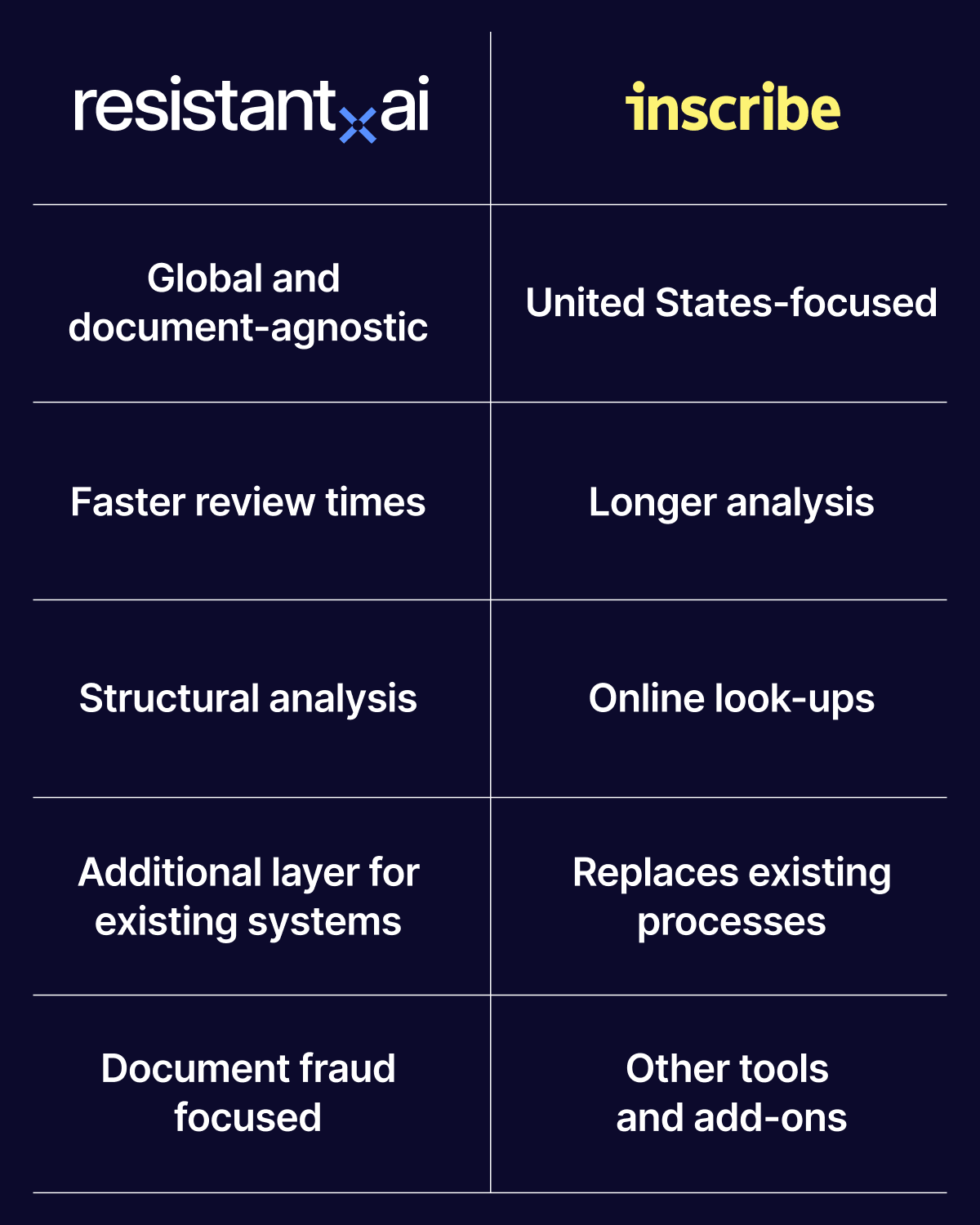
| Global and document-agnostic. Works across all languages, formats, and financial documents. | United States-focused. Optimized for US financial documents and workflows. |
| Faster review times. Can check a document for fraud in seconds. | Longer analysis. Takes 72 seconds to complete a fraud review. |
| Structural analysis. The tool doesn't read documents, just looks at how they’re built. | Online look-ups. Reads applicant details and compares them against online registries. |
| UI & API. Meant to protect your document process, whether manual or automated, and feed into your broader risk processes. | Replaces existing processes. As an IDP, Inscribe must replace your existing system to attain its fraud detection capabilities. |
| Document fraud focused. Built to catch fraud within and across your document database. | Privacy concerns. LLM-based document processing may raise questions around sensitive data handling and control. |
3. Finovox
Finovox is a French technology company that identifies forgery in identity and financial documents, particularly within the French market.
Benefits
Finovox offers a streamlined toolkit for spotting visual document fraud, with an emphasis on ease-of-use and quick wins over deep customization or investigative depth.
- French market expertise. They’re well positioned in French-speaking markets largely because they are a French company. That focus makes them a fit for local businesses, but it also means they’re far less equipped to operate outside of those markets.
- Streamlined by design. Finovox promotes ease of deployment and a straightforward interface, reflecting the simplicity of a platform built for limited use cases.
Key features
Finovox uses a proprietary AI to analyze documents and deliver results via API or SaaS, providing businesses with clear indicators of a document's authenticity. The emphasis on detailed reporting supports human-led investigation rather than enabling fully automated, at-scale decisioning.
- 3D document layer visualization. Finovox provides a unique 3D view that allows analysts to examine the different layers of a document.
- Anomaly timeline navigation. Allows users to step through anomalies chronologically.
- Forgery type classification. Categorizes the nature of each manipulation.
Notable Customers
- Younited
- Qonto
- Agicap
Positive feedback
Finovox received praise in one third-party review for the simplicity and straight forwardness of their solution, calling it a tool that mostly achieves its intended purpose:
-
"An invaluable piece of software for anyone working to combat document fraud.”
Negative feedback
As a private, Europe-focused B2B solution, Finovox does not have many public, end-user reviews on major international platforms like G2, Capterra, or Reddit beyond the one listed above. Customer feedback may be managed through direct case studies and confidential client relationships.
Company history
Finovox was co-founded in 2019 by Marc de Beaucorps, Théophile du Portal, and Pierre-Alexis Gouzien. The trio have backgrounds in anti-fraud development, blockchain, machine learning, and marketing. Initially focusing on the French market, Finovox has since expanded its reach, serving various sectors including insurance, banking, and telecommunications.
Resistant AI vs. Finovox
Finovox offers a regionally focused tool that supports businesses in Europe mainly by producing reports for manual review, with strengths limited to straightforward, local use cases.
Resistant AI, by contrast, is a global security layer built for real-time, automated fraud detection that scales across document types, workflows, and jurisdictions, engineered to meet the demands of complex, cross-border businesses from day one.
Here’s how Resistant AI compares:
Resistant AI |
Finovox |
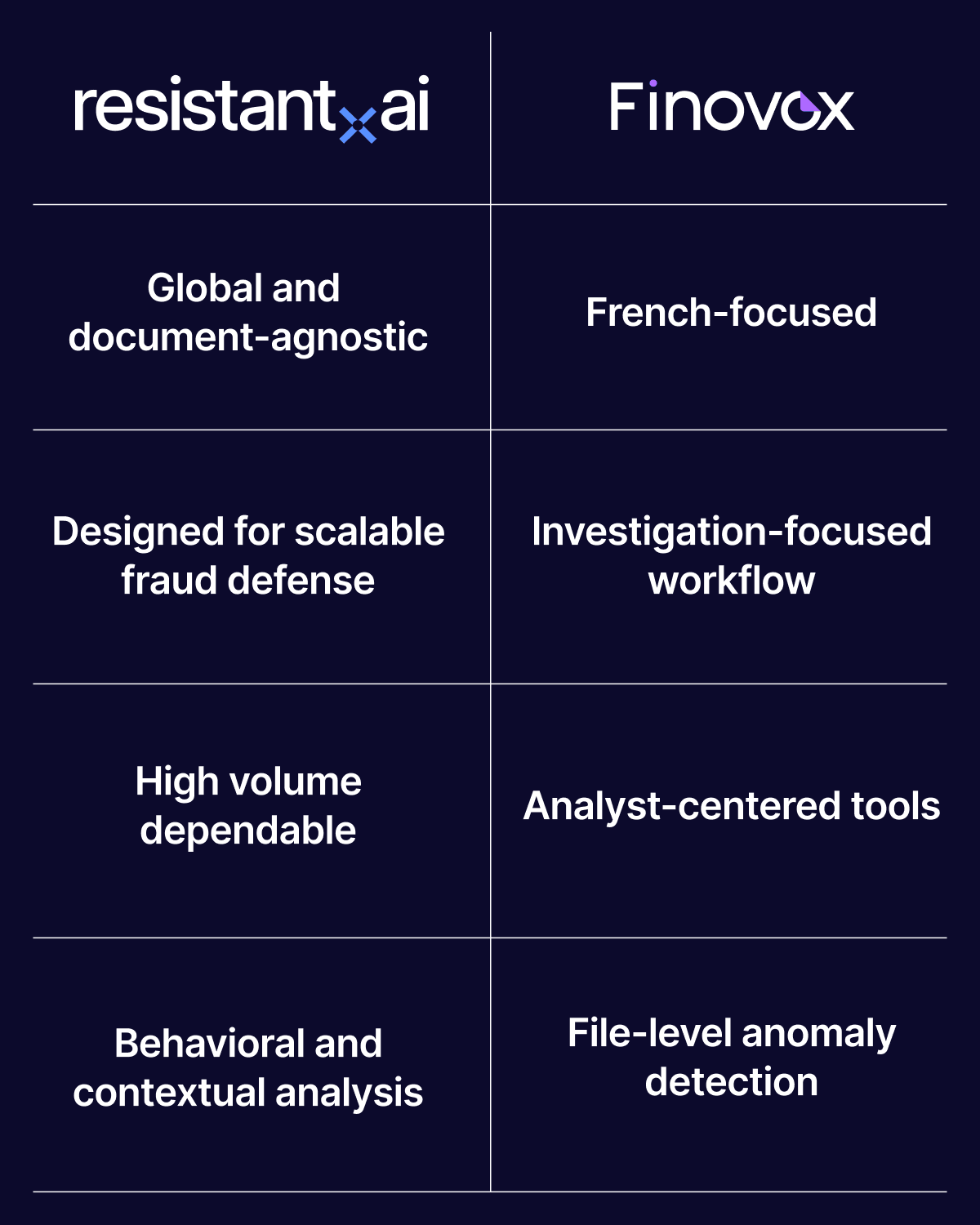
| Global and document-agnostic. Works across all languages, formats, and financial documents. | French-focused. Optimized for European documents, with a strong emphasis on French formats. |
| Scalable fraud defense. Built to detect document tampering across high volumes, with automation-ready signals and integration flexibility. | Investigation-focused workflow. Optimized for manual review, with visual tools that support case-by-case analysis and analyst-driven decisions. |
| High volume dependable. Can escalate cases automatically: ideal for high-volume or low-friction use cases. | Analyst-centered tools. Offers visual aids like 3D document views and anomaly timelines, best suited to investigative workflows. |
| Behavioral and contextual analysis. Resistant AI connects signals across users, sessions, and documents, identifying coordinated fraud patterns at scale. | File-level anomaly detection. Finovox focuses on structural tampering within a document, without broader behavioral context. |
4. Fortiro
Fortiro is an Australian fintech company specializing in automated document fraud detection and financial verification.
Founded in 2021 by former PwC directors, Fortiro offers solutions that combine AI, document forensics, and machine learning to detect fraudulent documents and streamline verification processes.
Benefits
An Australia-focused brand, Fortiro are adept at dealing with financial documents from the land down under.
- Regional compliance expertise. Designed with the Australian lending and property markets in mind, making it particularly well suited for institutions navigating regional documentation standards and local fraud risks.
- Financial document focus. Core strengths lie in analyzing financial documents like bank statements and pay stubs. This specialization supports fast deployment in mortgage and loan origination use cases, but its narrower scope may fall short when faced with diverse document types.
Key features
Fortiro’s focused suite of automation tools aim at streamlining financial document review and catching obvious signs of manipulation — prioritizing workflow speed and operational efficiency over deep forensic analysis.
- Fortiro protect. Automates fraud detection by analyzing documents for signs of tampering, inconsistencies, and other fraud indicators.
- Fortiro accelerate. Extracts and verifies income and expense data from financial documents, aiding in faster decision-making.
- Fortiro redact. Automatically redacts sensitive information from documents to ensure compliance and privacy .
Notable customers
- Pepper Money
- Bank Australia
- MONEYME
Positive feedback
Fortiro has been recognized for its innovative approach to document fraud detection, winning the 2024 "Startup of the Year" award for its contributions to automating fraud checks and financial verification.
- “It makes it really simple for customers to do business with us – that’s at the heart of everything we do.”
- Andrew Gamble (Pepper Money)
Negative feedback
Fortiro is a growing company in the fraud detection space and it currently has no public reviews of its products on sites like G2, Captera, or Trust Pilot.
Company history
Fortiro was established in 2021 by Sean Quagliani, Amir Vahid Dastjerdi, and David Weber, leveraging their experience at PwC to address the challenges of manual document verification in financial services. The company has since grown to serve various sectors, including banking, insurance, real estate, and government agencies.
Resistant AI vs. Fortiro
While Fortiro delivers regionally tailored fraud checks for Australian lenders, Resistant AI was built for a broader mission: stopping document fraud at scale, in real time, across industries and borders.
Here's how Resistant AI compares:
Resistant AI |
Fortiro |
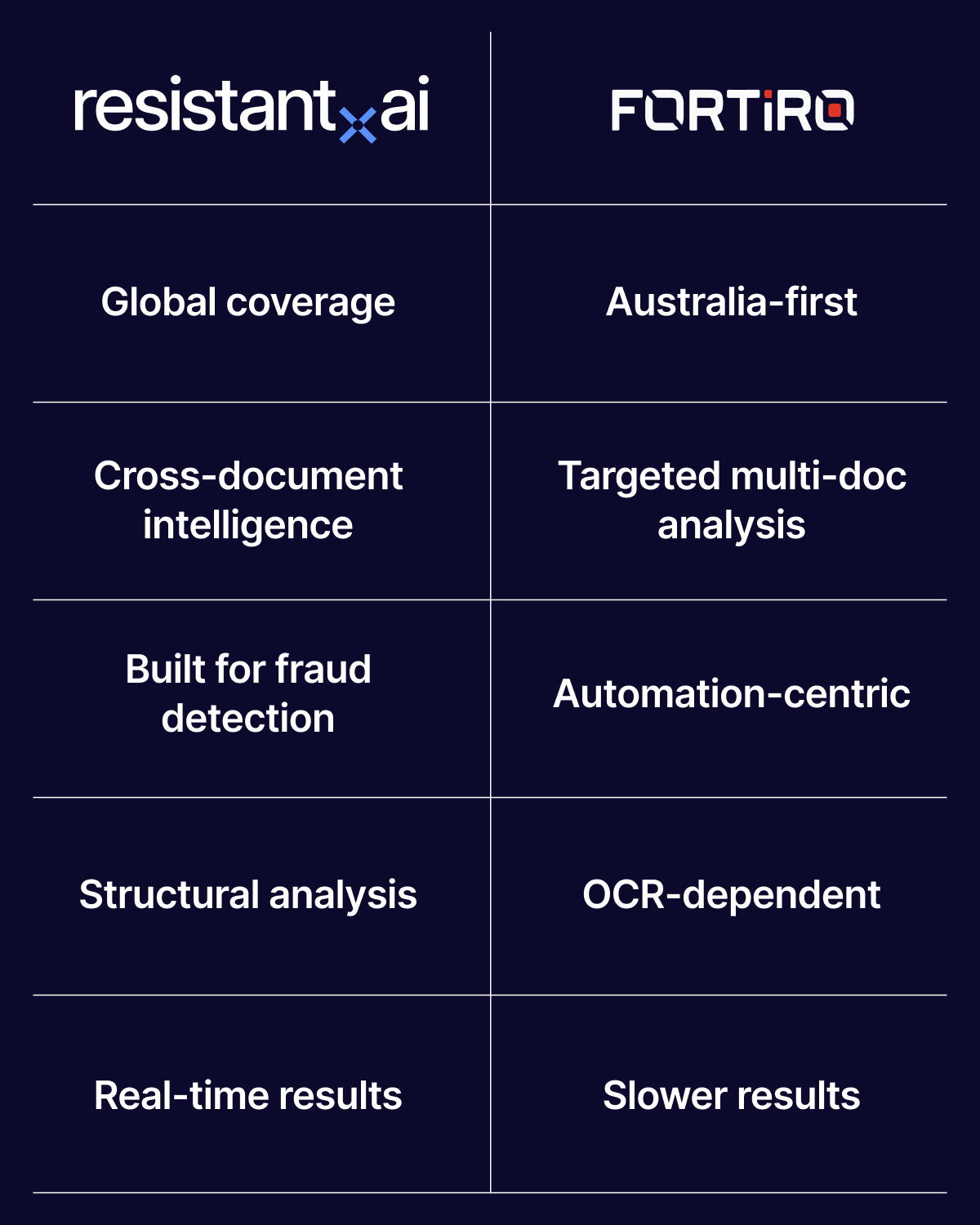
| Global and document-agnostic. Works across all languages, formats, and financial documents. | Australia-first. Tailored to local financial workflows and document types. |
| Real-time results. Verifies documents in under 20 seconds, even at scale. | Delayed analysis. Document checks return in about 30 seconds, optimized for lending queues. |
| Cross-document intelligence. Detects serial and pattern-based fraud across multiple applicants and data sources. | Targeted multi-doc analysis. Can analyze bundled documents within a case, but lacks broader pattern recognition across applicants or systems. |
| Built for fraud detection. Designed specifically to detect manipulation, forgery, and synthetic documents. | Automation-centric. Fraud checks are integrated into broader document automation. |
| Structural analysis. Detects fraud by analyzing how a document is built (fonts, layers, metadata, internal structure) rather than trusting what it says. | OCR-dependent. Extracts and verifies visible content using Optical Character Recognition, which can miss well-crafted structural forgeries. |
5. Doxis (formerly Klippa)
Doxis, formerly known as Klippa is a European software company based in the Netherlands that specializes in Intelligent Document Processing (IDP).
It offers a broad suite of tools for OCR, data extraction, and workflow automation, focusing on reading and processing the contents of documents. Fraud detection is only an element of a larger system and not a core focus.
Benefits
Instead of focusing on fraud detection, Doxis handles all elements of the document processing journey, from collection of the document to actually reading its contents.
- All-in-one document processing. Doxis provides a wide array of document handling capabilities in a single platform, appealing to businesses looking for a general-purpose automation tool rather than a specialized security solution.
- ID and address verifications. Advertise advanced ID and address verification systems on their product page.
Key features
Doxis' platform is fundamentally an engine for digitizing documents and extracting data. Its features are built for operational efficiency and data capture, with fraud detection acting as a supplementary check rather than the core competency.
- Optical character recognition (OCR). The core of the platform is its OCR technology, designed to convert images of documents into machine-readable text for data extraction and processing.
- Broad data extraction. It can be configured to pull data from a wide variety of structured and semi-structured documents, such as invoices for accounts payable or passports for onboarding.
- Workflow automation. Offers tools to build automated business rules and workflows, positioning itself as a solution for reducing manual data entry across an organization.
Notable customers
- GLS
- Trading 212
- Inspark
Positive feedback
Doxis' receives positive feedback for the quality of its OCR and its effectiveness in automating high-volume, repetitive data entry tasks. This praise centers on its ability to improve operational efficiency, not its prowess as a security or fraud prevention tool.
- “Klippa [Doxis] allows us to digitally register, approve, and process expenses and invoices in one user-friendly cloud environment.”
- Tim Lorijn (Label A)
Negative feedback
Users have reported frustrations with Doxis' usability, saying it isn’t very customizable and was confusing at times.
- "Selection process was a bit difficult as there are a lot of options.“
- “The software's limited customization options have presented us with the primary obstacle.“
- “No possibility to configure the models or submit a batch of documents with data to improve the results by ourselves.”
Company history
Doxis was founded in 2015 by a group of IT specialists in Groningen, the Netherlands. The company's initial focus was on creating a mobile application to digitize expense receipts.
Seeing a broader market need, they expanded their OCR technology into a comprehensive Intelligent Document Processing (IDP) platform. Today, Klippa aims to help organizations across Europe and beyond automate a wide range of document-based workflows.
Resistant AI vs. Doxis
Doxis is a classic Intelligent Document Processing (IDP) platform; its goal is to read and process documents for efficiency. Fraud detection is a simple feature on a long list. Resistant AI is a dedicated document forensic solution built to determine if a document is authentic or fraudulent.
Trying to secure a workflow with a general-purpose IDP is like using a Swiss Army knife for brain surgery.
Here’s how Resistant AI compares:
Resistant AI |
Doxis |
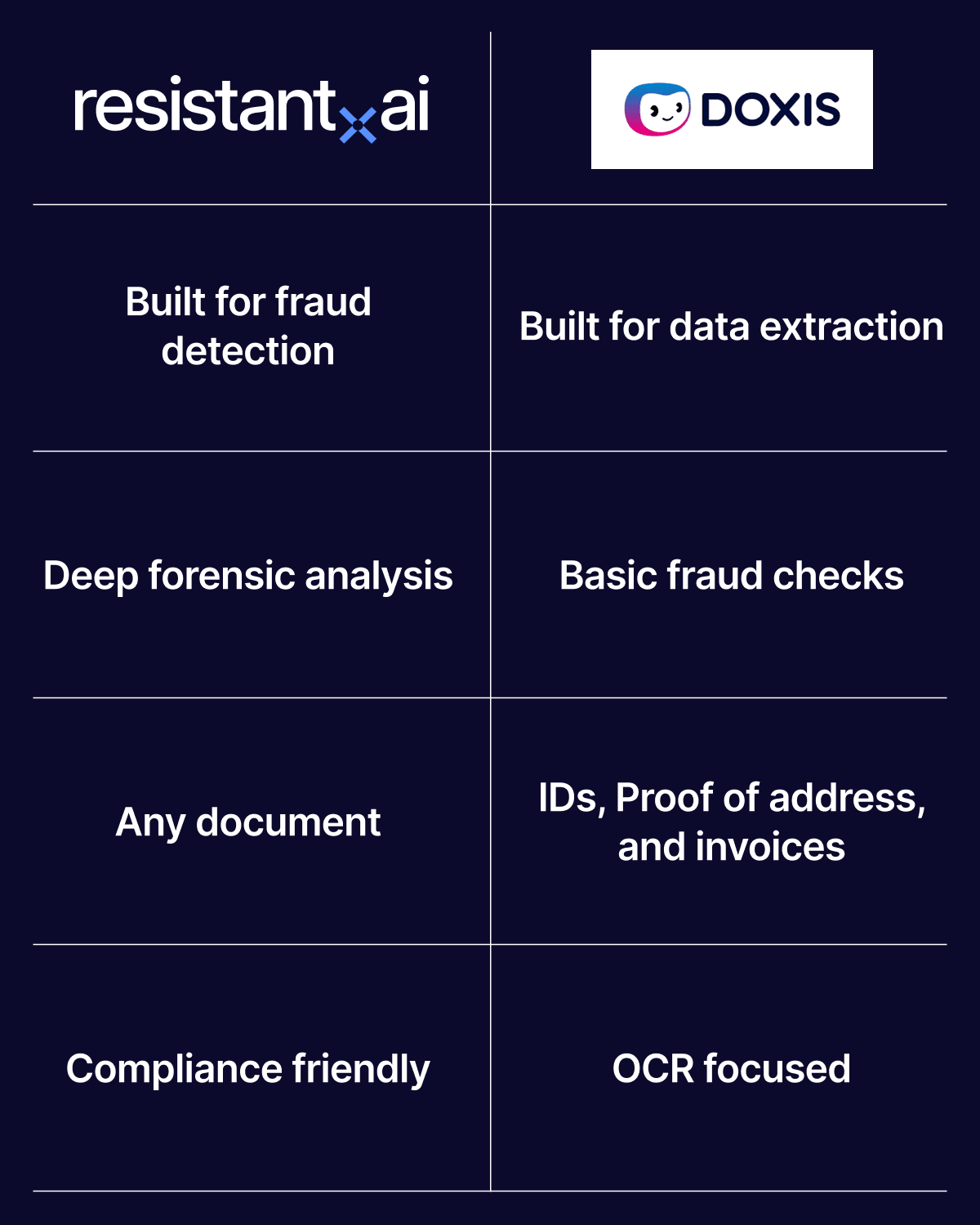
| Built for fraud detection. Purpose-built to catch document forgery and manipulation. | Built for data extraction. Core strength is OCR and automating data entry. |
| Deep forensic analysis. AI-powered detection of tampering and manipulation. | Basic fraud checks. Simple feature limited to registry look-ups, data validation, and content analysis. |
| Global and document-agnostic. Works across all languages, formats, and financial documents. | IDs, proof of address, and invoices. Only mentions document verification for IDs, bank statements, utility bills, pay stubs, tax statements, and invoices. |
| Doesn’t read PII. No PII vulnerabilities because it doesn't read documents. | OCR focused. Extracts information from documents, running compliance and data leak risks. |
6. Snappt
Snappt is a software company that provides a fraud detection solution specifically for the property management industry. It focuses on analyzing applicant-submitted financial documents, like pay stubs and bank statements, to identify modifications and prevent rental fraud.
Benefits
Snappt is primarily focused in the tenant screening market, making it well suited for businesses that operate in the property and real estate industries.
- Industry specialization. The platform is purpose-built for property managers, addressing the specific and widespread challenge of fraudulent rental applications.
- Property management integration. If you are already using a leading property management software (PMS) like Yardi, Entrata, or RealPage, Snappt has pre-existing integrations that should make them very compatible.
Key features
Snappt offers a targeted solution for property managers by connecting to leasing workflows and scanning documents for signs of tampering. Its fraud detection is tuned specifically for application documents, not for broader enterprise-wide document verification challenges.
- Financial document scanning. Scans and analyzes common application documents, including pay stubs and bank statements, to determine their authenticity.
- Niche fraud detection. Fraud detection is exclusively focused on the documents used in rental applications, rather than a wide range of corporate or official document types.
- Holistic application review. Designed to analyze the entire package of financial documents within a rental application as a single, interconnected case.
Notable customers
- Greystar
- FPI Management
- Avenue5 Residential
Positive feedback
Snappt is often praised by property managers for its direct impact on reducing costly evictions. This praise highlights its value as a point solution for a specific industry problem, not as a comprehensive document fraud detection platform.
- “I am thrilled with the product and the service. This is a must have for every property management company!”
- Melissa Meyer (NMS Residential)
Negative feedback
Tenants (the end users of the Snappt software purchased by property managers) have pointed to issues with Snappt’s user experience, surface level fraud checks, and the production of false positives, specifically on the submission side of the tool where they’ve voiced extreme frustrations on Trustpilot.com:
- “I think the creator of this tool is a genuinely bad person. I make almost $300k a year and this tool can't verify my bank account, my paystubs, or my investment accounts ALL OFFICIALLY RECEIVED DIRECTLY FROM THE INSTITUTIONS.”
- "This service is an utter scam aimed at landlords. "Print to pdf" is not some big source of fraud detection, it is a system utility that most software uses to produce a pdf. My formal work contracts that I needed to submit where turned into a pdf by my employer, using print to pdf. To make things even more insane IT CAN'T EVEN TELL WHEN SOMETHING WAS MADE USING PRINT TO PDF.”
- "Snappt rejected my documents as "edited" and they are authentic. Now I'm having a hard time getting an apartment in LA. This has never happened to me. They're a scam!"
Company history
Snappt was founded in 2016 by Daniel Berlind and Noah D. Borenstein. The idea was born from their direct experiences in real estate management, where they encountered a significant and growing problem with tenants submitting altered financial documents to secure leases.
They developed Snappt to provide landlords and property managers with a reliable way to verify the authenticity of applicant documents and mitigate the financial risks associated with fraudulent tenants.
Resistant AI vs. Snappt
Snappt is an effective point solution for preventing rental application fraud in the US property management industry. Its strength is its narrow focus. Resistant AI is a foundational security technology built to provide comprehensive document fraud detection across any document type, industry, or geography.
Here’s how Resistant AI compares:
Resistant AI |
Snappt |
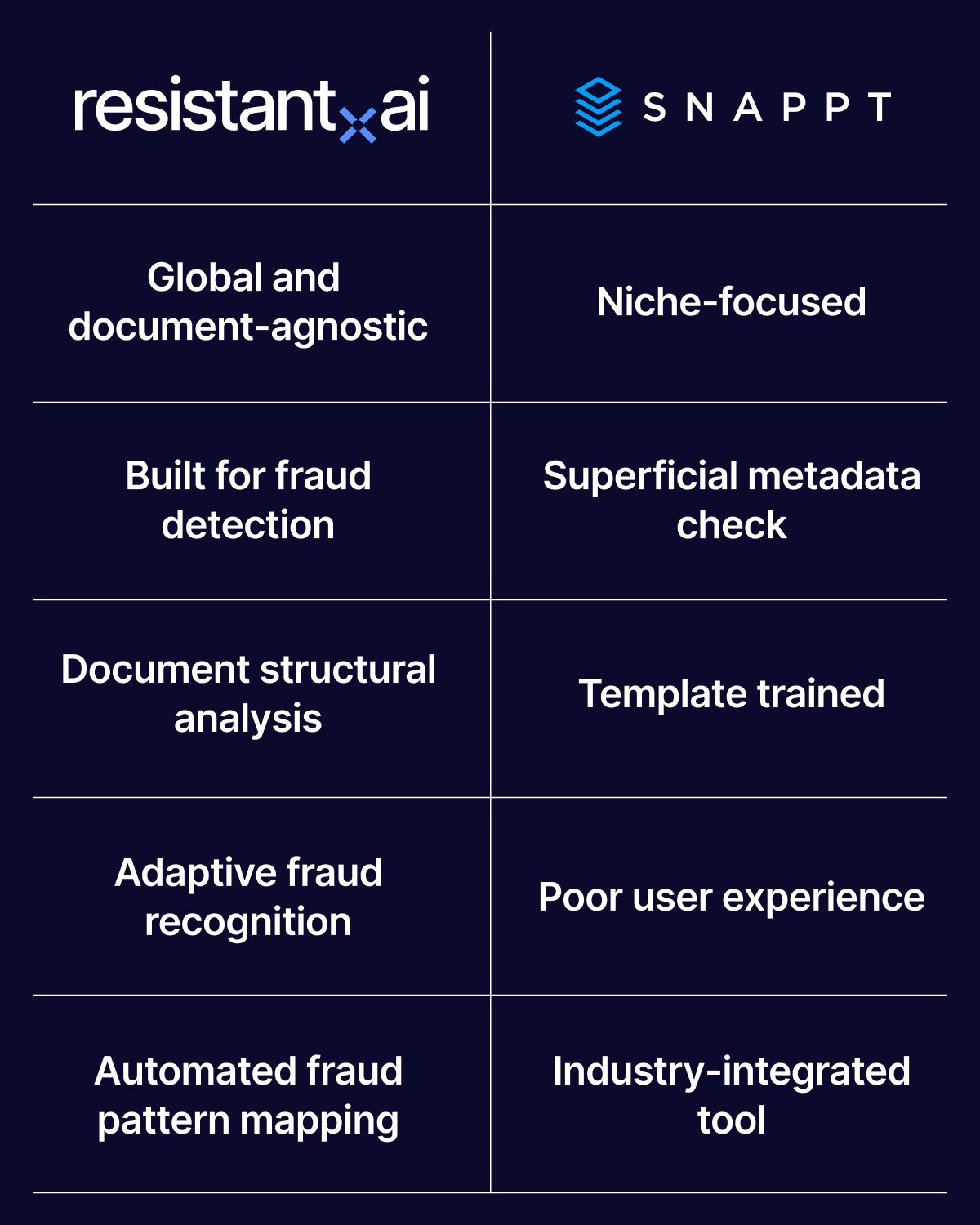
| Global and document-agnostic. Works across all languages, formats, and financial documents. | Niche-focused. Optimized for consumer income verification and other documents used in US rental applications. |
| Built for fraud detection. Purpose-built to catch document forgery and manipulation. | Application-screening first. Core strength is weeding out bad tenants in a leasing workflow. |
| Structural analysis. Validates authenticity by catching subtle inconsistencies in formats, fonts, internal structure, and visual details without relying on pre-existing document templates. | Template trained. Uses a database of 2000+ financial institutions and 13+ million documents to train AI to spot discrepancies between submissions and trusted copies. |
| Automated pattern mapping. Identifies complex fraud rings by automatically connecting a visualizing suspicious patterns, sequences, or anomalies across multiple documents. | Industry-specific tool. Primarily used as an integrated tool with property management software. |
Other document checking software: Pdfchecker, 24checker, and Bynn
PDFChecker and Checker24 are web-based utilities created by Bynn, an IDV company. They allow users to upload a PDF and view basic file properties and metadata.
Functionally, they’re limited to surfacing superficial data points rather than performing a robust forensic analysis.
Some signs to be aware of before choosing them:
- Lack of transparency and verifiable leadership.
- Suspicious domain structure and ownership.
- Lack of genuine customer evidence.
- No discoverable funding or investment information.
They present privacy, security and compliance concerns for any company that operates in the financial sector due to this lack of transparency.
Benefits
PDF Checker’s benefits are related to its simplicity and ease-of-access.
- Superficial simplicity. The tool offers a minimalist, single-function interface that requires no training, which is reflective of its lack of depth and advanced capabilities.
- Drag-and-drop feature. PDFchecker has a drag and drop function that allows visitors to test one of their documents immediately on the web.
Key features
PDF Checker is fundamentally a file metadata viewer presented as a fraud detection tool. Its features are confined to reading accessible file data, lacking the AI-driven analysis, image forensics, or security infrastructure of an enterprise-grade solution.
- Basic metadata viewer. Displays surface-level information from a file’s properties, such as creation dates and authoring software, which are easily manipulated by fraudsters.
- Limited "edit" flagging. The tool performs a rudimentary check for signs of modification without the forensic depth to distinguish between benign revisions and malicious tampering.
- Anonymous web uploader. Operates as a public web tool where users upload documents, raising significant security and data privacy concerns for any organization handling sensitive information.
Notable customers
PDF checker has not listed customers on their site. Testimonials on the homepage belong to individuals whose company’s names are unclear and their names are not listed on corresponding websites.
Positive feedback
The testimonials on their site are not verifiable. The people behind them are not searchable and their positions at the listed companies are non-existent.
Negative feedback
The tool has drawn sharp criticism regarding its reliability, functionality, and the significant privacy risks associated with uploading sensitive documents to an anonymous online service.
Company history
Information on the entity "Bynn" is sparse and lacks the transparency of an established software company. The tool emerged as a simple web utility without a clear corporate history, funding record, or public team. PDFChecker’s “about” section mentions being found by “a team of cybersecurity experts” but gives no names or references.
Resistant AI vs. PDF Checker (Bynn)
PDF Checker is a risky, unreliable web tool that only checks for basic, easily faked metadata. Resistant AI is an enterprise-grade security platform that performs deep forensic analysis to detect sophisticated fraud. Entrusting sensitive customer documents to an anonymous online utility is a compliance and security risk that’s not worth taking.
Here’s how Resistant AI compares:
Resistant AI |
Bynn |
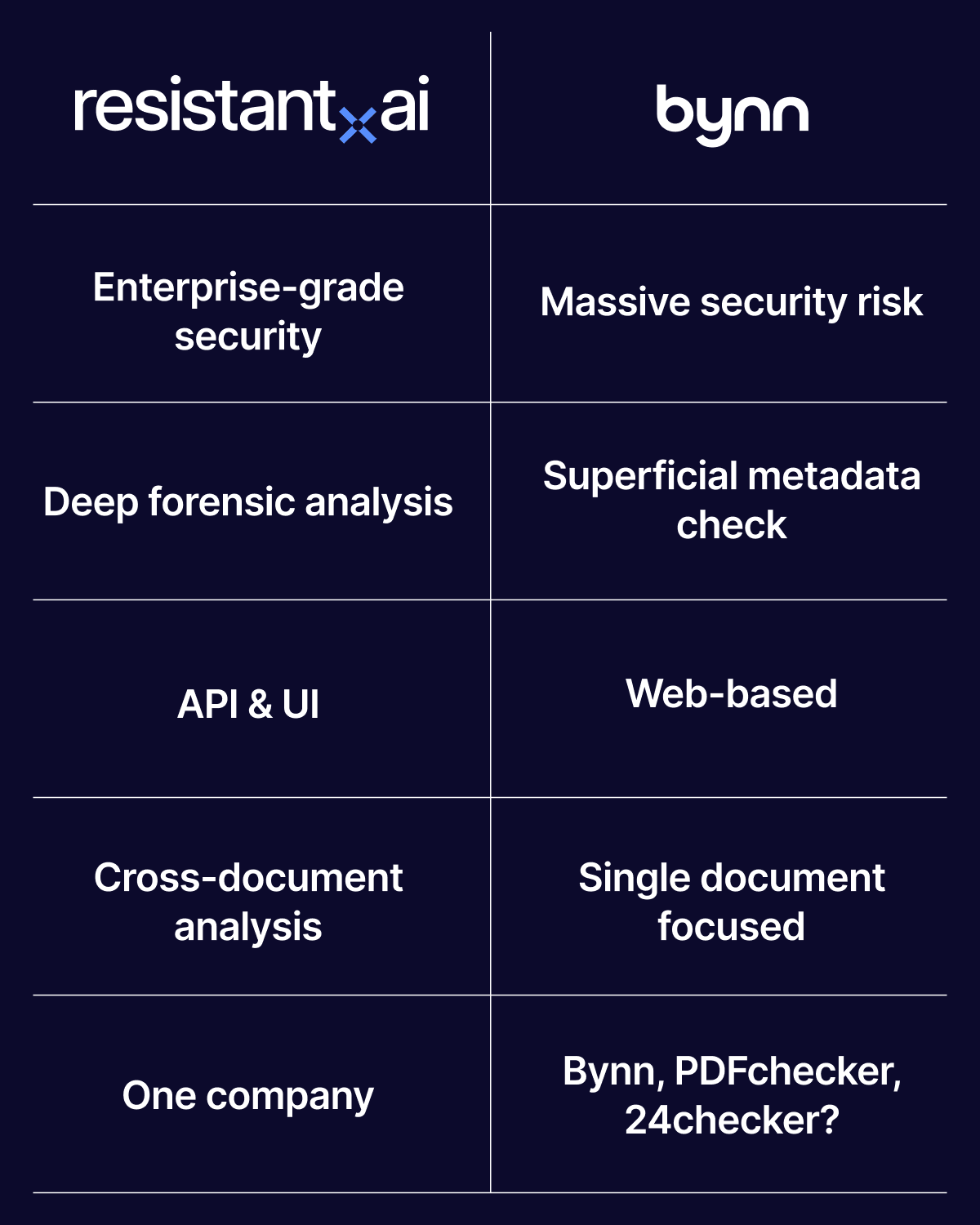
| Enterprise-grade security. SOC 2 Type II certified and designed for secure data handling with documentation easily found on their website. | Uncertain certifications. Claims to be ISO 27001 and SOC 2 Certified but has no trust center on their site to verify this information. |
| Deep forensic analysis. AI-powered detection of well hidden and sophisticated threats using 500 different models, not just metadata. | Metadata check. Claims AI capabilities but only describes features that do basic metadata and overt modification checks. |
| UI & API. Deployable as both an API to existing systems and a standalone application. | Web-based. Only usable through their website or another web-based API like Google Drive, Amazon S3 or Microsoft OneDrive. |
| Cross-document analysis. Can identify patterns across submissions and datasets to spot fraud. | Fixed document analysis. Can only check individual documents for fraud without context. |
| One company. Only one company that sells specific products to detect fraud. | Multiple brands & domains. Three companies offering identical products under the same ownership. Which one to use? |
Choose Resistant AI as your document fraud detection software
Resistant AI stands apart from its competitors by being purpose-built for deep forensic analysis and remaining fully document-agnostic, able to integrate across diverse workflows without retraining. Most importantly, it is designed for the reality of modern fraud: attacks that adapt quickly, exploit new document types, and shift tactics faster than static tools can respond.
Gen AI? Pre-authorized account selling? Publicly available templates? Just like fraud, Resistant AI is continuously evolving, giving global businesses resilience against threats that don’t just grow in scale, but in creativity and speed.
Comprehensive fraud detection vs. secondary features
Unlike Snappt and Doxis, which focus mainly on data extraction and generic document processing, Resistant AI is built specifically for detecting document fraud.
The "document processing first" order of operations creates both higher costs and bottlenecks: fraudulent documents still get fully processed before being flagged, which wastes API calls, slows decisioning, and limits flexibility in catching new types of fraud.
Resistant AI reverses that model, detecting fraud up front so only trustworthy documents move forward into extraction or external checks.
Similarly, Doxis offers basic fraud checks as secondary features, insufficient for identifying complex forgery or repeated fraud attempts.
Resistant AI provides an in-depth forensic analysis, capable of detecting even the most advanced fraud from generative AI, online document mills, and organized crime syndicates.
Global, document-agnostic capabilities
Where competitors like Snappt and Fortiro have limitations due to regional or industry-specific focus, Resistant AI excels in versatility and international reach.
Snappt is narrowly optimized for US rental applications, often criticized for false positives and poor user experience. Fortiro caters primarily to Australian financial institutions and struggles to identify broader patterns of fraud.
Resistant AI, by contrast, handles all documents across all languages, formats, and jurisdictions, ensuring your global operations remain seamlessly protected against fraud.
Cross-document intelligence and pattern recognition
Most competitors lack the critical capability of identifying serial and cross-document fraud patterns. Resistant AI excels by leveraging cross-document intelligence, rapidly identifying complex fraud networks through robust pattern recognition and structural analysis.
Those that do, like Fortiro, can typically only bundle documents within one case, not across systems or applicants, limiting their views of serialized fraud.
Proven efficiency and tangible ROI
Unlike Inscribe, which suffers from slower processing times (thanks to their extraction-based approach), Resistant AI provides exceptional speed and accuracy, drastically improving efficiency and business outcomes.
Just look at the customers: Payoneer automated 82% of fraud checks with 99.2% accuracy, Habito cut first line reviews to 3 seconds and second-line manual investigations by 52 minutes per case, and Close Brothers achieved a remarkable 22x return on investment.
By choosing Resistant AI, you're equipping your organization with the most advanced, flexible, and globally effective document fraud detection software available today.
Resistant AI’s document fraud detection partners
Heard of a document fraud detection vendor that didn’t make the list? They could be one of Resistant AI's partners. Document automation companies like ABBYY and Tungsten Automation already use Resistant AI to bolster their fraud detection capabilities.
Conclusion
Now that you have a comprehensive overview of the best fraud detection software on the market, you have the information needed to make the right choice. This analysis should help you truly secure your business against evolving threats.
Making the wrong decision can have serious consequences, from missed fraud to the hidden costs of operational inefficiency. An inadequate tool provides a false sense of security that can put your revenue and reputation at risk.
If your goal is to stop fraud with a dedicated, enterprise-grade security platform, then the decision is simple.
See why the most secure businesses choose Resistant Documents.
Scroll down to book a demo.

Fraud awareness, examples, and lessons
Learn more about fraud in specific industries, best practices, and targeted documents.
View all
Document fraud detection software is the fastest, most reliable way to check any document for signs of forgery in ...

Whether it’s a forged medical diploma or a suspicious Australian degree used for a Hong Kong visa application, ...

Money moves faster than ever in 2026. Instant payments, digital wallets, embedded finance, online marketplaces, ...

It seems ludicrous, but Chief Risk Officers are still getting labeled as a “novelty” or an “exotic creature” in ...
When it comes to fake document generators, OnlyFake is a household name. It caused a stir within the financial ...

Given the events of early 2026, the state of Minnesota has considered offering a reprieve on certain business ...